
Considering the dynamics of crypto trading, I've been contemplating the necessity of options alongside the well-functioning perpetual swaps. The recurring thought is centered around the concept of time. Traders may anticipate that Bitcoin will appreciate over a three-month horizon, yet a leveraged perpetual contract could face liquidation as soon as tomorrow. Acquiring a call option allows for greater flexibility, providing more time for the anticipated price movement to materialize. While total loss of the premium is still a possibility, a sudden downturn won't automatically exit the position.
This inquiry led us to examine the relatively small size of options trading on-chain. We investigated the process of purchasing options, assessed liquidity levels, and analyzed the reasons behind the failures of previous initiatives. A significant factor relates to whether selling options is worthwhile. Perpetual exchanges have the potential to alter this landscape by offering sellers avenues to hedge and access existing traders. This article delves into the feasibility of this approach, the required improvements, and the stakeholders who could benefit. Additionally, we investigate several designs that might incentivize sellers.
Innovative Trading Models
Recently, I've been experimenting with Papertrade, a platform where the house takes the opposite side of every trade. Each dollar lost by a trader results in the minting of PAPER, a token that entitles them to a share of the house's fees. The idea of compensating losses with tokens piqued my curiosity regarding what this model could look like for options, especially considering the lack of significant breakthroughs in this area.
While perpetual contracts allow traders to specify the extent of adverse price movement they can tolerate, they do not provide the luxury of determining how long they can remain incorrect. In July 2025, we posited that options would eventually parallel perpetual contracts (referred to as perps throughout the article) on-chain, with projections of a hundredfold increase over three years. However, fifteen months later, options still account for less than 1% of the total perpetual decentralized exchange volume. In conventional markets, options trading volume is approximately three times that of futures.
This piece is part of a series examining the current state of crypto options.
Challenges and Opportunities
Through this exploration, I detail the costs incurred by traders who are correct but premature with their perp trades, outline why the next generation of on-chain options is likely to develop in conjunction with perp markets like Hyperliquid, and identify which protocols stand to gain the most once trading volume increases. Ultimately, those who control the hedge will benefit the most. Key players include Hyperliquid, serving as the landlord of the hedge market, Derive, acting as the foundational engine for others, and Paradex, which facilitates large block trades. We also outline two initiatives that could attract the elusive seller.
One initiative incorporates options into Metric’s liquidity provider pools, while the other proposes a Papertrade model for options.
Analyzing Liquidation Risks
How frequently does a perp eliminate a profitable trade? We analyzed Bitcoin’s daily closes from January 2018 to October 2026, treating each day as a potential entry point for a long position. We retained only those trades that concluded above the entry point after a duration of 7 to 180 days, focusing on instances where the trader was correct, and assessed whether Bitcoin's price dipped sufficiently to warrant the liquidation of a 5x, 10x, or 20x perp.
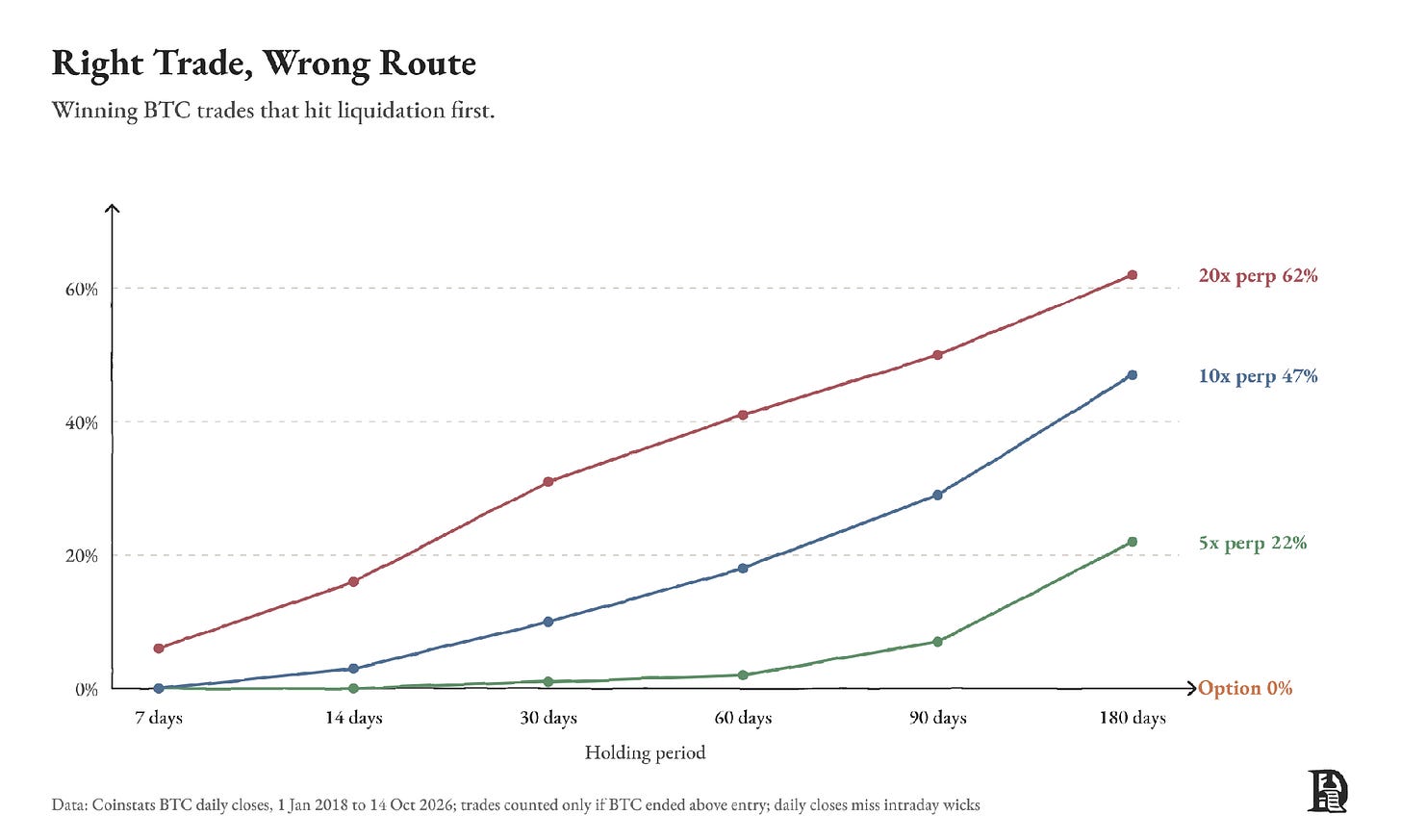
A 10x perp exhibited a 47% likelihood of liquidation over 180 days, 29% over 90 days, and 18% over 60 days. An option purchased for the same timeframe cannot be closed prior to its expiration. Daily closes also overlook intraday price fluctuations, suggesting that the actual liquidation rates may be even higher. In March, our article titled “bounded options-like instruments” noted that directional flow predominantly favored perps, a trend that persists for short-term trades. However, as the time required for a thesis to materialize increases, the likelihood of a perp being stopped out or liquidated also rises.
We simulated trading on October 10, 2025. At 12:00 UTC, we initiated three $1,000 long positions in Bitcoin. The first position was a 10x perp, the second a 30-day call option purchased with the same $1,000, and the third was the same 10x perp accompanied by a 7-day put option struck 5% below the entry price, also financed from the $1,000.
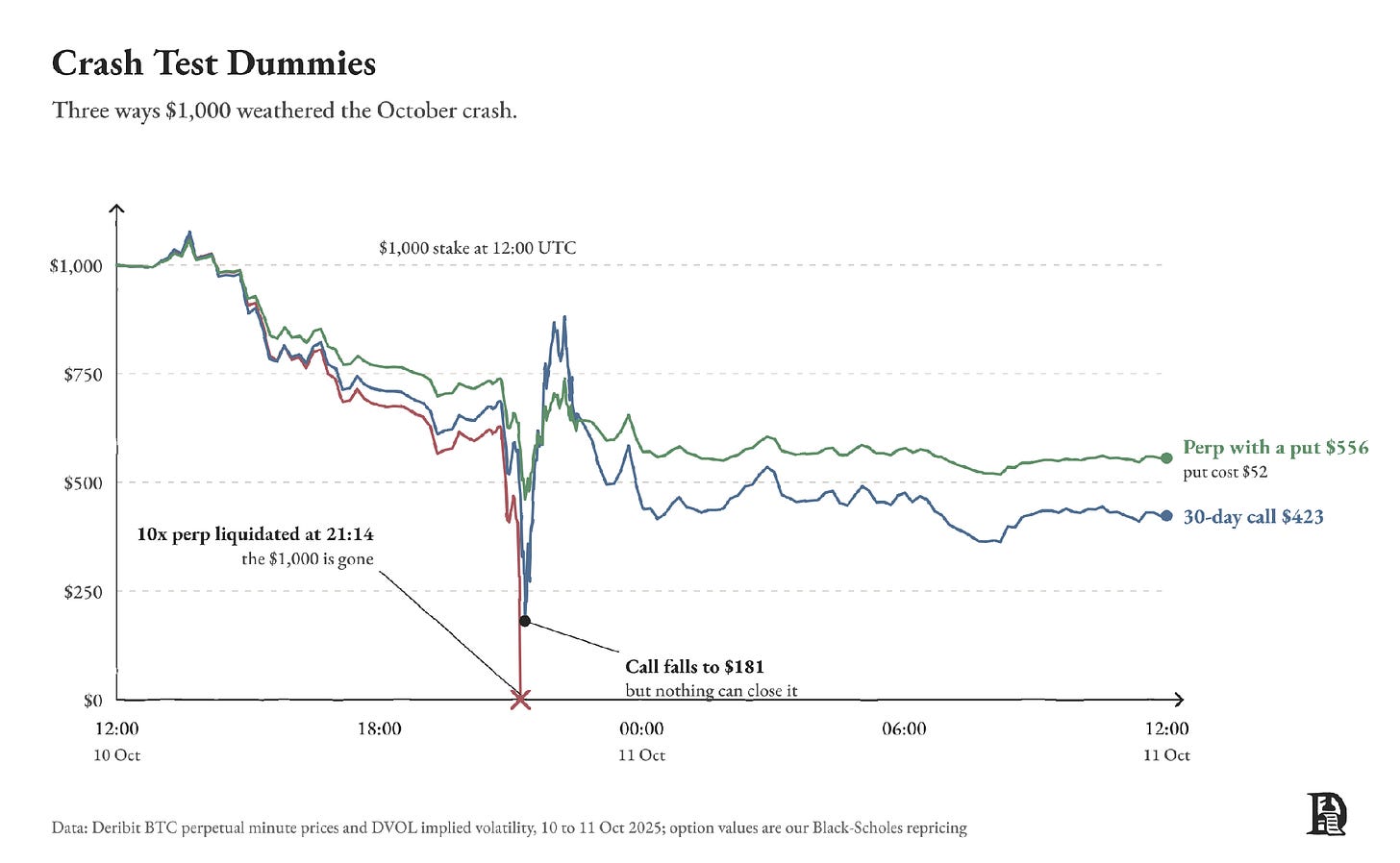
The perp position faced liquidation at 21:14. Although the call option plummeted to $181 at its lowest point, it rebounded to over $800 within the hour. The put option, which cost $52, maintained the viability of the 10x long position throughout the market downturn. We replicated this test across eight assets using pricing data from Deribit, and the results were consistently observed.
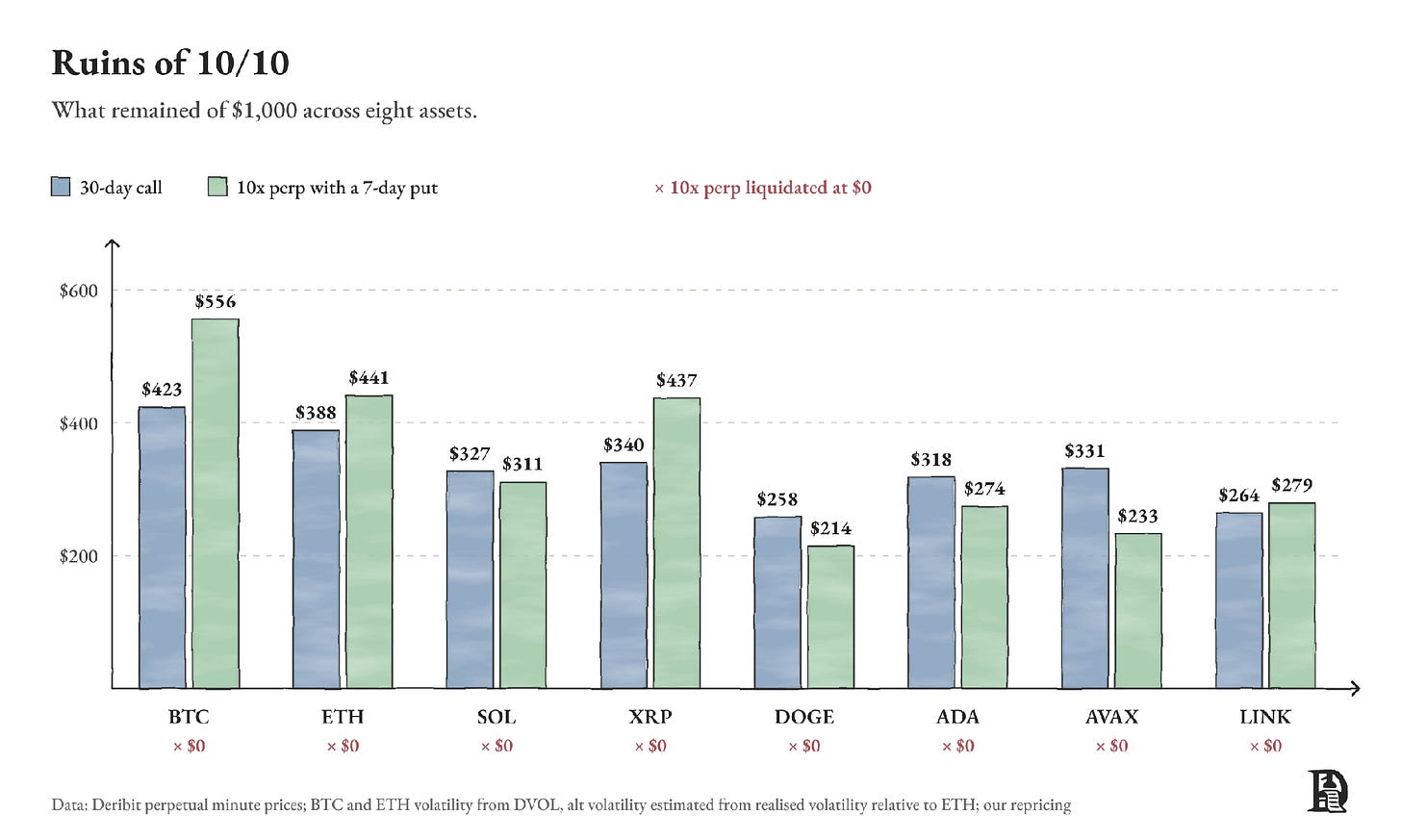
For alternative cryptocurrencies, protection costs ranged from $250 to $340 of the $1,000 due to their options reflecting significantly higher volatility.
Learning from Traditional Finance
Traditional finance and the crypto sector are learning from one another in three main ways.
- First, traditional finance is adopting instruments from the crypto sphere. The CME now offers 24/7 trading of crypto futures and options. Hyperliquid's perp prices are now accessible via the Bloomberg Terminal, and both Hyperliquid’s policy group and trade.xyz have sought regulatory clarity from the SEC regarding pre-IPO perps. Moreover, Polymarket introduced perps for international users in September.
- Second, crypto is integrating traditional finance’s assets. On Hyperliquid, traders can engage with perps for the S&P 500, Nvidia, gold, and oil at any time. In a previous article, "Everything is a Market," we stated that various assets, including treasuries, equities, computation resources, and attention, would eventually be traded on-chain. It is evident to those in the industry that all significant assets will find their place on-chain, with perps facilitating this transition. On March 23, trade[XYZ] witnessed $2.3 billion in combined trading volume for WTI and Brent oil perps in a single day. Perps are now available for the hourly rental rate of an Nvidia H100 GPU, as well as for an index of Pokémon cards. The CME and ICE await the CFTC's approval to list computation futures. As additional prices become tradable, the demand for diverse trading methods will only increase. For instance, someone might use GPU perps to speculate on a compute shortage, while an AI startup exposed to those costs might prefer options to hedge against rising expenses in the upcoming quarter. By purchasing an option, the startup can secure a fixed cost for protection. Should rental rates exceed the agreed threshold, the option pays out; if rates decline, the startup benefits from lower costs while only losing the premium paid. Additionally, the perp provides the option seller with a tool to hedge. Each new perp market creates the opportunity for a corresponding options market.
- Third, traditional finance's instruments are now being applied to crypto assets. As of April, open interest in options related to BlackRock’s Bitcoin ETF reached $27.6 billion, surpassing the open interest in Bitcoin options on Deribit. Meanwhile, Coinbase has invested $2.9 billion to acquire Deribit.
Ultimately, a venue could offer spot trading, perps, options, and binaries across an array of assets, from Bitcoin to stocks and commodities. The first entity to accomplish this will attract the majority of trading flow. We believe the crypto sector has an advantage for two primary reasons.
- Firstly, the listing process is fundamentally a software decision. IBIT launched in January 2024, yet its options only became available for trading in November after receiving approval from the exchange, clearing house, and SEC. Hypercall managed to list options on SpaceX on June 3, 2026, just nine days before SpaceX debuted on Nasdaq, utilizing Hyperliquid’s pre-IPO perp as a reference price.
- Secondly, the market operates continuously. Hypercall enables trading of options on Nvidia and SpaceX even on Sundays, as the associated perps for hedging are also available for trading on that day. During U.S. market hours, spreads can be 1.5 to 2 times wider, yet no traditional venue offers options for Nvidia during non-trading hours.
The emergence of perps has been a boon for on-chain options, as perps act as a hedge for option sellers. The expansion of perp markets reduces the cost of selling options layered on top. Every new perp market holds the potential for establishing an options market.
Historical Context and Future Prospects
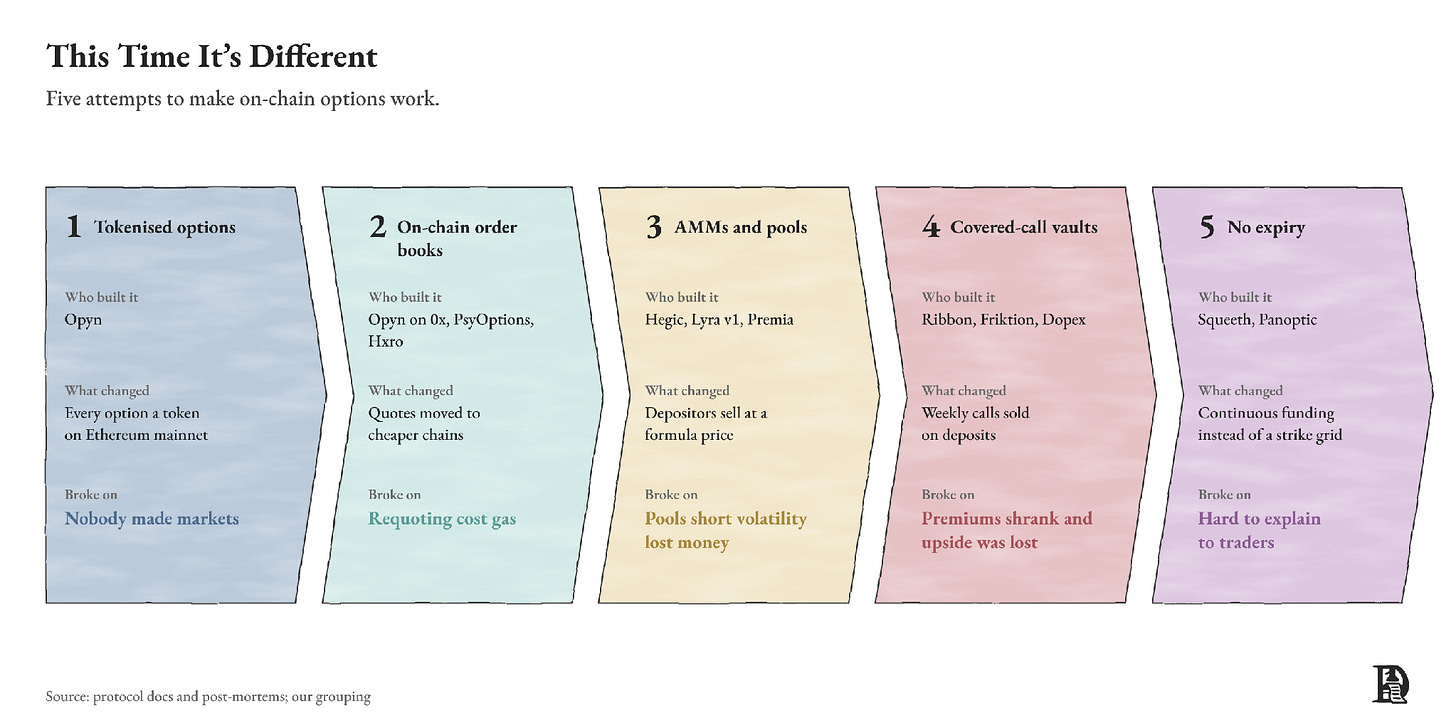
Since 2019, numerous protocols have attempted to introduce options on-chain, with most either shutting down, pivoting, or experiencing minimal trading activity. We previously explored each generation in "Trading Optionality," but here’s a concise overview. Listing an option is significantly more challenging than a perp for three reasons.
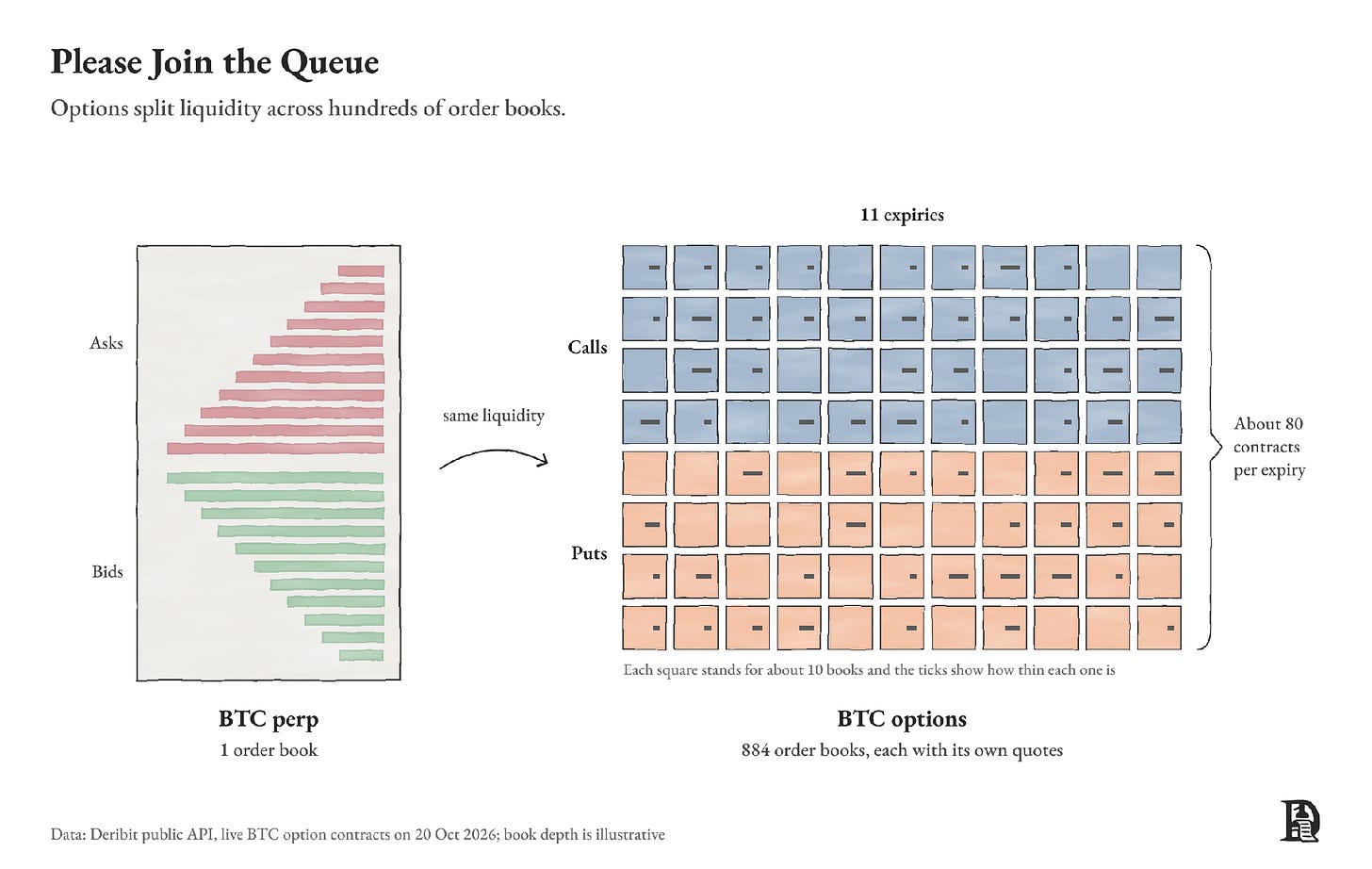
- Liquidity is fragmented across numerous order books for each asset. A BTC perp operates on a single order book, whereas Deribit lists 884 BTC options across 11 expirations, necessitating continuous quoting for each.
- The seller faces challenges in hedging effectively. To maintain a neutral position, a seller must engage in continuous trading of the underlying asset, which requires a robust market nearby.
- Capital is tied up when selling. The earliest protocols mandated that sellers secure the maximum potential liability. For instance, selling a $110,000 BTC call for $1,800 required locking up $100,000 to earn a mere 1.8% monthly return. No professional market maker would accept such terms.
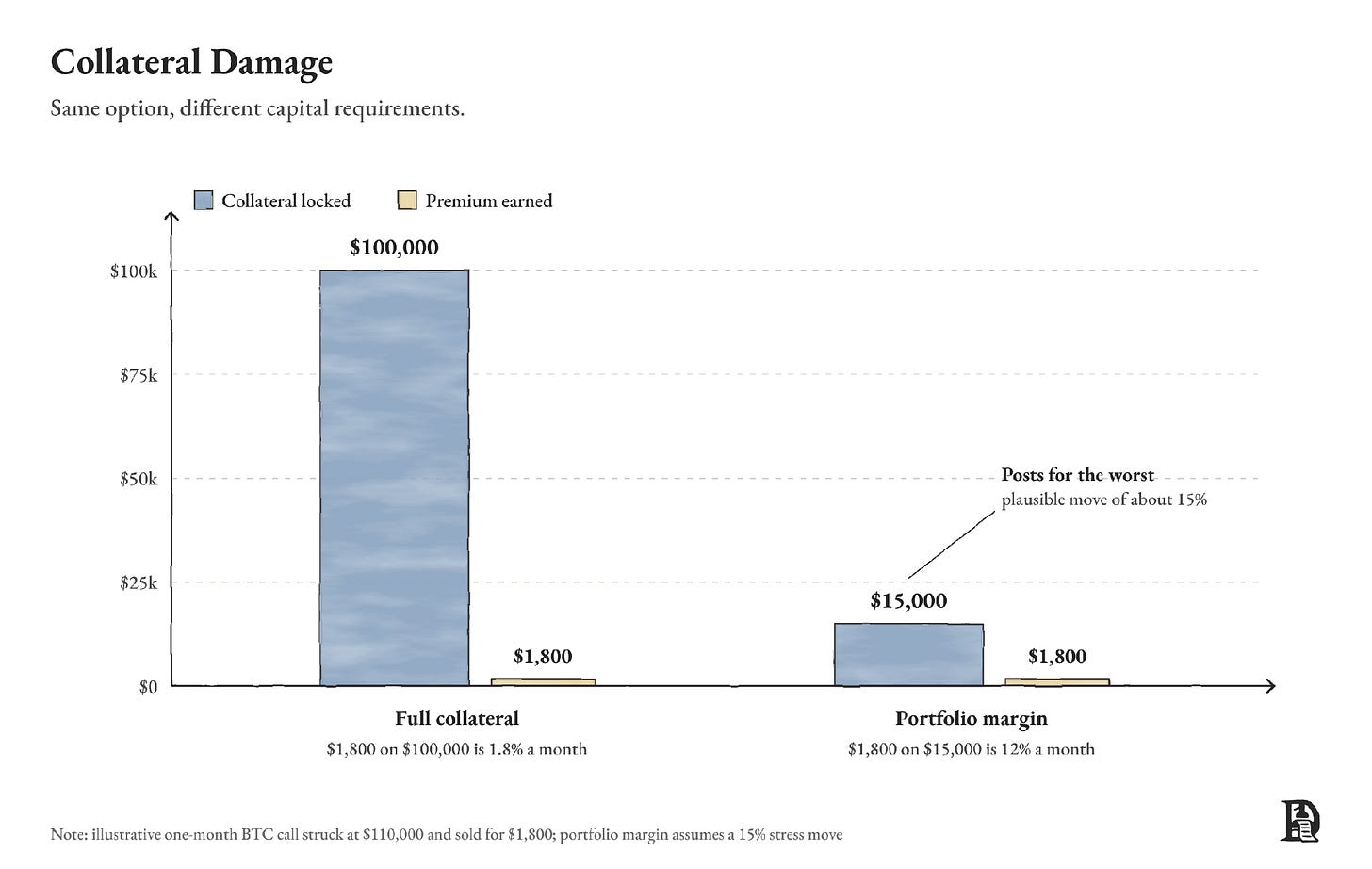
Every generation has addressed one of these issues but has stumbled upon another. Hegic’s depositors suffered significant losses, totaling nearly $80 million in May 2021. Meanwhile, Lyra’s depositors experienced a 4.9% loss in the BTC pool and a 17.6% loss in the ETH pool over a span of seven months, while PsyOptions discontinued its products in June 2024.
What deters a market maker from participating? Before retail activity begins, the majority of flow into a new venue’s quotes originates from traders arbitraging prices against Deribit. These traders only engage when the new venue's quotes are outdated, resulting in market makers incurring losses on nearly every fill, even if the venue operates flawlessly. A new venue has two choices: either compensate its initial market makers to absorb those losses or attract retail flow that is currently nonexistent.
The successful venues today share a common foundational design. Orders are matched off-chain, ensuring that updating quotes incurs no costs. Meanwhile, collateral, margin, and settlement processes occur on-chain, preserving custody of the funds.
However, an improved design must provide sellers with a compelling reason to engage. The most persuasive incentive is a cost-effective hedge within the same account. Recall the seller who was required to lock $100,000 to sell one BTC call for $1,800?
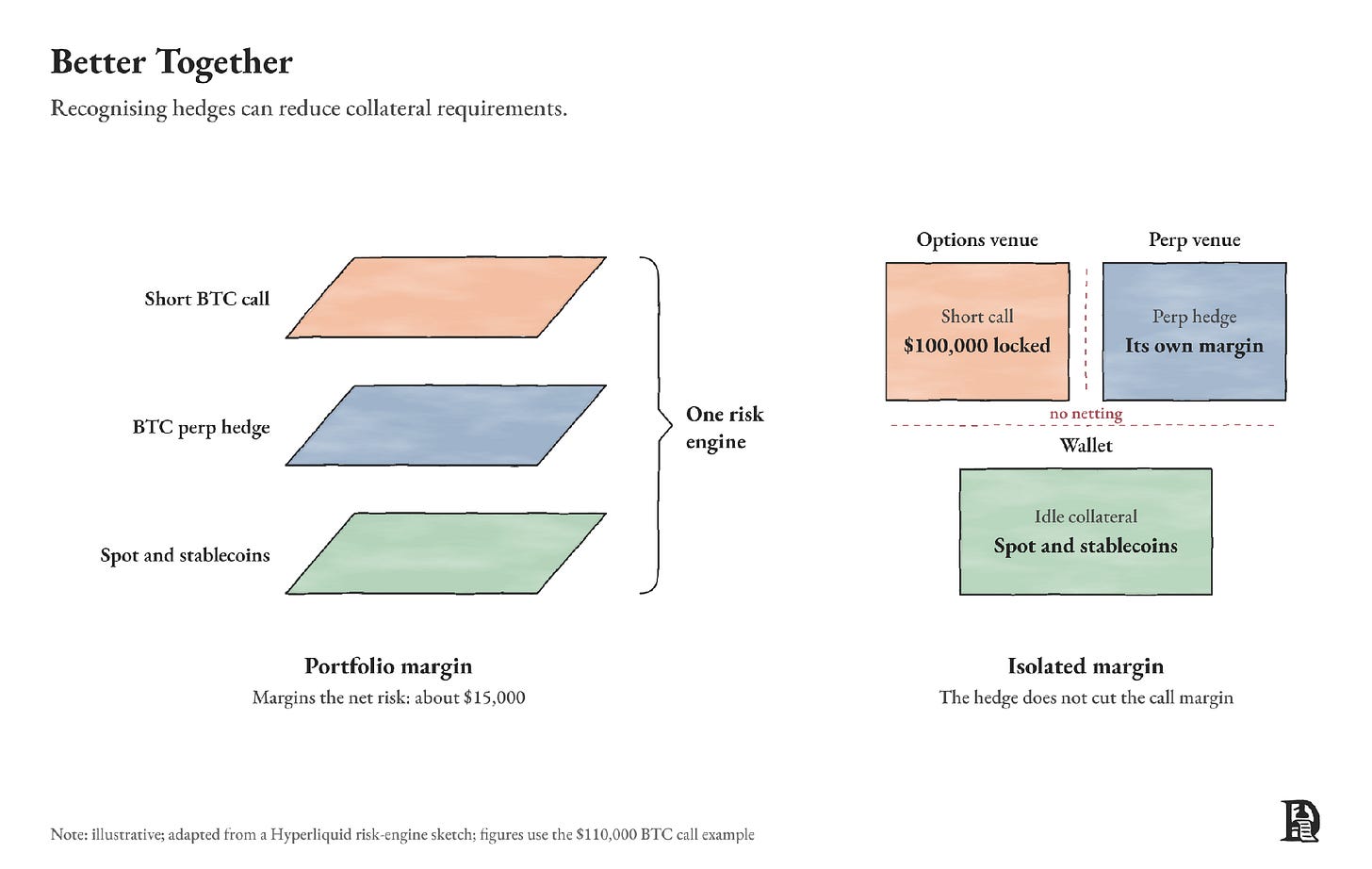
A portfolio-margin engine evaluates the maximum potential loss across all positions to determine the necessary collateral. If the most significant plausible price movement is 15%, the seller is required to post approximately $15,000 instead of $100,000. The premium remains at $1,800, thus elevating the return on locked capital from 1.8% monthly to approximately 12%.
This suggests that options may flourish in environments where perp liquidity already exists, particularly on platforms like Hyperliquid and Lighter. An options seller on Hyperliquid benefits from three unique advantages that are not found in other on-chain venues.
The first advantage is depth. Hyperliquid boasts the most extensive perp order books in the crypto space, and its builder codes allow any application to integrate with them seamlessly.
The second advantage is the use of a single account. A trader who sells a put option can utilize the same collateral to take long positions in perps, with spot trading, perps, and event contracts all sharing a unified risk engine. This represents a significant improvement over previous iterations. The third advantage lies in user engagement; venues that maintain liquidity, user access, and distribution capabilities typically preserve the value they generate.
Hypercall is the first options venue structured on this model. A market maker selling a call option on Nvidia can simultaneously purchase Nvidia perps through Hyperliquid within the same account, reducing the margin required for the option. Its founder estimates that the number of market makers quoting perps far exceeds those for options by a factor of 10 to 100. Hypercall presents these perp market makers with an incentive to quote options as well.
The other venues have identified various strategies to attract sellers.
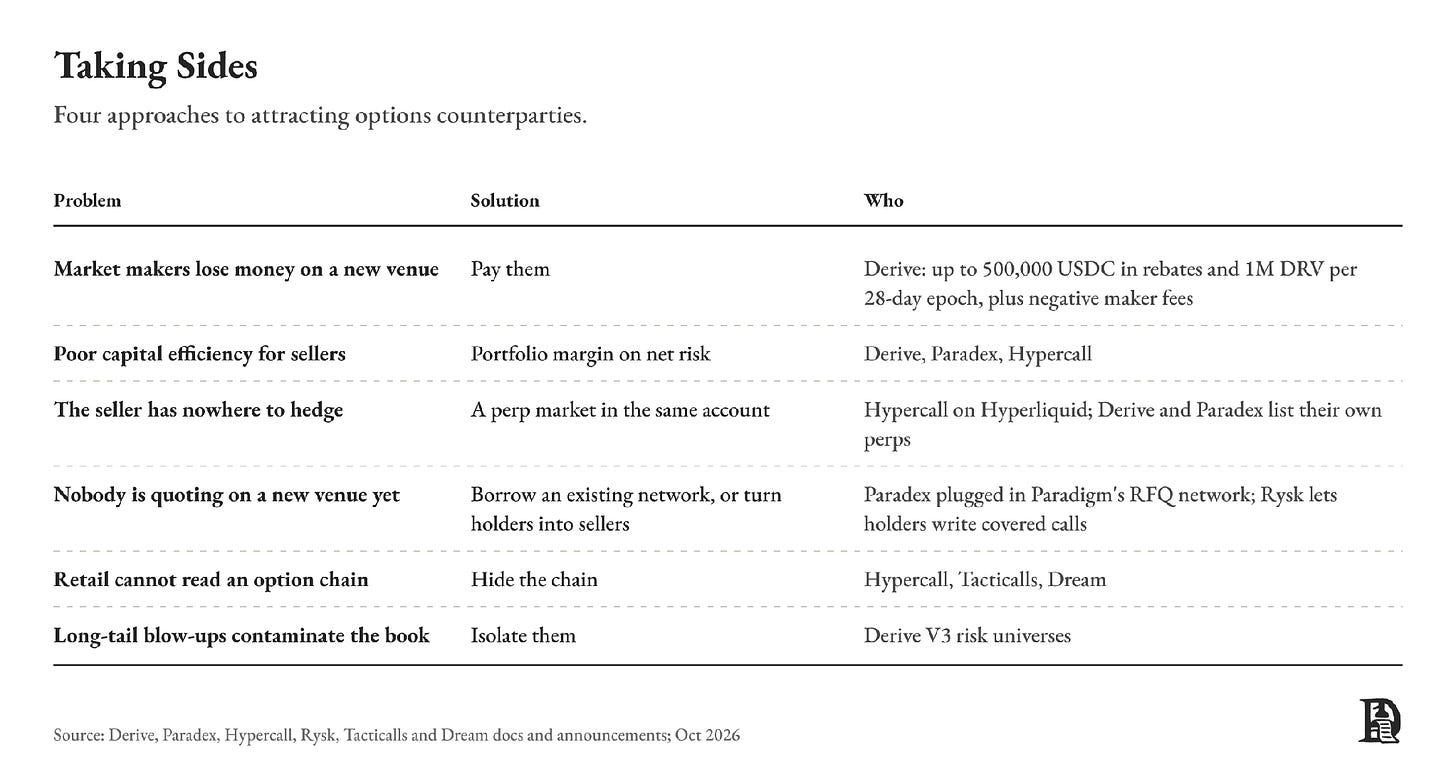
Derive, formerly known as Lyra, compensates its sellers. Over the year leading to October 19, it facilitated approximately $18 billion in options notional, with FalconX as its sole publicly recognized market maker. The funds from FalconX remain with its custodian, and Derive reflects that balance as a token in its trading operations, allowing institutions to quote on-chain without transferring collateral.
Paradex secures its sellers through borrowing. On September 15, it integrated with Paradigm’s network, which processes about a quarter of Deribit’s block trades. This led to daily options volume surging from below $3 million to $58.7 million within a week; however, open interest plummeted from over $250 million to roughly $96 million by October 14. Block traders typically engage for specific trades and then exit.
Rysk transforms holders into sellers. Users can deposit HYPE, BTC, or ETH and sell covered calls to approved market makers in exchange for an upfront premium. In the thirty days leading to October 14, it achieved $148 million in notional volume, though activity stalled as the buyers of those calls limited their exposure to HYPE.
Front-end interfaces atop these venues obscure the strike grid entirely. Dream allows users to replenish their accounts via Apple Pay, select a direction and size, and procures options on their behalf. Tacticalls, built on Derive, provides a three-tap betting interface and copy trading features. Simplified packaging has the potential to attract users, but it cannot create sellers when the underlying order books lack liquidity.
September 2026 marked the most successful month for on-chain options to date. Notional volume roughly doubled to around $5 billion, premiums surged by a third to $85 million, and open interest peaked near $2.5 billion. Nevertheless, this still represented only about 7% of Deribit’s monthly volume, with the majority transacted through Derive.
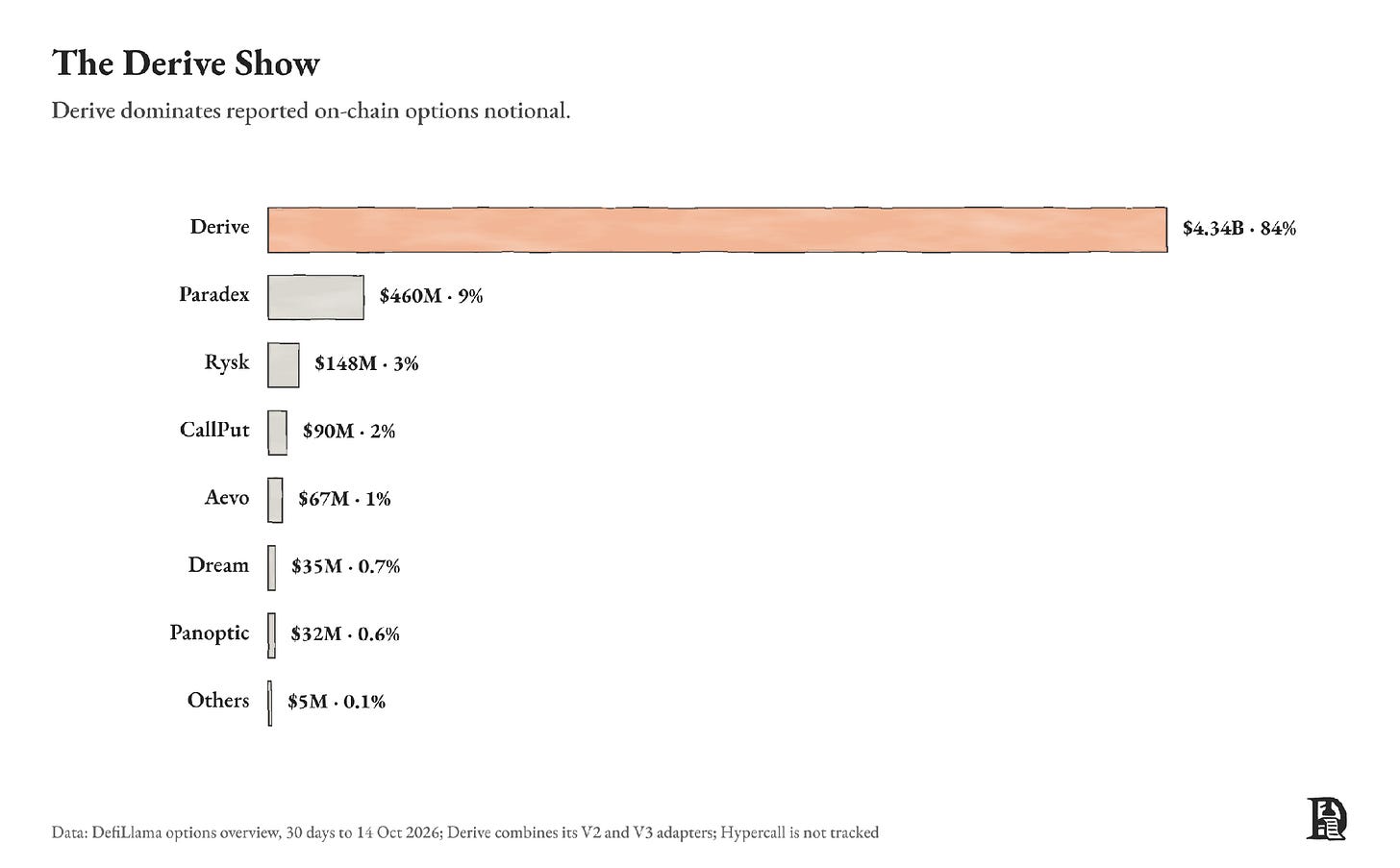
A venue that offers inexpensive, far out-of-the-money contracts can accumulate significant face value without substantial monetary exchange. Premiums, the actual cash paid for options, serve as a more accurate measure, and in terms of premiums, Derive's share exceeds 90%.
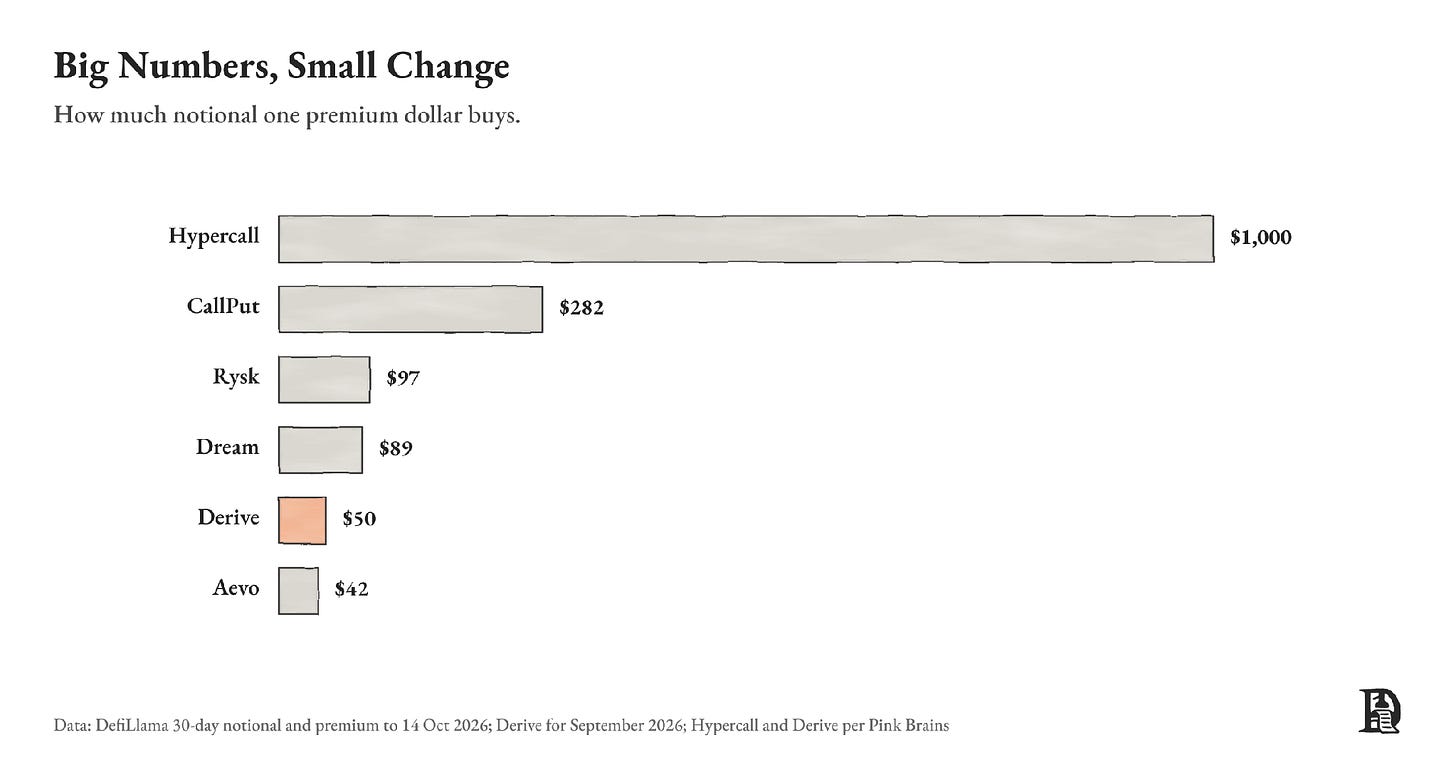
Hypercall’s notional volume primarily comprises affordable, far out-of-the-money options on the S&P 500, acquired similarly to lottery tickets. According to Pink Brains, $1 of premium on Hypercall translates to approximately $1,000 of face value, compared to about $50 on Derive. Three factors likely contribute to this disparity.
- First, volatility. The S&P 500 experiences about 16% annual movement, whereas Bitcoin's volatility is around 43%, making its options considerably cheaper.
- Second, the contract types. Short-dated calls situated far from the market price incur minimal costs relative to face value.
- Third, the incentives. When Hypercall distributed $1,000 of HYPE daily, notional volume surged 50-fold, while premiums remained relatively unchanged, leading traders to purchase the most economical contracts to earn rewards. Conversely, Derive serves as the platform where traders pay a premium for genuine option exposure.
Is Derive’s order book sufficient? On the evening of October 19, we evaluated every BTC and ETH option available on both Derive and Deribit, excluding contracts far out of the money and those expiring within three days. Deribit offered both bids and asks for all 346 strikes considered. In contrast, Derive provided both for 206 strikes. Where Derive did provide quotes, its ask was within 0.2% of Deribit’s, with its bid-ask spread averaging about 3.8% of the option’s price, compared to 2.6% on Deribit.
In our previously published piece "Trading Optionality" from July 2025, we observed that Derive's spreads were often two to five times wider than those on Deribit. However, this gap has significantly narrowed since then.
In markets beyond Bitcoin and Ethereum, the situation is markedly different. Derive lists options for 12 assets, and we extracted every 25 December strike from its public API.
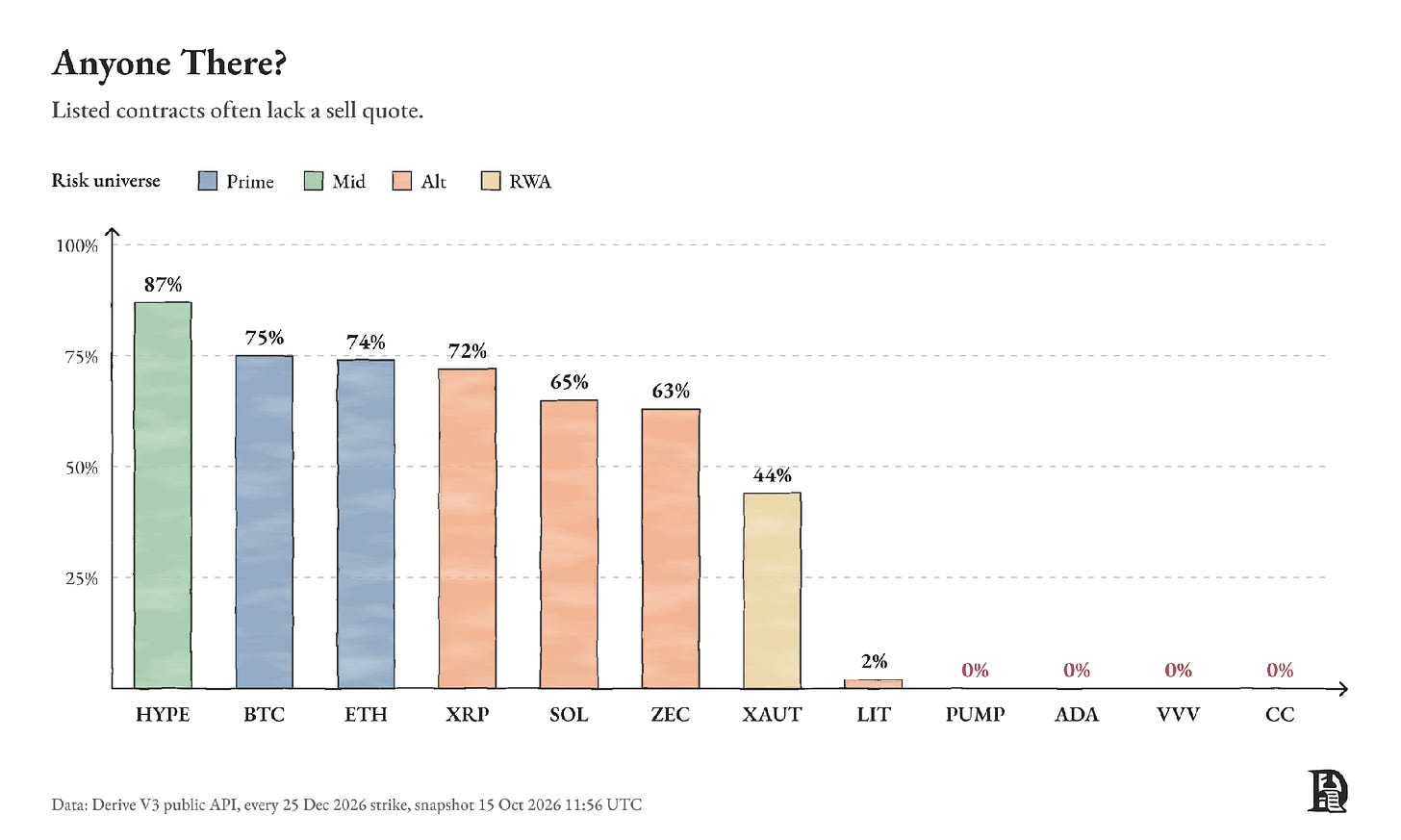
PUMP, LIT, ADA, VVV, and CC have a total of 220 strikes for the 25 December 2026 expiry, but only one offer was available. When we attempted to purchase PUMP calls set to expire in December, the order took an extended period to fill. Even in cases where quotes were available, the spreads widened significantly as we deviated from the current price. HYPE, the most liquid mid-cap asset on Derive, illustrates how rapidly this occurs.
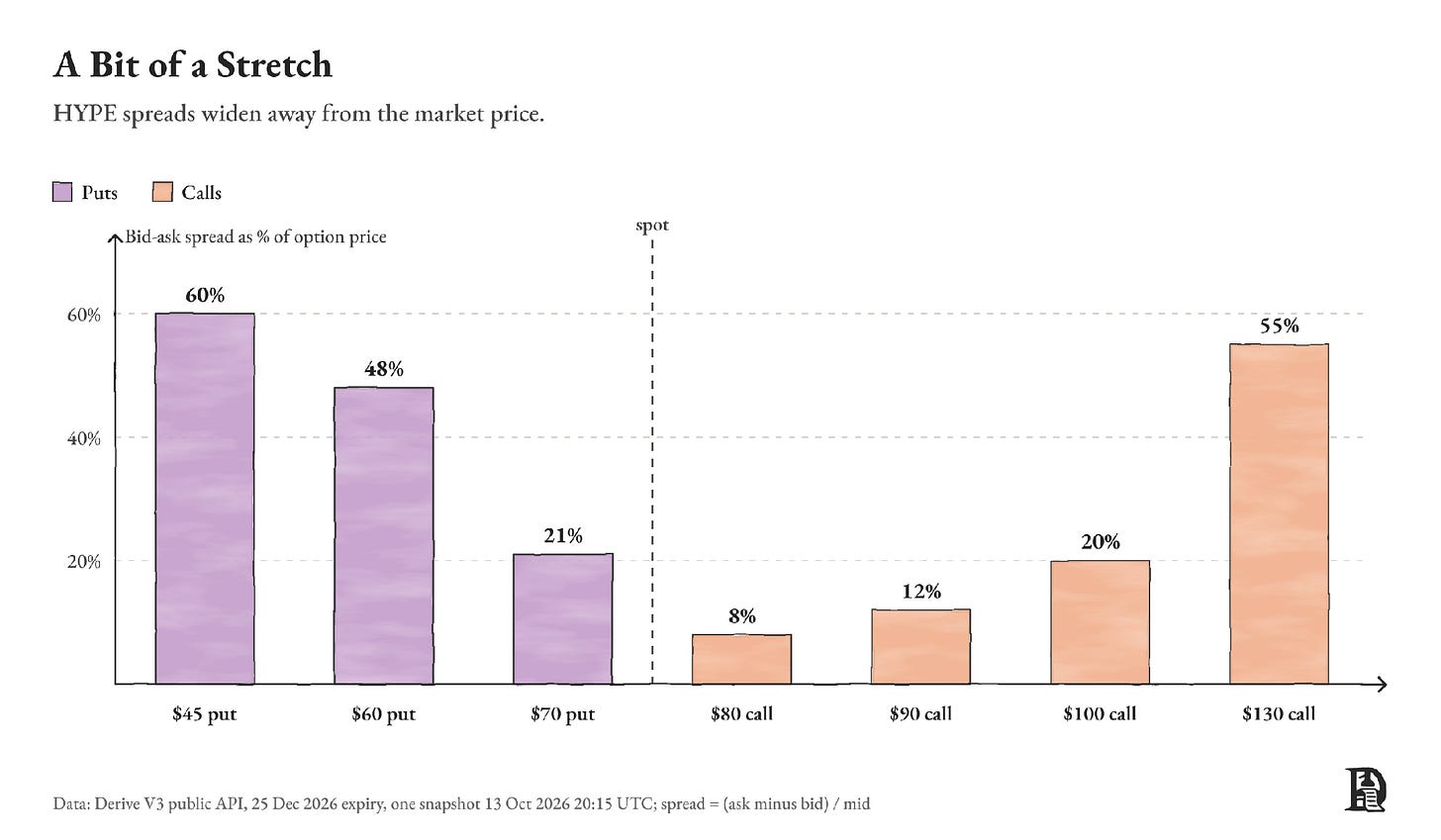
We encountered similar challenges across every venue we examined. Aevo only provides memecoin options through its over-the-counter desk, while Dream shifted its PUMP and LIT transactions to a single OTC counterparty. The cost of listing an option is minimal for a venue, however, selling one poses significant expenses and risks.
In traditional finance, 88.65 billion option contracts were traded in 2025 compared to 30.64 billion futures contracts. In the 30 days leading to October 19, 2026, on-chain options registered a notional volume of $4.9 billion against $627 billion for perpetual DEXs, representing roughly 0.8%.
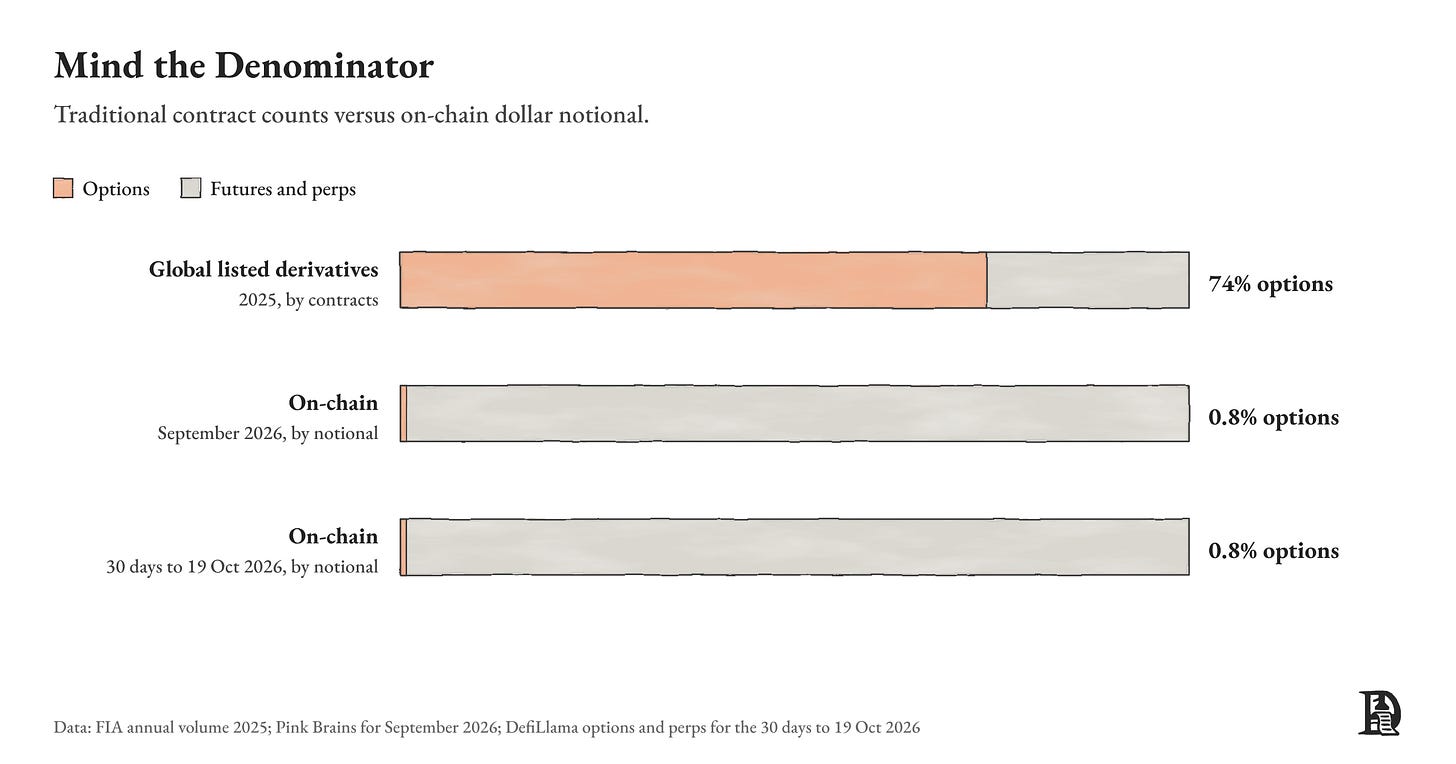
Many individuals already possess options without recognizing them as such. For example, if your mortgage allows for early repayment, you effectively hold a call option against the bank. Insurance policies act as puts, while employee stock options are treated as calls compensated through salaries. Each of these scenarios addresses a specific need, and all these needs are reflected in the current crypto landscape.
We do not anticipate on-chain options achieving the same ratio as traditional finance, as certain demands within crypto are already being satisfied by various instruments. Prediction markets offer a binary alternative, and many perpetual venues fulfill similar functions. On October 19, Lighter introduced binary options for Bitcoin and Ethereum.
Nevertheless, three categories of demand persist for on-chain options:
- Assets that traditional finance cannot swiftly list, such as HYPE, pre-IPO companies, GPU rental rates, and equities or oil on Sundays.
- Users that traditional finance cannot adequately serve, including those outside the U.S., individuals without brokerage accounts, and those wishing to trade with just $1. In our prior analysis, "It’s All Derivative," we pointed out that weekly options comprised 95% of trades on India's NSE.
- Options integrated into other products, such as downside protection linked to a perp, covered calls for treasuries, and liquidation insurance on loans. On-chain options can be seamlessly embedded into any application via an API.
The simplest way to illustrate the situation is by examining the fee structure from a single options trade.
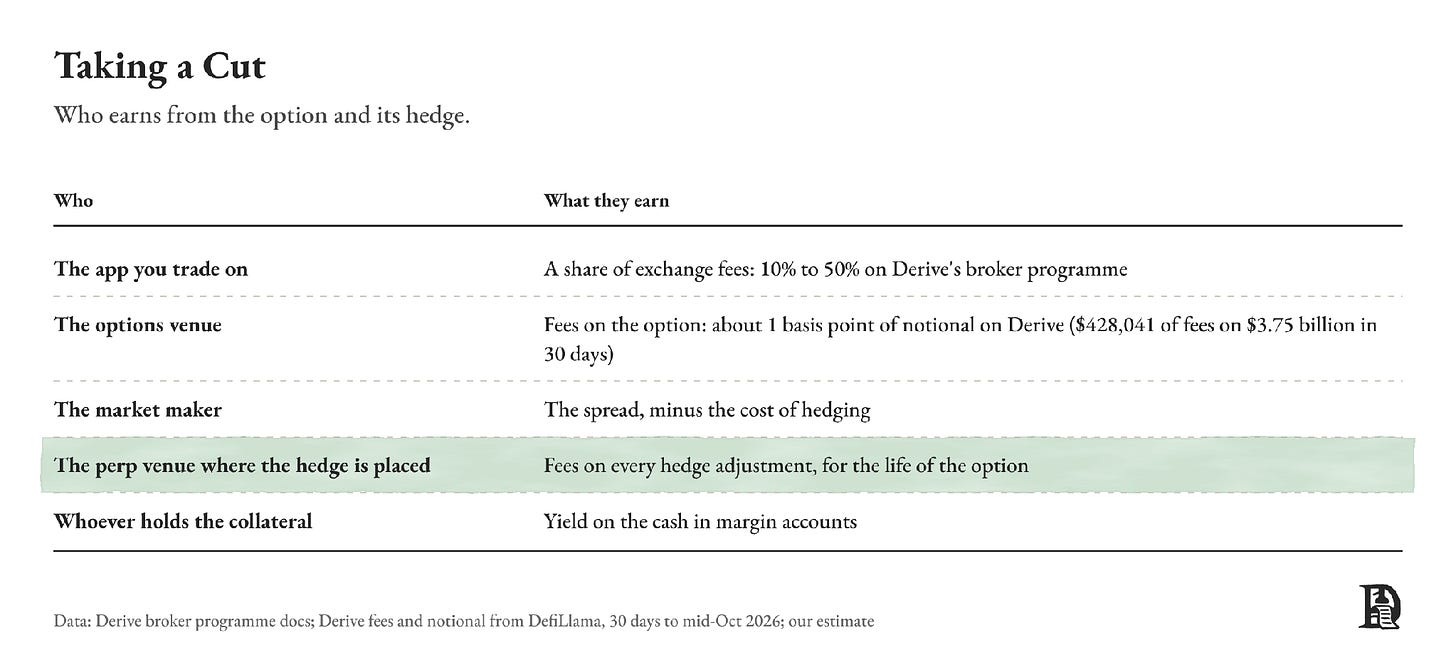
The options venue receives a nominal fee upon trading the option. In contrast, the venue where the hedge is executed earns fees each time the market maker adjusts that hedge. This dynamic explains why options contribute to the volume of perpetuals. Deribit maintains over $2 billion in futures open interest primarily to hedge options traded on its platform. Consequently, we identify three significant positions worth owning.
- Landlords like Hyperliquid control the hedge market, manage margin accounts, and possess user access. Additionally, HIP-4 binaries already operate within the same account framework. These HIP-4 contracts are tailored for "bounded options-like instruments," potentially threatening Hypercall’s market share. Regardless, the hedging activity ultimately benefits Hyperliquid.
- Engines that facilitate options trading are another prudent investment. Derive boasts the most extensive order book, a robust risk engine, and a professional user base. With the introduction of V3, it now offers an API for others to build upon. If wallets, vaults, and agents direct their options flow through Derive, it could solidify its position as the backbone for on-chain options. If not, it risks remaining a venue with subsidized liquidity and a single public market maker.
- Block trading desks like Paradex provide access to Paradigm’s institutional flow, which holds substantial value for large trades. The market makers attracted by this flow also enhance the overall liquidity for all participants.
Venues that fail to offer mechanisms for sellers to hedge are already losing market share. Aevo's options business declined by over 90% while the overall category expanded fourfold. Isolated options products are unlikely to compete against those that provide composability with other primitives, such as perps and spot trading. It is likely we will see the adoption of builder codes for options, where a single venue houses liquidity for various front-end applications.
The market is already reflecting one of these potential outcomes. Citrini Research’s "Breaking The Wall" portfolio allocated 10% to DRV, and DRV has surged over 1,000% this year. As of October 22, it had a market capitalization of approximately $390 million, juxtaposed with $486,000 in net revenue for the 30 days ending October 20, suggesting DRV trades at roughly 66 times its annualized revenue.
What would it take for Derive to achieve that level of growth? Consider a scenario in which on-chain options capture 5% of the perpetual volume. Perpetuals are projected to reach around $660 billion in volume for October. Five percent of that amounts to about $33 billion in notional options volume. If Derive retains around 80% of this notional, with a fee structure of approximately 1.1 basis points, this could yield around $35 million in annual fees, translating to around 11 times the fees at the current market capitalization. Thus, the price of DRV is betting on a roughly sixfold expansion of the category, with Derive maintaining its share while Hyperliquid, Lighter, and Paradex pursue the same market flow.
Not all sellers need to originate from an options venue. Metric functions as a DEX with active pools resembling Uniswap’s concentrated liquidity model. Liquidity providers deposit funds within defined price ranges to earn the spread when traders utilize their pools. The crucial distinction lies in how these ranges are established. In Uniswap, an LP’s range is static, meaning that trades alone drive price fluctuations; thus, LPs must repeatedly adjust their ranges as market conditions change.
Conversely, on Metric, a curator inputs a price provider, typically an oracle, and the bins are adjusted as percentages around that reference price. As prices fluctuate, the bins shift accordingly. Metric achieved $4.4 billion in volume over the 30 days ending October 21, supported by approximately $12 million in deposits.
What if these pools began to quote options? Metric’s documentation includes Black-Scholes with volatility inputs as one of the pricing models for a price provider. A curator could price a tokenized ETH call based on a real-time volatility feed.
For instance, consider a call option with a $2,600 strike price expiring on October 30. With ETH trading around $2,430 and implied volatility near 50%, Black-Scholes would value it at approximately $18. Should ETH rise to $2,500, the same call option would be valued at about $35, with every bin moving upward in tandem. Moreover, since Metric pools route through aggregators like 0x, 1inch, CoW Swap, and PancakeSwap, traders could acquire an option token just like any other token, utilizing the swap interfaces they are already familiar with.
However, the challenge lies in capital efficiency, despite immediate distribution benefits.
Each strike and expiration would necessitate its own token and pool. For example, the ETH $2,600 strike with a 30 October expiry would compensate holders based on the amount by which ETH exceeds $2,600 at expiration. A new set of tokens would need to be issued for each subsequent expiry. A market maker on Deribit can quote hundreds of instruments from a single margin account. Conversely, selling the $2,600 call on Derive would require approximately $330 in margin under standard rules, with no offsets from hedges considered. Selling a fully backed $2,600 call would tie up 1 ETH, valued at around $2,430, with a return of $18. Additionally, each Metric pool would require its own inventory, meaning that managing five strikes across two expirations would necessitate ten separate capital reserves.
Thus, the solution depends on who issues the token. If Derive were to take on this role, it would allow sellers to post margin and hedge on perps. Consequently, if a seller wrote the $2,600 call through Derive, they would only need to pledge about $330 instead of an entire ETH. Metric would then effectively perform its role by pricing the token and making it available to traders.
Returning to Papertrade, the incentives for token loss rapidly attracted both capital and traders. This aspect appears to be what is currently lacking in on-chain options. Options sellers do not have sufficient incentives.
What might a Papertrade model for options entail? A house vault could sell calls and puts at predetermined strikes. When an option expires worthless, the buyer mints the house token in proportion to the premium lost, while staked tokens accrue the surplus generated by the house.
Historical data shows that option buyers frequently incur losses. Between January 2018 and October 2026, a buyer of a weekly BTC call option with a strike 10% above the market price forfeited their premium in 87% of weeks. Papertrade itself stands as a prime candidate to develop this model. The distinction lies in the fact that a trader using high leverage in a perp may face liquidation from a minor price movement, whereas an option buyer remains engaged until expiration, necessitating that the house charges a fair premium rather than relying solely on liquidations.
The inherent risk for a call-selling house is to earn small profits consistently over months, only to incur substantial losses when the market shifts significantly in either direction. I conducted a simulation based on BTC’s historical data. The pool initiates at zero and sells weekly calls set 10% above the market price. During this simulation, the house collected an average premium of around $1,300 for every $100,000 of BTC, which was set at 50% above the average cost of the calls. In 12% of the weeks, specifically 57 out of 458, BTC closed above the strike, resulting in average payouts of approximately $6,900. Thus, the net outcome saw the house retaining about $1,300 per call, paying out roughly $860 per call on average, and earning about $440.
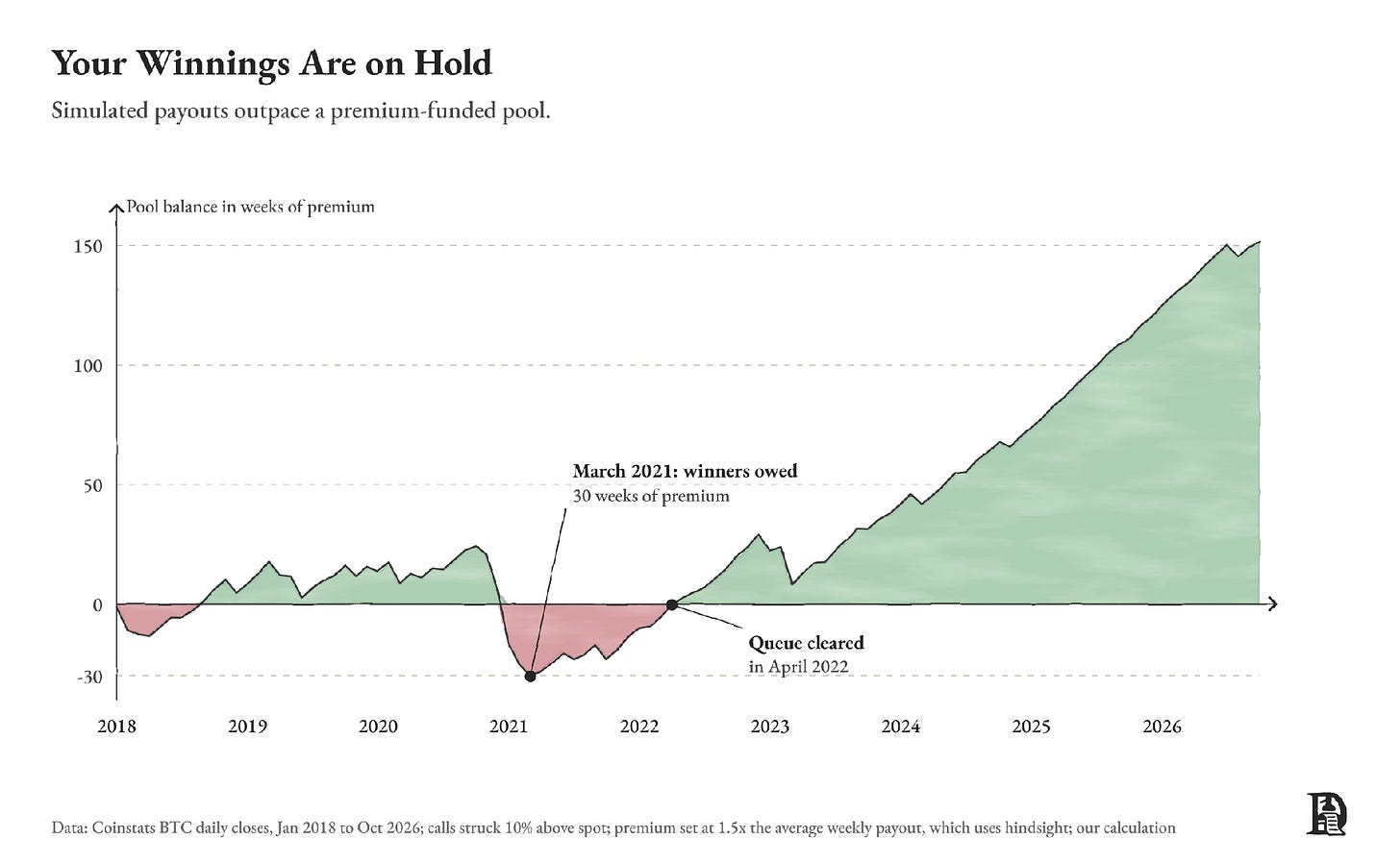
Over the span of eight years, the house remained profitable. However, it owed winners 30 weeks’ worth of premium income in March 2021, leading to a backlog that couldn’t be resolved until April 2022. The worst single week witnessed payouts equating to approximately 20 weeks’ worth of premium income at once.
The design must minimize the backlog. Stakers, who benefit from the house’s surplus during prosperous weeks, should also cover its losses during challenging periods, ensuring that winners receive timely payments rather than experiencing delays. Furthermore, the house should hedge against the existing perps. As BTC approaches the strike price, it can purchase BTC perps on Hyperliquid. Thus, during weeks of significant price movement, the hedge can offset a substantial portion of what is owed to winners.
When I integrated a daily hedge into the simulation, the worst week resulted in a loss equivalent to about 10 weeks’ worth of premium income rather than 20. The pool managed to avoid financial distress during the 2021 rally, which had previously left winners waiting for 30 weeks’ worth of payouts. Our analysis in the parlays piece underscored the same necessity for a central liquidity manager.
An alternative design could involve the house taking the opposite side of every trade, buying options from traders wishing to sell while simultaneously selling to those wanting to buy. In this scenario, when buyers and sellers match up, the house remains neutral and retains the spread, only needing to hedge and fund any imbalance.
The challenge remains with the token. If losses on either side generate tokens, a trader could purchase a call on one account and sell the same call on another, knowing one of the positions will incur a loss. Tokens would need to be minted based on each account’s net losses per expiration, with a spread that exceeds the worth of the tokens. This approach is somewhat akin to how users can partially hedge their positions on Papertrade today.
There are reasons to believe this endeavor to establish on-chain options could endure. Sellers have access to deeper markets for hedging, improved capital utilization, and more pathways to connect with buyers. Incentives can provide a kickstart. However, whether sellers can accumulate enough earnings to continue quoting amid diminishing rewards and market fluctuations remains an open question.
Nevertheless, the foundational structures are more robust than those seen in previous attempts. If these foundations hold, a greater number of traders will be able to assess the prices at which they are willing to wait for their predictions to materialize. The crypto landscape has made leverage readily accessible; perhaps the next evolution will center around time.