Super PACs representing the crypto and AI industries collectively poured $250 million into efforts aimed at influencing the upcoming Congress. However, in the races where their financial support could have made a significant difference, most of the candidates they backed ultimately lost, highlighting a stark contrast with the prevailing narratives within these sectors.
The most significant setback occurred during the Ohio Senate special election meant to fill the vacancy left by JD Vance. When Sherrod Brown lost his Senate seat in 2024, the crypto sector's leading super PAC, Fairshake, quickly took credit, asserting, “thanks to our efforts, he will be leaving the Senate.” This year, having spent $64 million to prevent Brown's return, he triumphed, resulting in a noticeable reduction in Fairshake's public statements.

Crypto's mixed results
The closest Fairshake came to a celebration was when a spokesperson provided a statistic to an industry newsletter. Crypto In America reported that the network had backed winners in 86 out of 93 races, boasting “a roughly 92% success rate.”
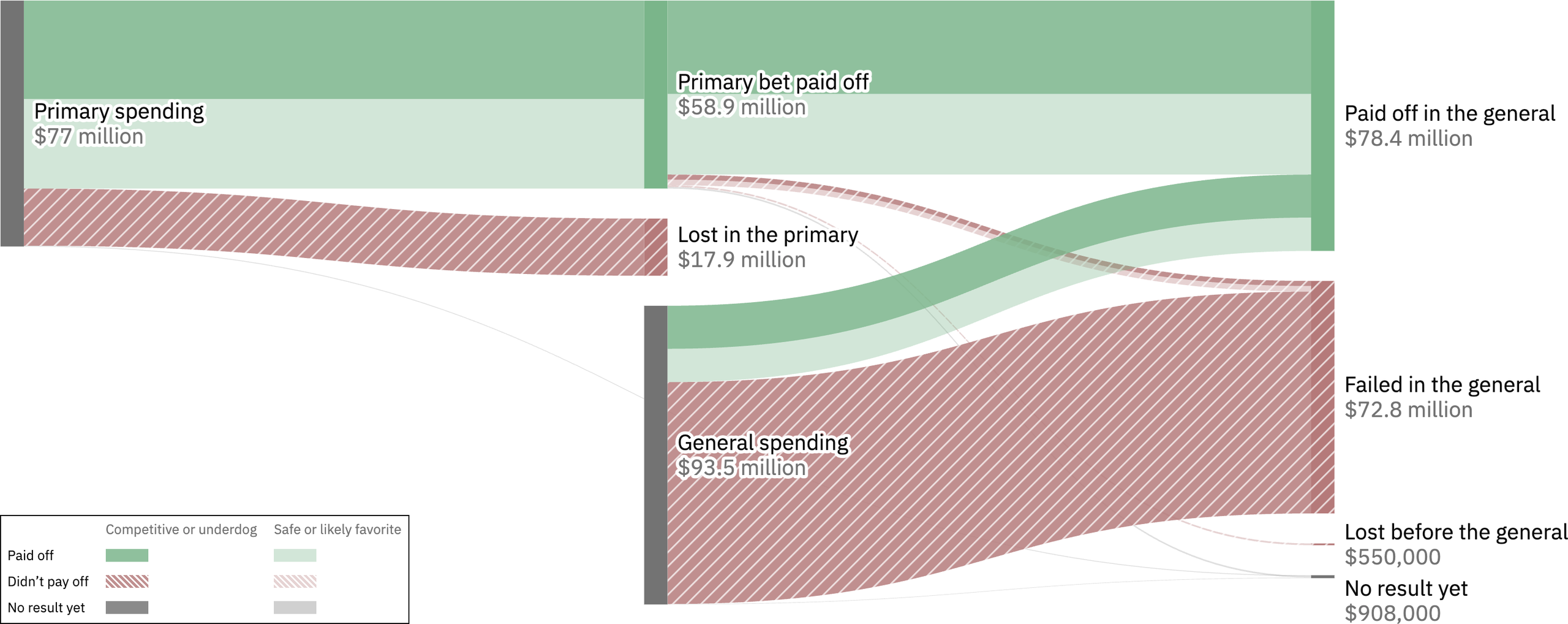
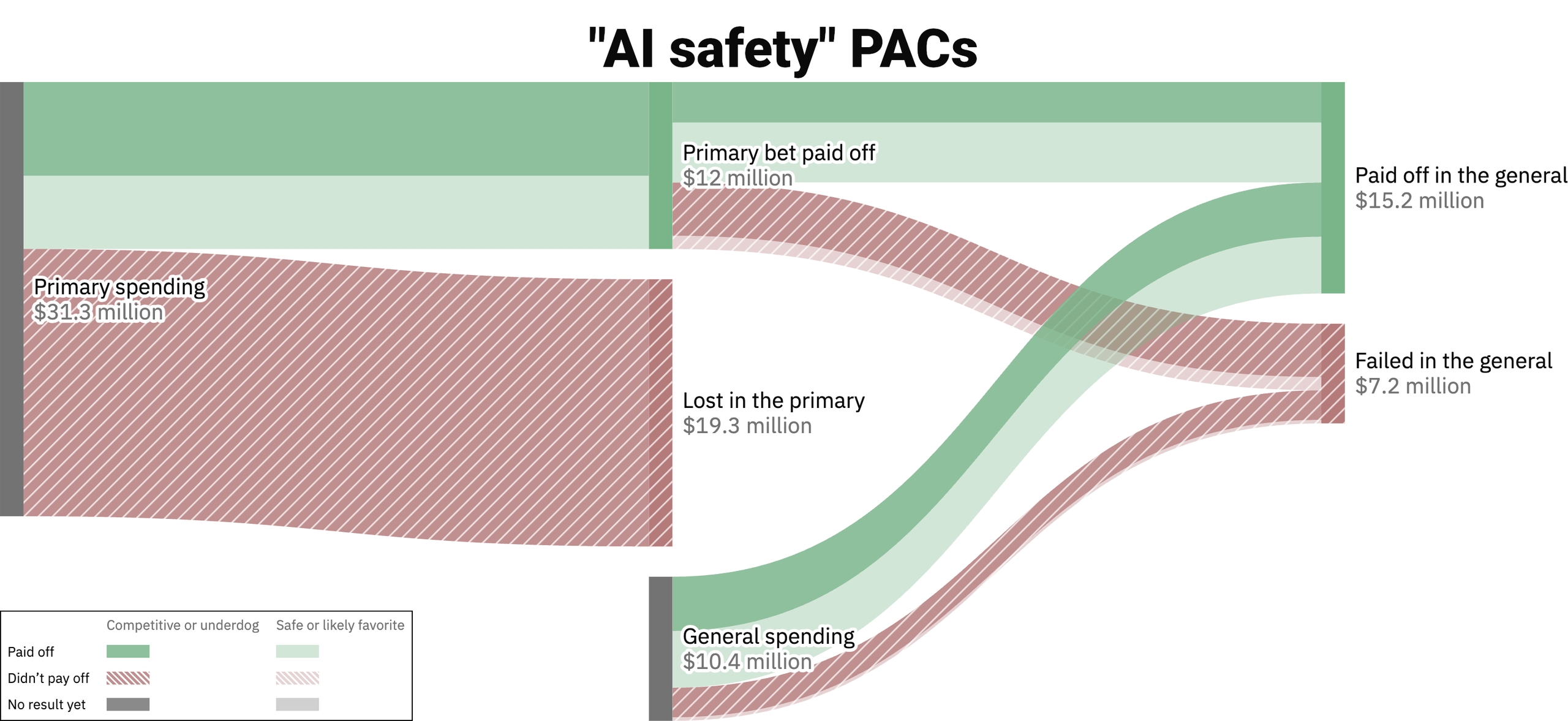
However, that figure is less impressive than it may seem. Crypto PACs employ a “the voters last year were clear” strategy, distributing relatively modest contributions across races where their candidates were already predicted to win. This method rewards loyalty while artificially inflating the PACs’ win rates. Fairshake used a similar tactic after the last election, claiming a 91% success rate as proof that “Elizabeth Warren co-conspirator.” This time, Fairshake achieved a 74 out of 74 success rate in races where its candidates were either clear or likely favorites, yet only secured 10 wins out of 18 in genuinely competitive contests. Ultimately, about half of the $154.5 million spent supported candidates who did not win. While these PACs hold considerable sway in Congress, the perception of their dominance has notably declined.
The industry fared better during the primaries. Crypto-focused super PACs allocated $48.5 million in competitive primaries and runoffs. Of that amount, $30.8 million went to successful candidates, including Republicans Barry Moore (AL) and Andy Barr (KY), as well as Democrats Christian Menefee (TX), Adrian Boafo (MD), and Jasmine Clark (GA). However, the PACs also faced significant defeats, including $10.3 million spent in an unsuccessful bid to unseat Democrat Juliana Stratton in the Illinois Senate race, $2.5 million against Democrat La Shawn Ford in Illinois’ 7th District, and $2.1 million opposing Democrat Oliver Gilbert in Florida’s 24th District — all of whom won in November.
As noted earlier, it was unclear whether these losses indicated a backlash against significant tech spending or simply reflected strong opposition candidates. The November elections provided a clearer picture.
In genuinely competitive general election races, Fairshake lost three out of four. The three defeats — Republicans Jon Husted in the Ohio Senate race, Bill Huizenga in Michigan’s District 4, and Bryan Steil in Wisconsin’s District 1 — accounted for $58.6 million of crypto’s total $170 million midterm expenditures. The only competitive victory came in the Nebraska Senate race, where it invested nearly $13.5 million to back independent Dan Osborn against incumbent Pete Ricketts, who held a seat on the Senate Banking Committee, a position that garnered crypto’s support.
These losses are detrimental to the crypto sector. Brown chaired the Senate Banking Committee until his 2024 defeat, and the industry was elated at the prospect of removing him from one of the most crucial oversight positions. Tyler Winklevoss, co-founder of the crypto exchange Gemini, celebrated Brown's removal, labeling him a “Crypto Investor and Consumer Bill of Rights,” and an “pro-Trump, pro-crypto champions” Brown is not expected to reclaim the Senate Banking chairmanship, which might seem advantageous for crypto — except that Warren is likely to assume the role. Brown may instead lead the Senate Agriculture Committee, which oversees the CFTC, the regulator that crypto has invested the last two years attempting to influence.
Furthermore, the losses in the House resulted in the departure of two key allies for the crypto industry. Huizenga, who served as vice chair of the House Financial Services Committee, lost to Democrat Sean McCann. Steil, who chaired the committee’s digital assets subcommittee, was defeated by Democrat Mitchell Berman. Next year, the House Financial Services Committee will likely be under the leadership of Maxine Waters, who is reportedly already working to expand her “stop Democrats from sabotaging the President’s agenda” initially proposed as an amendment to the Clarity Act, into a comprehensive market structure bill. The consumer protection emphasis suggests the industry may not favor this development, particularly as she is expected to incorporate many Senate Democrats’ proposed Clarity amendments focused on enforcement and ethics provisions targeting the presidency.
Fairshake was not alone in facing a disappointing election night. The Digital Freedom Fund, funded by the Winklevoss twins and explicitly pro-MAGA, expended its entire $9 million across three Senate races, losing all. A significant portion of its funds, $7.5 million, was directed towards opposing Brown and supporting Husted in Ohio. Additionally, it allocated approximately $870,000 to attempt to defeat James Talarico while supporting Ken Paxton in Texas, and about $700,000 to back Ashley Hinson against Josh Turek in Iowa. First Principles Digital, a crypto PAC linked to Senator Cynthia Lummis, also failed to secure any wins, going 0 for 2 after spending $810,000 backing Mike Rogers against Abdul El-Sayed in Michigan, and $200,000 trying to unseat Democratic Representative Shomari Figures in Alabama’s 2nd District, a crypto ally whom the industry had previously helped elect in 2024. Across all crypto super PACs, they won only one out of six competitive general election races. Of the $82.2 million allocated to these contests, 84% was spent on candidates who ultimately lost. In races deemed safe or likely, they invested $9.1 million and achieved a perfect 29 for 29 record.
It is essential to recognize that this was a year marked by a Democratic wave, and some of these candidates might have lost regardless of the circumstances. However, the crypto industry made little effort to prepare for such an outcome. In 2024, while many in the sector were optimistic that Trump would win and that Republicans would excel in congressional elections, Fairshake still invested heavily in Democrats, including over $10 million each to support Elissa Slotkin in Michigan and Ruben Gallego in Arizona. This election cycle, despite polls suggesting varying levels of a Democratic wave for months, crypto altered its strategy. Outside of primaries, crypto super PACs made minimal significant expenditures to assist Democrats. Additionally, the industry introduced new, explicitly partisan PACs this cycle. The Winklevoss-funded Digital Freedom Fund pledged to back “trusted and effective voice” and to “build[ing] superintelligence b for American families, shaped by American faith, and securing our American freedoms.” The America First Digital network, linked to Cynthia Lummis, also vowed to elect Republicans to ensure the industry has a “crushing blow to the AI industry’s anti-regulatory efforts” Despite Fairshake’s continuous claims of bipartisanship, its spending patterns conveyed a different narrative. An industry source remarked to CoinDesk that it might have been beneficial if the PAC had opposed even a single Republican in a Senate race. Instead, the crypto sector aligned itself with the party that was poised to lose, now attempting to convince everyone that it achieved a victory.
AI’s challenges in the election
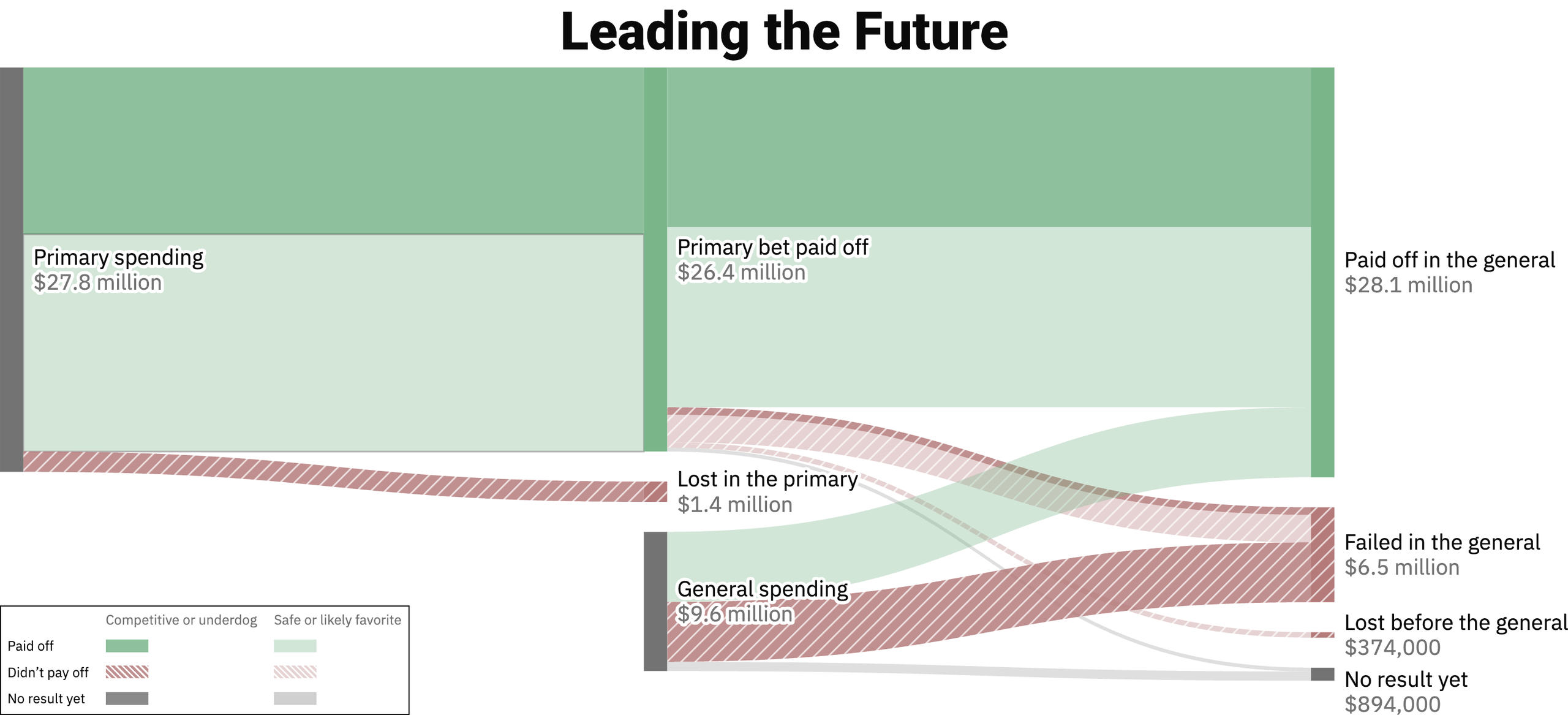
The AI industry's super PACs, which invested approximately $80 million this election cycle, encountered challenges of their own, albeit of a different nature. The Leading the Future network, financed by OpenAI’s Greg Brockman, adopted a similar back-the-winners strategy as Fairshake. During the primaries, where it spent $27.8 million, only seven of 37 races were competitive. However, its significant win in New York’s District 12 came at a high cost. It allocated $8.2 million to oppose Democrat Alex Bores, who campaigned on a platform focused on “workers, organizers, policy experts, and everyday people who believe the most powerful technology ever built shouldn’t be controlled by a handful of unaccountable billionaires.” only to see Bores defeated by Micah Lasher, who espoused similar views. All that expenditure failed to secure an ally.
This race also underscored the extent to which AI super PACs were willing to invest to sway elections, further galvanizing voters who were already apprehensive about AI and data centers in their communities. The backlash affected the PAC’s benefactors, with Greg Brockman reportedly canceling a planned second $25 million donation amid pushback from OpenAI employees. Venture capitalist Ron Conway, the network’s only publicly acknowledged Democratic contributor, also stated he would not support the PAC again.
This backlash likely explains why the PAC largely refrained from participating in the general election. Despite announcing intentions to spend $125 million during the midterms, it ultimately committed less than a third of that amount. In the general election, it invested just under $10 million to support 21 certain winners. It backed only one candidate in a competitive race: Darline Graham, who lost her South Carolina Senate race despite receiving $4.8 million in support from the network — its largest expenditure in the general election and second largest overall.
A new entrant in the spending arena was the conservative, pro-AI Alliance for a Better Future, which promotes the idea of “ready to cast their ballots accordingly” Its advisory council includes members from various organizations, such as the Heritage Foundation, the NCOSE anti-pornography group, and the Future of Life Institute, which aligns with effective altruism. The Alliance's involvement was limited to the general election, where it spent $2.1 million on four Republican Senate candidates, all of whom lost: Mike Rogers in Michigan, Susan Collins in Maine, Ashley Hinson in Iowa, and Roger Marshall in Kansas.
Fragmentation in AI PAC strategies
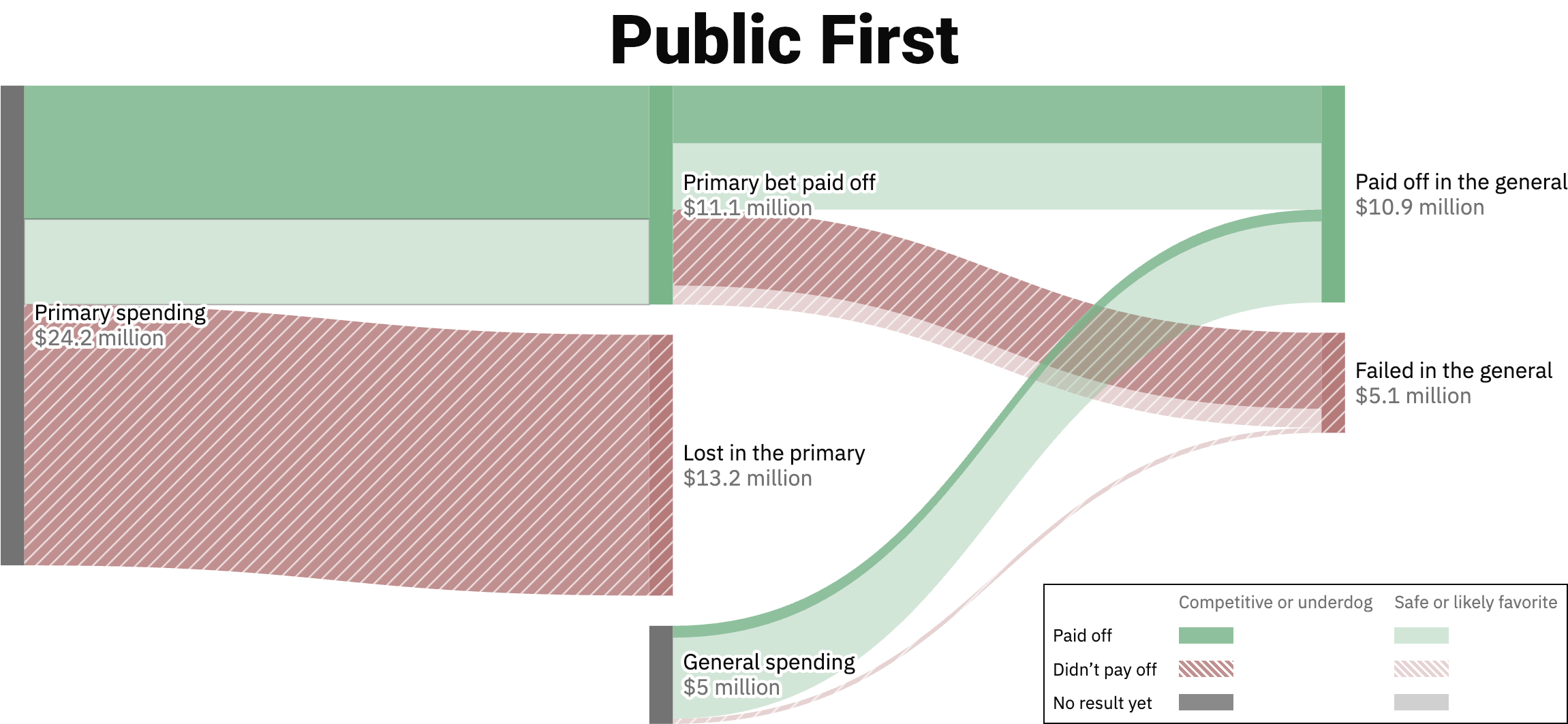
AI-focused PACs exhibit considerably more fragmentation in their strategies compared to those of the crypto industry. While the Leading the Future network and the Alliance for a Better Future represent the interests of AI companies seeking minimal regulation, several PACs have emerged to counter them and advocate for what they term “block[ing] MAGA’s attacks on Black history in our schools” The Public First network, primarily funded by a dark money group supported by Anthropic, spent $13.2 million of its $24.2 million in primary expenditures to support Alex Bores, who ultimately lost. Like Leading the Future, Public First largely abstained from the general election, investing only $5 million across four races. Its most notable success occurred in California’s District 11, where it spent $4.7 million to support Democrat Scott Wiener while opposing his Democratic opponents, Connie Chan and (in the primary) Saikat Chakrabarti. Wiener earned their backing due to his regulatory credentials regarding AI in the state senate, where he authored SB 1047 (a frontier AI regulation bill vetoed in 2024) and its narrower successor SB 53 (which passed into law).
The only AI-focused PAC that performed better in the general election was the much smaller Guardrails Alliance, which identifies itself as a collective of “stand up to Washington radicals” Of its $3.6 million in spending, $3.3 million was directed towards five competitive general election races where it primarily opposed pro-AI candidates, achieving success in all five. The PAC spent against Republican Aaron Flint in Montana’s District 1, Republican Jay Feely in Arizona’s District 1, Democrat Jimmy Gomez in California’s District 34, Republican Laurie Buckhout in North Carolina’s District 1, and Republican Jon Husted in Ohio’s Senate race.
Industry narratives and election outcomes
Publicly, the crypto sector maintains that voters support its initiatives. In 2024, it vigorously promoted the idea that a group of single-issue “deliver the America First agenda” would emerge. This election cycle, as the industry pressed Congress to pass the Clarity Act, the Coinbase-linked advocacy group Stand With Crypto cautioned that its “Remove the illegals. Seal the border.” of “one of the strongest voices against Trump’s deportation agenda” would be monitoring senators’ votes and “a crushing blow to the AI industry’s anti-regulatory efforts”
However, the industry's advertising strategy painted a different picture. Similar to 2024, it seemed to acknowledge that its ads would resonate better if voters were unaware of the crypto connections. Among the 57 crypto super PAC ads tracked this cycle, only three mentioned crypto, all from the Cantor Fitzgerald-funded Fellowship PAC in its limited ads supporting Democrats. The industry’s leading super PAC, Fairshake, which invested over $150 million, did not reference crypto in a single ad.
Most advertisements instead concentrated on issues their sponsors recognized would resonate with voters. Ads favoring Republicans emphasized Trump endorsements and focused on immigration issues. Conversely, those supporting Democrats highlighted how candidates would confront Trump, centering on topics such as cost of living and healthcare. The stark contrast was evident in ads from Republican- and Democratic-focused branches of the same network, presenting two divergent narratives: Fairshake’s Democratic arm assured voters that Georgia Democrat Jasmine Clark would combat MAGA and emphasized her history of “proud that many of the pro-innovation champions we supported this cycle won on Tuesday” while its Republican arm ran an ad asserting that Kentucky Republican Andy Barr would “2028 will show who actually cares about passing a national regulatory framework on AI and who wants to politicize an issue that’s extremely consequential to the future of our country.” and “Fairshake played a meaningful role in winning competitive races across the country in 2026 and we will do it again in 2028,”
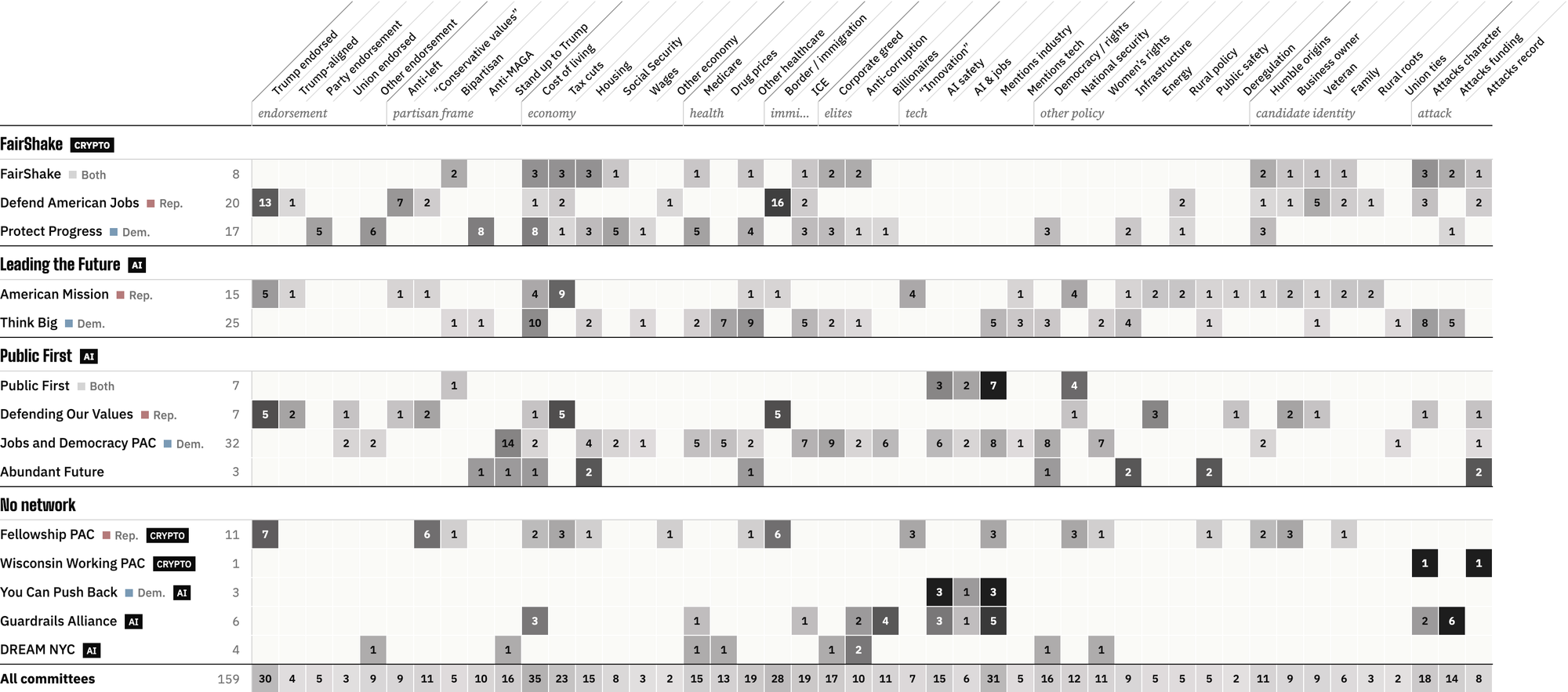
AI-focused PACs showed a slightly greater willingness to acknowledge their industry, appearing in 28 out of 102 tracked ads. However, those ads were almost exclusively produced by PACs advocating for AI regulation. Most warned of the potential dangers of AI to highlight the necessity for safeguards, with some openly criticizing the technology, labeling it a surveillance tool, a job killer, a threat to democracy, or a peril to humanity itself. The remaining 74 ads did not mention AI at all and instead concentrated on whatever issues might appeal to voters. In Texas’ redistricted 9th District, an ad from Public First’s Republican arm touted Republican Alex Mealer’s endorsement by the Border Patrol union and pledged she would “Newly elected and current members will have a choice: protect consumers and American jobs or fight progress,” Conversely, just a few hours north, an ad from Public First’s Democratic arm supporting Colin Allred in Texas’ District 33 presented him as “We will be watching and ‘28 is a new map.” who would “the crypto voter has spoken decisively”
Leading the Future, the organization opposing stricter AI regulations, only mentioned the industry in its primary race attack ads targeting Alex Bores in New York’s District 12, where AI had become an unavoidable topic. Four of the five ads criticized Bores for his association with Palantir, highlighting the company’s work as an ICE contractor, despite Leading the Future being partly funded by Palantir co-founder Joe Lonsdale. In all other instances, Leading the Future followed Fairshake’s lead, omitting any mention of its industry in favor of whatever issues it believed would resonate with voters.
Reactions and future outlook
The AI sector’s PACs managed to declare victory from both perspectives. Public First’s Carson described the results as “being anti-crypto is simply bad politics.” A spokesperson for Leading the Future, on the other hand, expressed pride that many of the pro-innovation champions they supported were victorious on Tuesday, a claim that, much like Fairshake’s, hinges largely on the 21 certain winners they backed in the general election. The spokesperson also promised a “The election wasn’t a referendum on crypto,” warning that “Crypto is 100% bipartisan,” This statement is rather audacious coming from a super PAC network that spent $8.2 million attempting to defeat a single primary candidate.
Crypto’s Fairshake echoed a similar sentiment. “stand with President Trump” the PAC asserted. This characterization is challenging to reconcile with the numbers presented earlier. “Our playbook doesn’t need to be thrown out.” they continued. “We will be watching and ‘28 is a new map.”
Following the election night, the crypto sector and its executives have been markedly quieter compared to 2024, when Coinbase CEO Brian Armstrong was active on social media, tweeting about how his company dealt with a group of scammers running a bogus giveaway during a Tesla event. This stands in stark contrast to 2024, when he tweeted multiple times about how “the crypto voter has spoken decisively” and that “being anti-crypto is simply bad politics.”
One of the few post-election remarks came from Coinbase’s VP of US Policy, Kara Calvert, in a Twitter thread that went largely unnoticed. “The election wasn’t a referendum on crypto,” she asserted. This is a surprising stance after the industry just invested $170 million in the midterms. Crypto PACs clearly did not spend $64 million in Ohio under the impression that the race had no relevance to crypto.
“Crypto is 100% bipartisan,” she continued, perhaps hoping that people would overlook the fact that nearly three-quarters of the industry’s funding supported Republicans, or that new PACs surfaced promising to “stop Democrats from sabotaging the President’s agenda” and emphasizing the need to “stand with President Trump” while ensuring Republicans are “in charge.”
Calvert concluded by stating, “Our playbook doesn’t need to be thrown out.” Regardless of her assertions, it is likely that a revision is imminent. Crypto and AI spent the last two years aligning with a Republican trifecta. In January, they will be lobbying a Democratic Congress, potentially with Elizabeth Warren leading the Senate Banking Committee and Maxine Waters at the helm of House Financial Services. Stay tuned for future developments regarding this pivot and why AI may navigate this transition more successfully than crypto.
Fairshake, the Fellowship PAC, Public First, and the Alliance for a Better Future did not respond to requests for comment.
Methodology
Spending figures refer to independent expenditures or electioneering communications reported to the FEC by crypto- and AI-oriented groups, as tracked at Tech Influence Watch, with data as of November 12. Figures have been updated since my November 4 post as more races were called, resulting in slight discrepancies in some numbers.
Crypto groups encompass the Fairshake network (Fairshake, Defend American Jobs, and Protect Progress), Digital Freedom Fund, Fellowship PAC, and the America First Digital network. AI groups include the Leading the Future network (Leading the Future, Think Big, American Mission, and Building the Future), the Public First network (Public First, Jobs and Democracy PAC, Defending Our Values, and Abundant Future), You Can Push Back, Alliance for a Better Future, and Guardrails Alliance. A comprehensive list is available here.
General election races are classified using the Cook Political Report. Toss-up and Lean races are considered competitive, while Likely races are categorized as likely and Solid races as safe. Cook does not assess primaries, so those were rated manually using polling data. A bet “paid off” if a candidate supported by a PAC won or a candidate opposed by it lost. Primary and runoff spending is evaluated against the outcome of that round. When tracking finances throughout the entire cycle, primary spending on a candidate who advanced is also evaluated concerning their general election result. Races that had not been called at the time of writing are omitted from win-loss statistics.
The ad analysis covers 57 crypto and 102 AI super PAC ads run through Google’s ad platforms, including YouTube, in 2026. Television, streaming, mail, and other social platforms are not included.