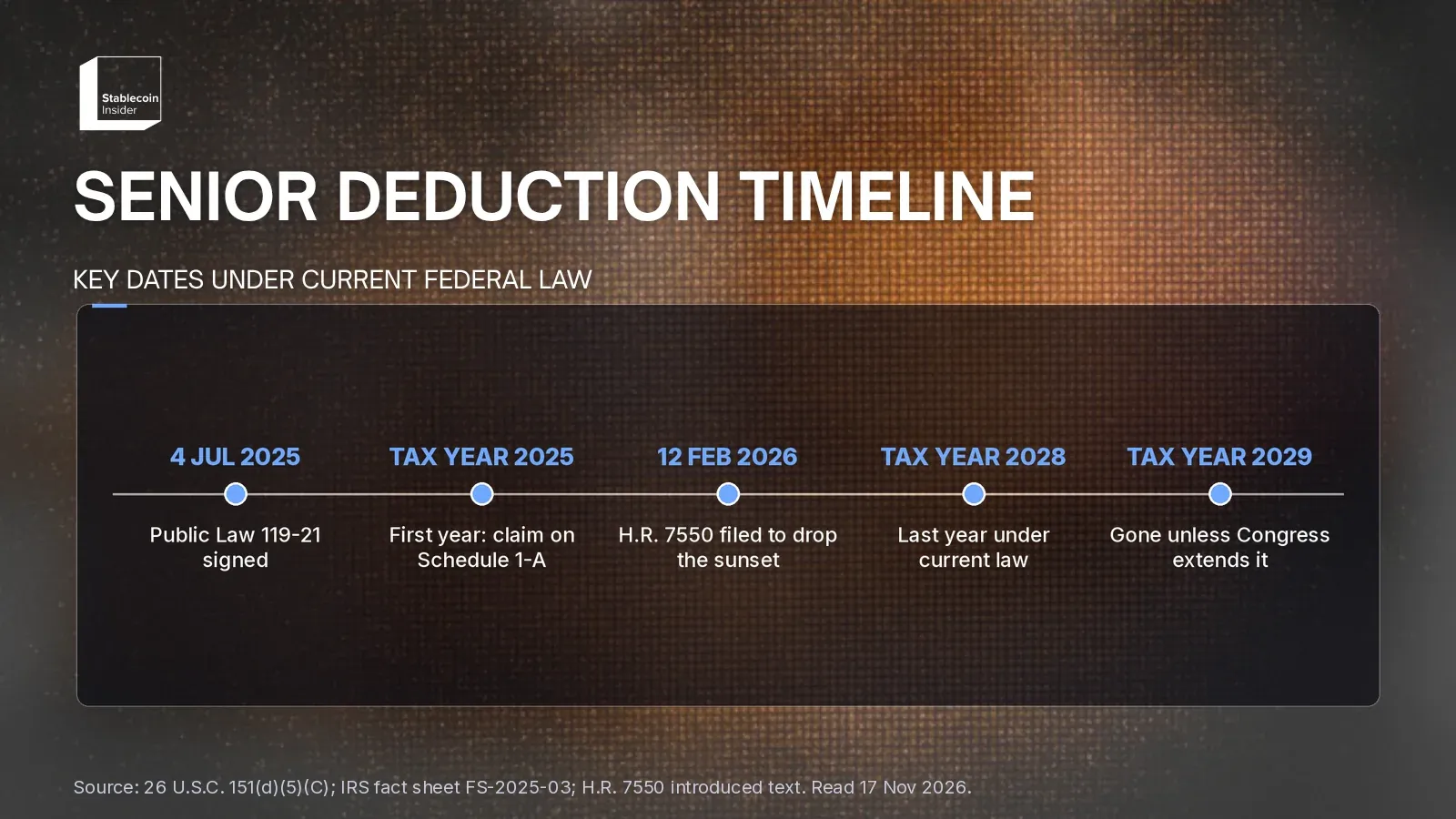
The senior tax deduction is set to expire following the tax year 2028. This law permits an additional $6,000 deduction exclusively for taxable years beginning before January 1, 2029 ( 26 U.S.C. §151(d)(5)(C) ). Therefore, for the majority of taxpayers, 2028 will mark the final year for claiming this benefit, with the last eligible return being filed in 2029.
The IRS reinforces this timeframe, stating, "taxable year beginning before January 1, 2029" ( IRS fact sheet FS-2025-03 ). According to a flyer published in October 2026, the IRS continues to affirm that the deduction is valid "Effective for 2025 through 2028, individuals who are age 65 and older may claim an additional deduction of $6,000" ( IRS Publication 6142 ). A surge in interest was noted with over 500,000 searches in the U.S. for "senior tax deduction expiration date" leading up to November 17, 2026. Additionally, on November 15, CNBC reported that newly elected lawmakers from the November 3 midterms might discuss the possibility of extending this tax break.
Last updated: November 17, 2026. The law text, IRS forms, and inflation figures for 2026-2027 were verified against official IRS and congressional sources on this date. This pertains exclusively to U.S. federal income tax.
Key Takeaways
- The current legislation provides the $6,000 senior deduction for tax years 2025, 2026, 2027, and 2028, concluding for tax years starting on or after January 1, 2029 ( §151(d)(5)(C) ).
- Eligibility requires individuals to be 65 years old by the last day of the tax year, possess a valid Social Security number, and if married, file jointly. This deduction applies whether or not one itemizes deductions ( IRS ).
- The $6,000 deduction is reduced by 6% for modified adjusted gross income (MAGI) exceeding $75,000, or $150,000 for joint filers. Thus, it completely phases out at $175,000 for single filers and $250,000 for couples who both qualify ( Schedule 1-A ).
- For example, a 67-year-old single filer with a MAGI of $90,000 would receive a $5,100 deduction, resulting in a federal income tax reduction of $1,122 at the 22% tax rate.
- Introduced on February 12, 2026, H.R. 7550 aims to eliminate the expiration of the deduction for years following 2026. The version reviewed is the introduced draft, which has been referred to the Ways and Means Committee ( GovInfo ).
When does the senior tax deduction expire?
The expiration of the senior tax deduction is set for tax years commencing on or after January 1, 2029. This expiration is highlighted in the initial wording of the provision: "In the case of a taxable year beginning before January 1, 2029, there shall be allowed a deduction in an amount equal to $6,000 for each qualified individual" ( 26 U.S.C. §151(d)(5)(C)(i) ).
Although the law, Public Law 119-21, was enacted on July 4, 2025, the deduction commenced with the tax year 2025 ( IRS FS-2025-03 ). This allows for four filing seasons: returns for 2025 are filed in 2026, followed by returns for 2026, 2027, and 2028 being submitted in the subsequent spring. The provision does not specify any early termination. The $6,000 amount, along with the $75,000 and $150,000 thresholds, are established as fixed amounts, without any inflation adjustments indicated in the subparagraph.
Who qualifies for the $6,000 senior deduction?
To qualify for the $6,000 senior deduction, individuals must be aged 65 or older by the last day of the tax year ( IRS Tax Tip 2026-14 ). For couples filing jointly, each spouse who meets the age requirement counts independently, allowing for a total claim of up to $12,000.
There are three additional conditions:
- Social Security number requirement: Each person qualifying must have their SSN included on the return. The statute adopts the definition used for the child tax credit: an SSN assigned to a U.S. citizen or a person authorized to work, issued prior to the due date of the return ( 26 U.S.C. §24(h)(7) ).
- Joint filing for married couples: Couples must file jointly to be eligible for the deduction; filing separately is not allowed ( §151(d)(5)(C)(v) ).
- Itemization flexibility: Both itemizers and individuals who take the standard deduction can utilize this deduction ( IRS ).
The age requirement is effectively turned into a birth-date cutoff on the forms. The 2025 Schedule 1-A inquires whether the taxpayer was "born before January 2, 1961" ( IRS ), while the draft 2026 form uses January 2, 1962 ( IRS draft ). Thus, if one was born on January 1, 1962, they would qualify as 65 for 2026.
How does the senior deduction phase out with income?
The senior deduction reduces by 6% for every $1,000 of MAGI surpassing $75,000, or exceeding $150,000 for joint returns ( §151(d)(5)(C)(iii) ). For this calculation, MAGI comprises adjusted gross income plus any foreign earned income or income from U.S. territories that was excluded under sections 911, 931, or 933. If there are no exclusions, MAGI equals AGI.
Concretely, each $1,000 over the threshold results in a $60 reduction. Schedule 1-A calculates a single reduced amount and records it for the individual and once more for a qualifying spouse ( lines 31–36b ). Therefore, a couple who both qualify retains a portion of the deduction until their MAGI reaches $250,000.
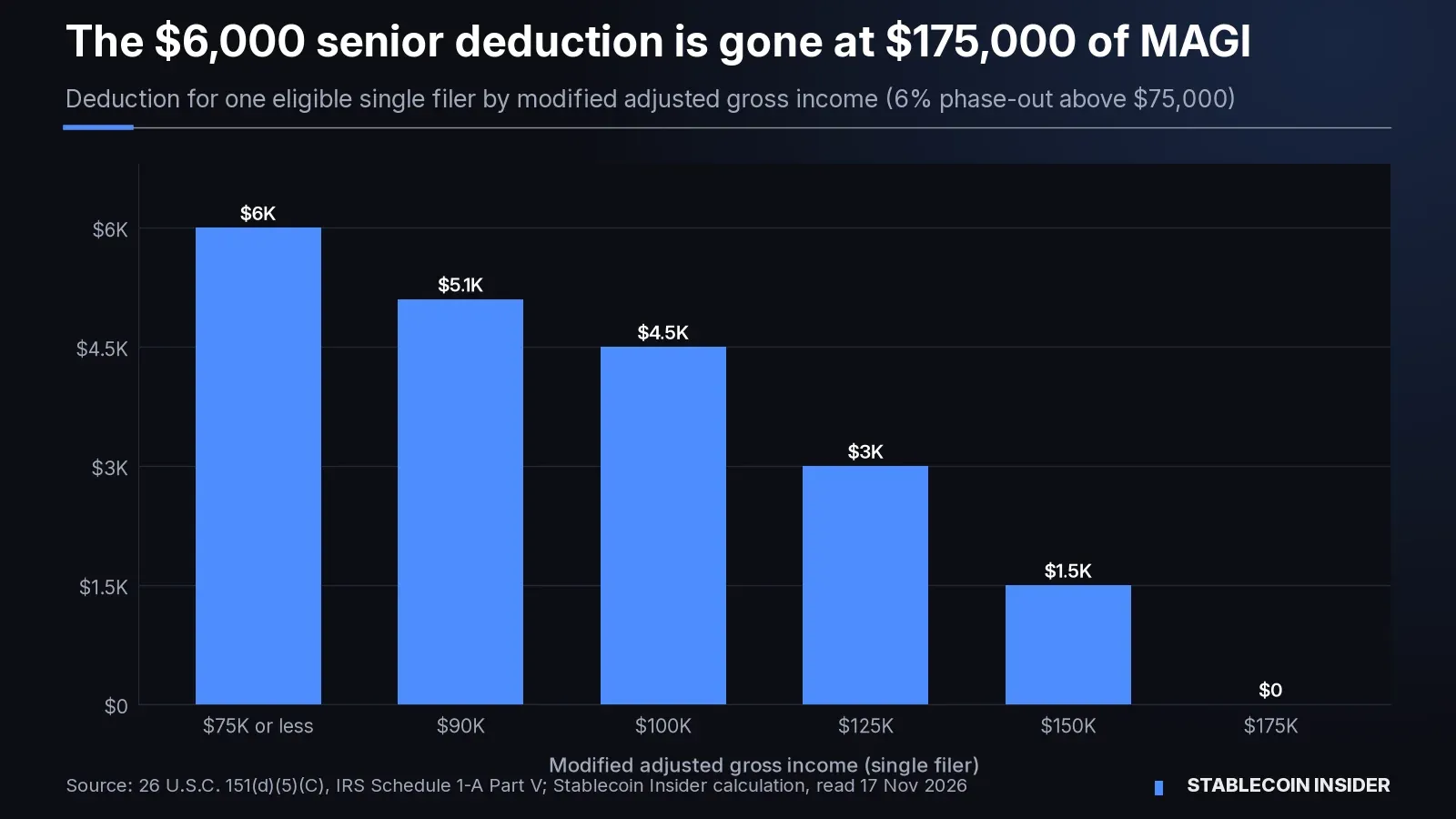
The table provided applies the same calculations for the primary filing scenarios. Each entry is derived from the statute referenced earlier.
| MAGI | Single, 65+ | Joint, one spouse 65+ | Joint, both 65+ |
|---|---|---|---|
| $75,000 | $6,000 | $6,000 | $12,000 |
| $100,000 | $4,500 | $6,000 | $12,000 |
| $150,000 | $1,500 | $6,000 | $12,000 |
| $175,000 | $0 | $4,500 | $9,000 |
| $200,000 | $0 | $3,000 | $6,000 |
| $250,000 | $0 | $0 | $0 |
The 6% rate illustrates the deduction's phase-out. A single filer exhausts the entire deduction within a $100,000 income bracket, while a couple who both qualify can retain some benefit until their income is $100,000 over the joint threshold.
How much does the senior deduction save in 2026?
The senior deduction provides savings approximately equivalent to the deduction amount multiplied by the taxpayer's highest tax rate. In the examples discussed for 2026, the savings amount to $1,122 and $2,376 respectively. These calculations utilize the IRS's figures for 2026: a standard deduction of $16,100 for singles or $32,200 for joint filers ( IR-2025-103 ), along with an additional age-65 standard deduction of $2,050 for singles or $1,650 for each married person ( Rev. Proc. 2025-32 ).
| Line (tax year 2026) | Single, age 67 | Joint, both 66 |
|---|---|---|
| MAGI (assumed equal to AGI) | $90,000 | $160,000 |
| Standard deduction | $16,100 | $32,200 |
| Age-65 standard add-on | $2,050 | $3,300 (2 × $1,650) |
| Senior deduction after phase-out | $5,100 ($6,000 − 6% × $15,000) | $10,800 (2 × $5,400) |
| Taxable income | $66,750 | $113,700 |
| Top bracket either way | 22% (single, over $50,400) | 22% (joint, over $100,800) |
| Tax saved by the senior deduction | $1,122 | $2,376 |
Both households remain within the 22% tax bracket regardless of the deduction's impact, resulting in savings equal to 22% of the deduction amount. If the deduction pushes part of the income into a lower tax bracket, the savings would be less than the straightforward calculation. These examples do not account for credits, state taxes, or the rules governing the taxation of Social Security benefits. They merely demonstrate the mechanics of the deduction, not the actual tax liability. For 2027, the IRS has increased the standard deduction to $16,600 for singles and $33,200 for joint returns ( IR-2026-133 ), with the age-65 add-on increasing to $2,100 for unmarried individuals or $1,700 for those married ( Rev. Proc. 2026-35 ). The senior deduction itself remains fixed at $6,000.
How do you claim the senior deduction on your return?
To claim the senior deduction, you will need to fill out Schedule 1-A, Part V. The total from this schedule is then transferred to Form 1040 or 1040-SR, line 13b ( IRS Publication 6142 ). The steps for the 2025 form are as follows:
- Record your MAGI on line 31 and $75,000 (or $150,000 if filing jointly) on line 32.
- Subtract line 32 from line 31 on line 33. If the result is zero or less, enter $6,000 on line 35.
- Calculate 6% of line 33 on line 34, then subtract this from $6,000 for line 35.
- Input line 35 on line 36a if you satisfy the birth-date and SSN criteria, and repeat for 36b for a qualifying spouse on a joint return.
- Add both amounts on line 37 and carry the total through to line 38 on Form 1040, which is line 13b.
The process is similar on the draft 2026 form; however, the line numbers have shifted to 37-43 ( IRS draft, not for filing ). Ensure you use the finalized form upon its release by the IRS.
Could Congress extend the senior deduction past 2028?
While Congress has the potential to extend the senior deduction beyond 2028, current legislation specifies that it will conclude then. A bill aimed at making the deduction permanent has been introduced. H.R. 7550, known as the Permanent Tax Relief for Seniors Act, was submitted on February 12, 2026, by Rep. Mariannette Miller-Meeks, alongside Reps. Anna Paulina Luna and Gus Bilirakis. This bill has been referred to the Ways and Means Committee ( GovInfo ). The proposed text is the only version available at this time. Until legislation is enacted, 2028 should be regarded as the final year for this deduction. CNBC also reported that several Republican candidates indicated during the midterm campaign that they would support extending the deduction. Furthermore, Jessica Riedl from the Urban-Brookings Tax Policy Center expressed her belief that it is unlikely either political party would allow senior tax cuts to lapse during the 2028 presidential election year. However, this remains speculative and not a definitive change in law.
The senior deduction does impact the revenue into Social Security's trust funds, as noted by the program's trustees. Their 2026 report states that the law "adds a temporary additional standard deduction for taxpayers over age 65". Consequently, this results in lower revenue levels for the funds in the future from the income taxation of Social Security benefits ( 2026 Trustees message ).
The same report forecasts that the Old-Age and Survivors Insurance (OASI) trust fund can sustain full benefits until the fourth quarter of 2032, which is one quarter ahead of previous projections. After that point, income is expected to cover only 78% of scheduled benefits ( Trustees ). The trustees identified this law as one of three primary factors contributing to a decline in the program's long-term financial health, alongside assumptions regarding fertility rates and immigration. However, they do not attribute the decline solely to the senior deduction.
The 2025 law also instituted a 1% tax on cash remittances. For information regarding the U.S. remittance tax, refer to our guide. If you possess cryptocurrency, taxable gains will contribute to the AGI that determines the deduction phase-out. For guidance on how the IRS manages taxation on stablecoins, see our U.S. stablecoin tax guide, and our comparison of crypto tax software will help track your cost basis.
Are you reviewing tax modifications for 2026? Check out five IRS changes impacting stablecoin holders in 2026.