
UK personal banking customers looking for alternatives to TSB have several noteworthy options to consider. Nationwide FlexDirect is particularly appealing for those who value physical branches, as it operates under a unique deposit license. In contrast, first direct's 1st Account is well-known for offering an attractive switching bonus and eliminating fees for international card transactions. Club Lloyds is a good fit for individuals who can maintain a monthly deposit of £2,000, allowing them to enjoy a traditional high-street banking experience without incurring charges for overseas debit card transactions. For those who prefer mobile banking, both Starling and Monzo provide excellent choices, while Chase UK is attractive for customers interested in earning cashback on their everyday spending. This information regarding fees and promotional offers was last reviewed on 17 November 2026.
The interest in exploring alternative banking options has notably increased after TSB announced its merger with Santander UK. On 10 November 2026, TSB revealed that a High Court hearing concerning the merger is scheduled for 15 February 2027, with the transfer expected to occur on 22 March 2027, pending judicial approval. Currently, no immediate changes are being enacted; however, once the merger is finalized, deposits at both TSB and Santander will be subject to a unified FSCS protection limit.
Last updated: 17 November 2026. Information regarding fees, switching bonuses, and eligibility criteria was verified against each bank's official websites on this date.
Key Takeaways
- TSB has confirmed that account numbers, cards, PINs, and payment methods will remain unchanged, with the exception of euro Direct Debits.
- If the court approves the merger on 22 March 2027, eligible deposits at TSB, Santander UK, and cahoot will be consolidated, offering protection up to a total of £120,000.
- TSB's standard Spend & Save account includes a 2.99% fee on foreign currency card transactions and a £1 charge per transaction outside of euros in the EEA.
- Incentives for switching accounts include £210 from first direct, £200 from Club Lloyds, and £175 from Nationwide.
- TSB advises that objections to the merger should be submitted before 5 February 2027, as they cannot be filed after the hearing on 15 February.
Reasons for Exploring TSB Alternatives
Customers are actively seeking alternatives due to TSB's upcoming merger with Santander UK, which was finalized on 30 April 2026. On 30 October 2026, both banks submitted a request to the High Court for a Part VII banking business transfer. The Global Banker reported the acquisition cost at £2.65 billion, indicating that TSB serves approximately 5 million customers and operates 175 branches.
TSB has outlined four significant changes anticipated to take place following the merger on 22 March 2027: unified FSCS protection, management of TSB ISAs by Santander UK, transfer of data responsibility to Santander UK, and new contractual rights for Santander UK regarding account terms. After the merger, TSB accounts will transition to Santander UK systems in the latter half of 2027.
TSB also emphasizes the advantages for customers who choose to stay, such as no further branch closures expected before 2028 and the elimination of foreign exchange fees on TSB debit card cash withdrawals at ATMs in Spain and Portugal. While these offerings are appealing, the alternatives detailed below cater to those wishing to avoid Santander or seeking lower fees abroad or attractive switching bonuses.
Overview of TSB Alternatives
The following table compares TSB's Spend & Save account with six alternatives, focusing on monthly fees, international card charges, branch access, and switching incentives as of 17 November 2026. Each entry includes a link to the respective bank's webpage.
| Account | Monthly Fee | Card Fees Abroad | Branch Access and Switch Offer |
|---|---|---|---|
| Our Pick:Nationwide FlexDirect | None (Nationwide) | 2.99% on purchases and cash (Nationwide) | 605 branches open until at least 2030 (Nationwide); £175 switch (Nationwide) |
| Reference:TSB Spend & Save | None (TSB) | 2.99%, plus £1 per payment outside EEA euros (TSB) | No more closures before 2028 (TSB); £5 cashback for six months (TSB) |
| first direct 1st Account | None (first direct) | None from first direct (first direct) | No branches; £210 switch (first direct) |
| Club Lloyds | £5, refunded if you pay in £2,000+ (Lloyds) | None from Lloyds (Lloyds) | £200 switch, offer ends 8 Jan 2027 (Lloyds) |
| Starling | None (Starling) | None from Starling; £300 daily cash limit (Starling) | App only; no switch offer listed |
| Monzo | None; paid plans from £3 (Monzo) | None on spending; cash limits apply (Monzo) | App only; no switch offer listed |
| Chase UK | None listed (Chase) | None from Chase (Chase) | App only; no switch offer listed |
Two significant trends emerge from this comparison. Nationwide is the only choice among these alternatives with a substantial branch network, even though FlexDirect imposes the same 2.99% foreign transaction fee as TSB's standard account. The remaining options do not charge for international card usage. Additionally, Club Lloyds is noteworthy for having a monthly fee, which can be waived by depositing at least £2,000 each month.
Identifying the Best TSB Alternatives for 2026
The ideal alternatives to TSB for 2026 primarily depend on whether customers utilize TSB mainly for branch access, international spending, or cashback rewards. Each option is assessed to highlight its suitability and the advantages and disadvantages compared to TSB.
1. Nationwide FlexDirect: Best for Branch Users
Nationwide FlexDirect is an excellent choice for TSB customers who prioritize access to physical branches. Nationwide reports operating 605 branches, with 154 remaining in their towns, all expected to remain operational until at least early 2030, barring unforeseen circumstances. As a building society, its FSCS limit operates independently from TSB and Santander.
FlexDirect does not charge a monthly maintenance fee. During the first year, customers making monthly deposits of £1,500 can earn 5% AER on balances up to £1,500, followed by a variable rate of 1% AER thereafter. Customers may also qualify for up to £10 in cashback each month, including £5 for £300 in Direct Debits and another £5 for £500 in card transactions. To secure the £175 switching bonus, a complete switch must be finalized within 28 days, including at least two Direct Debits, a minimum deposit of £1,000, and one card payment within 31 days.
Compared to TSB, FlexDirect has some drawbacks: it applies a 2.99% fee on foreign currency purchases and cash withdrawals. Additionally, the switching bonus is not available for customers moving from a Nationwide or Virgin Money account.
- Pros: Extensive branch network committed to remaining open until 2030; separate FSCS limit from TSB and Santander; introductory interest and cashback opportunities; £175 switching bonus.
- Cons: 2.99% fee for international transactions; introductory rate applies only to the first £1,500 for 12 months.
2. first direct 1st Account: Highest Switching Bonus, No Fees Abroad
first direct's 1st Account caters to individuals who rarely need branch access and seek the most significant switching incentive. This account offers £210 (£175 plus a £35 bonus for accounts opened between 14 September and 2 December 2026) if customers switch within 45 days and meet requirements including at least two Direct Debits, depositing £1,000, making a minimum of five card transactions, and logging into digital banking.
It includes no monthly fees, no debit card fees abroad, a £250 interest-free overdraft (subject to status), and access to a 7% AER Regular Saver account for monthly deposits ranging from £25 to £300. This offer is available only for new customers and excludes those who opened an HSBC current account after 1 January 2018.
Disadvantages compared to TSB: first direct does not provide branch access, and customers' FSCS limit is shared with HSBC UK, HSBC Private Bank, and M&S Bank. Switching from TSB to first direct enhances FSCS protection only if no other accounts with those brands are held.
- Pros: Largest switching incentive available; no debit card fees for international transactions; interest-free £250 overdraft.
- Cons: No branches; shared FSCS limit with HSBC brands; offer not applicable to recent HSBC customers.
3. Club Lloyds: High-Street Banking with No Foreign Fees
Club Lloyds is tailored for TSB customers who wish to remain with a high-street bank while traveling frequently. This account does not impose any debit card fees for international use and offers up to 3.00% AER on balances up to £5,000 when two different Direct Debits are paid each month. Customers can also choose one lifestyle perk annually, such as a Disney+ subscription or cinema tickets.
The £200 switching bonus requires customers to switch accounts through the Current Account Switch Service, needing at least three active Direct Debits, and the offer expires on 8 January 2027. Additionally, Lloyds has indicated that the Halifax brand is transitioning to the Lloyds name.
In contrast to TSB, Club Lloyds has a £5 monthly fee unless £2,000 or more is deposited each month, while TSB's Spend & Save account does not impose any such fee.
- Pros: No debit card fees abroad; £200 switching incentive; interest earned on balances up to £5,000; annual perks available.
- Cons: Monthly fee of £5 if less than £2,000 is deposited; offer ends on 8 January 2027; perks and interest rates are conditional.
4. Starling: Mobile Banking with Round-the-Clock Support and Cash Deposits
Starling is ideal for customers who favor mobile banking and desire support available at all hours. There are no monthly fees, no charges for spending or withdrawing cash abroad, and the bank provides 24/7 UK-based customer support. Cash withdrawals abroad from Starling are fee-free up to £300 daily in local currency.
Disadvantages compared to TSB: Starling does not operate physical branches. Customers can deposit cash at the Post Office, free for the first £1,000 each calendar year, after which a 0.7% fee is applied. As of 17 November 2026, there was no switching incentive listed.
- Pros: No foreign transaction fees; 24/7 UK support; no monthly fees.
- Cons: No branches; cash deposits incur a fee after £1,000 per year; no switching incentive available.
5. Monzo: Budgeting Tool with Optional Premium Plans
Monzo is well-suited for individuals seeking budgeting features and who do not require branch access. The personal current account is free, with premium plans starting at £3 monthly, and Monzo imposes no foreign transaction fees on card purchases. If Monzo is the primary account, cash withdrawals are fee-free within the EEA and up to £200 every 30 days outside of it, after which a 3% fee applies.
Disadvantages compared to TSB: Monzo lacks branches, and cash deposits at PayPoint or the Post Office incur a £1 fee per deposit. There was no switching incentive mentioned as of 17 November 2026.
- Pros: Free account; no foreign transaction fees for spending; 24/7 in-app support.
- Cons: £1 fee for cash deposits; cash withdrawals outside the EEA capped at £200 every 30 days before incurring a 3% fee; no switching incentive available.
6. Chase UK: Cashback on Everyday Purchases
Chase UK, managed by J.P. Morgan Europe Limited, is designed for users who prefer app-based banking and wish to earn cashback. It provides 2% cashback, up to £20 monthly, on various everyday expenses including groceries, dining, transportation, fuel, and EV charging, requiring both a Chase current account and a saver account.
Disadvantages compared to TSB: Chase does not have physical branches, purchases outside of the UK and the Channel Islands do not earn cashback, and cash withdrawals are limited to £500 per day and £1,500 per calendar month abroad.
- Pros: 2% cashback up to £20 per month; no fees for international transactions; FSCS coverage up to £120,000.
- Cons: App-only; no cashback on international spending; no switching incentive noted.
Cost of International Card Spending for a Year at TSB and Alternatives
The annual cost of using a card abroad with TSB's Spend & Save account totals £39.90 in fees, contrasted with £0 at five of the six alternatives. This calculation is based on £1,000 spent in US dollars across ten transactions of £100 each, with the bank managing the currency conversion. TSB's fees comprise a 2.99% charge (£29.90) alongside a £1 fee for each of the ten transactions.
| Account | Card Fee (2.99% or None) | Per-Payment Fees | Total Bank Fees |
|---|---|---|---|
| TSB Spend & Save | £29.90 (TSB) | £10.00 (10 × £1) | £39.90 |
| TSB Spend & Save Plus | £0, but £3 monthly fee (TSB) | £0 | £0 card fees + £36 a year |
| Nationwide FlexDirect | £29.90 (Nationwide) | None listed | £29.90 |
| first direct, Club Lloyds, Starling, Monzo, Chase UK | £0 (first direct;Lloyds;Starling;Monzo;Chase) | £0 | £0 |
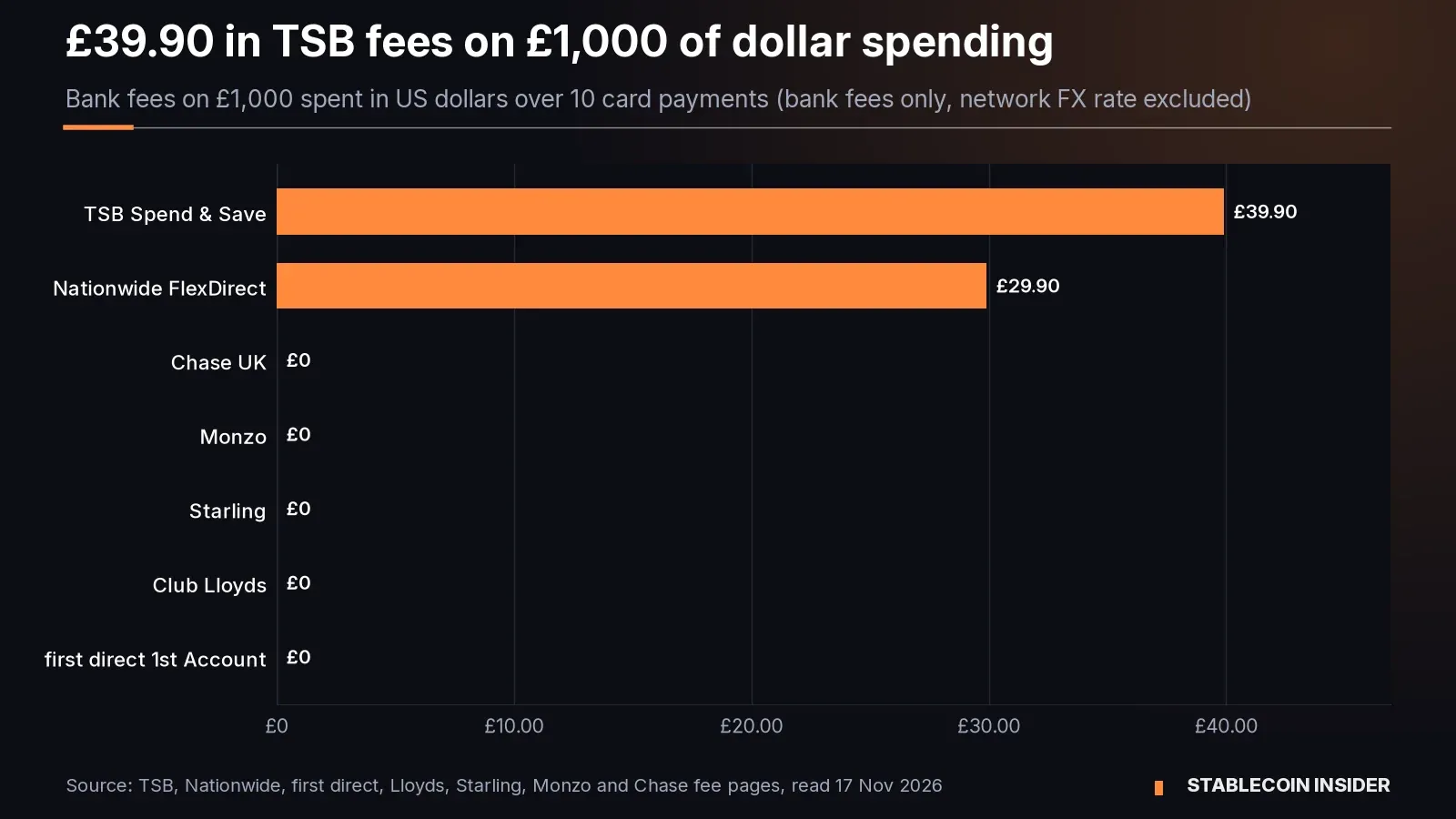
The estimates do not consider any ATM operator fees and variations in exchange rates utilized by Visa and Mastercard. When spending in euros within the EEA, TSB waives the £1 purchase fee, reducing its total cost to £29.90. Additionally, Club Lloyds' £0 in fees is contingent upon a monthly deposit of £2,000; otherwise, its £5 monthly fee leads to an annual cost of £60.
Changes to FSCS Protection with TSB's Transition to Santander
Your FSCS protection will be affected by TSB's transition to Santander if you hold accounts with both banks. Currently, TSB and Santander UK operate as separate entities, each covered up to £120,000. After the merger on 22 March 2027, pending court approval, all eligible deposits at TSB, Santander UK, cahoot, Santander Business, and Santander Corporate & Commercial will share a unified limit of £120,000.
For example, if you have £90,000 in TSB savings and £60,000 in a Santander account, your total of £150,000 is fully protected today because each bank has its own £120,000 limit. However, post-merger, only £120,000 of your combined £150,000 will be safeguarded, leaving £30,000 exceeding the limit.
The PRA rule 19.1 states that a bank must notify depositors at least one month before a merger or transfer takes legal effect. If your coverage is reduced, you will have three months from the notification to withdraw or relocate the excess funds, along with interest, without incurring penalties. The Bank of England has confirmed that this right applies when two separately licensed banks merge.
Transferring excess funds is only advantageous if the new bank does not share a license with another institution you currently use. For instance, first direct shares its FSCS limit with HSBC UK, HSBC Private Bank, and M&S Bank. Temporary high balances, such as those arising from a property sale, can be protected up to £1.4 million for six months. To verify your combined coverage, you can utilize the FSCS protection checker.
Steps to Switch from TSB Without Missing Payments
To switch from TSB without disrupting your payments, utilize the Current Account Switch Service offered by your new bank. This service facilitates the transfer of your balance, Direct Debits, standing orders, and saved payees while closing your old account on a weekday of your choosing, scheduled at least seven working days in advance.
- Open your new account and ensure any necessary overdrafts are approved before initiating the switch, as overdrafts require approval.
- Request a full switch and select your switch date. Avoid setting up new payments on your TSB account during the final seven working days, as these will not be transferred.
- Adhere to the conditions of the switch offers promptly: 31 days for Nationwide's £175, 45 days for first direct's £210, and before 8 January 2027 for Club Lloyds.
- Manage savings and ISAs separately, as the Current Account Switch Service only applies to current accounts. If you prefer to keep your TSB ISA out of Santander UK’s management, TSB offers options for transferring it.
- Check euro Direct Debits, as TSB has indicated that these payments will not remain unchanged.
If you wish to retain your TSB account, TSB states that a partial switch will take longer than seven working days, and the aforementioned switching bonuses require a complete switch.
Should You Remain with TSB Instead?
Staying with TSB may be the most practical choice if its branches, account features, and the Santander merger timeline align with your needs, especially if your total balances at TSB and Santander are under £120,000. TSB assures that your banking experience will remain consistent until the transfer, and you will receive adequate notice for any subsequent changes.
If foreign transaction charges are your primary concern, TSB's own Spend & Save Plus account imposes a £3 monthly fee, has no foreign fees, and offers £5 cashback monthly when conditions are met. You can switch between Spend & Save and Spend & Save Plus without needing to open a new account.
If you wish to raise objections to the merger, TSB encourages you to submit your objection via online form, phone, post, in a branch, or at the hearing, preferably before 5 February 2027.
Our Assessment of TSB Alternatives
Nationwide FlexDirect comes highly recommended for most TSB customers who prioritize branch access. It boasts the most extensive branch network in this comparison, a commitment to keeping branches operational until 2030, a separate deposit license from TSB and Santander, and a £175 switching bonus. Its downside is that it charges the same 2.99% fee for international transactions that TSB does.
For frequent travelers who do not require branch access, first direct offers the largest switching bonus and eliminates international card fees. Club Lloyds is ideal for those who prefer a high-street name with no fees abroad and can deposit £2,000 monthly. Starling, Monzo, and Chase UK cater to users who favor mobile banking.
For those evaluating UK bank accounts amid another acquisition, consider our guide on Metro Bank alternatives. If you plan to transfer money overseas from your new account, check the fees and limits of Wise and Revolut, explore alternatives to Western Union, or review how stablecoin foreign exchange rates compare to bank rates.