The Department for Work and Pensions (DWP) has the authority to instruct banks to conduct checks on accounts associated with Universal Credit, Pension Credit, and New Style Employment and Support Allowance. Announced on October 26, 2026, the DWP issued its inaugural Eligibility Verification Notice, which mandates banks to verify compliance with DWP regulations regarding savings and time spent abroad.
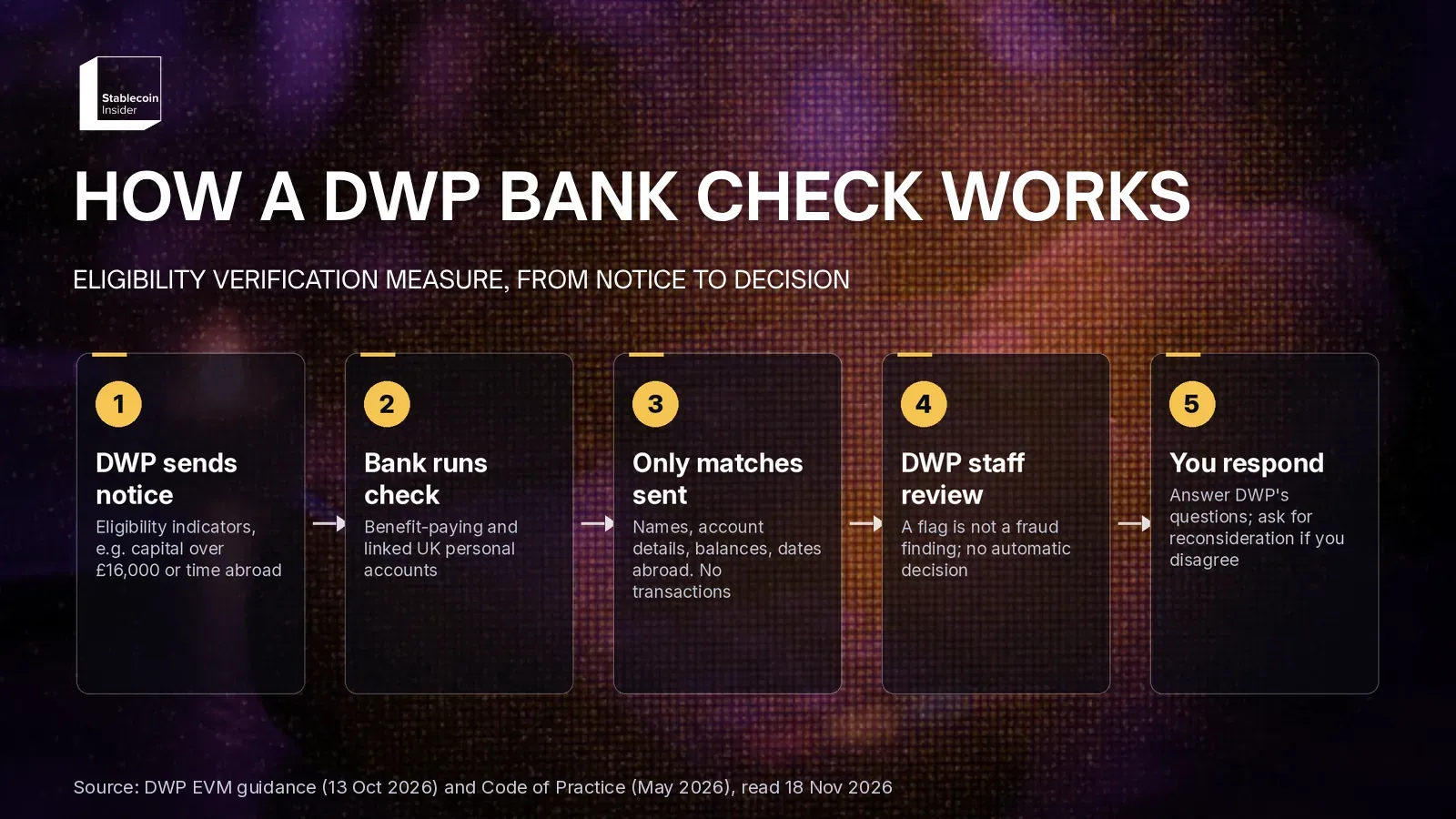
However, the information that banks can provide is restricted to specific details: the names of account holders, account numbers, sort codes, current account balances, and dates of any transactions abroad. Banks cannot disclose transaction statements, spending patterns, or any real-time access to accounts, as emphasized in the DWP's guidance. Currently, these checks are being piloted with a limited number of financial institutions.
Last updated on November 18, 2026, the regulations were reviewed in accordance with the Code of Practice and relevant legislation, applicable across England, Scotland, and Wales; Northern Ireland operates its own distinct benefits system.
Key Takeaways
- The checks are known as the Eligibility Verification Measure (EVM), established by the Public Authorities (Fraud, Error and Recovery) Act 2025, integrated into the Social Security Administration Act 1992.
- Only three types of benefits are included: Universal Credit, Pension Credit, and Employment and Support Allowance. Any additions require parliamentary approval.
- A threshold of total capital exceeding £16,000 serves as a key indicator, with the DWP having the option to lower this limit to monitor claimants with savings between £6,000 and £16,000.
- Importantly, a flag raised during these checks does not imply fraud or misconduct, and no benefit determinations can be based solely on EVM data.
- For instance, undeclared savings of £10,000 under Universal Credit could result in an overpayment of £69.60 monthly, totaling £835.20 over a year, reflecting the tapering system.
- The DWP anticipates that the EVM will save approximately £1.2 billion by the fiscal year 2030/31, aiming for extensive coverage of eligible benefit claims.
Understanding the UK Benefit Fraud Account Checks
The UK benefit fraud account checks are eligibility assessments that banks can perform at the request of the DWP under the EVM framework. When the DWP sends an Eligibility Verification Notice (EVN) to a bank, it specifies various 'eligibility indicators' that the bank must use to identify relevant accounts.
The authority for these checks is derived from Schedule 3B of the Social Security Administration Act 1992, amended by the 2025 Act, which became effective on February 2, 2026. The statutory Code of Practice was presented to Parliament in May 2026. On October 26, 2026, Minister Lilian Greenwood confirmed the issuance of the first notice during a session in the Commons.
The DWP cites two main reasons for implementing this measure: the significant financial losses due to undeclared savings and the time spent abroad by recipients of Universal Credit and Pension Credit, which are estimated to cost the government £1.5 billion in the 2025-26 period. Unlike the PAYE earnings data already accessible to the DWP from HMRC, information regarding savings and time spent abroad is not readily available.
Benefits and Accounts Subject to Checks
The benefits subject to these checks include Universal Credit, Pension Credit, and New Style Employment and Support Allowance. The types of accounts that can be scrutinized are UK personal current, savings, and investment accounts, including those related to e-money. This legal provision encompasses accounts associated with electronic money and authorized firms, permitting the inclusion of app-based accounts along with traditional bank accounts.
Furthermore, any additional accounts at the same banking institution are also considered. A 'linked' account refers to any account owned by the individual who holds the benefit-receiving account, and multiple accounts can collectively meet the eligibility indicators.
| Account or data | In scope? | Source |
|---|---|---|
| Current account where benefit is deposited | Yes | Code 3.23 |
| Other savings, current, or investment accounts with the same provider | Yes, as linked accounts | Sch 3B para 1(8) |
| Joint account where benefit is deposited | Yes, including other accounts held by both account holders | Code 3.34 |
| E-money accounts | Yes, if the provider is authorized to issue e-money | Sch 3B paras 2, 20 |
| Credit cards, current account mortgages | No | Code 3.24 |
| Business, charity, and non-UK accounts | No | Code 3.24–3.25 |
| Cryptoasset accounts | Not currently; regulations could include them in the future | Sch 3B para 2(3) |
It's important to note that if benefits are deposited into a joint account, the bank is unable to determine which account holder is the claimant. Consequently, information on all accounts that both holders possess may be shared. Additionally, data related to appointees can be reported, but the DWP has stated that it will not utilize this information and will destroy it afterward.
Information Accessible to the DWP
The DWP is limited to a concise set of account details that meet the eligibility indicators. The department does not have access to account statements or transaction histories. The relevant guidance and legislation delineate these boundaries.
| Banks may share (matched accounts only) | Banks cannot share |
|---|---|
| Names of all account holders | Complete statements or transaction histories |
| Account details, including linked and joint accounts | How funds are spent |
| Account numbers and sort codes | Specific transaction locations |
| Account balances in relevant accounts | Special category data, such as religious beliefs or political opinions |
| Dates of transactions conducted abroad | Information on accounts that do not match an indicator |
The time frame for data collection is restricted; data older than one year cannot be requested, although banks may inquire about when an account first began to meet eligibility criteria. The DWP is also prohibited from providing personal information about individuals to banks, necessitating that banks screen all relevant accounts instead of targeting specific ones.
Furthermore, banks face penalties for non-compliance, which can include a fixed penalty of up to £1,000, a daily penalty of up to £40 for continued failures, and additional penalties for sharing prohibited information.
Criteria for Triggering a Flag
A flag is raised when an account, individually or in conjunction with linked accounts, satisfies an eligibility indicator specified in the notice. The DWP has yet to make the live indicators public. The Code outlines two examples: capital exceeding £16,000 for Universal Credit and indications that the account holder may have spent more time abroad than permitted by benefit eligibility criteria. During the testing phase, the DWP refrained from disclosing the first bank involved or specific operational details.
The eligibility indicators are assessed against the underlying benefit rules.
| Benefit | Savings rule | Time abroad rule |
|---|---|---|
| Universal Credit | Payments are reduced above £6,000; ineligible above £16,000 () | Temporary absence of up to 1 month, extended for bereavement or medical treatment (UC Regs 2013, reg 11) |
| Pension Credit | No impact up to £10,000; each £500 above counts as £1 per week of income () | Absences of up to 4 weeks, extended for specific situations () |
| New Style ESA | Based on National Insurance contributions; no savings limit specified () | Time-abroad indicators can apply to any relevant benefit (Code 3.6) |
Consequences of Undeclared Savings
Undeclared savings while on Universal Credit can incur a charge of £4.35 per month for every £250 held between £6,000 and £16,000, plus an additional £4.35 for any fraction of £250. If these savings remain unreported, they lead to an overpayment, which may necessitate repayment.
Applying this rule to several savings amounts yields the following:
| Total savings | Monthly UC reduction | 12 months unreported |
|---|---|---|
| £5,000 | £0 (below £6,000) | £0 |
| £10,000 | 16 × £4.35 = £69.60 | £835.20 |
| £12,100 | 25 × £4.35 = £108.75 (including 24 full £250 bands and a partial band) | £1,305.00 |
| £16,000 | 40 × £4.35 = £174.00 | £2,088.00 |
| Over £16,000 | Ineligible for UC | Potentially the entire award |
Pension Credit operates on different principles. Savings up to £10,000 are disregarded; above that, each £500 is counted as £1 per week of income. For instance, £11,000 translates to £2 weekly, while £15,000 accounts for £10 weekly, totaling £520 across 52 weeks. There is no defined upper savings limit on this matter; thus, savings reduce Pension Credit rather than eliminate it entirely.
It is crucial to note that these figures presume a single claimant whose award is sufficient to absorb reductions, excluding any other income. In joint claims, the savings of both partners are aggregated.
Implications of a Flagged Account
If an account is flagged, the DWP will review the associated claim, but this does not halt benefit payments automatically. The review may determine eligibility, ineligibility, or incorrect payment amounts. The DWP will reach out through the Universal Credit journal or via phone, letter, or text for those without an online account, urging prompt responses to prevent delays or interruptions in benefit payments.
- Respond promptly to inquiries and provide requested documentation, such as bank statements or evidence of travel dates.
- If you disagree with the outcome, you may request a mandatory reconsideration.
- In cases where the DWP suspects deliberate fraud, a separate process is initiated, which could involve an interview under caution, potential repayment, financial penalties from £350 to £5,000, or even prosecution.
- You have the right to request information the DWP holds about you, and an independent reviewer submits an annual report to Parliament on the use of this power.
Clarification on DWP Bank Checks
The DWP bank checks remain in effect; however, an alternative plan was abandoned. On November 8, 2026, reports indicated that Chancellor John Healey had rescinded a previous proposal that would have allowed verification of Universal Credit applicants' savings through Open Banking prior to claims being approved. A DWP spokesperson noted that this plan depended on claimant consent, whereas the current EVM system mandates banks to report matching accounts.
The key difference lies in timing. Open Banking would have conducted checks at the claim submission stage with the claimant's consent, while EVM assesses accounts already receiving benefits without requiring such consent.
Avoiding Overpayments
To prevent overpayments, it is essential to report any changes as they occur, ideally before a bank check identifies them. The DWP outlines various changes that must be communicated, including alterations in money, savings, investments, one-off payments like gifts or refunds, and any travel outside England, Scotland, or Wales.
- Aggregate all balances held by you and any partner under a joint claim, incorporating savings, investment accounts, and e-money applications.
- Compare the totaled amount against the thresholds of £6,000 and £16,000 for Universal Credit or £10,000 for Pension Credit.
- Prior to traveling, inform the DWP and verify the allowable absence durations (1 month for UC or 4 weeks for Pension Credit).
- Report any one-off payments, such as inheritances or compensations, upon receipt.
For those reviewing their financial arrangements, guides are available that compare UK current accounts, including alternatives to Metro Bank and TSB, as well as insights into the best pension providers in the UK for Pension Credit claimants contemplating a Self-Invested Personal Pension (SIPP).
Currently, the potential for including crypto accounts remains theoretical, as Schedule 3B allows for the addition of accounts related to cryptoassets through future regulations. For further guidance on the UK's broader framework for stablecoins, see the Bank of England's draft rules.