As of November 18, 2026, the leading gold ETFs in India include ICICI Prudential Gold ETF, which is favored by long-term investors due to its 0.49% expense ratio and status as the second-largest fund. For traders seeking liquidity, the Nippon India ETF Gold BeES is the top choice, while those prioritizing the lowest annual fees may consider Tata Gold ETF, Mirae Asset Gold ETF, or Zerodha CASE Gold ETF, all with fees ranging from 0.35% to 0.39%.
Each of the eight funds mentioned below tracks the domestic gold price and holds physical gold, making the decision primarily about cost, tracking accuracy, and trading ease. All data is derived from AMFI's expense ratio records, tracking difference disclosures, average AUM statistics, and the NSE’s ETF market page.
Last updated: November 18, 2026. The expense ratios, tracking differences, fund sizes, and trading data were verified against AMFI and NSE on this date.
Key Takeaways
- Total expense ratios (TER) for the eight gold ETFs range from 0.35% (Mirae Asset, Zerodha CASE) to 0.81% (Nippon India Gold BeES), according to AMFI's November 2026 data.
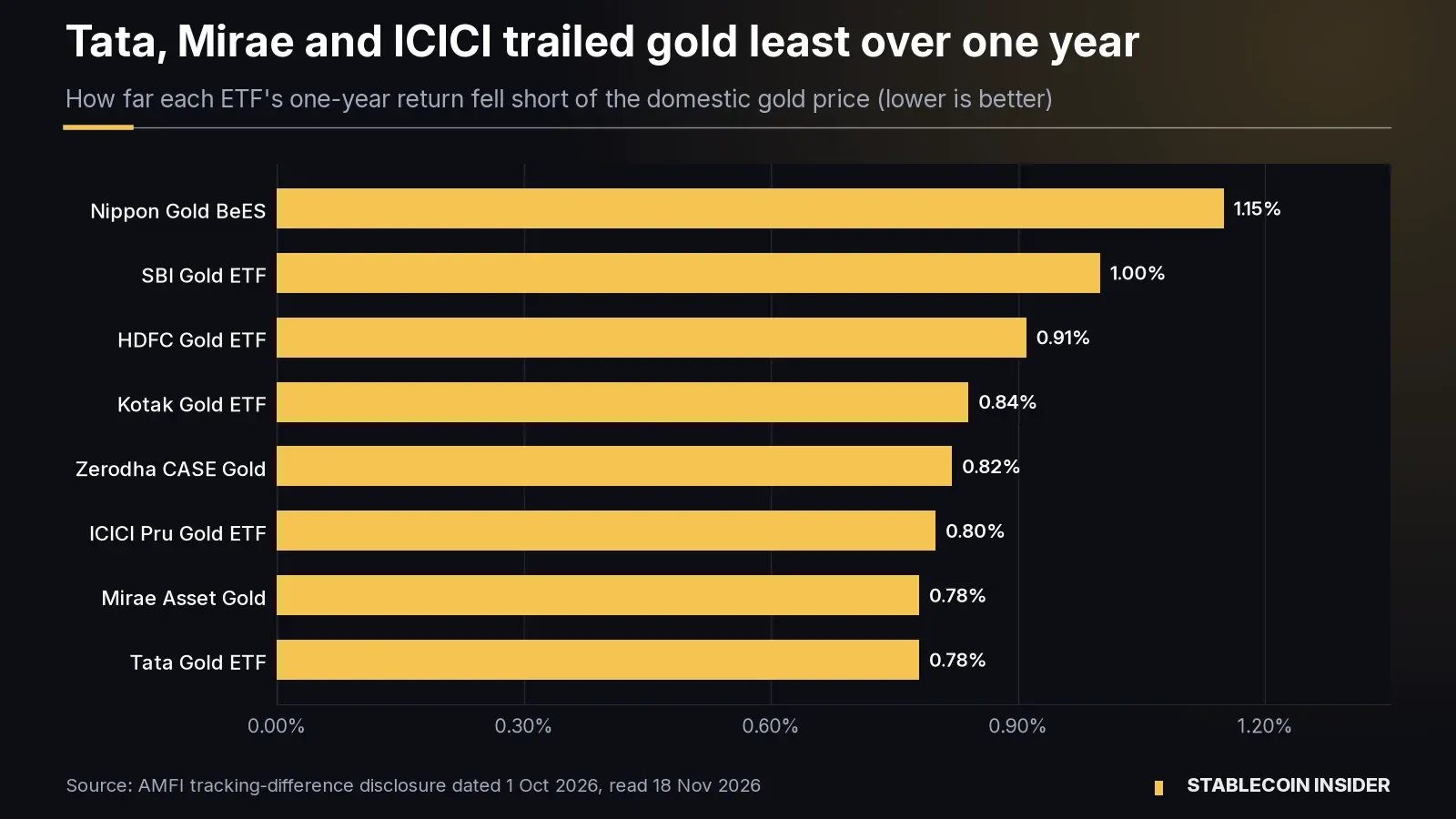
- In the year ending October 1, 2026, Tata and Mirae Asset had a tracking difference of 0.78%, while Gold BeES lagged behind by 1.15%.
- Gold BeES is the largest fund, with an average AUM of ₹56,306 crore from July to September 2026, nearly double that of ICICI Prudential's ₹27,185 crore.
- On November 18, 2026, GOLDBEES traded approximately ₹867 crore on NSE, significantly more than the next largest fund, GOLDIETF, which traded around ₹147 crore.
- For an investment of ₹1,00,000 held for a year, the TER difference between the cheapest and most expensive fund amounts to ₹460, excluding brokerage and tax.
Ranking the Best Gold ETFs in India for 2026
The optimal gold ETF in India for 2026 depends on your investment strategy—whether you plan to hold for the long term or trade frequently. The following table ranks our eight selections based on suitability, along with each fund's one-year tracking difference. Each fund's name links to the data source used, and the NSE symbol is provided for use in broker applications.
| ETF (NSE symbol) | TER | 1-year gap to gold | Best for |
|---|---|---|---|
| Our pick:ICICI Prudential Gold ETF(GOLDIETF) | 0.49% | −0.80% | Best all-rounder: low cost, large and liquid |
| Nippon India ETF Gold BeES(GOLDBEES) | 0.81% | −1.15% | Most liquid; largest fund; highest cost |
| Tata Gold ETF(TATAGOLD) | 0.39% | −0.78% | Lowest-cost large-volume option; low unit price |
| Mirae Asset Gold ETF(GOLDETF) | 0.35% | −0.78% | Joint-lowest TER; smaller fund |
| Zerodha CASE Gold ETF(GOLDCASE) | 0.35% | −0.82% | Joint-lowest TER; low unit price |
| HDFC Gold ETF(HDFCGOLD) | 0.59% | −0.91% | Large fund at a mid-range cost |
| SBI Gold ETF(SBIGOLD) | 0.65% | −1.00% | Large fund; higher cost than peers |
| Kotak Gold ETF(GOLD1) | 0.52% | −0.84% | Mid-sized, mid-cost option |
Two notable trends emerge from the data. The funds with the lowest TERs, Mirae Asset and Zerodha CASE, are relatively smaller in size, while Gold BeES, the largest fund, has the highest charges. Additionally, a lower TER does not always correlate with a smaller gap to gold; for instance, Zerodha CASE (0.35% TER) underperformed compared to ICICI Prudential (0.49%) over the year.
Annual Costs of Each Gold ETF for ₹1 Lakh Investment
When investing ₹1,00,000, the annual cost of each gold ETF ranges from ₹350 to ₹810 based on the expense ratio. The following table illustrates what last year's tracking difference would imply in rupee terms, based on these assumptions:
- ₹1,00,000 invested for one year, treating the holding value as flat (note that the TER is charged daily based on a changing value).
- TERs are based on the November 2026 figures from AMFI's records; tracking gaps utilize each fund's one-year tracking difference from the October 1, 2026 disclosure. Past performance does not guarantee future results.
- Brokerage fees, depository charges, bid-ask spreads, and taxes are not included.
| ETF | TER on ₹1 lakh | Last year's tracking gap on ₹1 lakh | Extra TER vs cheapest |
|---|---|---|---|
| Mirae Asset Gold ETF | ₹350 | ₹780 | ₹0 |
| Zerodha CASE Gold ETF | ₹350 | ₹820 | ₹0 |
| Tata Gold ETF | ₹390 | ₹780 | +₹40 |
| ICICI Prudential Gold ETF | ₹490 | ₹800 | +₹140 |
| Kotak Gold ETF | ₹520 | ₹840 | +₹170 |
| HDFC Gold ETF | ₹590 | ₹910 | +₹240 |
| SBI Gold ETF | ₹650 | ₹1,000 | +₹300 |
| Nippon India ETF Gold BeES | ₹810 | ₹1,150 | +₹460 |
The tracking gap exceeded the TER for each fund, indicating that the published fee alone does not fully reflect how much each fund lagged behind gold last year. This is why both metrics are evaluated. Over a long holding period, the ₹460 difference annually between Gold BeES and the cheaper funds accumulates, but it is minor in comparison to the gold price: for instance, Gold BeES yielded a return of 27.16% for the year ending September 30, 2026.
Top Gold ETFs by Size and Trading Activity
The largest and most actively traded gold ETFs in India are Nippon India ETF Gold BeES, ICICI Prudential, SBI, and HDFC, with Gold BeES leading significantly in daily trading volume. The trading value reflects the activity level of each fund's market, which is crucial for investors dealing with substantial amounts.
| ETF (NSE symbol) | Average AUM, Jul–Sep 2026 | NSE traded value, 18 Nov 2026 | NAV per unit, 17 Nov 2026 |
|---|---|---|---|
| Nippon India ETF Gold BeES (GOLDBEES) | ₹56,306 cr | ₹867.5 cr | ₹109.89 |
| ICICI Prudential Gold ETF (GOLDIETF) | ₹27,185 cr | ₹147.3 cr | ₹113.93 |
| SBI Gold ETF (SBIGOLD) | ₹25,899 cr | ₹139.0 cr | ₹113.39 |
| HDFC Gold ETF (HDFCGOLD) | ₹23,492 cr | ₹87.9 cr | ₹113.59 |
| Kotak Gold ETF (GOLD1) | ₹14,346 cr | ₹42.9 cr | ₹110.99 |
| Tata Gold ETF (TATAGOLD) | ₹6,006 cr | ₹130.6 cr | ₹12.94 |
| Mirae Asset Gold ETF (GOLDETF) | ₹3,371 cr | ₹34.6 cr | ₹129.43 |
| Zerodha CASE Gold ETF (GOLDCASE) | ₹2,454 cr | ₹37.7 cr | ₹20.92 |
Choosing the Right Gold ETF
Different gold ETFs cater to varying types of investors. Below are the use cases, pros, cons, and key figures for each.
1. ICICI Prudential Gold ETF (GOLDIETF): Best Overall
ICICI Prudential Gold ETF is ideal for long-term investors seeking a low fee without compromising on fund size or trading volume. It has a TER of 0.49%, a one-year tracking difference of −0.80%, and a three-year difference of −1.20%. The average AUM was ₹27,185 crore from July to September 2026, with a trading volume of approximately ₹147 crore on November 18.
Pros: second-largest gold ETF; high trading volume; reasonable cost.
Cons: slightly higher than the cheapest funds by 0.14 percentage points; three-year tracking still above 1% per year.
2. Nippon India ETF Gold BeES (GOLDBEES): Best for Active Trading
Nippon India ETF Gold BeES is tailored for active traders and large transactions. Launched on March 8, 2007, it is the largest fund, boasting an average AUM of ₹56,306 crore and trading around ₹867 crore on NSE on November 18.
Pros: most liquid option among gold ETFs; established record since 2007.
Cons: highest TER at 0.81%; widest one-year tracking difference at −1.15% and three-year at −1.54%. Long-term investors may bear costs for liquidity they might not utilize.
3. Tata Gold ETF (TATAGOLD): Affordable Option with High Volume
Tata Gold ETF appeals to budget-conscious investors seeking an active market. It has a TER of 0.39% and trailed gold by 0.78% over the past year. With a trading volume of about ₹131 crore on November 18, it ranked fourth among gold ETFs.
Pros: competitive fee; equal-best one-year tracking; low unit price.
Cons: lacks a three-year tracking figure; has a −1.53% tracking difference since inception; AUM of ₹6,006 crore is significantly lower than the top funds.
4. Mirae Asset Gold ETF (GOLDETF): Lowest Expense Ratio
Mirae Asset Gold ETF is designed for buy-and-hold investors prioritizing cost. It has the lowest TER at 0.35% and a one-year tracking difference of −0.78%.
Pros: lowest expense ratio; equal-best one-year tracking performance.
Cons: smaller fund with an average AUM of ₹3,371 crore and approximately ₹35 crore traded on November 18; NAV of around ₹129 per unit is the highest among these options.
5. Zerodha CASE Gold ETF (GOLDCASE): Low Fee and Price
Zerodha CASE Gold ETF suits small, regular investors seeking a low fee and affordable unit price. Its TER is 0.35%, with a NAV of approximately ₹20.92.
Pros: joint-lowest fee; affordable units for smaller purchases.
Cons: lagged behind gold by 0.82% over the past year and by 1.47% since launch; the smallest fund at ₹2,454 crore.
6. HDFC Gold ETF (HDFCGOLD): Established Fund with Moderate Fees
HDFC Gold ETF caters to investors looking for a large, reputable fund with a mid-range fee. Its TER is 0.59%, with a one-year tracking difference of −0.91% and a three-year difference of −1.33%.
Pros: strong average AUM of ₹23,492 crore; ten-year performance history.
Cons: costs slightly more than ICICI Prudential with poorer one-year tracking; approximately ₹88 crore traded on November 18.
7. SBI Gold ETF (SBIGOLD): Large Fund with Higher Fees
SBI Gold ETF is suitable for investors who utilize SBI's services and prefer a large fund. Its average AUM is ₹25,899 crore, and it traded about ₹139 crore on November 18.
Pros: third-largest gold ETF; active trading on NSE.
Cons: TER of 0.65% is the second-highest; tracked gold at −1.00% over the past year and −1.40% over three years.
8. Kotak Gold ETF (GOLD1): Moderate-Sized Fund with Average Costs
Kotak Gold ETF appeals to investors seeking a fund with a long history at a fee comparable to ICICI Prudential's. It has a TER of 0.52%, with a tracking difference of −0.84% over the past year and −1.01% over ten years.
Pros: tight tracking difference over ten years; average AUM of ₹14,346 crore.
Cons: traded only about ₹43 crore on November 18, significantly less than leading funds; slightly more expensive and with a wider one-year tracking difference than ICICI Prudential.
Understanding Gold ETFs in India
Gold ETFs in India operate as mutual fund schemes regulated by SEBI, with each unit representing a portion of physical gold stored in secure vaults, according to DSP Mutual Fund. These ETFs track the domestic gold price, which is influenced by global gold prices and currency fluctuations.
Investors buy and sell units through the NSE or BSE via a demat and trading account. Retail investors cannot exchange units for physical gold; exits are settled in cash, and physical deliveries are restricted to authorized participants. For those interested in systematic investment plans (SIPs) without a demat account, gold fund of funds invest in ETFs on the investor's behalf, albeit at an additional cost.
For those weighing gold against equity index funds, consider our comparison of Nifty 50 and Sensex for costs associated with different funds.
Final Recommendations: Which Gold ETF to Choose?
The ideal gold ETF for you will depend on your investment strategy. For most long-term investors, ICICI Prudential Gold ETF emerges as the top recommendation, featuring a 0.49% fee, being the second-largest fund, and showing strong daily trading activity. On the other hand, select Nippon India ETF Gold BeES if you frequently trade large amounts and prioritize liquidity over cost. If minimizing fees is your main concern, both Mirae Asset Gold ETF and Tata Gold ETF offer competitive one-year tracking at 0.35% to 0.39%, with Tata being the more actively traded option.
For those interested in gold through blockchain technology, explore gold-backed stablecoins like PAXG and XAUt, or understand why some savers in countries like Turkey and Argentina opt for USDT over gold.