
While Social Security benefits are not currently facing cuts, an automatic reduction of approximately 22% is anticipated for late 2032 if Congress takes no action. According to the 2026 Social Security Trustees Report, the retirement trust fund (OASI) is expected to deplete its reserves by the fourth quarter of 2032. After that point, ongoing program income would only cover 78% of scheduled retirement and survivor benefits.
In the short term, the outlook is positive, as benefits are set to increase by 3.6% in January 2027 due to the 2027 cost-of-living adjustment. However, the risk looms six years ahead, with the Congressional Budget Office's projections being more severe than those of the Trustees: a potential 26% cut upon insolvency in mid-2032, as summarized by the Committee for a Responsible Federal Budget (CRFB).
Last updated: 19 November 2026. Projections and benefit amounts were verified against SSA, CBO, and CRFB sources on this date, covering US Social Security (OASI and DI); figures represent projections, not legislated amounts.
Key takeaways
This section outlines the critical insights regarding the future of Social Security benefits. The Trustees indicate that the retirement fund (OASI) can maintain 100% of scheduled benefits until Q4 2032, then drop to 78%, and further decline to 62% by 2100. The disability fund (DI) is projected to provide full benefits at least until 2100, meaning the 2032 shortfall primarily affects retirement and survivor benefits unless the funds are merged.
If OASI and DI were to be combined, which would require a legislative change, reserves would last until Q3 2034, providing 83% of benefits. CBO's projections are bleaker, forecasting OASI insolvency in mid-2032 with a 26% cut, or a 23% cut for the combined funds by 2033. On the 2027 average retired-worker benefit of $2,170 a month, a 22% cut translates to a reduction of $477.40 monthly, or $5,728.80 annually in today’s dollars.
- The Trustees indicate that the retirement fund (OASI) can maintain 100% of scheduled benefits until Q4 2032, then drop to 78%, and further decline to 62% by 2100.
- The disability fund (DI) is projected to provide full benefits at least until 2100, meaning the 2032 shortfall primarily affects retirement and survivor benefits unless the funds are merged.
- If OASI and DI were to be combined, which would require a legislative change, reserves would last until Q3 2034, providing 83% of benefits.
- CBO's projections are bleaker, forecasting OASI insolvency in mid-2032 with a 26% cut, or a 23% cut for the combined funds by 2033.
- On the 2027 average retired-worker benefit of $2,170 a month, a 22% cut translates to a reduction of $477.40 monthly, or $5,728.80 annually in today’s dollars.
Automatic reductions to Social Security benefits will occur only if Congress allows the retirement trust fund to run dry, which the Trustees predict will happen in late 2032. No reductions are scheduled before that time. The Trustees emphasize that once reserves are exhausted, "full scheduled benefits in the law cannot be paid" CRFB bluntly states that Social Security "cannot legally spend more than its revenues and assets"
However, the program will not cease to exist entirely. Incoming funds, such as payroll taxes, continue to flow, which is how the 78% figure is calculated. The reduction represents the difference between the benefits promised by law and what incoming revenue can support.
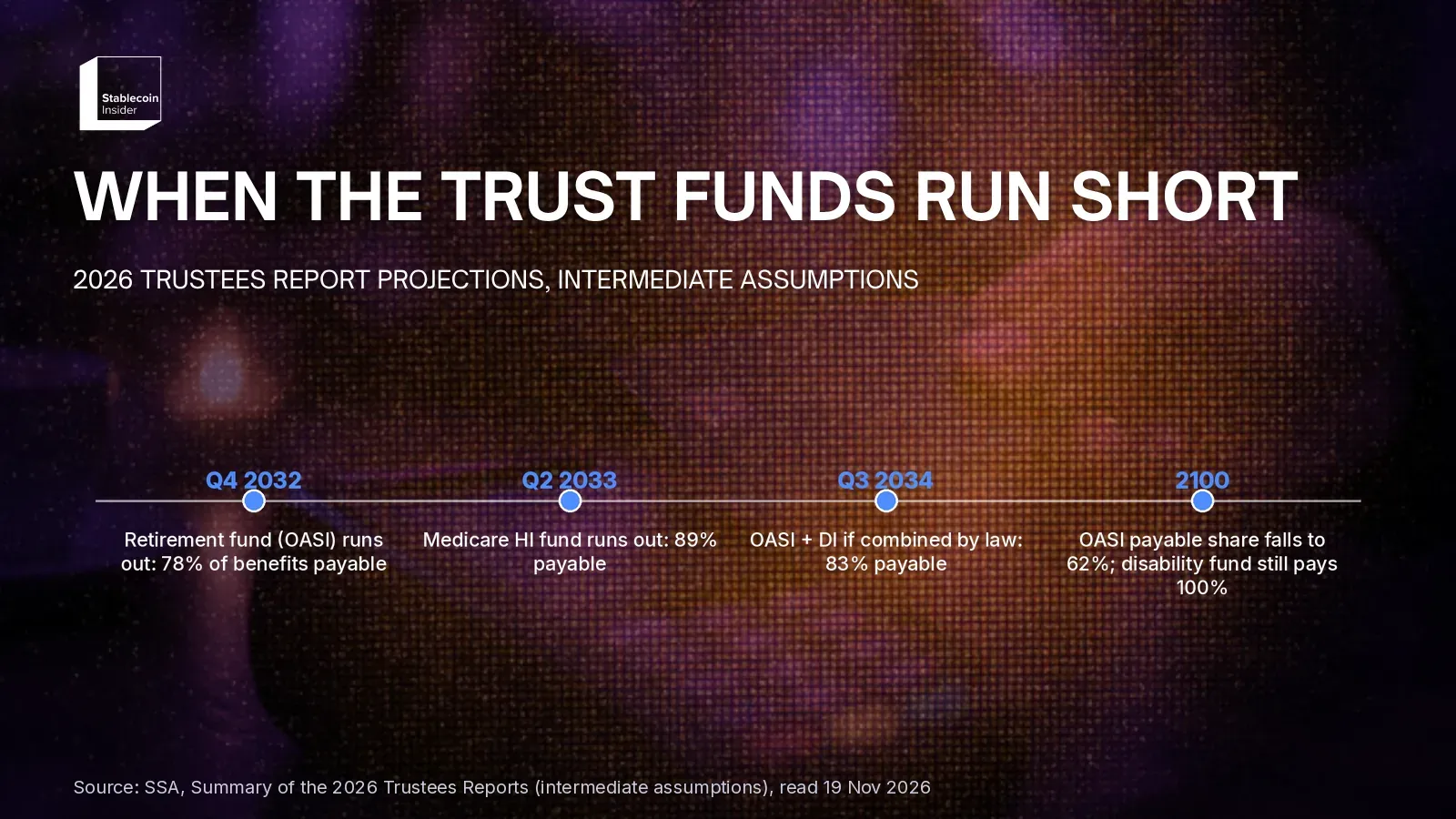
According to the Trustees' best-estimate assumptions, the Social Security retirement trust fund will deplete in the fourth quarter of 2032, one quarter earlier than indicated in the 2025 report. The specific timelines depend on which fund is referenced and the projections utilized. A table comparing these projections is provided, with each row linked to its source.
| Fund and projection | Reserves run out | Share payable then | Share payable in 2100 |
|---|---|---|---|
| OASI (retirement and survivors), Trustees (SSA) | Q4 2032 | 78% | 62% |
| OASI + DI combined, Trustees (SSA) | Q3 2034 | 83% | 65% |
| DI (disability), Trustees (SSA) | Not in the 75-year period | 100% | 100% |
| Medicare HI, Trustees (SSA) | Q2 2033 | 89% | 93% |
| OASI, CBO (via CRFB) | Mid-2032 | 74% (26% cut) | 60% (40% cut) |
| OASI + DI combined, CBO (via CRFB) | 2033 | 77% (23% cut) | 63% (37% cut) |
Two significant points emerge. First, both the Trustees and CBO concur on the year 2032, with their differences primarily concerning the magnitude of cuts. Second, the frequently cited 2034 date applies only if lawmakers decide to merge the two Social Security funds. The Trustees clarify that the funds "could not actually be combined unless there were a change in the law"
Social Security benefits are projected to be reduced by about 22% according to the Trustees’ estimates, or 26% based on CBO projections, when the retirement fund is depleted. To illustrate the financial impact, these percentages have been applied to the SSA's estimated average benefits for January 2027, following the 3.6% COLA.
| Average monthly benefit, Jan 2027 | Trustees OASI: 22% cut | Trustees combined: 17% cut | CBO OASI: 26% cut |
|---|---|---|---|
| All retired workers ($2,170) | $1,692.60 (−$477.40) | $1,801.10 (−$368.90) | $1,605.80 (−$564.20) |
| Aged couple, both receiving benefits ($3,355) | $2,616.90 (−$738.10) | $2,784.65 (−$570.35) | $2,482.70 (−$872.30) |
| Aged widow(er) alone ($2,005) | $1,563.90 (−$441.10) | $1,664.15 (−$340.85) | $1,483.70 (−$521.30) |
| All disabled workers ($1,701) | No cut while DI stays separate | $1,411.83 (−$289.17) | No cut while DI stays separate |
These figures should be interpreted as indicative rather than definitive forecasts of individual payments. Several limitations apply. The amounts are expressed in January 2027 dollars, while the actual benefits in 2032 will likely be higher due to future COLAs. The Trustees present the share of scheduled benefits that income can cover, not a specific calculation for each individual. Disabled-worker benefits are sourced from the DI fund, which the Trustees project will remain solvent; they would only experience the 17% cut if the funds were combined.
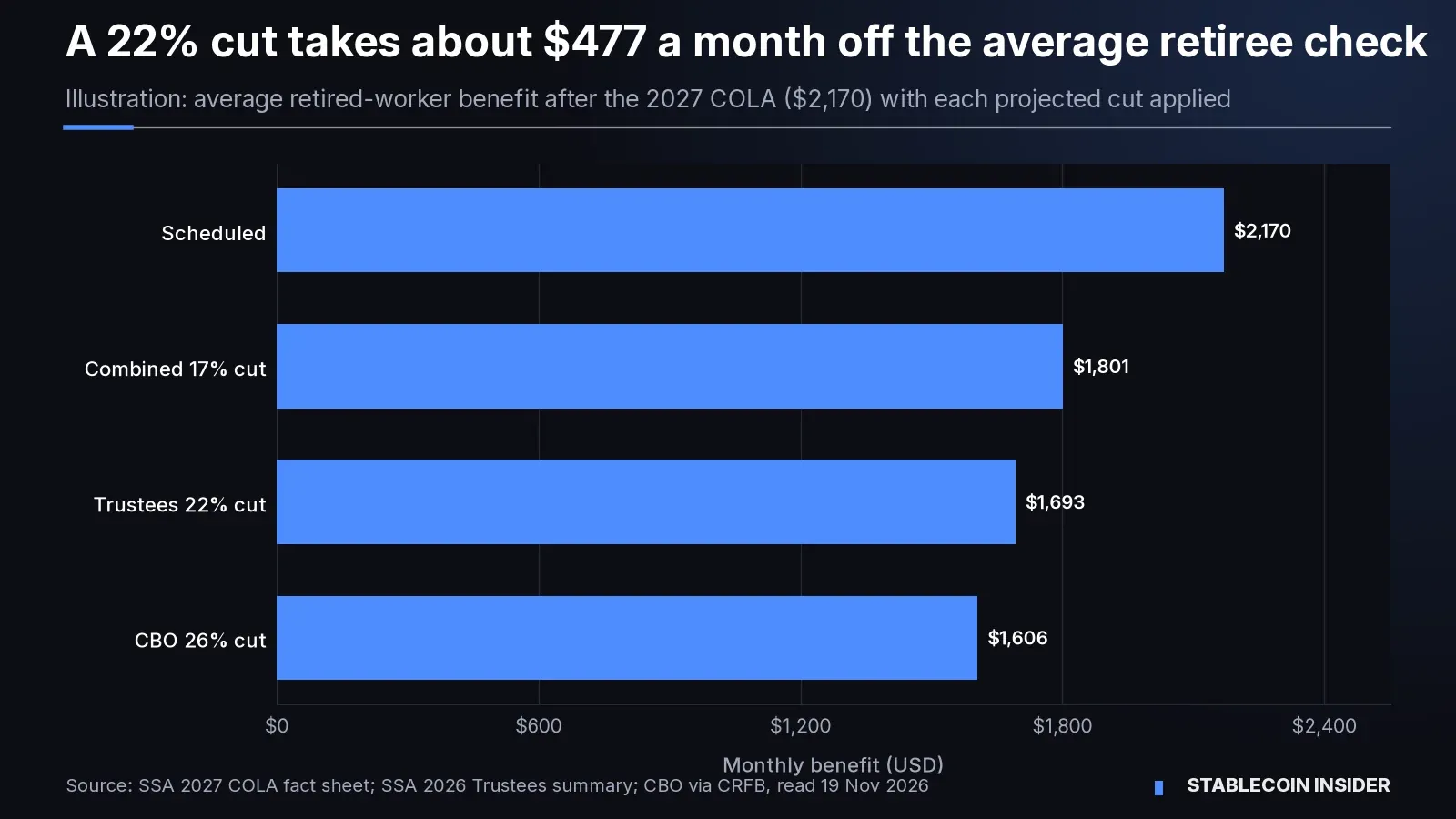
For a more complete retirement, the shortfall is even greater. CRFB estimates that a typical couple retiring in 2033 could see an annual reduction of $18,400, although this figure is based solely on CRFB's modeling and not SSA data.
The Social Security system is facing challenges due to costs rising faster than payroll-tax income as the population ages. The 2026 report showed a more troubling outlook for three main reasons, according to the Trustees:
- A lower expected long-term fertility rate of 1.75 children per woman, decreased from 1.90.
- Reduced historical and projected future net immigration, resulting in fewer workers contributing.
- The enactment of the One Big Beautiful Bill Act (OBBBA) on July 4, 2025, which altered tax rates and larger standard deductions, thereby decreasing the revenue the trust funds receive from tax on benefits.
The combined 75-year actuarial deficit is currently at 4.42% of taxable payroll. CRFB describes this as the largest shortfall in nearly fifty years, highlighting a 16% increase from the previous report, which was at 3.82%.
What could Congress do to prevent the cuts?
Congress has the ability to avert these cuts by increasing revenue, reducing scheduled benefits, or employing a combination of both strategies. The longer action is delayed, the larger the bill becomes. The Trustees assert that lawmakers "a broader range of solutions" and that taking action sooner will allow for "a broader range of solutions." CRFB has estimated the size of the gap.
| Option to close the combined gap | If enacted now | If enacted in 2034 |
|---|---|---|
| Payroll tax increase | 4.25 percentage points (34%) | 4.9 percentage points (40%) |
| Cut to all benefits | 25% | 29% |
| Cut to new beneficiaries only | 30% | Not given |
For context, the employee Social Security (OASDI) tax rate is currently set at 6.2%, applicable to earnings up to $184,500 in 2026 and $192,300 in 2027. CRFB notes that previously proposed solutions, such as removing the cap on earnings, would now only close about half of the current gap.
It is advisable for individuals to review their own records and plan for a potential lower-benefit scenario, without assuming either outcome. Some actionable steps based on the aforementioned sources include:
- Review your record and estimate by signing in to my Social Security. SSA indicates that 2027 COLA notices will be available to most beneficiaries' online Message Center by late November 2026.
- Assess your budget at 78%. If your retirement income is crucial after 2032, consider whether your financial plan accommodates 78% of your scheduled benefit (the Trustees' projection) and 74% (CBO's, via CRFB).
- Understand which fund provides your benefits. Retirement and survivor benefits are sourced from OASI, while disability benefits are drawn from DI, which the Trustees expect to remain solvent through 2100.
- Stay informed about legislation and monitor the next Trustees Report. The Trustees issue reports annually, and any changes in law would impact these dates and percentages.
Having savings outside Social Security becomes increasingly important should a cut occur. Our comparison of Robinhood vs Webull covers IRA matches, and our explanation on whether stablecoins can protect against inflation clarifies why dollar-pegged tokens are not a viable retirement hedge.
This guide does not belong to a broader hub: our hubs focus on stablecoin regulation, payments, yield, and AI agent payments, with none addressing US retirement benefits.
FAQ
Will Social Security be cut in 2026 or 2027?
Will Social Security run out of money completely?
Would people already retired be cut too?
Are SSDI disability benefits at risk in 2032?
Why do the Trustees and CBO give different numbers?