1inch and CoW Swap stand out as two prominent DEX aggregators, having evolved beyond traditional swap routing. Both platforms now utilize professional market makers to execute trades, rather than directing transactions straight to a liquidity pool.
Their approaches differ significantly. 1inch employs Dutch auctions where resolvers typically cover gas fees, while CoW Swap organizes orders into batch auctions that avoid public mempool exposure.
This analysis explores the fees associated with stablecoin swaps, their mechanisms for handling MEV, various order types, supported blockchain networks, and security histories, helping traders determine which platform suits their needs.
For stablecoin transactions, both platforms charge minimal or no upfront fees. The critical distinction lies in price improvements: 1inch retains the surplus, whereas CoW Swap shares it with the user.
Main Points
This section summarizes the key features of both platforms regarding stablecoin transactions. CoW Swap imposes a 0 bps volume fee for stablecoin transactions, while 1inch applications charge between 0 to 5 bps. Additionally, 1inch retains any surplus from price improvements, while CoW Swap distributes half of the price improvement to the user.
- CoW Swap imposes a 0 bps volume fee for stablecoin transactions.
- 1inch applications charge between 0 to 5 bps on stablecoin transactions.
- 1inch retains any surplus, while CoW Swap distributes half of the price improvement.
- 1inch supports a wider range of networks, including Solana and Monad.
- CoW Swap's batch auctions offer enhanced MEV protection.
Side-by-Side Comparison
This comparison highlights the differences between 1inch and CoW Swap in terms of features and fees. Understanding these distinctions can help users make informed decisions about which platform to use for their stablecoin transactions.
| Feature | 1inch | CoW Swap |
|---|---|---|
| Default execution | Fusion Dutch auction | Batch auction |
| Who fills orders | Up to 10 staked resolvers | Competing solvers |
| Fee on stablecoin pairs | 0 to 5 bps | 0 bps volume fee |
| Price improvement | Surplus retained by 1inch | 50% retained, limited to 0.98% |
| Gas | Usually paid by resolver | Recovered from the order |
| Networks | 18+ listed | Fewer, primarily EVM and Solana |
| Additional order types | Limit orders, Terminal | Limit orders, TWAP |
Both platforms are non-custodial, allowing users to maintain control of their funds until trade completion. Users can sign an order instead of executing a swap transaction directly.
It's important to note that fees are incorporated into the quoted rate, so the amount received should be the primary figure for comparison.
Order Fulfillment Mechanisms
This section discusses how each platform handles order fulfillment. Understanding these mechanisms can provide insights into the efficiency and effectiveness of each platform.
In 1inch, the default Swap mode utilizes Fusion. Users sign an order, and the price begins high, gradually decreasing until one of up to 10 approved resolvers executes it, or until the order expires, allowing resubmission at no extra cost.
Meanwhile, CoW Swap aggregates signed orders into frequent batches. Independent solvers compete to settle these batches, and when two users seek opposing trades, CoW Swap can match them directly, bypassing the liquidity pool.
A comprehensive review of 1inch delves deeper into its Fusion, Classic mode, and resolvers.
Keep in mind that 1inch Fusion generally results in faster order fulfillment, while CoW Swap's batching process may lead to slightly longer settlement times.
Stablecoin Swap Fees
This section outlines the fees associated with stablecoin swaps on both platforms. Understanding these fees is crucial for users looking to minimize costs.
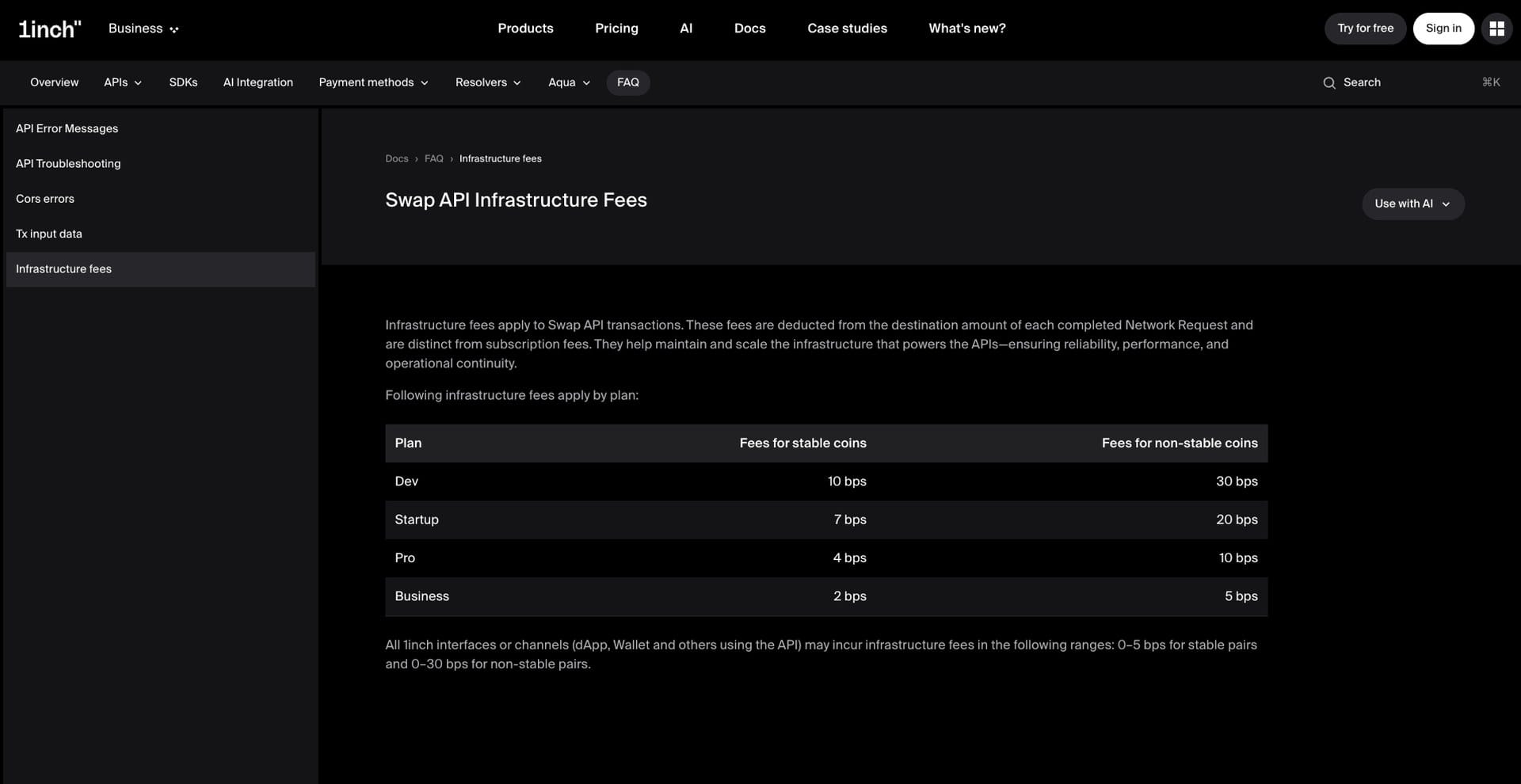
1inch imposes an infrastructure fee ranging from 0 to 5 bps on stablecoin transactions within its applications. In the default Swap mode, the resolver covers both this fee and the gas, which are included in the quoted rate.
CoW Swap, on the other hand, does not charge a protocol volume fee for stablecoin swaps, but applies a 2 bps fee for standard assets. Gas costs are recouped from the order rather than paid separately.
For a $10,000 USDC to USDT swap, the maximum infrastructure fee on 1inch would be approximately $5, whereas CoW Swap would charge no fee. Network costs are integrated into the amounts received in both cases.
It is noteworthy that applications that incorporate either protocol may apply their own fees, which can go up to 1% for CoW Protocol.
Price Improvement Differences
This section highlights the differences in price improvement strategies between the two platforms. Understanding these differences can help users maximize their trading outcomes.
This aspect highlights the most significant differences between the two services. When a trade executes at a better rate than quoted, 1inch retains the additional output, referring to it as surplus, which it does not classify as a trading fee.
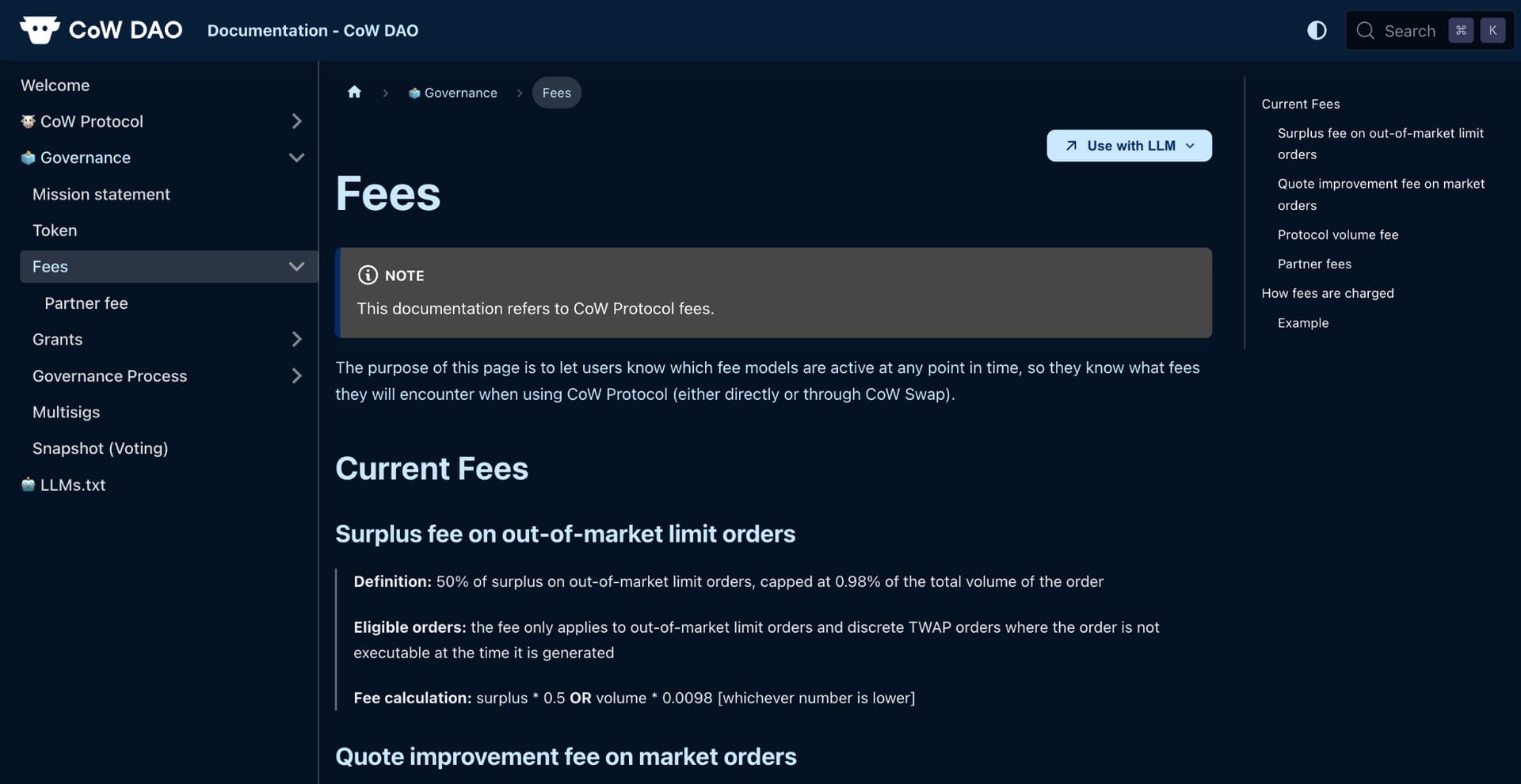
In contrast, CoW Swap levies a quote improvement fee that is 50% of any enhancement, capped at 0.98% of the transaction volume. For example, if a solver exceeds your quoted price by $5, you would receive an additional $2.50, while CoW Swap retains the other $2.50.
Both systems guarantee that users will not receive less than the amount they initially signed for. The distinction lies solely in who benefits from favorable market movements.
It’s important to note that in stablecoin pairs with low volatility, improvements tend to be minimal, making this factor more crucial for larger or more volatile trades.
MEV Protection Strategies
This section examines the measures both platforms take to protect users from MEV risks. Understanding these strategies can help users choose a platform that aligns with their risk tolerance.
Both platforms take measures to keep swaps away from the public mempool, where bots may attempt to exploit trades through front-running or sandwiching. In the case of 1inch, resolvers execute and bear the trade costs, which mitigates front-running risks.
CoW Swap enhances this protection by settling entire batches simultaneously and directly matching opposing orders. Its entire architecture is designed to minimize MEV issues, with organizations like the Ethereum Foundation utilizing it for substantial conversions.
1inch's Classic mode, available under the Pro interface, enables direct swaps where users pay gas fees themselves. This mode sacrifices some MEV protection in favor of near-instant execution.
For substantial stablecoin trades on Ethereum, CoW Swap’s batching model provides superior protection.
Order Types and Supported Chains
This section outlines the order types and blockchain networks supported by each platform. This information is essential for users looking to execute trades across different networks.
1inch supports over 18 networks, including Ethereum, Arbitrum, Base, BNB Chain, Solana, Sonic, Monad, and HyperEVM. It also facilitates cross-chain swaps, limit orders, and provides a Terminal for active traders.
CoW Swap offers Swap, Limit, and TWAP orders. As of September 2026, the TWAP functionality operates from any wallet, making it suitable for entities managing large conversions over time.
CoW Swap expanded to Solana in May 2026 and promotes cross-chain functionalities; however, most of its trading volume still occurs on Ethereum. A detailed review of CoW Swap examines its order types and supported chains.
It’s worth noting that neither platform supports Tron, meaning USDT on Tron requires alternative methods.
Security Incidents
This section reviews the security incidents that have impacted both platforms. Understanding these incidents can provide insights into the security measures users should consider.
- 1inch, March 2025: Approximately $5 million was lost through outdated Fusion v1 code in resolver contracts. 1inch stated that user funds were unaffected.
- 1inch, May 2026: An independent liquidity provider, TrustedVolumes, lost around $5.87 million due to issues in its own contract. 1inch confirmed that its systems remained unaffected.
- CoW Swap, April 2026: The swap.cow.fi domain was compromised. CoW DAO paused its backend, and reviews did not indicate confirmed losses.
Incidents involving 1inch impacted market makers supporting the gasless model, while the CoW Swap event primarily affected the website rather than the contracts. This highlights different risk layers associated with each platform.
Users should bookmark the official sites and limit token approvals on both platforms for added security.
Choosing the Right Platform
This section provides guidance on selecting the appropriate platform based on user needs and transaction types. Understanding these factors can help users make informed decisions.
- For large stablecoin transactions on Ethereum: CoW Swap is preferable due to its zero stablecoin volume fee and batch-auction MEV protections.
- For gasless swaps: 1inch is ideal, as Fusion resolvers typically handle gas costs.
- For transactions on Solana, Monad, or newer chains: choose 1inch for broader network support.
- For treasury conversions executed over time: CoW Swap is better, as it offers TWAP orders from any wallet.
- For active trading tools: 1inch excels with its Terminal and limit order features.
For additional alternatives regarding stablecoin pairs, refer to our compilation of DEX aggregators tailored for stablecoins.
For any trade exceeding a few thousand dollars, it is advisable to obtain quotes from both platforms and compare the minimum amounts received.
Methodology of This Comparison
This section outlines the methodology used in this comparison. Understanding the sources and processes can provide transparency to the analysis.
The information presented is derived from the official websites, help centers, and documentation of 1inch and CoW DAO, reviewed on November 17, 2026, alongside media coverage of prior incidents. No trades were conducted for this analysis.
Volume claims are based on company assertions. Fee structures are sourced from published documentation and may be subject to change through updates or governance votes.
It is crucial to note that live quotes may vary from the published fee ranges, so checking both applications on the day of trading is recommended.
Risks and Limitations
This section discusses the risks and limitations associated with both platforms. Understanding these factors can help users make informed decisions about their trading activities.
- Fees on both platforms are incorporated into the quotes, making them less transparent.
- 1inch retaining surplus resembles a fee for trades that execute favorably.
- CoW Swap’s batching may result in longer processing times compared to direct swaps.
- Both resolver contracts and front-end interfaces have experienced security breaches in the past.
- Third-party applications utilizing either protocol may impose additional fees.
Final Thoughts
This section summarizes the key takeaways from the comparison. Understanding these points can help users make informed decisions about their trading preferences.
When it comes to stablecoin swaps, 1inch and CoW Swap are closely matched in terms of costs, both offering strong protections against significant MEV risks. CoW Swap stands out for its low stablecoin fees and robust MEV framework, while 1inch excels in network diversity and the option for gasless transactions.
Ultimately, the deciding factor often revolves around price improvements. If users prefer to benefit from any upside, CoW Swap's model is advantageous, whereas 1inch retains that surplus.
The straightforward strategy is to compare quotes from both platforms and select the one that offers the higher total amount received.
- 1inch Review 2026: Fees, Fusion Swaps, Safety and How It Handles Stablecoins
- CoW Swap Review 2026: Fees, MEV Protection, Batch Auctions and Stablecoin Swaps
- Best DEX Aggregators for Stablecoin Swaps in 2026, Ranked
Frequently Asked Questions
This section addresses common questions regarding the two platforms. Understanding these FAQs can provide clarity for users considering their options.
1. Is 1inch or CoW Swap more cost-effective for stablecoins?
CoW Swap imposes a 0 bps volume fee on stablecoin transactions, while 1inch applications charge from 0 to 5 bps. However, CoW Swap retains half of any price improvement, so it's essential to compare the net amounts received from both.
2. Which platform offers superior MEV protection?
Both platforms keep swaps out of the public mempool. CoW Swap's batch auctions and direct order matching provide it with enhanced MEV protection, particularly for large trades.
3. Is gas required to swap on 1inch or CoW Swap?
In the default Swap mode of 1inch, resolvers typically cover gas costs. For CoW Swap, gas is recovered from the order, meaning no separate gas payment is necessary for most swaps.
4. Which platform supports more blockchain networks?
1inch lists over 18 networks, including Solana, Monad, and HyperEVM. CoW Swap has fewer supported chains and primarily conducts its trading volume on Ethereum.
5. Have there been any security breaches involving 1inch or CoW Swap?
Both 1inch and CoW Swap have experienced incidents where funds were lost due to vulnerabilities in resolver and liquidity provider contracts, alongside CoW Swap's domain being compromised in April 2026. However, 1inch reported no impact on user funds, and assessments of the CoW Swap incident indicated no confirmed losses.