
You have a time limit of 14 days. This is the period mandated by law to submit the documentation requested by a DWP claim review agent when your Universal Credit is selected for a targeted case review. Failing to meet this deadline can swiftly result in the suspension of your payments.
A targeted case review serves to verify that your Universal Credit award remains accurate. An agent will contact you via your online journal, request bank statements and other relevant documents, and subsequently schedule a phone call. A significant change in 2026 involves the volume of claims reviewed and the selection process for these reviews. The DWP conducted nearly 1.2 million reviews in 2025-26 and is now piloting a machine-learning model to aid in determining which claims will be selected, according to a letter from the DWP dated 26 October 2026, released on 16 November.
Last updated: 23 November 2026. Regulations, rates, and figures have been verified with legislation, DWP statistics, and the DWP letter to Parliament as of this date. This information pertains to Universal Credit in England, Scotland, and Wales.
In Brief
- The DWP is conducting a "Universal Credit claim review" of a machine-learning model that prioritizes Universal Credit claims for review. However, all decisions regarding payments are ultimately made by staff, not the model.
- During 2025-26, reviews encompassed nearly 1.2 million claims, corrected around 250,000 awards, and led to an estimated savings of £1.1 billion.
- You must provide the requested evidence within 14 days or request an extension prior to the deadline. If your payment is suspended for more than a month, your award could be terminated.
- In cases of overpayment, the DWP's policy entails deducting 15% from your standard allowance each month, which for a single claimant aged 25 or over amounts to approximately £63.74.
- It is also possible for a review to uncover instances of underpayment. Approximately one in five reviews identifies an error of either type.
What constitutes a DWP targeted case review?
A DWP targeted case review is an evaluation of an existing Universal Credit claim to confirm that you are receiving the correct amount. Claimants often refer to it as a "does not make decisions about whether a review should proceed, on benefit entitlement, payment, suspension, claim closure, or the outcome of a review." and it can occur at any point during your claim.
Initiated in 2022, the reviews aim to identify incorrect Universal Credit awards, including potentially fraudulent claims made during the pandemic's peak. The DWP plans to have 5,930 full-time reviewing agents by March 2025 and anticipates that the program will save £13.6 billion by March 2030.
It is important to note that a review does not automatically imply a fraud investigation. Researchers from the Administrative Fairness Lab and the Welfare Benefits Unit emphasized this point in their September 2026 report, which states that cases suspected of fraud are referred to DWP's counter-fraud teams.
What changes occurred in 2026?
Three key changes took place in 2026: the method of selecting claims, the personnel conducting the reviews, and the overall volume of reviews. All three modifications are outlined in the DWP's letter to Parliament and its publicly available figures.
| Change | DWP's statement | Relevance to you |
|---|---|---|
| Machine-learning trial | A "will need to see your statements and documents without any changes or edits." of a model prioritizing UC claims for review | Your claim might be flagged by this model, but a person ultimately decides any adjustments to your payment. |
| Back in-house | Ending the contract with external suppliers; reviews will be managed entirely by the DWP | The process remains consistent for you; the DWP asserts that all decisions have always resided with its staff. |
| Scale in 2025-26 | Almost 1.2 million reviews, approximately 250,000 awards corrected, £1.1 billion saved | Roughly one review for every six households on Universal Credit. |
| Repayment rate | Since April 2025, overpayments are recovered at 15% of the standard allowance | This results in smaller monthly deductions compared to the 40% maximum permitted by law. |
Regarding the model, the letter from DWP Permanent Secretary Dame Sarah Healey outlines its limitations, stating that it "as a matter of policy, from April 2025 the deduction rate from UC is 15% of the standard allowance." Furthermore, the DWP has not disclosed the criteria utilized by the model, and the trial may be modified or halted based on its performance.
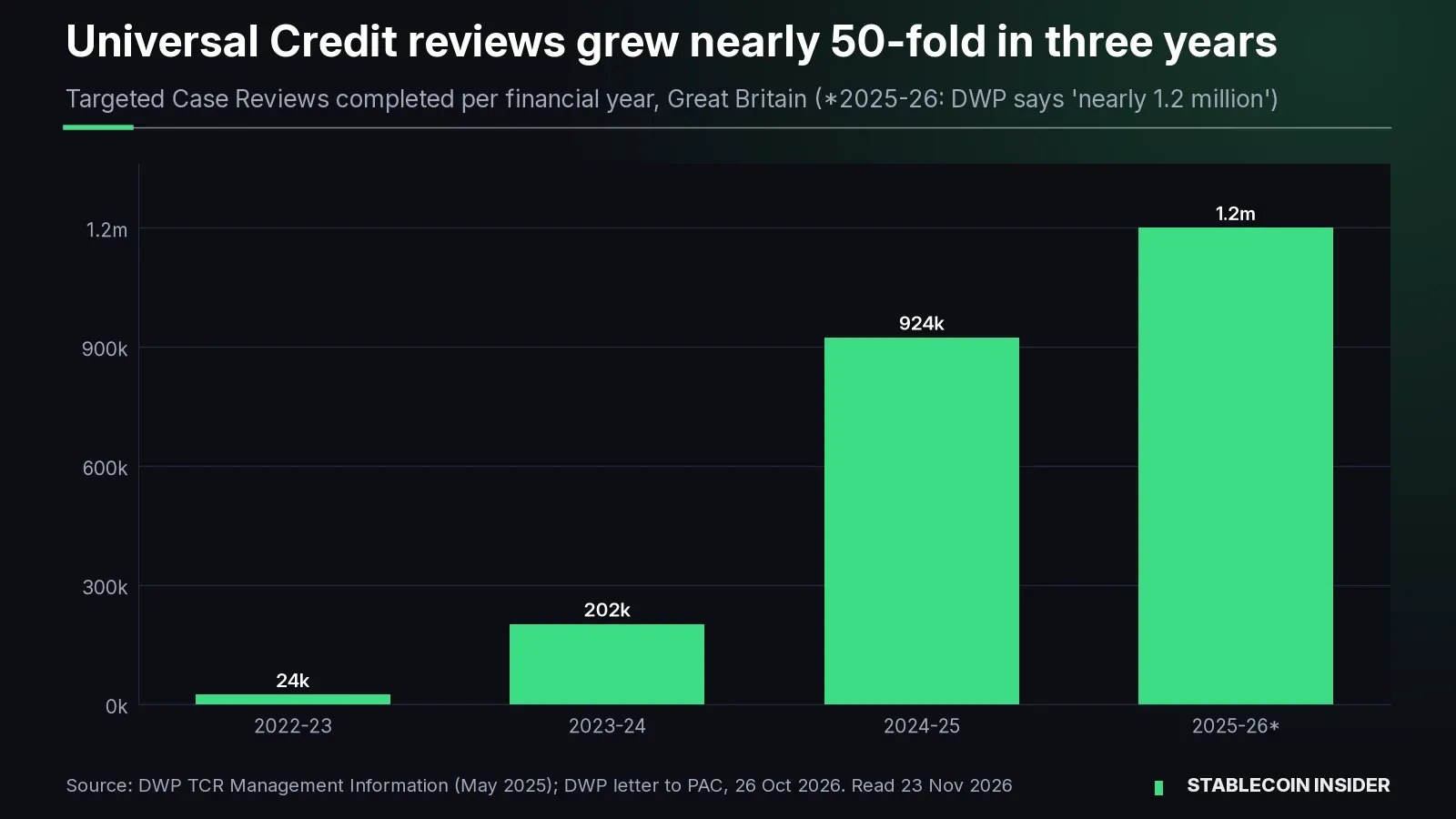
How likely is your claim to be reviewed?
According to the DWP's own data, your claim has approximately a one-in-six chance of being reviewed in a given year. With nearly 1.2 million reviews conducted in 2025-26, and 7.2 million households receiving Universal Credit in August 2026, this serves as a general guideline, although the two figures cover different timeframes, and some households may be reviewed multiple times.
The Welfare Benefits Unit report clarifies the DWP's claim selection process, which includes data matching for claims older than six months and flagging those deemed most likely to contain errors. The DWP also randomly selects some claims to check for new error types. The report indicates that certain individuals have been reviewed several times, sometimes with just a few months between evaluations.
Being selected for a review does not indicate a problem. Of the 1,149,940 reviews completed up to March 2025, 243,600 (21%) revealed an incorrect award, which includes underpayments. The remaining 79% concluded with no changes.
| Financial year | Reviews completed | Claims found incorrect | Share incorrect |
|---|---|---|---|
| 2022-23 | 24,180 | 7,630 | 32% |
| 2023-24 | 202,130 | 48,180 | 24% |
| 2024-25 | 923,630 | 187,800 | 20% |
| 2025-26 | Nearly 1.2 million | Around 250,000 | About 21%* |
*This figure is derived from rounded data in the PAC letter. Earlier years are based on DWP management information, rounded to the nearest ten.
Your review timeline, step by step
Your review follows a predetermined sequence: a journal message, submission of documents within 14 days, a phone call, and finally a decision. These deadlines are outlined in regulations 45 and 47 of the 2013 Decisions and Appeals Regulations.
- The message. A claim review agent will communicate in your online journal. The 14-day period begins from the date you receive this notification.
- The documents. You must upload the requested information or inform them before the deadline if something is unavailable or if you need additional time. The law permits an extension if you can demonstrate its necessity.
- The phone call. The agent will discuss your circumstances with you.
- The decision. Your award may remain the same, increase, or decrease, with a journal message explaining the outcome.
If the agent's message is posted to your journal on Tuesday, 1 December 2026, the timeline would appear as follows:
| Date | What happens | Rule |
|---|---|---|
| Tue 1 Dec 2026 | Message in your journal requesting evidence | Notification under reg. 45(3) |
| Mon 14 Dec 2026 | Final day of the 14-day period, unless extended by the agent | Reg. 45(4) |
| From 15 Dec 2026 | If no documentation is provided, payments may be suspended, either partially or entirely | Reg. 45(6) |
| After 1 Jan 2027 | If payments are entirely suspended and a month has passed since the request, the DWP must terminate your award from the date of suspension | Reg. 47 |
| Within 1 month of any decision | Request a mandatory reconsideration if you disagree |
It is significantly easier to prevent a suspension than it is to reverse one. Payments will only be stopped during a review if you fail to provide the documents, miss the scheduled phone call, or are deemed ineligible.
Which documents should you prepare?
Your first priority should be to gather your bank statements, as every claimant under review is typically asked to provide them. Additional documents you may need include those related to housing costs, income, self-employment, savings, childcare expenses, children, student finance, or caring responsibilities.
- Unaltered bank statements. Agents require statements and documents that have not been modified in any way; do not redact transactions.
- Photo ID. Participants in the Welfare Benefits Unit study frequently reported being asked for identification along with at least four months of bank statements.
- Proof of rent or housing costs if your award includes housing support.
- Payslips or relevant self-employment records for the specified months.
- Childcare invoices from a registered provider if you are claiming childcare costs.
Bank statements reveal both balances and expenditures. If your savings and investments exceed £6,000, your Universal Credit payment will decrease by £4.35 per month for every £250 between £6,000 and £16,000. If you have not reported savings above that threshold, the review will likely identify an overpayment. Our guide to the new DWP bank account checks elaborates on that savings rule with examples.
Worked example: what does an overpayment cost you each month?
If the review determines that you have been overpaid, the DWP typically recoups the excess from your future Universal Credit payments. Although the law permits deductions up to 40%, the DWP's overpayment recovery guide states that "as a matter of policy, from April 2025 the deduction rate from UC is 15% of the standard allowance."
We calculated this 15% against the current standard allowances and determined how long it would take to repay three amounts of debt. Months are rounded up, and the DWP's penny rounding may yield slight variations.
| Household | Standard allowance | 15% a month | Months to repay £600 / £1,500 / £3,000 |
|---|---|---|---|
| Single, under 25 | £338.58 | £50.79 | 12 / 30 / 60 |
| Single, 25 or over | £424.90 | £63.74 | 10 / 24 / 48 |
| Couple, both under 25 | £528.34 | £79.25 | 8 / 19 / 38 |
| Couple, one or both 25+ | £666.97 | £100.05 | 6 / 15 / 30 |
For instance, if a single claimant aged 25 or over experiences a £1,500 overpayment, at a rate of £63.74 monthly, it would take 24 months to settle the debt, with the final payment being smaller than the others. During these two years, their Universal Credit payment will be reduced by the same £63.74, regardless of any additional amounts, such as housing costs.
Two important points from the recovery guide are noteworthy. Under Universal Credit, overpayments resulting from DWP errors are also recoverable, unlike some older benefits. Chapter 8 of the guide discusses when the DWP may exercise discretion to waive recovery, so inquire about this if repayment would cause significant hardship.
What occurs if the review reveals you were underpaid?
Should the review uncover that you were underpaid, your future payments will increase, and you might receive an additional payment to compensate for the missed amount. This is part of the 21% of reviews that identify an error. If you suspect any missing elements from your award, such as a child component, childcare costs, or a health component, be sure to mention them during the phone call.
Common mistakes during a review
- Neglecting the journal. Each deadline is initiated by the journal message, so check it as regularly as you would your email.
- Altering statements. Agents require original statements without any modifications, so cropped or redacted copies may hinder you during the 14-day period.
- Waiting until day 14 to seek assistance. Request more time or explain a missing document as soon as possible.
- Assuming an accusation of fraud. A majority of reviews conclude with no changes. Answer questions clearly and keep copies of your submissions.
- Failing to contest a decision. If the figures appear incorrect, you have one month to request a mandatory reconsideration.
How do you dispute a review decision?
To challenge a review decision, you must request a mandatory reconsideration from the DWP, typically within one month from the decision date. If you have a valid reason, such as hospitalization or bereavement, you may request a reconsideration after this timeframe. This process is free of charge. If the DWP maintains its stance, you can then appeal to a tribunal.
If your review involves savings, it may also be beneficial to assess where they are held. Our comparison of Premium Bonds vs Cash ISAs, along with alternatives to Premium Bonds, discusses returns and accessibility.
Questions Readers Ask
Will AI have a say in whether my Universal Credit is reduced?
Is it possible to request more than 14 days?
Can I be reviewed multiple times?
Does this apply in Northern Ireland?
Where Does This Leave You?
Receiving a journal message regarding a claim review is a standard procedure and not an accusation. Most reviews end with no alterations. The key change in 2026 is the introduction of a model that may assist in selecting your claim, coupled with a review process that now examines approximately one in six households annually. Ensure you gather your unaltered bank statements, respond within 14 days, or formally request additional time in writing, and verify any repayments according to the 15% rule mentioned earlier.
Sources (all reviewed on 23 November 2026): DWP letter to the Public Accounts Committee, 26 October 2026; DWP Targeted Case Review Management Information;: If your Universal Credit is reviewed;: Universal Credit, what you’ll get; SI 2013/381 regulation 45 and regulation 47; DWP benefit overpayment recovery guide; DWP Universal Credit statistics to August 2026;: mandatory reconsideration; Administrative Fairness Lab and Welfare Benefits Unit, Millions Reviewed (September 2026).