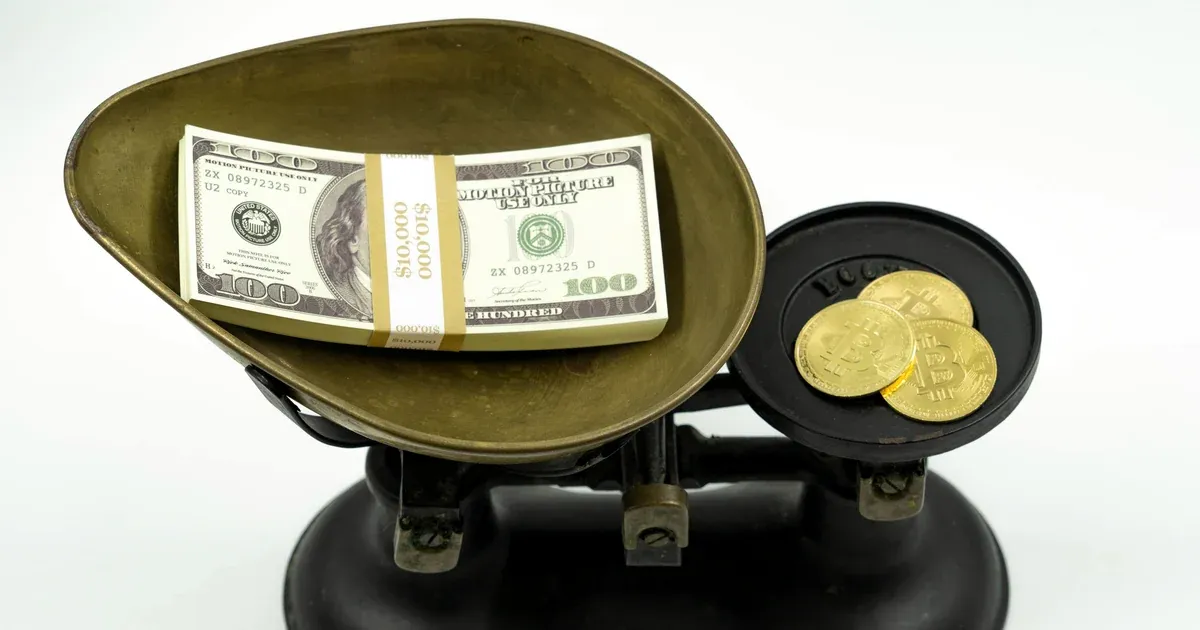
When considering between IBIT and FBTC, there's no difference in cost. Both BlackRock's iShares Bitcoin Trust ETF (IBIT) and Fidelity's Wise Origin Bitcoin Fund (FBTC) charge an annual fee of 0.25%. However, the distinction lies in other aspects. For most buyers, IBIT proves to be the superior option, especially for traders and options users, due to its larger size and a median bid/ask spread of 0.02%. Conversely, FBTC is more suitable for Fidelity customers and those preferring their bitcoin to be held by the fund sponsor's own trust bank instead of Coinbase.
This comparison is particularly relevant as bitcoin has experienced a significant drop. The benchmark tracked by IBIT fell from $83,721.81 on September 30, 2026, to $58,413.85 on November 20, 2026, marking a decline of 30.2%. Additionally, IBIT's net asset value decreased by 33.26% for the year up to November 20 (calculated from the IBIT fact sheet). Neither fund offers protection against such losses; they merely dictate how the asset is held.
Last updated on November 23, 2026, this information includes verified fees, fund data, custody arrangements, and returns against the official pages of BlackRock iShares and Fidelity. All amounts are stated in US dollars and pertain to US-listed funds.
At a glance
This section summarizes key aspects of both funds, highlighting their similarities and differences. Fees, size, tracking performance, custody arrangements, and options trading are all critical factors for potential investors to consider.
- Fees are the same: 0.25% annually for both. For an investment of $10,000 with a constant bitcoin price, the fee would amount to $25 in the first year for either fund.
- Size: As of September 30, 2026, IBIT managed $67.06 billion, while FBTC held $15.45 billion.
- Tracking was nearly identical: both funds experienced a return of −26.80% at NAV over the year leading to September 30, 2026, each trailing their respective benchmarks by approximately 0.2 points, roughly equivalent to the fee.
- Custody represents the primary structural difference: IBIT’s bitcoin is held by Coinbase Custody, whereas FBTC’s bitcoin is managed by Fidelity Digital Assets, an affiliate of its sponsor.
- Options: IBIT options have been traded on Nasdaq since November 19, 2024, while the SEC approved Cboe's listing of FBTC options in October 2024.
Spec sheet: IBIT compared to FBTC
The following tables present a side-by-side comparison of the funds. The first table outlines costs and trading ease, while the second details the structure of each fund. Each cell links to the corresponding official page or filing.
| Cost and trading | IBIT (BlackRock iShares) | FBTC (Fidelity) |
|---|---|---|
| Our pick:IBIT for most buyers | Ideal for traders, options users, and those seeking a deeper market | Best for Fidelity account holders wanting in-house custody |
| Annual fee | 0.25% sponsor fee (iShares) | 0.25% gross and net expense ratio (fact sheet) |
| Fund assets, 30 Sep 2026 | $67,060.47M (fact sheet) | $15,454.1M (fact sheet) |
| Median bid/ask spread | 0.02%, 30-day median to 20 Nov 2026 (iShares) | Not listed on the Fidelity pages and fact sheet |
| Listing and launch | Nasdaq; fund launched January 5, 2024 (fact sheet) | Cboe BZX; fund inception January 10, 2024 (fact sheet) |
| Listed options | Yes, on Nasdaq since November 19, 2024 (Nasdaq) | Cboe listing approved by the SEC on October 18, 2024 (Federal Register) |
| Structure | IBIT (BlackRock iShares) | FBTC (Fidelity) |
|---|---|---|
| Bitcoin custodian | Coinbase Custody Trust Company; Anchorage Digital Bank can be an alternative but there are no plans to transfer bitcoin there (prospectus) | Fidelity Digital Assets, N.A., an affiliate of the sponsor; BitGo Bank & Trust is another custodian, but no plans to move bitcoin there (prospectus) |
| Benchmark | CME CF Bitcoin Reference Rate – New York Variant (iShares) | Fidelity Bitcoin Reference Rate (fact sheet) |
| Legal form | Grantor trust; not registered under the 1940 Act (prospectus) | Grantor trust; not registered under the 1940 Act (prospectus) |
| Bitcoin held | 760,926.24 BTC as of November 20, 2026 (iShares holdings) | Not specified on the Fidelity pages we reviewed; stated as 100% bitcoin per the fact sheet (Fidelity) |
Two notable trends emerge. There are no compelling reasons to favor one fund over the other in terms of price and tracking. However, differences in scale, published trading data, and custody arrangements indicate varying preferences based on individual needs.
Fees: a tie, illustrated with $10,000
IBIT and FBTC share identical holding costs. The sponsor fee for IBIT accrues daily at an annual rate of 0.25% of net asset value (as per the IBIT prospectus). Similarly, FBTC incurs a 0.25% unified fee on its bitcoin assets, also accrued daily (according to the FBTC prospectus). In both cases, the sponsor covers custody, administration, and listing expenses from this fee, although fee waivers are possible but not guaranteed.
For illustration: if $10,000 is invested in either fund, with bitcoin's price remaining stable and the 0.25% fee applied just once annually (the daily accrual may cause minor variations), and no brokerage commissions incurred, the results would be as follows:
| Holding period | Value left in IBIT or FBTC | Sponsor fees paid |
|---|---|---|
| 1 year | $9,975.00 | $25.00 |
| 3 years | $9,925.19 | $74.81 |
| 5 years | $9,875.62 | $124.38 |
| 10 years | $9,752.79 | $247.21 |
The only variable cost is related to trading. When purchasing half of IBIT's 0.02% median spread and then selling, the total comes to approximately 0.02%, or around $2 on a $10,000 investment (as per iShares). Fidelity's documentation does not provide a comparable figure for FBTC, making it difficult to evaluate that aspect; for long-term investors, the difference is minimal either way.
Examining IBIT's own figures reveals the fee's impact in bitcoin terms. A 40,000-share basket represented 22.64 BTC on September 30, 2026, and 22.63 BTC on November 20, 2026 (according to the fact sheet and fund page). The fee is gradually absorbed by the diminishing bitcoin behind each share.
Liquidity and trading: IBIT's size advantage
IBIT is the more liquid option. As of September 30, it managed $67.06 billion compared to FBTC's $15.45 billion, and on November 20, its 30-day average trading volume stood at 50,110,122 shares (according to the IBIT and FBTC fact sheets). This factor is vital for large orders, frequent trading, and options transactions.
Regarding options, IBIT took the initiative. Nasdaq began trading IBIT options on November 19, 2024, reporting 353,716 contracts on the first day (as reported by Nasdaq). The SEC approved Cboe's rule change to list options for FBTC on October 18, 2024 (as per the Federal Register). Traders engaging in covered calls or hedging with puts should check the open interest and spreads in their broker's option chain prior to making a choice; this article does not include a comparison of option-chain data.
However, for a consistent $200 monthly investment in a retirement account, these minor liquidity differences generally do not affect the final outcome. Over the year leading up to September 30, the market price returns were −27.17% for IBIT and −27.22% for FBTC (according to iShares and Fidelity).
Custody: Coinbase or Fidelity's own trust bank
The key distinction between these funds is their custodial arrangements. IBIT's bitcoin is stored with Coinbase Custody Trust Company, which also notes Anchorage Digital Bank N.A. as a potential alternative. However, the prospectus specifies that there are no plans to transfer bitcoin there (as per the IBIT prospectus).
FBTC, on the other hand, retains its bitcoin with Fidelity Digital Assets, N.A., which is described in the prospectus as an affiliate of the sponsor and a national trust bank. BitGo Bank & Trust serves as an additional custodian, with no intentions to transfer bitcoin there as well (according to the FBTC prospectus).
Both custodial setups come with their own risks. With IBIT, the fund relies on a third-party custodian that is part of a larger cryptocurrency exchange group. In the case of FBTC, a single financial group sponsors the fund and holds its assets, which appeals to some investors for its simplicity, while others may view it as a risk of concentration. Both prospectuses provide detailed descriptions of custody, hacking, and loss risks, so it's advisable to review those sections instead of merely relying on brand recognition.
Tracking: how closely each followed bitcoin
Both funds closely tracked bitcoin, minus the management fee. The following table compares each fund’s NAV return against its respective benchmark index (measured for one year up to September 30, 2026, and for the calendar year 2025), sourced from the IBIT and FBTC fact sheets dated September 30, 2026.
| Fund | 1-yr NAV | 1-yr index | 2025 NAV | 2025 index |
|---|---|---|---|---|
| IBIT (source) | −26.80% | −26.61% | −7.08% | −6.84% |
| FBTC (source) | −26.80% | −26.62% | −6.98% | −6.74% |
Both funds lagged behind their benchmarks by 0.18 to 0.24 points, which aligns with the 0.25% fee structure. Since both funds utilize different benchmarks, their 2025 returns cannot be directly compared, and their performance since inception starts from distinct dates. The reasonable conclusion is that both funds perform adequately; tracking is not a compelling reason to switch.
Accounts and taxes
FBTC is designed to work within Fidelity's ecosystem. Fidelity states that investors can use a Fidelity brokerage account, including an IRA, to invest, and that FBTC is compatible with most brokerage, trust, and IRA accounts (according to Fidelity). The fact sheet for IBIT indicates that its shares can be traded on the secondary market through any brokerage account (as per the IBIT fact sheet); investors should check their broker's policies regarding crypto products beforehand. Our previous report on Vanguard's entry into the crypto ETF space highlights one platform that has changed its approach.
Tax implications are structured similarly for both funds. Both are intended to be grantor trusts, which means that US holders are considered to own their proportionate share of the trust's bitcoin. The prospectus for IBIT states that any delivery or sale of bitcoin to cover fees is a taxable event for holders, while FBTC's prospectus indicates that holders must include their share of bitcoin sold for trust expenses in their taxable income (as detailed in the IBIT and FBTC prospectuses).
Who should choose which
This section outlines the ideal investors for each fund based on their unique features and advantages. Understanding these distinctions can help potential investors make informed decisions.
IBIT: for most buyers and active traders
IBIT is suited for individuals outside Fidelity, active traders, option writers, and those placing larger orders. It is the largest fund in this comparison, with a published median spread of 0.02%, and options available on Nasdaq since November 2024 (according to iShares and Nasdaq). However, bitcoin is kept with Coinbase Custody, a third-party provider, and the fee is the same 0.25% as FBTC, offering no cost advantage (as per the prospectus).
- Suits: individuals outside Fidelity, active traders, option writers, and those placing larger orders.
- Strengths: the largest fund in this comparison, a published median spread of 0.02%, and options available on Nasdaq since November 2024 (according to iShares and Nasdaq).
- Limits: Bitcoin is kept with Coinbase Custody, a third-party provider; the fee is the same 0.25% as FBTC, offering no cost advantage (as per the prospectus).
FBTC: for Fidelity customers prioritizing in-house custody
FBTC is ideal for those who already invest through Fidelity, including in an IRA, and prefer their fund's bitcoin held outside an exchange-affiliated custodian. It has custody managed by Fidelity Digital Assets, N.A., a national trust bank, with the same 0.25% fee and nearly identical tracking (as per prospectus and fact sheet). However, it is significantly smaller, roughly a quarter of IBIT’s size, and Fidelity's public pages do not disclose a median spread or daily bitcoin count; both the sponsor and custodian belong to the same financial group (according to the fact sheet).
- Suits: those who already invest through Fidelity, including in an IRA, and prefer their fund's bitcoin held outside an exchange-affiliated custodian.
- Strengths: custody managed by Fidelity Digital Assets, N.A., a national trust bank; same 0.25% fee and nearly identical tracking (as per prospectus and fact sheet).
- Limits: significantly smaller, roughly a quarter of IBIT’s size; Fidelity's public pages do not disclose a median spread or daily bitcoin count; both the sponsor and custodian belong to the same financial group (according to the fact sheet).
For a broader perspective on the recent downturn, refer to bitcoin's four-month low. If you are considering bitcoin against dollar-pegged currencies, our analysis on stablecoins versus bitcoin outlines the distinctions, and our comparison of Nasdaq versus S&P 500 illustrates how fund fees accumulate in equity ETFs.
Common questions
This section addresses frequently asked questions regarding IBIT and FBTC, providing clarity on common concerns that potential investors may have.
Is IBIT cheaper than FBTC?
Both funds charge the same annual fee of 0.25%, making them equal in terms of cost.
Can I exchange my existing bitcoin for IBIT shares?
Investors should check with their broker for specific policies regarding the exchange of bitcoin for shares.
Do IBIT or FBTC distribute dividends?
Neither fund distributes dividends, as they are designed to track the performance of bitcoin.
The verdict: a decision guide
This section provides a concise guide for potential investors, summarizing key considerations for choosing between IBIT and FBTC.
- Frequent traders, options users, or those placing large orders should choose IBIT.
- Investors using Fidelity, including for IRAs, who prefer in-house custody should opt for FBTC.
- For those making smaller monthly purchases at another broker, select IBIT or whichever fund your broker allows you to buy without incurring a commission; fees are the same.
- If you already own one of the funds, maintain your position. Switching would require selling, potentially leading to tax implications and trading costs without saving on fees.
- For those unable to tolerate a 30% decline, neither fund is advisable as both exclusively hold bitcoin.