Investors looking to own the Nasdaq-100 may find Invesco QQQ no longer the most cost-effective option. With a total expense ratio of 0.18%, two recently launched funds—State Street's QNDX and BlackRock's IQQ—offer the same index at a lower cost of 0.10%. Additionally, Invesco's own QQQM is available at 0.15%.
This cost disparity has gained traction during a turbulent week for technology stocks. On November 23, 2026, search interest for "nasdaq correction vs bear market" exceeded 50,000 in the US, coinciding with inquiries about "low-cost, growth-oriented core equity allocation" On that day, the Nasdaq-100 was reported at 26,769.72, reflecting a 6.95% increase from the previous close of 25,028.98.
For those seeking the most economical option, consider transferring new investments to QNDX, which offers the lowest fees without any waivers. Alternatively, QQQM provides Invesco's established presence at 0.15%, IQQ serves iShares users, and QQQE caters to those concerned about mega-cap exposure. QQQ remains a viable choice for high-frequency traders or those handling large orders.
Last updated: November 23, 2026. The expense ratios, assets, and spreads were checked on the respective fund pages on this date. All figures are in US dollars for US-listed ETFs.
In Brief
- QQQ reduced its fee from 0.20% to 0.18% after shareholders approved its transformation from a unit investment trust to an open-end ETF in December 2025. New competitors in 2026 have since offered lower rates.
- QNDX charges a flat 0.10% with no waivers in place. IQQ has a gross rate of 0.12%, which is reduced to 0.10% through a waiver valid until July 31, 2027.
- Over a decade, holding $100,000 in QQQ incurs $1,800 in fees compared to $1,000 for QNDX. The annual savings of $80 may not justify selling QQQ if it results in significant taxable gains.
- Equal-weight indices do not consistently protect against downturns. The equal-weight Nasdaq-100 outperformed the standard index in only one of the last eight years, specifically in 2022.
Factors Driving QQQ Holders to Explore Alternatives
QQQ investors are exploring alternatives primarily due to pricing and concentration concerns. Since its launch in March 1999, QQQ has faced competition this year from two major ETF issuers. State Street introduced QNDX in June 2026, describing it as a "generally aren't taxed until distributed" with fees of 10 basis points. BlackRock followed with the launch of IQQ in July.
Concentration issues further complicate matters. As of June 30, 2026, NVIDIA constituted 8.36% and Apple 7.38% of the standard Nasdaq-100, with the technology sector representing 59.89% of the index, according to Direxion's index assessment. When a few prominent tech stocks fluctuate, QQQ tends to follow suit. On November 20, the Nasdaq-100 closed just 49 points above the bear market threshold.
However, QQQ still excels in terms of liquidity. According to Invesco, as of September 30, 2026, QQQ was the second-most traded ETF in the US by average daily volume. For intraday trading or significant transactions, this liquidity may outweigh a mere 0.08% annual fee difference.
Six Alternatives to QQQ, Ranging from Closest Copy to Significant Changes
The first three alternatives maintain the same 100 stocks as QQQ, allowing investors to switch issuers and reduce costs without altering exposure. The latter trio introduces different ownership structures.
1. State Street SPDR Portfolio Nasdaq 100 ETF (QNDX)
Consider QNDX if your goal is to replicate QQQ at the lowest fee. With a gross expense ratio of 0.10%, QNDX held 101 stocks and $1,033.64 million in assets as of November 20, 2026, after being listed on Nasdaq on June 24, 2026.
This fund provides an annual savings of 0.08 percentage points compared to QQQ, without an expiring waiver. However, it lacks the historical performance and size of QQQM, which holds significantly more assets. State Street's page did not indicate a median bid/ask spread, so verify the live quote before making a large purchase.
Verdict: QNDX is the preferred option for new investments in a Nasdaq-100 position.
If you prefer iShares, switch to IQQ. Its prospectus lists a fee of 0.12%, reduced to 0.10% through a waiver that is effective until July 31, 2027. BlackRock confirms this waiver's duration.
As of November 20, 2026, IQQ had net assets of $1.17 billion, with a 30-day median bid/ask spread of 0.04%. You gain comparable pricing to QNDX, along with a clear trading-cost figure from the issuer. However, fee certainty diminishes after the waiver's expiration, as the fee could revert to 0.12% unless renewed.
Verdict: IQQ is nearly equivalent to QNDX. Opt for it based on platform convenience, but mark the waiver's expiry date.
3. Invesco NASDAQ 100 ETF (QQQM)
QQQM represents the smallest deviation from QQQ. Tracking the same index from the same issuer, it charges 0.15% and had a market value of $97.29 billion as of November 20, 2026, along with a 0.01% median bid/ask spread. This fund was launched on October 13, 2020.
Investors gain a 0.03 point annual advantage and a tight spread but forfeit the additional 0.05 points a year saved by QNDX or IQQ.
Verdict: QQQM is a prudent choice for those prioritizing scale over minor fee differences.
4. Direxion NASDAQ-100 Equal Weighted Index ETF (QQQE)
Choose QQQE if your primary concern is the dominance of a few large companies within QQQ. This fund holds the same stocks, distributing roughly 1% to each, and rebalances quarterly. It charges a gross and net fee of 0.35%. As of June 30, 2026, the equal-weight index allocated 44.88% to technology compared to 59.89% for the standard Nasdaq-100.
QQQE offers genuine diversification among the same 100 companies but comes with nearly double the fee of QQQ. In terms of historical performance in strong tech markets, it has exhibited lower returns (see the chart below).
Verdict: QQQE serves as a hedge against concentration rather than a lower-cost alternative to QQQ.
5. Schwab U.S. Large-Cap Growth ETF (SCHG)
Consider switching to SCHG if you seek growth stocks beyond the Nasdaq-100 for the lowest cost available here. SCHG charges just 0.04% while tracking the Dow Jones U.S. Large-Cap Growth Total Stock Market Index, holding 190 stocks with net assets of $54.85 billion as of November 20, 2026. Its 30-day median spread was 0.03%.
This fund provides the lowest fees along with exposure to growth companies listed on other exchanges, which the Nasdaq-100 typically overlooks. However, it lacks the familiar benchmark of QQQ, meaning it won't necessarily track QQQ's movements.
Verdict: SCHG is ideal for cost-conscious long-term investors willing to substitute one growth index for another.
6. Fidelity Nasdaq Composite Index ETF (ONEQ)
Opt for ONEQ if you appreciate the Nasdaq brand but desire a broader range of stocks, including financial firms absent from the Nasdaq-100. ONEQ invests at least 80% of its assets in stocks from the Nasdaq Composite and has a fee of 0.21%. As of October 31, 2026, it reported net assets of $10.45 billion and a 0.05% median spread on November 20.
This fund offers increased diversification. However, it is pricier than QQQ aside from QQQE, and its top 10 holdings constituted 56.55% of the fund as of October 30, 2026, indicating only modest diversification benefits.
Verdict: ONEQ's cost makes it hard to justify unless the Composite is your preferred index.
Comparative Analysis: Fees, Index, and Trading Costs
The table below illustrates each fund's expense ratio, index, and the trading-cost data as reported by the respective issuers. QQQ is listed as the reference fund in the final row.
| Fund | Expense ratio | Index | 30-day median bid/ask spread |
|---|---|---|---|
| Preferred choice:QNDX(State Street) | 0.10% | Nasdaq-100 | Not stated on fund page |
| IQQ(iShares) | 0.10% net, 0.12% gross (waiver to July 31, 2027) | Nasdaq-100 | 0.04% |
| QQQM(Invesco) | 0.15% | Nasdaq-100 | 0.01% |
| QQQE(Direxion) | 0.35% | Nasdaq-100 Equal Weighted | Not stated on fund page |
| SCHG(Schwab) | 0.04% | Dow Jones U.S. Large-Cap Growth TSM | 0.03% |
| ONEQ(Fidelity) | 0.21% | Nasdaq Composite | 0.05% |
| Reference:QQQ(Invesco) | 0.18% | Nasdaq-100 | Not stated on fund page |
Two key observations emerge. Among the funds that replicate QQQ's holdings, the least expensive option is just 0.08 points cheaper annually, and there are no alternatives that are more costly. Furthermore, the only funds with higher fees than QQQ are those that provide different exposure.
Understanding the Value of the Fee Gap and When It’s Not Worth Selling
The fee disparity equates to an annual savings of $8 on a $10,000 investment between QQQ and QNDX. This analysis assumes a stable value and consistent expense ratios, excluding trading costs or taxes. Actual balances fluctuate, so this figure represents potential savings rather than a precise forecast.
| Fund | Expense ratio | Fee per year on $10,000 | Fees over 10 years on $100,000 |
|---|---|---|---|
| QQQ (reference) | 0.18% | $18 | $1,800 |
| QNDX | 0.10% | $10 | $1,000 |
| IQQ | 0.10% now, 0.12% after July 2027 | $10 | Approximately $1,180 if the waiver is not renewed after the first year |
| QQQM | 0.15% | $15 | $1,500 |
| SCHG | 0.04% | $4 | $400 |
| ONEQ | 0.21% | $21 | $2,100 |
| QQQE | 0.35% | $35 | $3,500 |
However, there is a significant consideration to factor in. If you own $100,000 of QQQ in a taxable account purchased years ago with a long-term gain of $40,000, selling would incur approximately $6,000 in taxes at the 15% federal rate applicable to most taxpayers, excluding state taxes. Transitioning those funds to QNDX would yield an annual saving of $80, which would take 75 years to recover the tax cost.
Consequently, for most long-held investments, it is advisable to cease additional contributions to QQQ and allocate new funds to the more affordable option. Selling should only be considered where the tax implications are minimal, such as within retirement accounts, in the 0% capital gains bracket, or for recently acquired shares near current pricing.
Does Equal Weight Provide Protection During a Sell-Off?
The equal-weight strategy proved beneficial for investors in 2022 but faltered in the following three years. Direxion reveals calendar-year returns for both indexes on its QQQE page, indicating that in 2022, the equal-weight index lost 24.31%, compared to a 32.38% loss for the Nasdaq-100. In 2023, it gained 34.01% while the Nasdaq-100 increased by 55.13%.
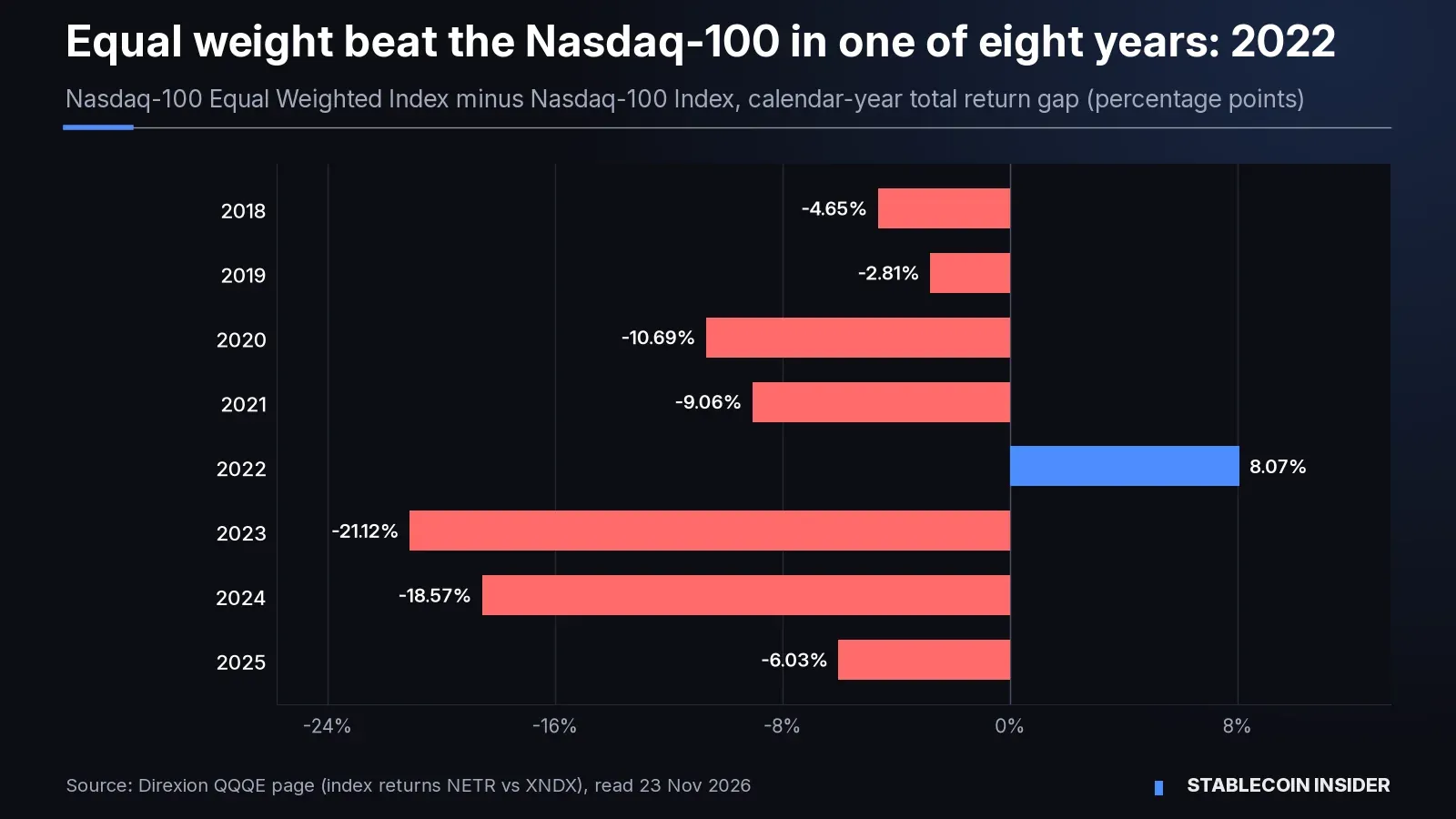
If a prolonged bear market is anticipated, QQQE experienced less of a decline during the previous downturn in 2022. However, if large-cap stocks continue to lead, QQQE is likely to lag. The justification for paying 0.35% for this strategy should primarily depend on intentional ownership rather than reacting to short-term market fluctuations.
How to Move Funds from QQQ Without Unexpected Tax Consequences
Transitioning out of QQQ can be straightforward if you organize your account types and tax lots before executing a trade.
- Identify the account holding QQQ. In a traditional IRA, earnings are typically not taxed until withdrawn, so switching investments within the account is often the simplest approach.
- Examine each tax lot in your taxable account. Your broker will display the gains or losses for each purchase. Lots with minimal gains are less costly to move; older lots with significant gains usually are not.
- Change any automatic investments first. Update recurring purchases from QQQ to the new fund. This allows for fee savings without tax implications.
- Be cautious when selling at a loss. A wash sale is triggered if you purchase "all the facts and circumstances" securities within 30 days before or after a loss sale. The IRS advises considering "all the facts and circumstances," without providing a specific test for ETFs. Since QNDX, IQQ, and QQQM track the same index as QQQ, consult a tax advisor before realizing a loss with any of these funds.
- Utilize limit orders for the newer funds. As QNDX and IQQ have only been available for a few months, verify the live bid and ask before placing a significant order.
For those still contemplating whether to invest in the Nasdaq-100, our comparison between the Nasdaq and S&P 500 reviews returns, drawdowns, and expenses for both. To understand the extent of previous declines in the Nasdaq, refer to our Nasdaq correction tracker. For insights into a similar fee-related decision in another ETF category, see IBIT vs FBTC.
Frequently Asked Questions
Is QQQM the same as QQQ?
What is the most affordable alternative to QQQ?
Did the transition of QQQ to an open-end ETF create a tax bill?
Will IQQ's fees increase in 2027?
Conclusion: Which QQQ Alternative Should You Choose?
For new investments in the Nasdaq-100, consider switching to QNDX at 0.10%, which tracks the same index without any waivers to monitor. Opt for IQQ if your investment platform favors iShares, and choose QQQM if you prefer to remain with Invesco's larger, well-established fund. Reserve QQQE for strategic bets against mega-cap concentration, and select SCHG if any low-cost growth fund meets your needs. Retain QQQ for high-frequency trading or if selling would trigger substantial taxable gains.