
The Social Security cost-of-living adjustment (COLA) for 2027 is set at 3.6%. This increase will be reflected in the December 2026 payment, typically received by most individuals in January 2027. For those on Supplemental Security Income (SSI), the adjustment will apply to the payment made on December 31, 2026. For the average retired worker, this translates to an additional $75 monthly, which amounts to approximately $68.50 after accounting for the increased Medicare Part B premium (SSA 2027 fact sheet; CMS).
To help individuals calculate their expected checks, this guide outlines the essential figures published by the SSA and CMS for 2027: the gross increase, Medicare deductions, payment dates, and other limits that will change on January 1, including the earnings test and the payroll-tax cap.
Last updated on November 24, 2026, all figures for 2027 have been verified against the SSA, CMS, and IRS sources. This information pertains to federal Social Security and SSI benefits; it does not include state SSI supplements or state taxes.
Key Details
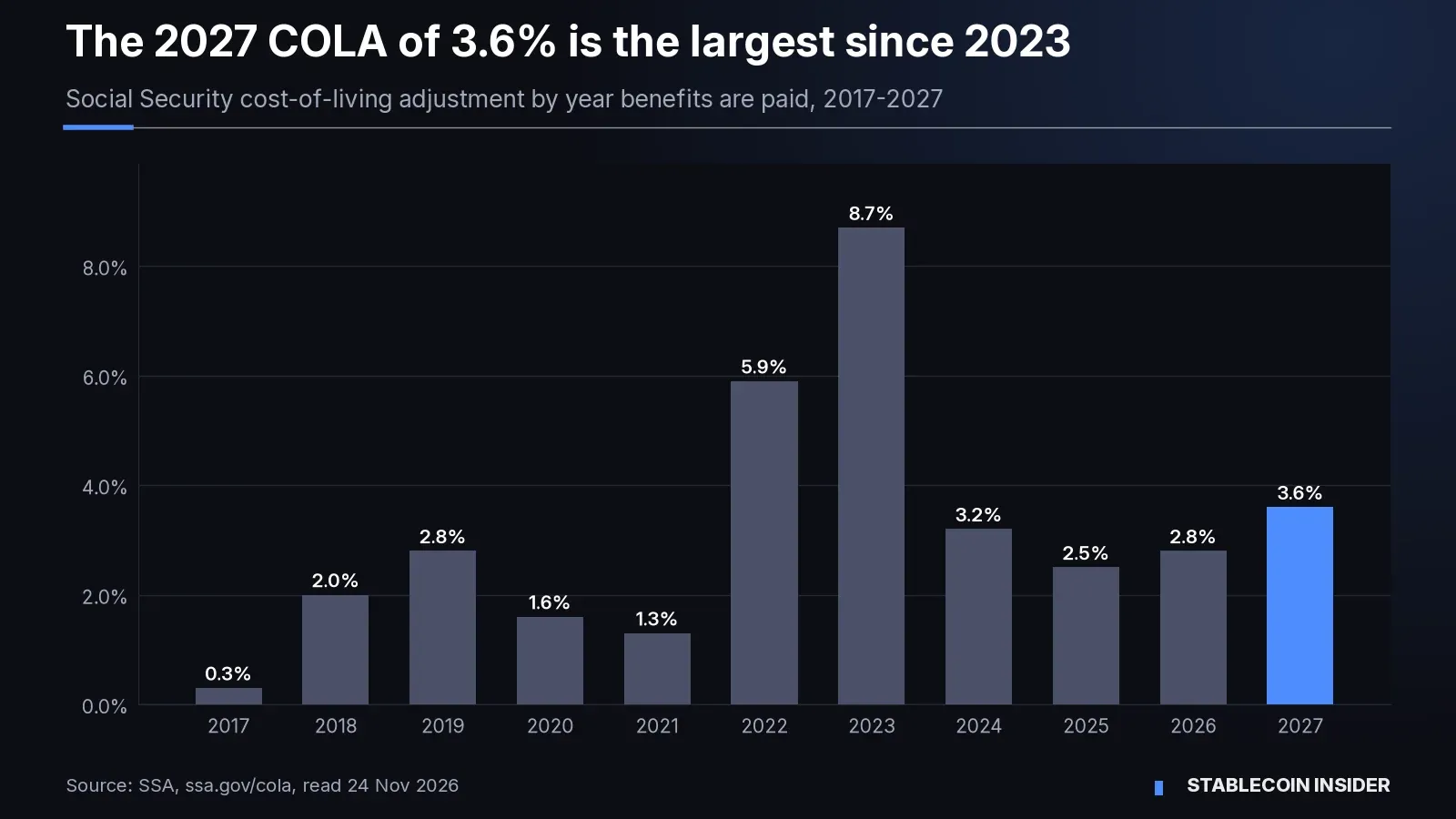
This section provides crucial information regarding the COLA for 2027. The 2027 COLA stands at 3.6%, an increase from 2.8% in 2026, marking the largest adjustment since the 8.7% increase in 2023. The SSA projects that the average retired worker's benefit will rise from $2,095 to $2,170 per month. The standard Part B premium will increase from $202.90 to $209.40, resulting in a net gain of about $68.50.
- The first enhanced payment will be disbursed on December 31, 2026, for SSI recipients and beneficiaries who began their benefits before May 1997. Others will receive their payments on January 13, 20, or 27, 2027, depending on their birth date.
- The earnings-test limit will rise to $25,560 (or $67,920 for those reaching full retirement age), and the payroll-tax cap will increase to $192,300.
- The income thresholds for taxing benefits ($25,000 for single filers and $32,000 for joint filers) will remain unchanged, which means that an increase in benefits could result in a higher portion of your benefits being taxable.
The 3.6% COLA applies to both Social Security and Supplemental Security Income, affecting around 76 million individuals, including nearly 72 million Social Security beneficiaries and about 7.3 million SSI recipients, some of whom receive both (SSA).
The increase is based on a percentage of each individual’s benefit, so the total dollar amount will vary depending on current benefit levels. For example, a monthly benefit of $1,000 will rise to $1,036. Below are SSA's estimates for typical households for January 2027:
| Household (SSA estimate) | Before COLA | After 3.6% COLA | Monthly raise |
|---|---|---|---|
| All retired workers | $2,095 | $2,170 | +$75 |
| Aged couple, both receiving | $3,238 | $3,355 | +$117 |
| Aged widow(er) alone | $1,936 | $2,005 | +$69 |
| Widowed mother and two children | $3,932 | $4,074 | +$142 |
| All disabled workers | $1,642 | $1,701 | +$59 |
These figures are averages from the SSA's 2027 COLA fact sheet and do not account for any Medicare deductions. Individuals can find their specific amounts on the COLA notice that SSA will distribute via the Message Center of their Social Security accounts in late November 2026, with paper notices being mailed in December.
How the 3.6% COLA was Determined
This section explains the methodology behind the COLA calculation. The 3.6% COLA was established by comparing the average inflation rates for the months of July to September 2026 with the same months in 2025. The law mandates the use of the Consumer Price Index for Urban Wage Earners and Clerical Workers (CPI-W) for this calculation, rounding to the nearest tenth of a percent (SSA Office of the Chief Actuary).
| CPI-W | 2025 | 2026 |
|---|---|---|
| July | 316.349 | 327.104 |
| August | 317.306 | 328.481 |
| September | 318.139 | 330.654 |
| Third-quarter average | 317.265 | 328.746 |
The calculation is as follows: (328.746 − 317.265) ÷ 317.265 = 3.62%, which rounds down to 3.6%. If the index had not increased, there would have been no COLA, as seen in 2010, 2011, and 2016.
Impact of Medicare Part B on Your Benefits
This section discusses how Medicare Part B affects the net increase in benefits. Your monthly check will increase by slightly less than 3.6% in dollar terms due to the deduction of Medicare Part B premiums, which will rise by $6.50 to $209.40 monthly in 2027 (CMS). For the average retired worker, the net deposit will grow from approximately $1,892.10 to $1,960.60.
The average benefits have been calculated with the standard premium deducted. This assumes only one standard Part B premium per person is taken out, with no income-related surcharge (IRMAA) or additional Part D or Medicare Advantage premiums withheld.
| Household | 2026 after Part B | 2027 after Part B | Net raise a month / year |
|---|---|---|---|
| Average retired worker | $1,892.10 | $1,960.60 | +$68.50 / +$822 |
| Aged couple, two premiums | $2,832.20 | $2,936.20 | +$104.00 / +$1,248 |
| Aged widow(er) alone | $1,733.10 | $1,795.60 | +$62.50 / +$750 |
| Disabled worker on Medicare | $1,439.10 | $1,491.60 | +$52.50 / +$630 |
To calculate your own adjusted amount, follow these three steps:
- Locate your gross benefit before deductions on your 2026 award letter or in your Social Security account.
- Multiply that amount by 1.036. For example, a $1,200 benefit would increase to $1,243.20, showing a raise of $43.20.
- Subtract the change in premium. If you pay the standard Part B premium, deduct $6.50. Thus, the $1,200 benefit nets $36.70 more each month.
If your benefit is relatively low, the hold-harmless rule may prevent the premium increase from reducing your net payment. Higher earners will be subject to IRMAA surcharges that begin at a total premium of $293.10 for single filers earning above $112,000. Our guide to the 2027 Medicare Part B premium provides further details.
Schedule for the First Enhanced Payment
This section outlines the payment schedule for the enhanced benefits. The initial larger payment will be available on Thursday, December 31, 2026, for SSI recipients or those who began receiving Social Security benefits before May 1997. Other recipients will receive their payments in January 2027, according to the Wednesday that corresponds with their birth date (SSA; SSA 2027 payment calendar).
| Who you are | Normal pay day | First payment with the 3.6% COLA |
|---|---|---|
| SSI recipients | 1st of the month | Thu 31 Dec 2026 (1 January is a holiday) |
| Started benefits before May 1997, or get SSI and Social Security | 3rd of the month | Thu 31 Dec 2026 (3 January is a Sunday) |
| Birthday on the 1st to 10th | 2nd Wednesday | Wed 13 Jan 2027 |
| Birthday on the 11th to 20th | 3rd Wednesday | Wed 20 Jan 2027 |
| Birthday on the 21st to 31st | 4th Wednesday | Wed 27 Jan 2027 |
SSI recipients will receive two deposits in December 2026: the regular payment on the 1st and the early arrival of the January 2027 payment on the 31st. This second deposit is not a bonus but rather January's payment arriving early, and there will be no SSI deposit in January itself. For SSI, the federal maximum will rise from $994 to $1,029 monthly for individuals and from $1,491 to $1,544 for couples.
Additional Changes on January 1, 2027
This section highlights other Social Security limits that will be adjusted. Several other Social Security limits will be adjusted on January 1, 2027, as they are linked to average wages or the COLA. These adjustments are detailed in the same SSA fact sheet.
| Limit | 2026 | 2027 | Who it affects |
|---|---|---|---|
| Taxable maximum (6.2% Social Security tax) | $184,500 | $192,300 | Workers earning above the cap |
| Earnings test, under full retirement age | $24,480 | $25,560 | Early claimers still working |
| Earnings test, year you reach full retirement age | $65,160 | $67,920 | Claimers turning full retirement age |
| Earnings for one work credit | $1,890 | $1,970 | Workers building credits |
| Substantial gainful activity (non-blind) | $1,690/mo | $1,770/mo | SSDI recipients who work |
| Trial work period month | $1,210/mo | $1,270/mo | SSDI recipients testing work |
| Maximum benefit at full retirement age | $4,152/mo | $4,188/mo | New retirees with top earnings |
Two of these changes merit closer attention. The maximum benefit rises by less than 3.6% because it pertains to a worker who first claims at full retirement age during that year, following the wage-indexed benefit formula for new claimants instead of the COLA. Furthermore, the SSI resource limits will remain at $2,000 for individuals and $3,000 for couples.
Example of the Earnings Test for Early Claimants
This section provides an example of how the earnings test will apply to early claimants. The earnings test will deduct $1 of benefits for every $2 earned over $25,560 in 2027 for individuals who are under full retirement age throughout the year. Full retirement age is set at 67 for anyone born in 1960 or later (SSA).
- For a 63-year-old earning $40,000 in 2027: ($40,000 − $25,560) ÷ 2 = $7,220 in benefits withheld. Under the 2026 limit, the same income would have resulted in $7,760 withheld, leaving you $540 better off with the higher limit.
- If you reach full retirement age in 2027 and earn $90,000 prior to that month: ($90,000 − $67,920) ÷ 3 = $7,360 withheld. Note that only earnings before reaching full retirement age are counted.
It’s important to note that withheld benefits are not permanently lost. The SSA states it will recalculate your benefit upon reaching full retirement age to account for the months in which benefits were reduced or withheld (SSA). Therefore, consider the earnings test as a postponement rather than a penalty.
Example of Payroll-Tax Cap Changes for Higher Earners
This section illustrates how the payroll-tax cap changes will affect higher earners. If you earn $200,000 in wages, your 6.2% Social Security tax will increase from $11,439.00 in 2026 to $11,922.60 in 2027, an additional $483.60, as the cap rises from $184,500 to $192,300. Your employer will incur the same additional expense. Self-employed individuals will pay 12.4% up to the cap, amounting to $23,845.20 instead of $22,878.00. If you earn less than $184,500, the cap increase will not affect you.
Tax Implications of the Raise
This section discusses the tax implications of the benefit increase. The benefit increase may also lead to a larger portion of your benefits being taxable, as the income thresholds are set in the tax code and do not adjust for inflation. IRS Publication 915 lists the same amounts for 2026. Up to 50% of benefits can be taxed once your combined income (half of your benefits plus other income, including tax-exempt interest) exceeds $25,000 for single filers or $32,000 for joint filers, and up to 85% for income above $34,000 single or $44,000 joint.
Consider a single retiree receiving the average benefit who also withdraws $14,000 annually from an IRA:
| Step | 2026 | 2027 |
|---|---|---|
| Annual benefit (average × 12) | $25,140 | $26,040 |
| Half of benefits | $12,570 | $13,020 |
| Plus IRA withdrawals | $14,000 | $14,000 |
| Combined income | $26,570 | $27,020 |
| Taxable benefit (half the excess over $25,000) | $785 | $1,010 |
This $900 increase results in an additional $225 added to taxable income in this scenario. While this may seem minor, it illustrates how your tax bill can rise even if your overall financial situation remains unchanged. For individuals aged 65 or older, the temporary $6,000 senior deduction may help mitigate some of this increase until 2028; refer to our guide for details on when the senior deduction expires.
Before Adjusting Your Budget: Four Considerations
This section outlines important considerations before adjusting your budget. Verify the net amount rather than the gross. Deductions for Part B, Part D, Medicare Advantage premiums, and voluntary tax withholdings are taken out before deposits. Review your Medicare plan for 2027. Any changes in plan premiums could absorb part of the increase. Our analysis on the value of Medicare Advantage in 2027 includes the 2027 out-of-pocket cap.
- Assess means-tested assistance. If you receive SSI, Medicaid, SNAP, or housing assistance, a higher benefit could alter those amounts, so expect notifications from the relevant agencies.
- Examine your withholding. If you have taxes withheld at rates of 7%, 10%, 12%, or 22%, the same rate will apply to a larger benefit.
Curious about the sustainability of COLAs at their current value? Our explainer on potential Social Security benefit cuts in 2032 discusses the outlook for the trust fund.
Frequently Asked Questions
This section addresses common questions regarding the COLA. When will I receive my 2027 COLA notice? Is the 2027 COLA identical for SSI and Social Security? Do I need to take any action to receive the COLA?
Final Insights
The 3.6% COLA represents the most significant raise since 2023; however, the amount that actually reaches your bank account will be lower: approximately $68.50 monthly for the average retiree after accounting for the $6.50 increase in Part B premiums. Look out for your COLA notice in late November or December, verify the net amount, and be aware of the new $25,560 earnings-test limit as you plan your finances for 2027.
Sources referenced (all accessed on November 24, 2026): SSA: Cost-of-Living Adjustment information for 2027; SSA: 2027 COLA fact sheet; SSA Office of the Chief Actuary: latest COLA computation; SSA: full retirement age and benefit reductions; SSA: schedule of Social Security payments for 2027; CMS: 2027 Medicare Parts A & B premiums and deductibles (November 17, 2026); IRS Publication 915 (2026); SSA: receiving benefits while working.