
In the wake of a significant Democratic win in the recent midterm elections, the White House is gearing up for major changes as a new Democratic Congress prepares to take office next year. Various regulatory agencies and lawmakers are collaborating to resume investigations into cryptocurrency transactions tied to the Trump family, which had previously been put on hold. Additionally, the president is putting forth Democratic candidates for key financial regulatory roles, while a prediction market is distancing itself from the Trump family. The cryptocurrency sector is beginning to understand that depending solely on a 'crypto president' may not suffice to boost market values.
On Friday, the Nasdaq experienced a sharp decline of over 5%, driven by concerns about a potential AI market bubble, which contributed to bitcoin's price falling below $56,000, its lowest point since September 2024. Although there was a brief recovery following Jensen Huang's return to Nvidia, by Tuesday, bitcoin had dropped back below $60,000, regaining only a fraction of its previous losses.
Currently, bitcoin is trading at levels lower than those observed when then-candidate Donald Trump proclaimed at the Bitcoin Conference 2024 that he would be the 'pro-bitcoin president that America needs.' This announcement came prior to crypto super PACs investing over $250 million in the elections and before the industry's efforts to influence congressional regulations. Consequently, the benefits of the so-called 'Trump pump' have completely diminished.
Moreover, bitcoin's price is significantly below its production costs. Recent evaluations from JPMorgan indicate that mining a single bitcoin incurs costs of approximately $86,000. In theory, miners operating at a loss should halt their activities, leading to reduced competition, which would subsequently decrease mining difficulty and costs. However, JPMorgan's assessments reveal that miners have been operating well below their break-even point for almost a year.
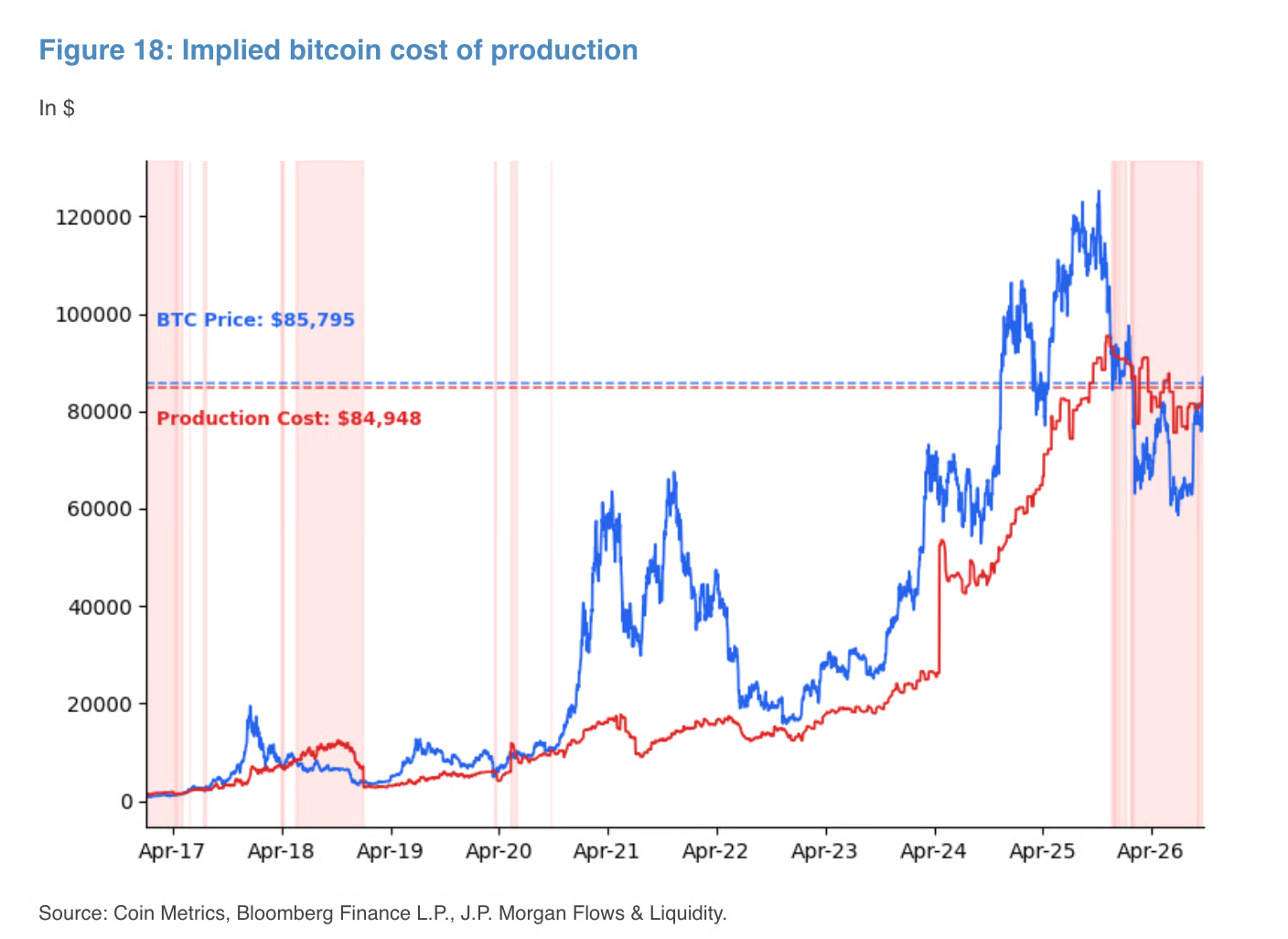
This situation is partly due to some costs already being sunk. Mining operations have invested in hardware, leases, and fixed power contracts, allowing them to continue mining without incurring losses on each coin. While this approach remains feasible for now, concerns may emerge as mining equipment becomes outdated, power contracts expire, or industry debts come due. Some miners are considering transitioning to AI data centers to capitalize on the next market opportunity, although recent events may prompt a reevaluation of this strategy.
Reflecting on the past, I recall when bitcoin was promoted as a safeguard against downturns similar to Friday's market drop. Proponents claimed it served as a protective measure against stock market declines, often labeling it 'digital gold.' However, when technology stocks plummeted, bitcoin mirrored that decline and, unlike those stocks, it has yet to recover.
Regulatory Developments
Since the appointments of chairpersons for the SEC and CFTC in 2025, Trump has not indicated further nominations for these commissions, which typically consist of five members, ensuring that no more than three belong to the same political party. Consequently, the CFTC currently has Mike Selig, a Trump loyalist, serving as its sole commissioner—an arrangement Trump seems content to maintain. Similarly, the SEC is led by Republican Chair Paul Atkins, who is accompanied by only one other commissioner, Republican Mark Uyeda.
However, it appears that Trump and his advisors have recognized that their chances of securing confirmations for his often-controversial and underqualified nominees are dwindling and are likely to continue to diminish once the new Congress is in session. They seem to be aware that the incoming Congress will be less inclined to allow one or two commissioners to determine the entire agency's agenda and regulations. On November 12, Trump nominated both a Republican and a Democrat for each agency: Republican Steven Levine and Democrat Kristin Johnson for the SEC, along with Republican Nathan Anonick and Democrat Matthew Rowland for the CFTC. These nominations are relatively standard compared to some of Trump’s previous selections. Levine has served as counsel and deputy chief of staff to Uyeda and has acted as general counsel for the White House Council of Economic Advisers. Johnson is a law professor at George Washington University and a former CFTC commissioner. Anonick is currently counsel to the Senate Agriculture Committee and played a pivotal role in negotiating the Clarity Act. Rowland is a career CFTC attorney who also contributed to the Clarity Act.
The nomination hearings were largely uneventful, although Democrats raised several critiques. During the Senate Banking Committee hearing for SEC candidates, Senator Elizabeth Warren criticized the SEC for weakening its enforcement division and for dropping cases against wealthy associates of the president who break laws. She expressed concern that Levine would exacerbate these issues, referencing Trump's 401(k) executive order from August 2025, which was issued while Levine was in the White House. She questioned whether Levine would act differently than 'another puppet who will prioritize Wall Street profits over safeguarding American investors.' Nevertheless, both SEC nominees during the hearing reaffirmed their commitment to maintaining the agency's independence and proactive enforcement. Johnson, the Democratic nominee, went further, stating that the significant reduction in SEC enforcement actions was 'concerning,' while Levine merely acknowledged the decline in actions. Johnson also challenged the agency's expedited crypto rulemaking, suggesting that the exemptive order allowing tokenized stock venues should undergo the formal rulemaking process with an opportunity for public comments.
During the Senate Agriculture Committee hearing for the CFTC nominees, both candidates insisted that regulations should be enforced regardless of any affiliations with companies, including those linked to the president. They faced inquiries regarding prediction markets, over which the CFTC, under Selig, claims exclusive jurisdiction. Rowland, the Democratic nominee, stressed the need for the agency to carefully balance public interest with the economic utility of these contracts. When Senator Ben Ray Luján asked whether the CFTC, which has cut its workforce by a quarter during Trump's second term, needs additional personnel, Anonick replied that he believed the agency should be 'appropriately resourced.' Luján noted, 'I understand that if you say too much, Trump will withdraw your nominations.'
Tokenized Stocks
The initial tokenized stocks have begun trading following the SEC's announcement of its 'innovation exception' in September. However, they are facing resistance from the companies whose stocks are being tokenized. Of the 62 companies proposed for tokenization in a joint venture between OKX and the Intercontinental Exchange, 56 have filed objections preventing their shares from being tokenized. This group includes major corporations such as Walmart, Costco, Nvidia, Microsoft, Tesla, JPMorgan Chase, and Wells Fargo. The remaining six companies are from the crypto sector: Coinbase, Robinhood, Circle, Microstrategy, Securitize, and BitGo.
Perpetual Futures
The CFTC continues its efforts to launch perpetual futures, or 'perps,' in American markets—a product that until recently could only be traded on offshore crypto exchanges. Back in June, I reported on the CFTC’s approval of the first bitcoin-based perpetual futures contracts offered by Kalshi. On November 3, the CFTC approved perps for individual stocks, with Kalshi’s contracts launching two days later, coinciding with the largest tech stock sell-off since the COVID-19 pandemic began. 'The CFTC is eager to push the boundaries of its legal interpretations and collaborate with its regulated entities,' stated Tyler Gellasch, president of the Healthy Markets Association, in an interview with the New York Times.
Retail traders quickly became involved, particularly amid the controversy surrounding Jensen Huang's departure and subsequent reinstatement as Nvidia's CEO, generating over $100 million in perp volume in just one day. Kalshi offered leverage of up to approximately 5×, meaning that any stock price movement was magnified fivefold. A drop of less than 4% is sufficient for Kalshi to automatically close a fully leveraged long position, and Nvidia's stock fell 14% last Friday.
Both rounds of approvals have swiftly led to lawsuits, creating a confrontation with unusual allies on both sides: regulators, prediction markets, and crypto firms on one side, and Wall Street incumbents and investor advocates on the other. The CME Group filed a lawsuit regarding the initial bitcoin perps approval in June, claiming that perps are essentially swaps and should be subject to stricter regulations under Dodd–Frank. The approval of the new stock perps prompted a same-day lawsuit from the Capital Markets Alliance Association, which argues that these new products are security-based swaps and therefore fall under the SEC's jurisdiction.
The outlook appears grim for the CFTC and the venues offering perps. A judge indicated that the plaintiff is likely to prevail on its claim that the CFTC lacks the authority to permit these products, as they do not meet the definition of futures contracts governed by the CFTC. She also noted that 'the CFTC’s actions seem to represent a significant disruption to the equities market' and found that public interest favors preventing such disruption, although she did not grant a temporary restraining order solely because the plaintiff had not demonstrated a likelihood of suffering irreparable harm without emergency relief.
Congressional Developments
As Democrats prepare to assume the majority, they are intensifying their oversight initiatives. Senator Elizabeth Warren, expected to chair the Senate Banking Committee, intends to focus investigations into the Trump family's cryptocurrency ventures and prediction markets, according to her office. Over the past two years, she has laid the groundwork for these inquiries through numerous letters, most of which went unanswered—an all-too-common issue for correspondence from minority members. As chair, she will possess subpoena power, warning that the Trump family's crypto enterprises and others 'should preserve their documents and prepare to answer tough questions,' according to a committee aide.
Senator Richard Blumenthal, anticipated to lead the Senate’s Permanent Subcommittee on Investigations, has placed 'crypto corruption' at the forefront of his agenda. He has resent several letters from earlier this year and the previous year to recipients who either failed to respond or provided inadequate answers. These letters include inquiries to Fight Fight Fight (an entity linked to the $TRUMP memecoin) and World Liberty Financial regarding ethics violations and interactions with foreign entities, some of which are under federal investigation; a letter to Tether concerning illicit finance on its platform; and a letter to Binance, referencing earlier reporting. He has also corresponded with all known contributors to Trump’s ballroom project, highlighting pay-to-play concerns; recipients include the Winklevoss twins from Gemini, Paxos CEO Charles Cascarilla, Coinbase CEO Brian Armstrong, Kraken co-CEO Arjun Sethi, Ripple CEO Brad Garlinghouse, Tether CEO Paolo Ardoino, Intercontinental Exchange CEO Jeffrey Sprecher, and the Lutnick family from Cantor Fitzgerald.
In the House, incoming Oversight Committee chair Robert Garcia has sent document preservation letters to a dozen individuals closely associated with the president, including sons Donald Trump Jr. and Eric Trump, whom he referred to as 'key players in the Trump family’s pay-to-play schemes' through their roles at World Liberty Financial. 'Lawyer up,' Garcia posted on social media shortly after Democrats secured the House majority.
The administration, along with various Trump loyalists, is already working to depict these investigations as unlawful lawfare against innocent parties. White House Counsel William Scharf—or possibly an individual signing his name to misguided letters—warned Representative Garcia that his 'abusive and capricious threats' could 'cross the line into blatant criminality.' Similar warnings emerged from the U.S. Attorney for the Southern District of Texas, Aaron Reitz, who lacks any apparent jurisdiction over a Massachusetts senator’s oversight duties but nevertheless seemed to relish sending a letter to Elizabeth Warren filled with derogatory stereotypes.
Changes in Prediction Markets
The Democratic wave has also initiated changes in prediction markets, which have surged since Trump regained office, primarily due to his CFTC chair’s transition from regulator to proponent.
Kalshi, which recently opted to cut ties with Donald Trump Jr., who had joined as a strategic advisor just a week before Trump’s inauguration, cited his venture firm 1789 Capital’s 'significant investment in a competitor this past summer'—referring to the $1 billion funding round for Polymarket led by 1789 in August. However, 1789 has been invested in Polymarket since August 2025, when Trump Jr. also joined its advisory board. I have previously pointed out the absurdity of him advising both companies, but Kalshi appears to wish to imply it just became aware of the conflict.
The timing of this separation coincides with the Democrats’ pledges to investigate the Trump family's lucrative businesses, including the prediction markets that Trump’s regulators have been clearing for the last two years. In a statement, Kalshi expressed gratitude to Trump Jr. for 'helping us market Kalshi to more customers.' This response is not significantly better than the one its co-CEOs provided a year ago, when they appeared on CBS with only one prepared answer regarding Trump Jr.'s advisory role.
Interviewer Jo Ling Kent: Why did you guys make Donald Trump Jr. a strategic advisor?
Kalshi co-CEO Tarek Mansour: We have a lot of advisors. And they span across the board, across different functions. But really, this is all about growing this industry, the prediction market industry, that a lot of people really believe in.
Kent: What kind of advice does he give you?
Mansour: So it really is, again, about growing prediction markets. He believes in prediction markets. We believe in prediction markets. A lot of people believe in prediction markets. And it’s really about go-to-market and expansion plans.
Kent: Does he come to meetings? How much do you pay him? What’s his role? I mean, this is the son of the president.
Mansour: We, again, I mean... we have a lot of advisors. And whether it’s our investors, whether it’s people that we really trust and respect...
Kent: Well, he’s not just any advisor. He has a direct line to the White House.
Mansour: We have a lot of advisors.
Legal Challenges
Prediction markets continue to face significant legal hurdles as more states file lawsuits against the platforms while the CFTC and Justice Department strive to protect them. The situation has intensified in Utah, where Kalshi filed a lawsuit in February seeking a declaration to prevent the enforcement of the state’s gambling laws against the company, but lost in August. Following this, the state sued Kalshi, the federal government took action against the state, and felony charges were brought against Kalshi and its two co-founders. On November 23, Kalshi announced it would pause operations in Utah, citing its loss in the original lawsuit. The company seems to have anticipated a more favorable ruling in the CFTC’s case against the state; however, on November 20, the judge, who previously ruled against Kalshi, indicated that the CFTC faced significant challenges in arguing against Utah’s application of its gambling laws to the platform. As a result, Kalshi paused operations the next business day.

Just weeks earlier, the CFTC had issued a directive instructing exchanges not to shut down in specific states, with CFTC Chair Selig asserting that 'geographic access restrictions are inconsistent with' federal law. This situation places Kalshi in a precarious position, although that may have been the intent. The move appears designed to provide prediction markets with the argument that they cannot simultaneously comply with both federal and state laws, thereby reinforcing the CFTC’s preemption arguments. However, courts have consistently rejected variations of that argument, including the Utah judge in Kalshi's own case. Senator Adam Schiff (D-CA) reacted to the CFTC’s interpretation by accusing the agency’s 'rogue chairman' of 'encouraging platforms to continue offering gambling products in defiance of these court orders,' labeling it 'the CFTC’s most egregious attempt yet to undermine state law, the Tribes, and now, the courts.'
The federal government has expressed support for Kalshi and other prediction markets, now involved in twelve lawsuits against states to assert what it maintains is its exclusive authority to regulate the platforms—a right it seems to be seeking to establish primarily in order to decline to exercise it. Recent outcomes have not favored the government. On November 20, a federal judge dismissed the CFTC’s effort to block a case in New York, ruling that the agency had not sufficiently demonstrated it was likely to succeed on its claim that federal law supersedes state gambling laws. She noted that three federal appellate courts have determined that states can regulate prediction markets, with a fourth ruling in favor of the prediction markets, suggesting that the Supreme Court will ultimately address the issue.
Kalshi has generally maintained a bold public stance regarding these lawsuits, seemingly emboldened by its governmental allies. It labeled the Utah criminal charges as 'a crazy overreach.' In July, following New York's lawsuit against the company, a spokesperson remarked, 'It’s disheartening to witness this kind of political theater from leadership in our own state. States can’t simply shut down a federally licensed exchange.' However, in court, Kalshi’s approach is markedly different. In a letter urging New York Supreme Court Justice Melissa Crane to deny a temporary restraining order, Kalshi cautioned that such an order could 'shut down operation of Kalshi’s federal derivatives exchange not only in the state but nationwide, as Kalshi is headquartered in New York,' and endorsed the CFTC’s view that a shutdown would pose an 'existential threat' to the company. This indicates that Kalshi is concerned that states can indeed close a federally licensed exchange.
On November 23, Justice Crane denied the temporary restraining order and questioned why New York is not awaiting the Supreme Court's decision on the matter. 'That ultimately will bind me,' she remarked. However, she expressed concern regarding Kalshi’s policy of allowing anyone aged 18 or older to use the platform, while New York’s sports gambling laws stipulate a minimum betting age of 21. She requested both parties to report back by November 30 on whether they could reach a compromise regarding restrictions for younger users; a lawyer representing Kalshi indicated the company might be open to negotiations for certain categories of bets.
Amid these challenges, the CFTC has also been drafting new rules for prediction markets, including one that would formally classify event contracts as swaps and differentiate them from casino-style bets, and another, currently under White House review, that seeks to define which contracts qualify as 'gaming.' A bipartisan coalition of attorneys general from 43 states and DC has formally opposed the first set of rules, asserting that the swaps proposal 'rests on a legal fiction' and exceeds the CFTC’s statutory authority.
The surge in rulemaking gives the impression of an agency attempting to get ahead of the Supreme Court, but an agency cannot simply rewrite the law it is responsible for enforcing. The Court will ultimately determine whether event contracts are swaps and if federal law supersedes state gambling regulations; if the justices conclude that it does not, no CFTC regulation will change that outcome.
DEATH BETS Act
On November 19, the Senate unanimously passed the DEATH BETS Act, introduced by Senators Adam Schiff (D-CA) and John Curtis (R-UT), which would prohibit CFTC-registered exchanges from offering contracts related to terrorism, assassination, warfare, U.S. military operations, or an individual’s death. Currently, the Commodity Exchange Act allows the CFTC to determine whether to ban these types of contracts. In a press release, Senator Schiff stated.
“pro-bitcoin president that America needs”
Schiff’s press release further noted, 'Lawmakers have previously raised alarms to the CFTC about these “hobbled its enforcement division and... dropped cases against the President’s billionaire buddies when they cheat American families” being offered on offshore exchanges, such as those predicting whether Artemis II would explode, Maduro would be ousted, or the Ukrainian town of Myrnohad would fall to Russian forces.' While the bill is a positive step, it remains unclear whether it would effectively prohibit all of the bets its sponsors referenced—especially since many were offered on offshore platforms. The market predicting Maduro’s removal did not mention war. A prediction regarding the explosion of the Artemis II rocket involves a scenario that could lead to death but is framed in a way that hinges on a rocket failure, which may not fall under the bill’s criteria for contracts resolving primarily based on an individual’s death. Additionally, the bill likely would not affect markets related to wildfire predictions or contracts that emerged amid rumors of Trump’s death last year, which asked whether he would be 'out as president.' Both can resolve on various outcomes that do not involve death while still fitting within the ambiguous category of contracts that could incentivize bettors to engage in risky or lethal behavior to secure a payout.
Judicial Proceedings
MEV Bot Case
A federal judge has acquitted the Peraire-Bueno brothers, who were indicted in May 2024 for exploiting Ethereum MEV bots—a controversial type of software that profits at the expense of traders by front-running or otherwise diminishing their trades. A jury deadlocked on the case in November 2025. The judge concluded that the prosecutors had not convincingly established that the brothers committed wire fraud or related offenses. This outcome is perceived as a victory for the often-invoked, yet rarely successful, 'code is law' argument. Much of the decision hinged on the perception that crypto operates in a lawless environment: 'Ethereum is a... trustless, highly adversarial environment with no terms of use,' wrote Judge Jessica Clarke. 'Participants concoct different strategies—often using pre-programmed bots—to compete to obtain value, without the safeguards that exist in regulated markets.' This result is likely more favorable than what the brothers had anticipated, especially given their Google search history following the theft, which included phrases like 'how to wash crypto,' 'top crypto lawyers,' and 'prison or jail worse.'
Justin Sun v. World Liberty Financial
Justin Sun is pursuing sanctions against the Trump family’s World Liberty Financial and its legal team for obscuring its connections to the United Arab Emirates. Sun and World Liberty are embroiled in a contentious legal dispute after Sun filed a lawsuit against WLF for freezing WLFI tokens he had purchased for tens of millions of dollars, while WLF countersued Sun for defamation. Initially, World Liberty claimed it was a Florida citizen. However, after a judge allowed some of Sun’s claims to progress rather than mandating arbitration, World Liberty revised its disclosures, revealing nearly two dozen entities with ownership stakes, including several from the UAE. The company now argues that its non-U.S. ownership precludes a federal court from handling the dispute between foreign parties. Sun tweeted, 'World Liberty was proudly American when it was selling tokens. It only discovered its UAE roots when it needed a way out of an American federal courtroom.'
In their opposition to sanctions, World Liberty’s attorneys stated, 'World Liberty’s counsel was not aware when it filed the Initial Disclosure that World Liberty had any foreign citizenship.' This assertion is striking, considering that an Emirati royal’s estimated $500 million stake in the company had been widely reported prior to the erroneous disclosure filing, and the attorneys would only have needed to inquire with their client.
Custodia Bank
Custodia Bank's lengthy six-year quest to obtain a Federal Reserve master account has reached its conclusion, as the Supreme Court has declined to hear its appeal. Custodia argues that, as a chartered depository institution, it is entitled to a master account rather than merely being eligible for one. The Tenth Circuit upheld the lower court's ruling against Custodia, stating that the company was 'attempt[ing] to impair the Fed’s ability to safeguard our nation’s financial system.' It seems that this decision is now final.
Most crypto firms have shifted away from seeking full master accounts, instead advocating for proposals that would grant them access to federal banking systems through 'skinny' master accounts or limited-purpose master accounts similar to the one granted to Kraken in March. However, Custodia contends that these alternatives are inadequate because they would not allow access to automated-clearing systems and would limit account balances, preventing them from earning interest on those balances.
Trump's Business Ventures
Trump has hosted his third memecoin dinner, following similar events in May 2025 and April 2026. Like its predecessors, this event failed to bolster the declining price of the token, which has now dropped below $1. Marketed as an 'evening of legends,' the dinner featured appearances from notable figures like Floyd Mayweather, a boxer who has not fought professionally since 2017; Tristan Thompson, a former NBA player who has been off the court for two seasons; 'mentalist' Lior Suchard; and crypto advocate Kevin O’Leary. As with previous dinners, many attendees were likely foreign nationals—barred from contributing to Trump’s campaign committees, yet invited to financially benefit the president through such events.
Just before the dinner, the New York Times reported that CFTC officials had initiated a fraud investigation into the memecoin shortly after its launch in 2025, only to promptly abandon it, concluding that the agency would not approve the subpoenas the investigation would necessitate. This represents the only known federal inquiry into Trump’s business dealings during his second term. At that time, the agency had four commissioners, including two Democrats, although three were departing. The remaining commissioner, acting chair Republican Caroline Pham, had directed the agency not to pursue charges against crypto firms for regulatory violations, encouraged the enforcement division to abandon crypto investigations, and intervened to clear the regulatory pathway for several crypto companies with ties to Trump and his family. Staff determined that an investigation into Trump would not yield significant results. Pham later left the agency after Trump’s nominee was confirmed, joining the crypto firm MoonPay, a frequent partner in Trump’s business dealings.
Web3 Developments
Between October 15 and November 24, there were seventeen incidents resulting in an addition of $3.526 billion to the grift counter.
- Fusionist exploited for $1.87 million [ link ]
- Cyber bridge exploited for almost $1 million [ link ]
- Chainflip suffers a $12 million loss due to a key compromise [ link ]
- K3 Capital's yield-bearing sBOLD vault drained in a flash loan attack [ link ]
- Lighter user(s) exploited for $15 million [ link ]
- Kava Lend exploited for $3.8 million [ link ]
- DataVault AI's stock plummets after claiming it can't access its own bitcoin [ link ]
- Initia experiences a second exploit less than a month after the last one [ link ]
- Mercado Bitcoin halts withdrawals following a $40 million hack [ link ]
- French bank Crédit Mutuel Arkéa hit in a $133 million crypto theft [ link ]
- Polymarket users' funds again stolen [ link ]
- North Korea hacks Binance for around $6.3 billion, some of which is frozen [ link ]
- Initia incurs a $2.7 million loss after an unauthorized mint exploit [ link ]
- CoinDCX admits to a $16 million theft after previously claiming it was a 'false alarm'
- Keystone plans to destroy 18,835 hardware wallets after a website breach [ link ]
- Cysic bridge exploited [ link ]
- AI-focused Qubic blockchain halts after weak wallet seeds lead to $1.4 million in thefts [ link ]
In the Spotlight
I joined Adam Becker on the Dreaming Against the Machine podcast, participated in a post-election panel with Brian Merchant for his Blood in the Machine podcast, and my work regarding the midterm elections has been cited by numerous publications.
This concludes the report for now. Until next time!