
Only 32.9% of retail cross-border payments currently reach the recipient within one hour, falling short of the G20 target of 75% by the end of 2027. Furthermore, the proportion credited within one business day decreased to 59.8% in 2026, down from 74% in 2023.
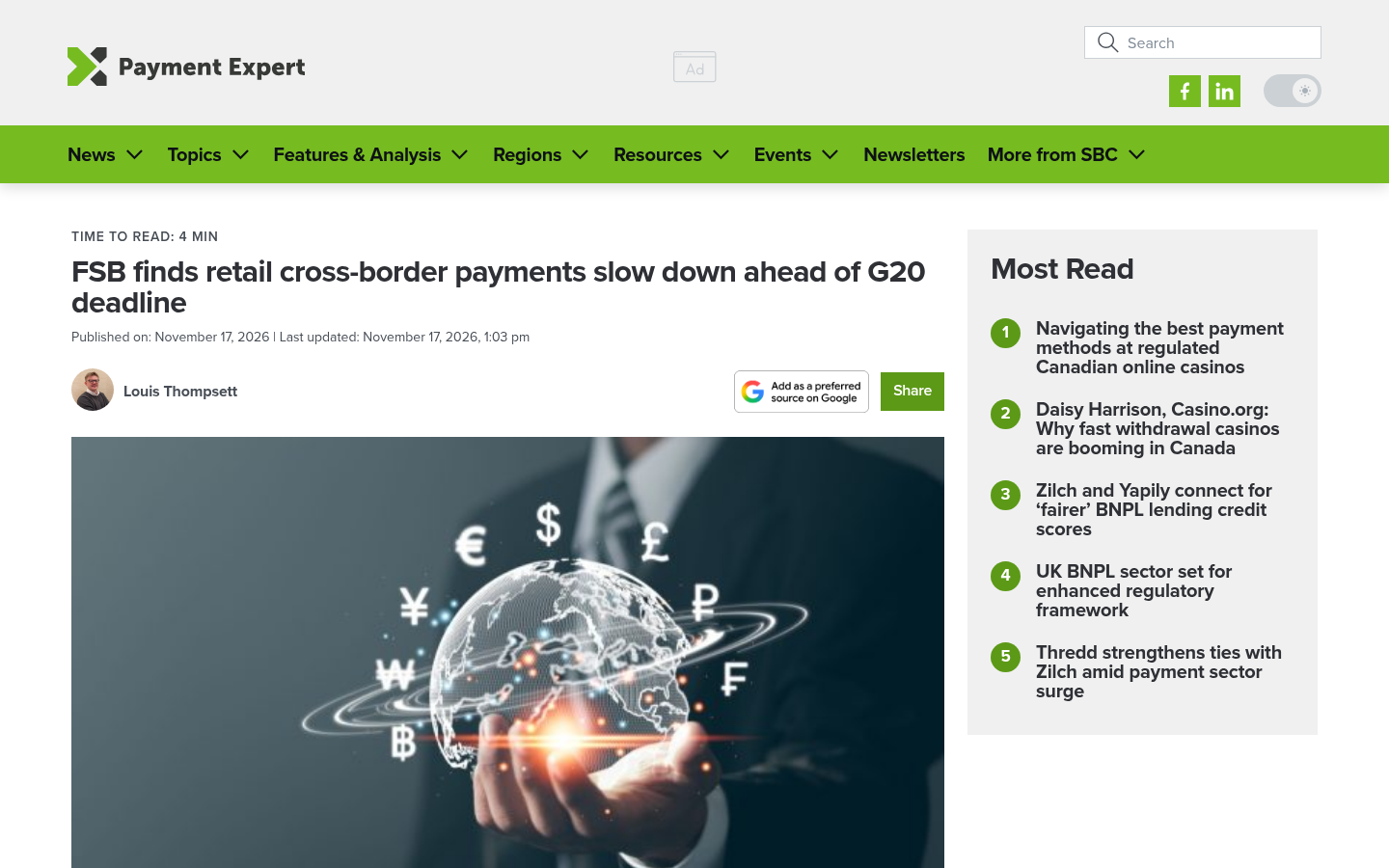
The G20's cross-border payment targets serve as a significant global benchmark for evaluating the efficiency of international money movement.
Established in 2021, these targets aim to enhance cross-border payments by making them more affordable, quicker, accessible, and transparent by the end of 2027.
With less than a year remaining, a recent report from the Financial Stability Board indicates that achieving most of these objectives appears unlikely.
This analysis will detail the targets, the 2026 scorecard results, reasons for the stagnation in progress, the role of stablecoins and instant payment links, and key developments to monitor as the deadline approaches.
Key Takeaways
- The G20 aims for 75% of cross-border payments to be credited within one hour.
- Retail payment speeds declined in 2026.
- Average retail costs remain between 1.5% and 2.7%, surpassing the 1% target.
- SWIFT's wholesale payments improved, with 57% credited within one hour.
- Stablecoins constituted only about 0.31% of retail cross-border flows in 2025.
Defining the G20 Targets
In 2021, G20 leaders approved 11 global targets for cross-border payments across three categories: wholesale payments, retail payments, and remittances. These targets address four critical issues: cost, speed, access, and transparency. While most targets are due by the end of 2027, the remittance cost target aligns with the UN goal for 2030.
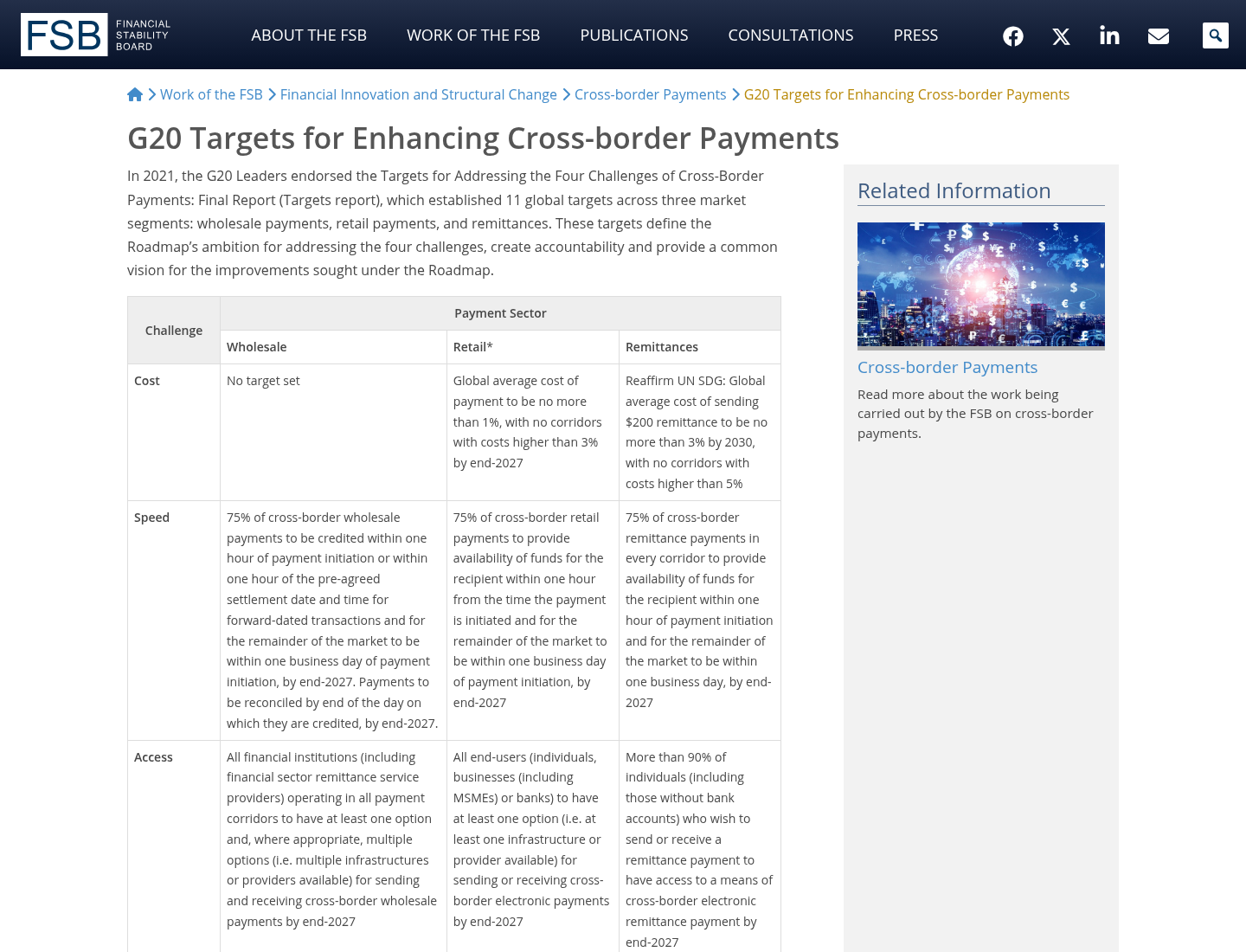
| Target | Goal | Deadline |
|---|---|---|
| Retail cost | Under 1% average | End-2027 |
| Retail speed | 75% within 1 hour | End-2027 |
| Wholesale speed | 75% within 1 hour | End-2027 |
| Remittance cost | 3% for $200 | 2030 |
| Remittance access | Over 90% of people | End-2027 |
The transparency objective mandates that all payment providers disclose the total costs, including foreign exchange fees, expected delivery times, payment tracking, and terms of service by the end of 2027.
2026 Progress Report
The Financial Stability Board released its 2026 consolidated progress report on November 16. The report states that while the international policy initiatives under the G20 Roadmap are mostly finalized, the progress experienced by end users regarding cost, speed, access, and transparency remains "remains gradual and uneven across regions and segments"
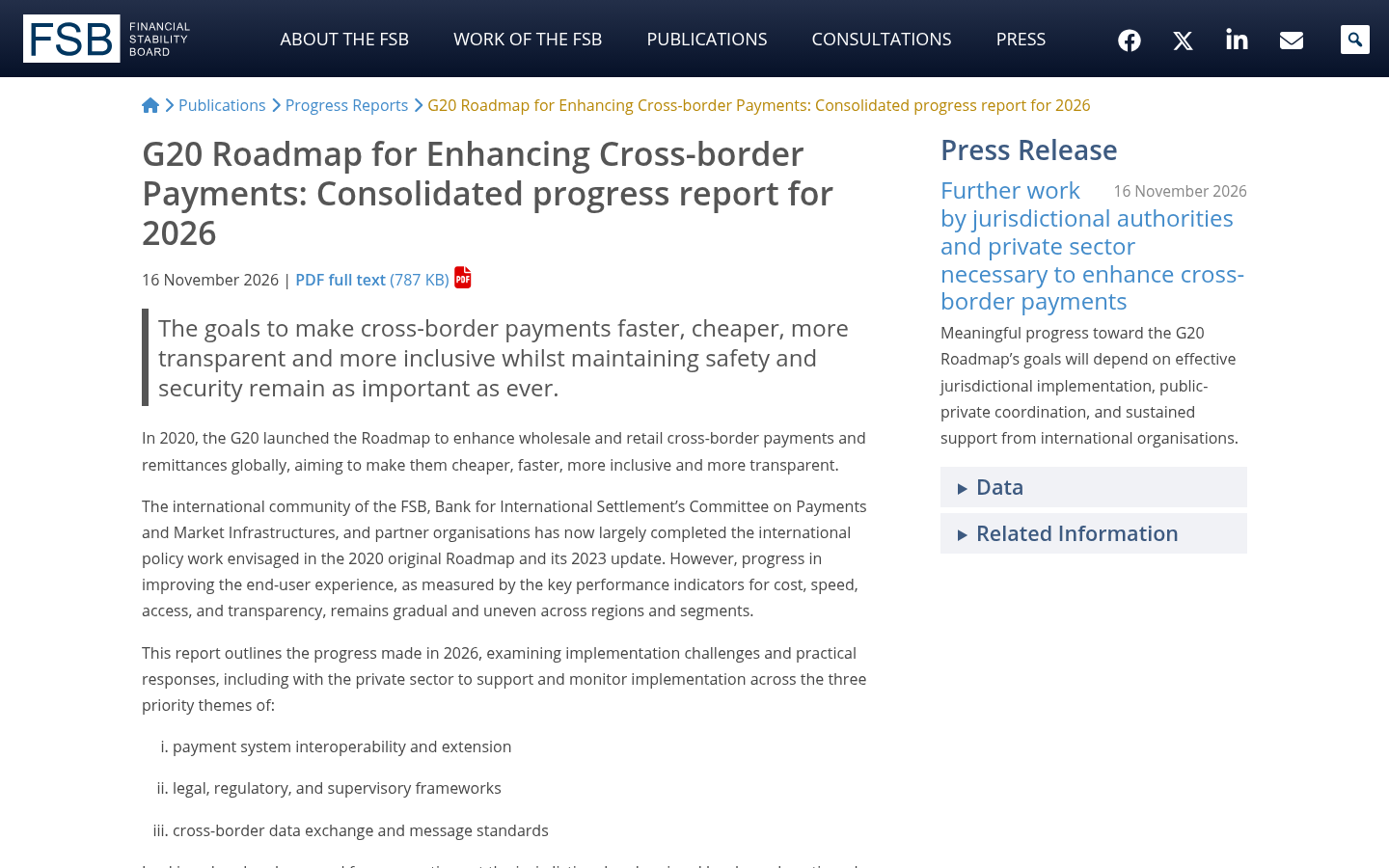
| Measure | Target | 2026 Result |
|---|---|---|
| Retail within 1 hour | 75% | 32.9% |
| Retail within 1 day | Rest of market | 59.8% |
| Retail cost | 1% | 1.5% to 2.7% |
| $200 remittance cost | 3% | 5.7% |
| Wholesale within 1 hour | 75% | 57% |
- Retail speed decreased: The proportion of payments credited within one business day fell from 74% in 2023 and 67.3% in 2025 to 59.8% in 2026.
- Retail costs remained unchanged: Average costs varied from 1.5% for business-to-business payments to 2.7% for person-to-person transactions, consistent since 2023.
- High-cost corridors: The percentage of retail corridors with costs exceeding 3% decreased to 15.1% from 18.3%, yet this was insufficient to affect overall averages.
- Remittance costs: The cost for a $200 remittance dropped to 5.7%, though almost all reductions since 2023 stemmed from adjustments in exchange rate benchmarks.
- Wholesale advancement: On SWIFT, 57% of wholesale transactions were credited within one hour, up from 53.8% in 2023, aided by improved data following the ISO 20022 migration.
Reasons for Stalled Progress
The Financial Stability Board attributes the lingering obstacles primarily to national-level issues, including data management, licensing, and fraud regulations. Its survey conducted with the Bank for International Settlements Committee on Payments and Market Infrastructures highlighted several concerning trends.
- Data localization: 48% of jurisdictions reported regulations restricting the locations where payment data can be stored, an increase from 31% in 2025.
- Outdated licensing requirements: One-third of respondents had not revised expectations for payment providers since 2020, and 57% had not conducted risk assessments encompassing both bank and non-bank providers.
- Fraud data sharing: There has been minimal progress in sharing fraud data internationally, hindered by varying privacy regulations.
Delays often occur during the final stages of the payment process. Data from SWIFT indicates that up to 80% of delays take place after the payment exits the SWIFT network, en route to the recipient's account.
The Financial Stability Board has urged jurisdictions to develop national action plans outlining their strategies through the end of 2027, with nearly all G20 members indicating their intention to produce such plans.
The Role of Stablecoins
Stablecoins are frequently promoted as a solution to the inefficiencies of slow and costly cross-border payments, yet their market presence remains limited. FXC Intelligence and Allium estimate that stablecoins accounted for approximately $135 billion of the $44.3 trillion retail cross-border market in 2025, representing only 0.31%, a rise from 0.20% in 2024.
- Settlement instead of checkout: In many cases, customers utilize ordinary currencies for sending and receiving funds, while stablecoins serve as intermediaries for settlement.
- Established players entering the market: Mastercard finalized its acquisition of BVNK in August 2026, and Western Union introduced its own stablecoin, USDPT, in May 2026.
- US regulations introduced: The GENIUS Act will be enacted on January 18, 2027, mandating that only approved issuers can offer payment stablecoins in the US.
Development banks are exploring similar concepts, as discussed in our analysis of the World Bank, Citi, and Circle's stablecoin disbursement trial. For available options today, refer to our guide on stablecoin FX platforms for cross-border payments.
Instant Payment Links and Other Solutions
Linking domestic instant payment systems emerges as the primary public-sector strategy to tackle speed challenges. The Paypers reports that Nexus Global Payments, which is being established by central banks and payment system operators from India, Malaysia, the Philippines, Singapore, and Thailand, aims to launch in 2027, and the number of rapid payment systems planning international links has doubled over the past year.
- Nexus: Each domestic payment system connects once to a shared hub, avoiding the need for multiple bilateral links.
- SWIFT: Enhanced ISO 20022 data has contributed to improved wholesale speed, and SWIFT is broadening its retail payments initiative.
- Domestic infrastructure: Systems like the EU's SEPA Instant and the US FedNow determine the speed of the final payment delivery.
Our analysis compares SWIFT's blockchain ledger against stablecoins, as well as FedNow versus RTP versus stablecoins, examining how these systems compete.
Implications for Payment Providers and Users
- Corridor performance is crucial: Providers demonstrating specific corridors that meet speed and cost targets will have a strong competitive advantage.
- Transparency is an achievable goal: Disclosing comprehensive costs, FX margins, and delivery times upfront is manageable for each provider.
- Regulatory factors influence access: Licensing and data regulations in each country will determine which providers can offer expedited routes.
- Remittance customers continue to face high costs: Averaging around 6% for a $200 transfer, it is essential to compare services.
Remittance fees are also under new scrutiny in the US, as discussed in our examination of the US remittance tax.
What to Monitor
- National action plans: The FSB intends to release a summary of G20 members' plans in early 2027.
- Possible deadline extension: The G20 may consider extending the timeline or revising the targets post-2027.
- Nexus launch: The effectiveness of the Nexus hub in linking Asian instant payment systems in 2027.
- GENIUS Act: The impact of US stablecoin regulations from January 18, 2027, on cross-border settlements.
- Peer review: The FSB's 2027 assessment of how members implement its regulations for payment providers and data management.
Conclusion
Current assessments of the frameworks facilitating cross-border financial transactions reveal that the G20 scorecard highlights the significant distance still to traverse to meet its own benchmarks.
While the rules and standards are predominantly established, end users have yet to experience faster or more affordable payment options, with retail speed actually deteriorating in 2026.
Future improvements hinge on national governments addressing issues related to data regulations, licensing, and the interconnections between domestic payment systems.
Although stablecoins and instant payment links present potential faster solutions, their current scale is unlikely to bridge the gap before the end-2027 deadline.
- Pension Surplus Sharing: What the New DB Rules Mean for You From April 2027
- Chime vs SoFi in 2026: Savings APY, Fees and Overdraft
- Direct Group Liquidation: 21 Companies Wound Up, and Who Gets Paid First
Frequently Asked Questions
1. What are the G20 cross-border payment targets?
The G20 cross-border payment targets consist of 11 objectives established in 2021 to enhance the cost-effectiveness, speed, accessibility, and transparency of cross-border payments. These targets encompass wholesale payments, retail payments, and remittances, with most deadlines set for the end of 2027.
2. Will the G20 achieve its 2027 cross-border payment objectives?
It appears unlikely that the G20 will meet the majority of its 2027 cross-border payment targets. The FSB's 2026 report indicates that retail payments have slowed, retail costs have remained stagnant since 2023, and only the wholesale speed on SWIFT has shown significant improvement.
3. How fast are cross-border payments in 2026?
In 2026, cross-border payment speeds vary by segment. Only 32.9% of retail payments are credited within one hour and 59.8% within one business day, while 57% of SWIFT wholesale payments are completed within one hour.
4. What are the costs associated with sending money abroad in 2026?
Sending a $200 remittance abroad in 2026 incurs an average cost of approximately 5.7%, or 6.2% without the FSB's exchange-rate adjustment. Retail cross-border payment costs range between 1.5% and 2.7% on average.
5. Can stablecoins aid in achieving the G20 targets?
Stablecoins have the potential to facilitate the G20 targets in certain corridors as they can settle transactions within minutes. However, they represented only about 0.31% of retail cross-border flows in 2025, meaning their overall effect on global averages is still minimal.