
In the three months ending in late October, Nvidia reported a net income of $65.3 billion. This figure is nearly five times the total revenue posted by AMD for its most recent quarter, which amounted to $13.4 billion.
This disparity in scale highlights the contrast between the two companies. For those seeking exposure to AI chips, Nvidia emerges as the superior choice, offering higher profit margins, a dividend, and a significantly lower price per dollar of current earnings. Conversely, AMD appeals to investors looking for a faster growth trajectory and a more diverse business model encompassing CPUs, PCs, and embedded chips, albeit at a considerably higher valuation.
Interest in the competition between these companies surged following Nvidia's board decision to reinstate Jensen Huang as CEO on November 22, 2026. In the past week, Google Trends indicated that searches for "to accelerate further in the fourth quarter as we scale Helios and 'Venice' production" exceeded one million in the United States.
Last updated: November 27, 2026. Financial results, forecasts, and dividends have been verified against Nvidia and AMD's investor releases on this date; stock prices are sourced from Nasdaq (US listings, figures in USD).
Overview
- Growth: Nvidia's revenue surged 103% year-over-year to $115.8 billion; AMD's revenue increased by 45% to $13.4 billion.
- Next quarter outlook: AMD expects to generate around $17 billion, approximately 27% more than Q3, while Nvidia anticipates $130 billion, a 12% increase, benefiting from an additional week in the quarter.
- Profit margins: Nvidia reports a GAAP gross margin of 74.8%, compared to AMD's 54%.
- Valuation metrics: Based on current earnings, Nvidia's stock trades at about 14 times the latest quarter's annualized GAAP earnings, while AMD's valuation stands at around 70 times.
- Dividend payments: Nvidia distributes $0.25 per share quarterly, whereas AMD does not offer dividends.
- Market drawdown: As of November 25, both stocks were approximately 38% below their 52-week peaks.
Nvidia vs. AMD: Key Metrics
This table compares each company's most recent reported quarter. Nvidia's fiscal third quarter concluded on October 25, 2026, while AMD's third quarter ended on September 26, 2026. Although the reporting periods overlap, they are not identical. Each entry links to its respective source.
| Measure | Nvidia (NVDA) | AMD (AMD) |
|---|---|---|
| Recommendation:Nvidia | Core AI-chip investment for most investors | Higher-risk growth option |
| Reported quarter | Q3 FY27, to October 25 (release) | Q3 2026, to September 26 (release) |
| Revenue | $115.8 billion, +103% y/y (Nvidia) | $13.4 billion, +45% y/y (AMD) |
| Data center revenue | $107.6 billion, +110% (CFO commentary) | $8.5 billion, +97% (AMD) |
| GAAP gross margin | 74.8% (Nvidia) | 54% (AMD) |
| GAAP net income | $65.3 billion (Nvidia) | $2.4 billion (AMD) |
| GAAP EPS | $2.70 (Nvidia) | $1.46 (AMD) |
| Forecast | $130.0 billion ±3%, excluding China data center compute (Nvidia) | Approximately $17 billion ±3% (AMD) |
| Dividend | $0.25 quarterly, next on December 23 (Nvidia) | None (Nasdaq) |
| Closing price, November 25 | $149.30 (Nasdaq) | $406.03 (Nasdaq) |
| Market capitalization | Approximately $3.54 trillion (Nasdaq, November 27) | Approximately $675 billion (Nasdaq, November 27) |
| 52-week price range | $124.50 to $243.37 (Nasdaq) | $188.22 to $658.52 (Nasdaq) |
Two distinct patterns emerge from the data. Nvidia excels in virtually every aspect regarding size and profitability, while AMD leads in its anticipated growth for the next quarter, which justifies its elevated share price multiple.
Growth: Who is Expanding Quicker?
Nvidia has outpaced AMD in growth over the past year, but AMD is forecasting faster expansion for the upcoming quarter. Nvidia's revenue more than doubled, increasing by 103% year-over-year and 20% compared to the previous quarter. In contrast, AMD's revenue grew by 45% year-on-year and 16% quarter-on-quarter, reaching a new high.
However, the growth outlook flips the script. AMD anticipates fourth-quarter revenue of about $17 billion, projecting a 66% increase compared to the same period last year and a 27% increase over Q3. Nvidia, on the other hand, estimates $130.0 billion, plus or minus 3%. This represents roughly a 12% increase over Q3, benefiting from an extra week in the quarter.
Nonetheless, the base figures are important. AMD's expected revenue increase of $3.6 billion for the upcoming quarter is less than Nvidia's projected addition of $14.2 billion. AMD's CEO, Lisa Su, noted that she expects growth "senior levels of the United States government"
Profitability: 75% Margins versus 54%
Nvidia significantly outperforms AMD in profitability metrics across the board. Its GAAP gross margin stands at 74.8%, with net income representing 56% of its revenue. In contrast, AMD's GAAP gross margin is 54%, and its net income is approximately 18% of revenue.
On the flip side, AMD shows a positive trend. Its GAAP operating margin has risen from 14% to 21% over the past year, and non-GAAP earnings per share have surged by 74%. Nvidia forecasts a decline in its gross margin to between 71% and 72% for the next quarter, while AMD expects about 55% on a non-GAAP basis.
Valuation: What $10,000 Can Buy in Each Stock
A $10,000 investment in Nvidia yields roughly five times the current profit compared to the same investment in AMD. The calculations are based on specific assumptions:
- Purchases made at the closing prices on November 25, 2026: $149.30 for Nvidia and $406.03 for AMD.
- Latest-quarter diluted EPS from each company's financial release, both GAAP and non-GAAP.
- "will proceed to conclusion" signifies the price divided by four times the latest quarter's EPS, serving as a simple benchmark, not a forward P/E forecast.
- Excludes fees for fractional shares, taxes, or price fluctuations post-purchase.
| With $10,000 | Nvidia | AMD |
|---|---|---|
| Shares acquired | 66.98 | 24.63 |
| Your share of one quarter's GAAP profit | $180.84 | $35.96 |
| Same, non-GAAP | $179.50 | $51.47 |
| Dividends over a year | $66.98 | $0 |
| Run-rate P/E, GAAP | 13.8 | 69.5 |
| Run-rate P/E, non-GAAP | 13.9 | 48.6 |
The disparity is considerable on either accounting basis. AMD's GAAP profit is dampened by amortization related to acquisitions and a $1.18 billion non-cash expense for warrants given to customers, both of which are added back in its cash-flow statement, explaining why its non-GAAP multiple is lower. Nonetheless, an investor in AMD pays more than triple for each dollar of current non-GAAP earnings.
This premium reflects a belief that AMD's growth will eventually reduce the earnings gap. If AMD achieves its fourth-quarter target near $17 billion and continues to improve its margins, its valuation multiple could decline swiftly. However, if growth stagnates, the lack of a safety net could be detrimental.
Business Mix: Dependency on Data Centers
Currently, Nvidia operates almost exclusively as a data-center company, while AMD still generates about one-third of its revenue from other segments. Data Center sales accounted for $107.6 billion of Nvidia's total $115.8 billion, with Edge Computing contributing the remaining $8.2 billion. AMD's Data Center segment represented $8.546 billion of $13.377 billion, alongside $3.722 billion from Client and Gaming, and $1.109 billion from Embedded.
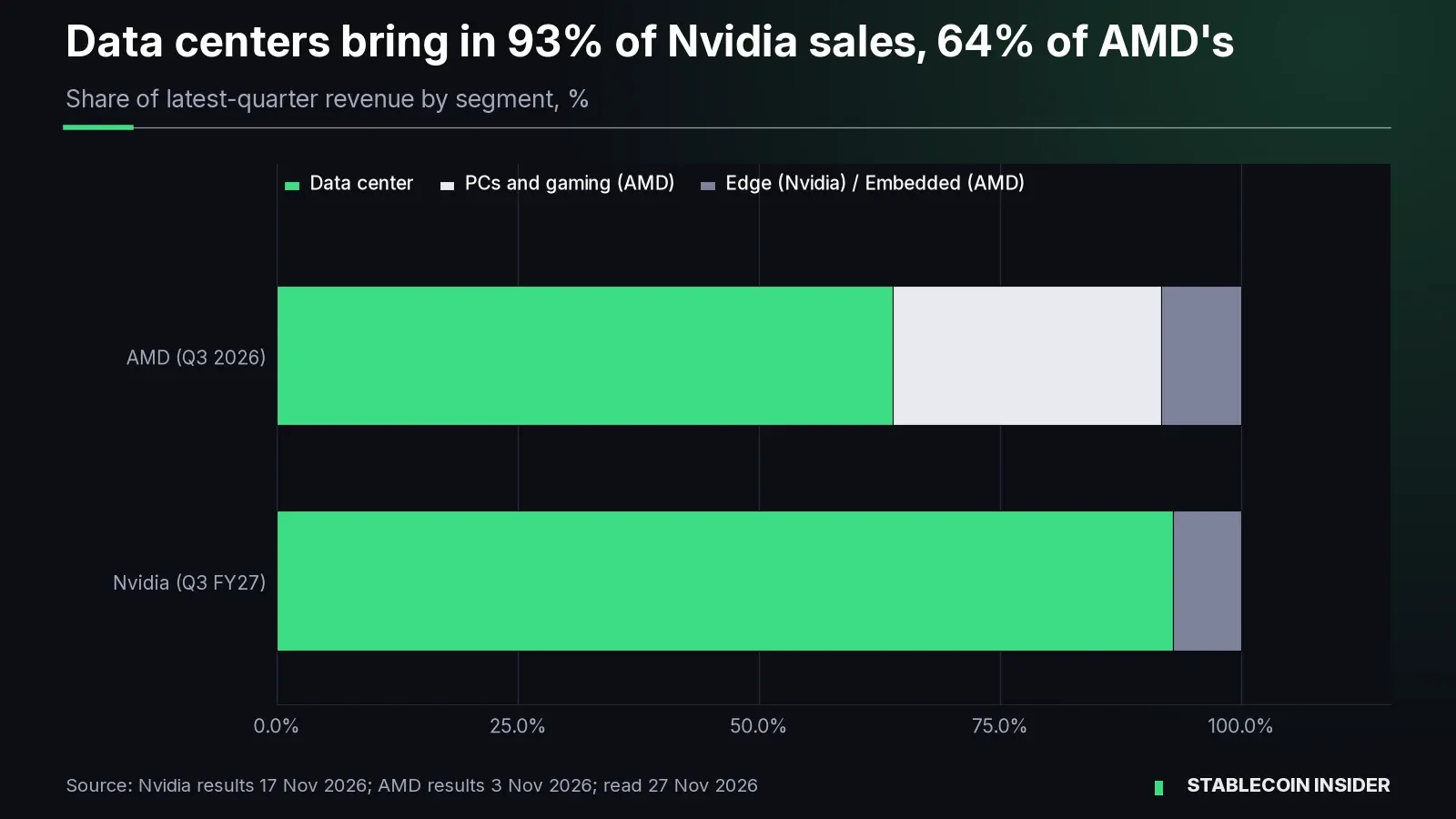
Diversification has both advantages and disadvantages. AMD's PC segment saw a 7% rise, yet its Gaming revenue plummeted by 40% to $773 million, indicating that not all non-AI segments are beneficial. Nvidia's focus means its performance is closely tied to spending from a small number of cloud and AI clients; hyperscalers alone contributed $60.1 billion to its revenue.
Dividends and Share Buybacks
Nvidia provides returns to its shareholders, whereas AMD currently does not. Nvidia returned $28.1 billion through buybacks and dividends in the latest quarter, with approximately $227.3 billion remaining under its repurchase authorization. Its next dividend payment of $0.25 is scheduled for December 2, 2026, yielding around 0.67% based on Nasdaq's current quote.
In contrast, AMD does not offer dividends and shows no share buybacks in its third quarter, having only spent $221 million in the first nine months of 2026.
Risks Associated with Each Stock
The primary risks facing Nvidia currently revolve around governance and regulatory policies rather than demand dynamics. The board reinstated Huang based on feedback from "senior levels of the United States government" and announced that an independent committee's investigation into a reported foreign intelligence effort targeting him will continue until completion. The company's outlook also factors in the absence of data-center compute revenue from China. On the day of the reinstatement, Nvidia shares rose by 31.5%, reflecting the volatility surrounding this issue.
For AMD, the risks are largely linked to execution and valuation. Its forecast hinges on the timely ramp-up of its Helios rack systems and 'Venice' EPYC processors. With a valuation of approximately 49 to 70 times run-rate earnings, any misstep could have a more significant impact compared to Nvidia's valuation. Both firms caution that their guidance is forward-looking and actual results may differ substantially.
Choosing Between Nvidia and AMD
Opt for Nvidia if you:
- Desire a core holding in the leading AI-chip manufacturer that boasts the highest margins in the sector.
- Prefer to invest at a lower price relative to current earnings (approximately 14 times based on our metrics).
- Value a modest and growing return through dividends and buybacks.
- Can tolerate potential volatility related to leadership, investigations, and export regulations concerning China.
Opt for AMD if you:
- Seek faster expected growth in the next quarter (approximately 27% compared to 12%).
- Prefer a company with a diverse portfolio including CPUs, PCs, and embedded chips in addition to AI accelerators.
- Are willing to accept a much higher valuation and no dividends for the potential of significant growth.
- Already hold Nvidia shares through an index fund and are looking for different chip exposure.
If selecting one company is not ideal, consider a semiconductor ETF that includes both. Our comparison of SMH versus SOXX illustrates the varying weightings of Nvidia and AMD in two chip-focused funds. For further context on this month's fluctuations, refer to our coverage of Nvidia's Q3 earnings call and Huang's reinstatement. If you are still undecided on where to invest, our guide comparing Robinhood and Webull provides insights into two popular US brokerage options.
Frequently Asked Questions
Is Nvidia stock more affordable than AMD stock?
Does AMD issue dividends?
Which company is experiencing faster growth, Nvidia or AMD?
Final Thoughts
Currently, Nvidia stands as the stronger company and, based on earnings, offers the more attractive stock. AMD represents the faster-growing competitor, with its price reflecting the expectation of continued acceleration. For a primary long-term investment in chips, Nvidia presents a compelling case. AMD is more suitable for investors seeking a smaller position focused on its growth potential, provided they can handle the associated volatility.