
On 4 November 2026, the European Commission indicated its intention to withdraw the Financial Data Access Regulation (FIDA) among 18 pending proposals, citing that the file has been stuck with lawmakers for over three years without trilogue discussions since June 2025.
This regulation governs how fintech, cryptocurrency, and stablecoin companies access customer data in Europe. The proposed withdrawal of FIDA represents the most significant shift in this area for the year.
The intention was for FIDA to expand open banking beyond payment accounts to include savings, investments, pensions, insurance, and cryptocurrency assets.
In the absence of FIDA, access to such data will hinge on commercial agreements rather than established legal rights.
This guide outlines the details of FIDA, the reasons behind its withdrawal, existing regulations, the diverging path of the UK, and what steps fintech companies should consider moving forward.
Key Takeaways
- The Commission aims to formalize the withdrawal of FIDA by May 2027.
- FIDA would have enabled access to savings, pension, insurance, and cryptocurrency data.
- Open banking related to payment accounts continues under the provisions of PSD2 and the PSR.
- Access to other financial data will now rely on voluntary agreements and contracts.
- The UK is developing an open finance framework aimed for completion by 2027.
Understanding FIDA
FIDA was introduced as the European Commission's framework proposal for Financial Data Access, released on 28 June 2023, alongside PSD3 and the Payment Services Regulation (PSR). Following the introduction of PSD2 in 2018, which allowed licensed third parties access to payment account data, FIDA sought to apply similar principles to a broader range of financial products.
- Data holders: Financial institutions such as banks, insurers, and investment firms would have been required to share customer data upon request.
- Data users: Licensed financial companies or a new category known as financial information service providers (FISPs).
- Data sharing schemes: Participants would have been part of data-sharing frameworks that establish technical standards and fee structures.
- Customer control: A permissions dashboard was envisioned to enable customers to view and revoke data access permissions.
| Data type | Under FIDA | Now |
|---|---|---|
| Payment accounts | PSD2 already in effect | PSD2, followed by PSR |
| Savings and loans | Included | No legal entitlement |
| Investments | Included | No legal entitlement |
| Crypto-assets | Included | No legal entitlement |
| Pensions | Included | No legal entitlement |
| Non-life insurance | Included | No legal entitlement |
Notably, life, sickness, health insurance, and individual credit scores were excluded from the original proposal. Additionally, the Council's position from December 2024 did not include occupational pension data but permitted member states to opt to include it later.
Reasons for the Withdrawal
The Commission's rationale for withdrawing FIDA, as stated in its 2027 work programme, is succinct: the proposal has been pending for over three years, with no trilogue discussions since June 2025, and it is unlikely to gain the necessary support from the Council in a reasonable timeframe.
- Cost concerns: Insurers and various sectors of the financial industry raised objections regarding the scope and expenses associated with developing the required APIs.
- Big Tech disputes: Conflicts arose between Parliament and the Council regarding the extent to which major platforms designated as gatekeepers should utilize the data.
- Simplification efforts: The introduction of new data-sharing mandates conflicted with the Commission's agenda to reduce regulatory burdens.
- A failed compromise: In April 2026, the Commission proposed a phased access plan over 24, 36, and 48 months, but member states remained divided.
The withdrawal process is not yet complete. It requires a separate decision from the Commission, and while Parliament and the Council can provide input, they lack formal veto power. A leaked draft in February 2025 had earlier listed FIDA for withdrawal before it was saved, but this time the proposal is included in the adopted work programme.
Regulations That Remain
Open banking for payment accounts remains unaffected. PSD2 continues to allow licensed account information and payment initiation providers access to payment accounts, while the PSR aims to enhance access by prohibiting banks from imposing barriers on third-party providers. The final vote by Parliament on PSD3 and the PSR is tentatively scheduled for 14 December 2026.
- GDPR portability: Individuals can still request their personal data; however, there is no standardized API, and it does not cover business clients.
- The Data Act: Effective since 12 September 2025, this law pertains to data from connected devices such as cars and machinery, rather than financial accounts.
- Voluntary agreements: The EPC’s SEPA Payment Account Access scheme and Germany’s giroAPI provide paid premium APIs, but both focus solely on payment accounts.
- Bilateral agreements: Beyond these frameworks, data users must negotiate access with each financial institution, which dictates the pricing and scope of access.
Despite the challenges, account-to-account payments, reliant on open banking, continue to expand. Our guide to Pay by Bank in Europe illustrates the current dynamics of this market.
Impacts on Industry Stakeholders
Traditional banks and insurers have welcomed this decision, while data users like aggregators, robo-advisors, pension dashboards, and comparison platforms face losses due to the elimination of the legal avenue they anticipated.
Industry experts have expressed concerns regarding potential consequences. Daniel Morgan, Yapily's director of public policy, contends that without FIDA, AI agents acting on behalf of customers may access savings and pension data by logging in with the user's password, representing a new form of screen scraping that Europe has worked to eliminate in open banking.
- Winners: Data holders maintain authority over access and pricing.
- Losers: Fintech companies that were planning to launch products reliant on legal access to savings, investment, or pension data.
- Mixed outcomes: Banks and insurers will also miss the opportunity to pull customer data from competitors.
- Unresolved issues: Proposed limitations on Big Tech gatekeepers that both Parliament and Council sought will not be enacted.
The debate over agent use is already active in the US, where major banks have moved to prevent AI agents from logging in with customer credentials. Our analysis of agentic banking discusses how these agents are establishing their own accounts and wallets.
The UK’s Divergent Path
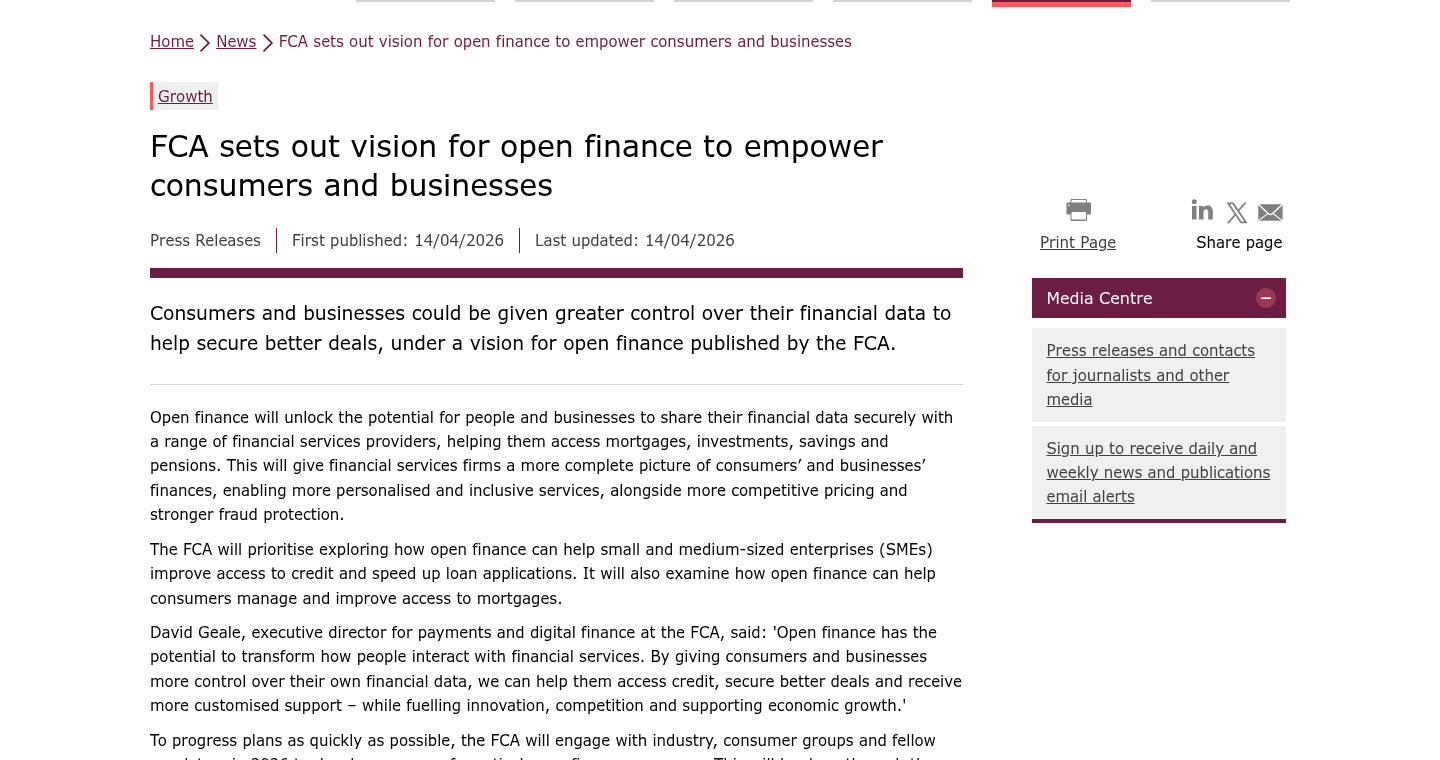
While Brussels retreats, London advances. The FCA introduced an open finance roadmap on 14 April 2026, focusing on small business lending and mortgage use cases. It has committed to collaborating with HM Treasury to develop a regulatory framework for open finance by the end of 2027. The UK's open banking sector already boasts approximately 17 million users, representing nearly one-third of adults.
| Area | EU | UK |
|---|---|---|
| Open banking | PSD2, then PSR | Regulated |
| Open finance law | Being withdrawn | Planned by 2027 |
| Main route now | Contracts | FCA pilots |
For companies operating in both regions, the divide will become more pronounced. Our explainer on the UK payments regulation overhaul outlines broader reform measures.
Implications for Crypto and Stablecoin Firms
Since FIDA encompassed crypto-assets, its withdrawal directly impacts the digital asset industry.
- No portability rights for crypto assets: Customers will lack a legal entitlement to share exchange or custody data with third-party applications via a standardized API.
- Portfolio management tools will be affected: Applications that aggregate banking, investment, and crypto holdings will need to negotiate agreements with each service provider.
- Payment accounts remain accessible: On-ramps and stablecoin applications can continue to utilize PSD2 open banking for bank account verification and payment initiation.
- Identity solutions stay available: The EU Digital Identity Wallet provides an alternative route for verified customer data, as detailed in our guide to EU Digital Identity Wallets for payments.
Next Steps for Fintechs
- Revise roadmaps: Remove any expectation of a legal right to savings, investment, or pension data by 2028 or 2029.
- Utilize PSD2: Leverage payment account access, which remains regulated and is expected to strengthen under the PSR.
- Seek direct access: Engage with data holders for commercial API agreements where products rely on their data.
- Participate in schemes: Follow the expansion of the EPC's SPAA scheme and national initiatives like giroAPI.
- Avoid credential sharing: Design AI functionalities around consent-based API access instead of relying on customer passwords.
- Monitor the UK market: Consider piloting open finance offerings there first.
Upcoming Developments
- 14 December 2026: Anticipated final vote by Parliament on PSD3 and the PSR.
- By approximately May 2027: Expected formal decision by the Commission to withdraw FIDA.
- End of 2026: FCA consultation on a long-term open banking framework in the UK.
- SPAA rulebook: Monitor whether the EPC's updated scheme attracts asset holders, not just brokers.
- Future proposals: Consider if the Commission will reintroduce open finance discussions later, potentially restarting the process anew.
Frequently Asked Questions
1. What is FIDA?
FIDA is the EU's proposed Financial Data Access Regulation, introduced in June 2023. It aimed to mandate banks, insurers, and investment firms to share customer data regarding savings, investments, pensions, insurance, and crypto-assets with licensed third parties at the customer's request.
2. Has FIDA been withdrawn?
FIDA has not been officially withdrawn yet, but the Commission has listed it for withdrawal on 4 November 2026, with plans to finalize the withdrawal within six months, likely by May 2027.
3. Why is the EU withdrawing FIDA?
The withdrawal is attributed to the prolonged stagnation of the file for over three years, with no trilogue discussions since June 2025. The Commission indicated that it is unlikely to secure Council support, amid ongoing debates regarding costs, scope, and Big Tech access.
4. Does the FIDA withdrawal affect open banking?
The withdrawal does not impact open banking for payment accounts. PSD2 remains applicable, and the Payment Services Regulation will enhance existing rules on third-party access.
5. Does FIDA apply in the UK?
FIDA does not apply in the UK, as the country left the EU prior to its proposal. The UK is in the process of establishing its own open finance framework, with the FCA and HM Treasury working on options for completion by the end of 2027.