Thailand stands out as one of the few nations permitting the sale of USDT for baht through fully licensed local exchanges, with USDT having been an approved trading pair since March 2025.
This regulatory framework simplifies the conversion process compared to other markets. Additionally, offshore peer-to-peer (P2P) applications face restrictions, with regulations becoming increasingly stringent.
This guide evaluates Bitkub and Binance TH using live order books from November 29, 2026, while also addressing tax implications, the offshore ban, and a proposed daily withdrawal limit.
On November 29, 2026, both Bitkub and Binance TH listed USDT at 34.03 baht for sale, with spreads around 0.03%. Together, they recorded approximately 19.6 million USDT traded over 24 hours, while Binance's global P2P platform displayed no available baht ads.
Key Takeaways
- Both Bitkub and Binance TH quoted 34.03 baht for purchases.
- Spreads for both platforms were around 0.03%.
- Binance's global P2P platform had no baht ads available.
- Gains from licensed exchanges are tax-exempt until 2029.
- A daily limit of 5 million baht is proposed.
Bitkub vs Binance TH Overview
| Exchange | Best Bid (THB) | Best Ask (THB) | 24h Volume (USDT) |
|---|---|---|---|
| Bitkub | 34.03 | 34.04 | 11.58 million |
| Binance TH | 34.03 | 34.04 | 7.98 million |
| Binance P2P (global) | No baht ads displayed |
Both exchanges are regulated by Thailand's Securities and Exchange Commission (SEC). In terms of selling USDT, the pricing is essentially identical between both platforms, making factors like fees and user experience the deciding elements.
It's important to note that the prices were recorded on a Sunday evening in Bangkok and fluctuate in correlation with the dollar.
1. Bitkub: Thailand's Leading Baht Market
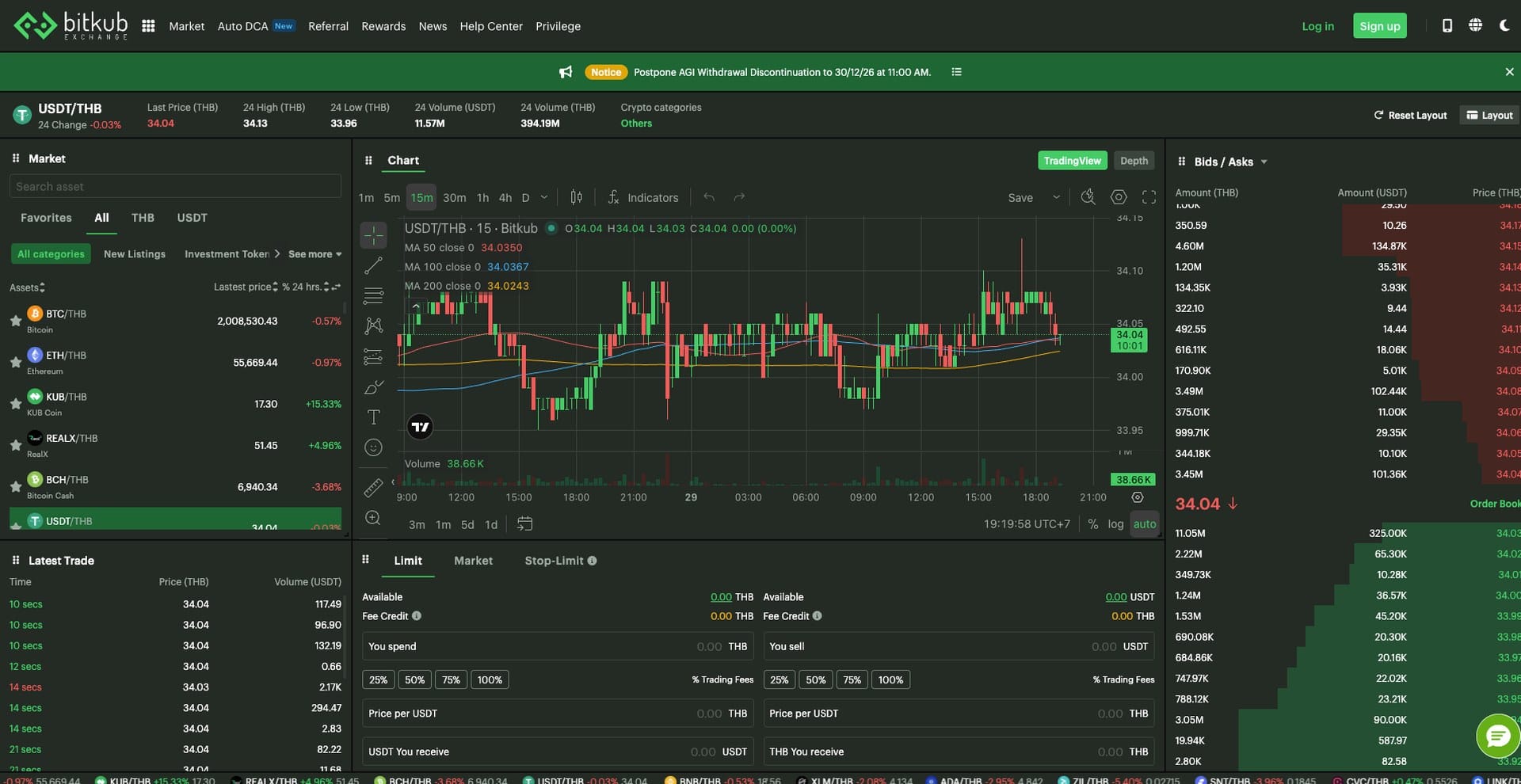
Bitkub is the most recognized cryptocurrency exchange in Thailand. On November 29, 2026, its USDT/THB market showed a best bid of 34.03 baht and a best ask of 34.04.
The trading volume for this pair reached around 11.6 million USDT over 24 hours, equating to about 394 million baht. At the top bid, buyers queued for approximately 325,000 USDT.
This liquidity implies that even larger transactions are unlikely to cause significant price fluctuations. For details on trading fees and baht withdrawal costs, refer to Bitkub's fee page.
It's worth noting that placing a limit order at the bid typically incurs lower costs than executing a market sell.
2. Binance TH: Comparable Pricing, Smaller Order Book
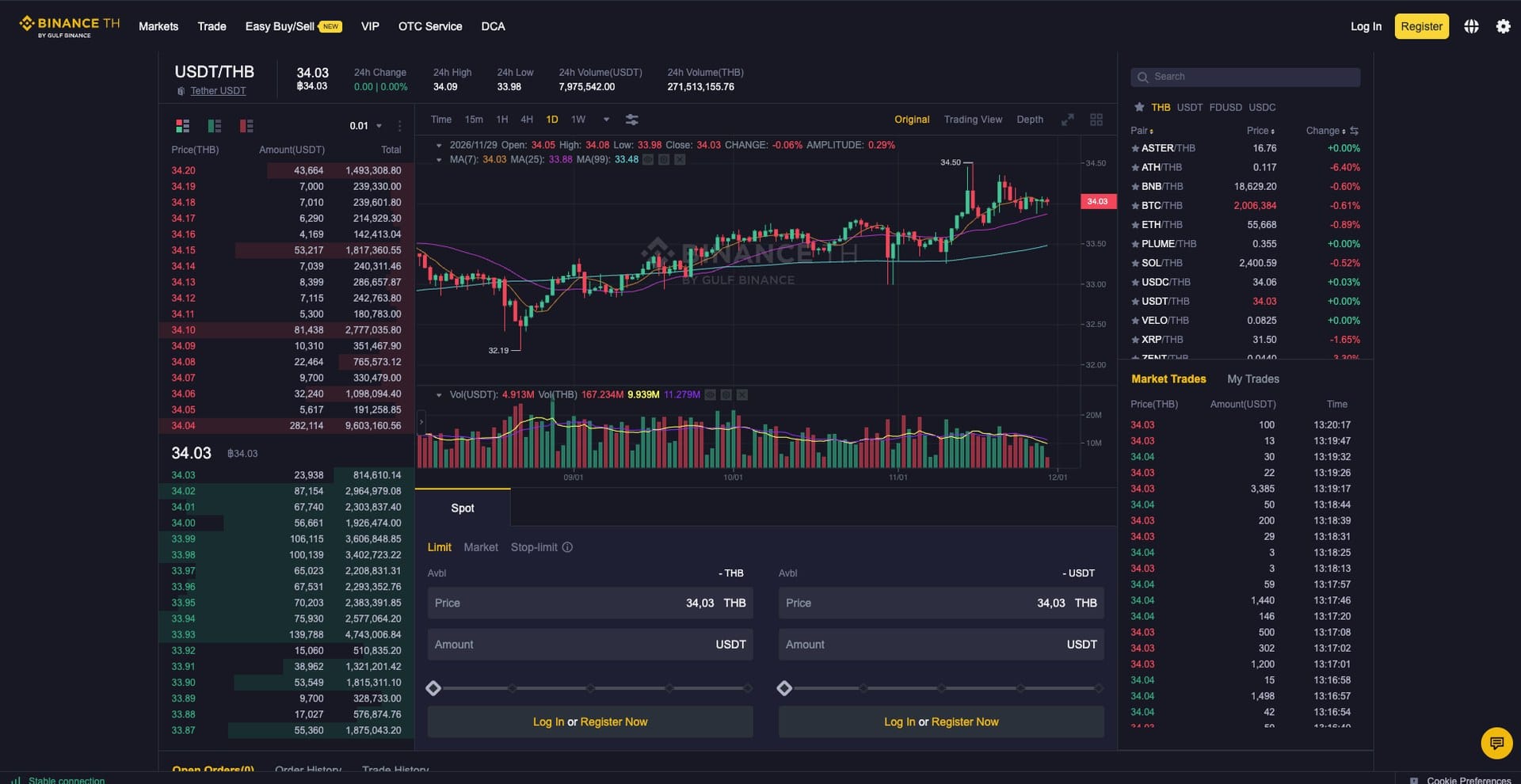
Binance TH operates as a distinct, licensed exchange affiliated with Gulf, separate from the global Binance application. Its USDT/THB order book displayed the same bid and ask prices of 34.03 and 34.04 baht, respectively.
The 24-hour trading volume was around 8.0 million USDT, or approximately 272 million baht, which is less than Bitkub but still adequate for most retail transactions.
Binance TH is ideal for users familiar with the Binance interface. However, accounts are separate, requiring users to complete Thai identity verification.
It's important to remember that a global Binance account does not transfer over, necessitating the establishment of a Binance TH account.
3. Offshore P2P: Access to Baht Restricted
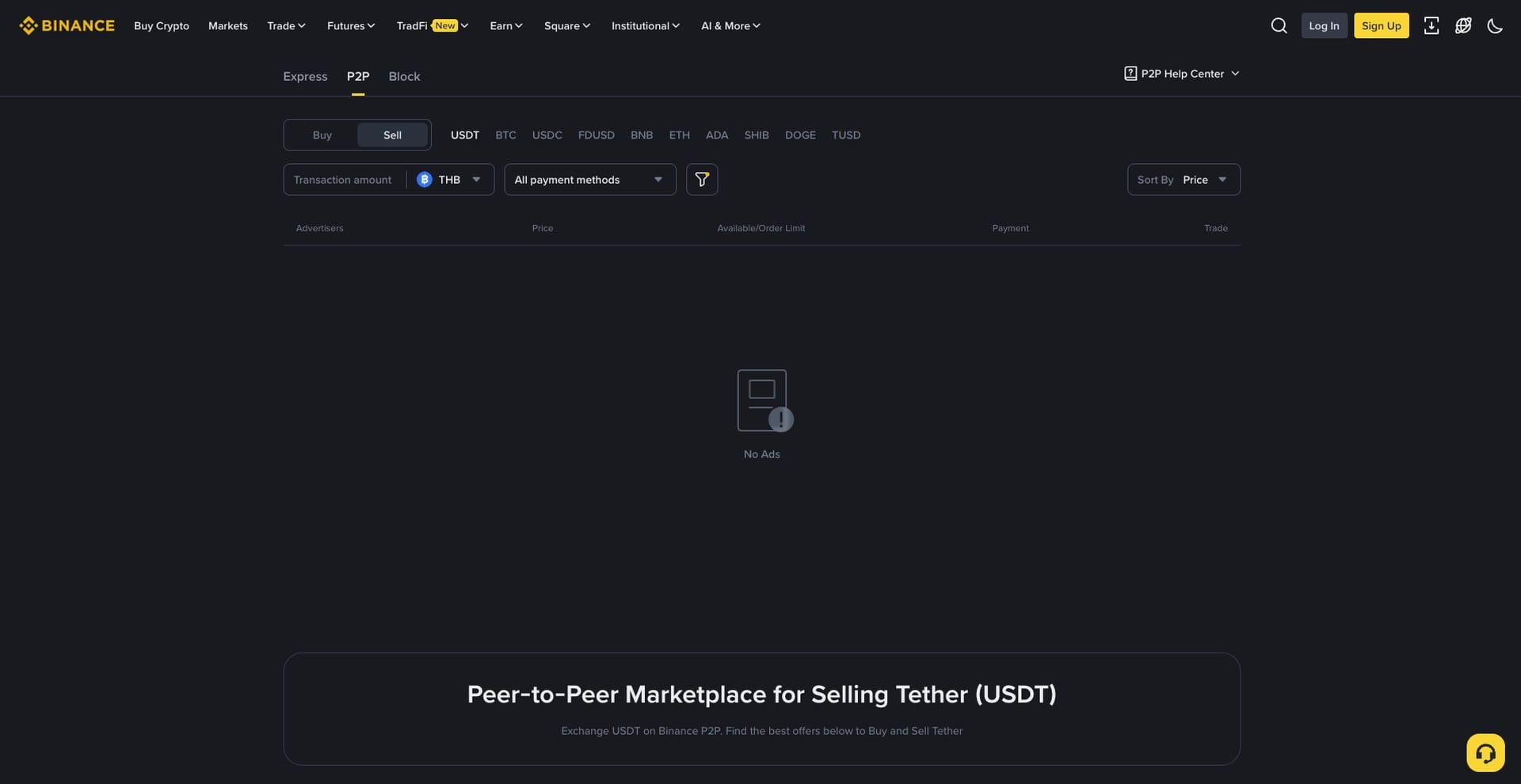
Upon checking Binance's global P2P market for selling USDT for baht, it displayed a message stating "No Ads." This contrasts starkly with markets like Egypt or Ghana, where P2P transactions are prevalent.
Regulations in Thailand classify foreign P2P services as digital asset exchanges, requiring them to obtain a local license. In June 2025, the SEC blocked several platforms, including Bybit, OKX, CoinEx, XT.COM, and 1000X, for operating without a license.
Utilizing informal channels, such as chat groups, poses risks of scams and legal issues, and profits made from such transactions do not qualify for tax exemptions.
It's advisable to use licensed exchanges in Thailand for a straightforward and secure method.
Proposed Daily Cap on Stablecoin Transactions in Thailand
On November 12, 2026, the SEC initiated consultations regarding draft regulations that would limit stablecoin deposits and withdrawals to 5 million baht per customer daily at each licensed operator.
The draft also proposes to prohibit transfers to or from third-party wallets. For more details, refer to our report on the stablecoin transfer cap in Thailand.
At a rate of 34 baht per USDT, a limit of 5 million baht translates to roughly 147,000 USDT, meaning that most individuals are unlikely to reach this threshold.
It's crucial to note that this cap remains a proposal; therefore, check the final regulations before executing large transactions.
Legal Status of Selling USDT in Thailand
Yes, it is legal to sell USDT through licensed platforms. The SEC included USDT and USDC in its approved cryptocurrency list starting March 16, 2025, allowing them as trading pairs on licensed exchanges.
Offshore platforms that serve Thai users without proper licenses can be blocked under regulations enacted in April 2025.
While USDT is not recognized as legal tender in Thailand, it cannot be directly used for purchases outside of sanctioned frameworks.
Ensure that transactions are conducted through SEC-licensed exchanges, brokers, and dealers.
Tax Implications for USDT Sales in Thailand
No personal income tax is levied on capital gains from licensed platforms until the end of 2029. Ministerial Regulation No. 399 exempts individuals from personal income tax on cryptocurrency gains realized through licensed exchanges, brokers, and dealers from January 1, 2025, to December 31, 2029.
This exemption is applicable solely to individuals, excluding corporations. Transactions through licensed operators are also exempt from value-added tax (VAT).
Gains from unlicensed or offshore platforms are not eligible for this exemption.
It is prudent to retain your exchange records in the event that regulations change after 2029.
Comparison of Thailand with Other Southeast Asian Markets
Thailand's regulatory approach closely resembles that of Indonesia, where licensed local exchanges also manage the majority of USDT sales. Our guide on converting USDT to IDR provides insights into that market.
Thailand is distinguished by its tax holiday, unlike many neighboring countries that impose taxes on crypto gains or transactions.
In every market, evaluating the exchange price against any instant quote before selling is essential.
It's beneficial to choose a licensed exchange with a narrow spread over instant-sell options.
Risks and Limitations
- Offshore exchanges are barred in Thailand.
- Informal P2P groups present a risk of scams.
- Profits from unlicensed platforms forfeit tax exemptions.
- A daily stablecoin transfer cap may be implemented soon.
- The baht's value can fluctuate alongside the dollar.
No funds were transferred, traded, or withdrawn for the purposes of this guide. Pricing was gathered from Bitkub and Binance TH on November 29, 2026.
It is advisable to withdraw baht only to a bank account registered in your name.
Final Thoughts
Converting USDT to THB is straightforward in 2026. On November 29, 2026, both Bitkub and Binance TH offered a bid of 34.03 baht per USDT, with a spread of approximately 0.03% and substantial order books.
Offshore P2P options are effectively unavailable for baht transactions, and the tax exemption applies solely to licensed platforms.
Utilize a licensed exchange, employ limit orders for selling, and be aware of the proposed 5 million baht daily cap. Vietnam has adopted a different approach, as detailed in our guide on converting USDT to VND.
- Thailand Stablecoin Transfer Cap: SEC Proposes 5M Baht Daily Limit
- How to Convert USDT to IDR in Indonesia (2026): 4 Ways Compared
- How to Convert USDT to VND in Vietnam (2026): 4 Ways Compared
FAQs
1. What is the best method to convert USDT to THB?
An SEC-licensed exchange like Bitkub or Binance TH. On November 29, 2026, both platforms quoted 34.03 baht per USDT with spreads around 0.03%.
2. Is it possible to use Binance P2P to sell USDT for baht?
On November 29, 2026, Binance's global P2P market displayed no baht ads. Thai regulations classify foreign P2P services as exchanges requiring local licensing.
3. Is selling USDT legal in Thailand?
Yes, it is legal to sell through licensed platforms. USDT has been an approved trading pair on Thai licensed exchanges since March 16, 2025.
4. Are there taxes when selling USDT in Thailand?
Individuals are exempt from personal income tax on crypto gains made through licensed platforms from 2025 to 2029. Gains from other sources are not included.
5. Is there a limit on stablecoin transfers in Thailand?
Not currently. In November 2026, the SEC proposed a daily cap of 5 million baht per customer for stablecoin deposits and withdrawals at each licensed operator.