Locking an FX rate at the time of instruction ensures that the conversion rate between a stablecoin and a fiat currency is fixed when the treasury team submits the trade. Once the rate is locked, it remains unchanged throughout the execution and settlement phases, depending on the transaction terms.
For fintech companies or non-bank financial institutions (NBFIs) handling $500,000 or $5 million per transaction, this distinction influences whether the instructed amount can be reliably budgeted. Stablecoins offer a novel method for institutions to manage and transfer dollar-denominated value.
Transforming USDC or USDT into euros, pounds, Swiss francs, or Turkish lira at a known price remains a distinct challenge for treasuries. Many off-ramps provide an indicative rate before executing at the current market rate when the funds are received.
The rate can fluctuate in the interim.
This guide targets CEOs, treasury leads, and operations teams within fintechs, payment service providers (PSPs), market makers, and other NBFIs that oversee significant stablecoin and fiat liquidity. It elucidates the process of locking a rate, the necessary actions in the funds flow to maintain the lock, and the essential checks prior to entrusting a provider with high-value conversions. Keyrails, which offers institutional rails for stablecoin transactions, serves as a practical example.
The fundamental principle: a locked rate is only as dependable as the underlying infrastructure. A provider with direct banking relationships, institutional FX access, and enhanced control over the execution path is in a stronger position to uphold a rate at the time of instruction. Each additional execution dependency introduces another variable between the quoted rate and the final settlement that the client cannot directly oversee.
Key Takeaways
- A rate locked at the point of instruction secures the stablecoin-to-fiat conversion price when the trade is initiated, allowing the fiat amount to be predetermined.
- Slippage is a management issue, not merely a cost: on a $2 million conversion, a 0.3% movement results in $6,000 of unanticipated treasury challenges.
- A locked rate relies on infrastructure: institutional FX access, direct banking relationships, and control over the settlement process provide greater execution certainty.
- Keyrails offers institutional stablecoin FX locked at instruction, supported by its own SWIFT BIC (KEYRCA62), direct banking connections, and interbank FX access.
- Verify regulatory status by entity, the currencies available in both directions, and the complete fee structure prior to directing high-value conversions.
The Importance of FX Rate Certainty for High-Value Stablecoin Transfers
In high-value transfers, even minor rate fluctuations can lead to substantial cash differences. A 0.3% change on a $2 million conversion generates $6,000 of unanticipated variance for the treasury. When a PSP frequently converts stablecoin receipts into local currency, these discrepancies accumulate, presenting a genuine treasury dilemma.
The Treasury Challenges Involved in Each Conversion
Fintechs and NBFIs in emerging markets typically maintain working capital in USDC or USDT while requiring fiat to fulfill obligations in other currencies. Common scenarios include
- Liquidity funding: a PSP needs to convert stablecoin balances into EUR, GBP, or TRY to meet its fiat requirements and must be aware of the amount that will be received.
- Inventory rebalancing: a market maker transfers value between stablecoin and fiat accounts and requires each leg to be priced prior to commitment.
- Treasury planning: a CFO projects the upcoming week's fiat position and needs today's conversion to align with that forecast.
- Client obligations: an NBFI has provided a price to its customer and must fulfill it without incurring any loss.
In every instance, the central question is the same: how much fiat will actually arrive? If the response depends on market fluctuations following the instruction, the treasury team is exposed to risks it has not chosen.
Identifying FX Execution Risks and Costs
The ultimate cost and certainty of an FX conversion hinge on how the provider manages pricing, liquidity, and execution. Five key factors warrant consideration:
- Indicative quotes: The displayed rate is merely an estimate, not a guarantee. The final rate may alter before the transaction is executed.
- Execution delay: Stablecoin FX transactions are typically executed in two stages. The conversion from stablecoin to USD and from USD to the final currency. If these stages are not executed simultaneously, price changes in either can affect the final amount.
- Intermediated execution: Relying on third parties for trade execution can add steps and dependencies that introduce price uncertainty.
- Volatility costs: Providers that cannot consistently lock an FX rate may inflate their pricing to safeguard against market shifts, resulting in wider spreads for clients.
- Prefunding and hedging costs: Some providers may hold funds in advance or implement hedging strategies to manage FX risk. These added expenses could manifest as wider spreads for clients.
For institutional treasury teams, these factors can lead to unexpected costs, less predictable settlement amounts, and more complex reconciliations. A dependable FX provider should present not only a competitive rate but also the necessary infrastructure and execution controls to ensure consistency.
Comparing Locked and Floating Rates: Funds Management
The distinction between a locked and a floating rate lies in when the price is established in relation to the movement of funds. With a locked rate, the price is fixed first, followed by the movement of funds. Conversely, with a floating rate, the funds are moved first, and the price is dictated by the market at execution.
| Rate locked at instruction | Floating or indicative rate | |
|---|---|---|
| When the price is set | Upon client trade submission | At the time of execution, after funds are received |
| Fiat amount known | When the FX instruction is confirmed | Only after settlement |
| Who bears market movement | Rate is fixed for the agreed instruction period | Client remains at risk until execution |
| Reconciliation | Instruction aligns with settlement | Variance must be clarified post-factum |
| Client pricing | Can be communicated with assurance | Requires a buffer to accommodate movement |
| What it necessitates from the provider | Institutional liquidity access, banking infrastructure, and stringent execution controls | Access to third-party pricing |
A Practical Example
Consider a PSP converting 1,000,000 USDC to euros for a week of merchant payouts.
- Locked: at the moment of instruction, the provider confirms the exchange rate and the euro amount, accounting for a disclosed fee. The PSP is aware of the exact euro amount that will be received and can proceed with payouts against that figure.
- Floating: the PSP receives an indicative rate, sends the USDC, and the trade is executed later. If the euro appreciates by 0.25% during that period, approximately €2,250 less will arrive than anticipated, leaving the treasury with less fiat than initially planned.
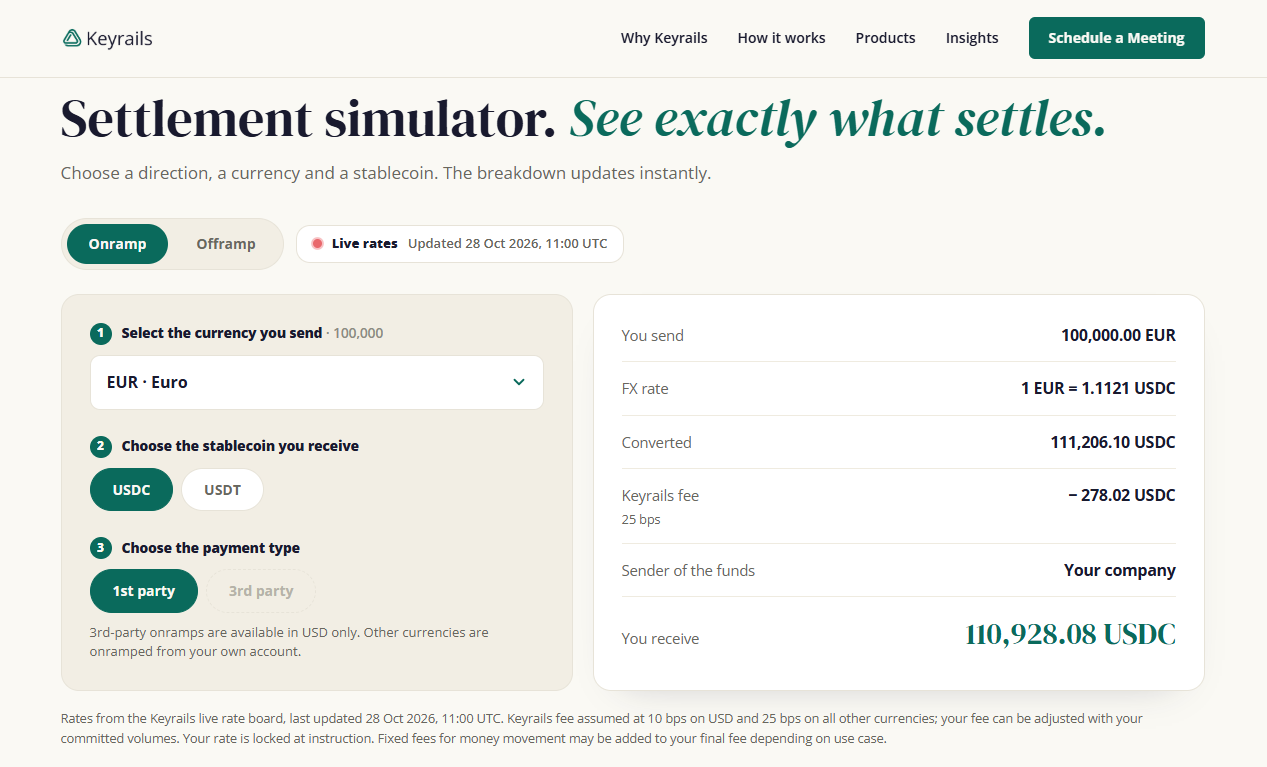
Keyrails' settlement simulator allows users to choose the direction, currency, and stablecoin, providing the FX rate, converted amount, disclosed Keyrails fee, and expected net amount before submitting the instruction.
Understanding How a Locked-Rate Institutional FX Transaction Operates
- Onboard as an institution: Complete KYB with the provider, including documentation on the company, ownership, source of funds, and intended use for the conversion. Rate locking is typically available to verified institutional clients, not retail users.
- Register your company's fiat account: Set up the bank account in the company’s name where the fiat will be deposited. For first-party FX, fiat settles to an account held in the client's name, which supports a more straightforward flow for compliance and reconciliation.
- Transfer the stablecoins: Move the stablecoin from your external wallet to the deposit address issued by the provider for that instruction.
- Request a firm quote: Via the API or dashboard, specify the stablecoin, target currency (for instance, EUR, GBP, CHF, CNY, etc.), and amount. Confirm whether the quote is locked or indicative.
- Instruct the trade: By submitting the instruction, the rate for both legs of the stablecoin FX (Stablecoin to USD and USD to final currency) is locked simultaneously. The anticipated fiat amount, net of disclosed fees, is thus known beforehand.
- Provider books the FX: The provider performs the conversion through its institutional FX infrastructure at the previously agreed rate. Any price fluctuations following the instruction are the provider's responsibility.
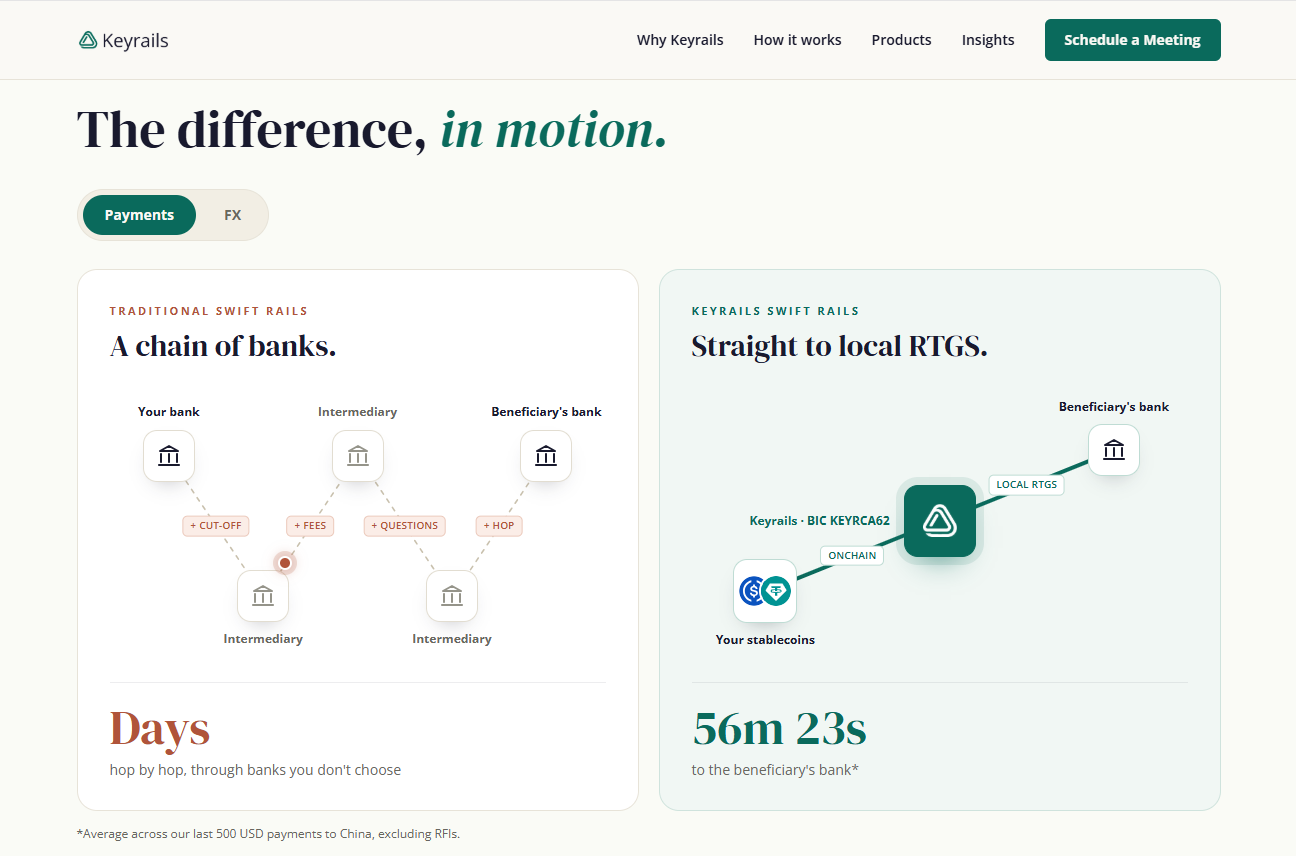
- Fiat settles to your account: The converted funds are transmitted to your linked bank account via the banking system. Keyrails connects to local RTGS infrastructure through its banking network and SWIFT connectivity. Proper management of local banking hours and payment deadlines helps minimize delays, especially for international transactions across different time zones.
- Reconcile: Match the transaction record against the amount received in your bank account. A confirmed FX rate and transparent fee structure enhance the predictability of reconciliation.
Helpful Tips for Treasury Teams
- Understand the instruction window: Each currency possesses its own cut-off time and settlement window. Instructions must be optimized accordingly.
- Distinguish the FX fee from fixed charges: A basis-point fee covers the conversion; payment fees may be added based on the use case.
- Agree on volume terms: Committed volumes can influence the fee schedule, which is crucial for recurring liquidity needs.
- Automate through the API: Regular conversions, such as daily payout funding, are easier to manage when quotes and instructions are processed through an API and directly integrated into your ledger.
The Infrastructure Enabling a Locked Rate
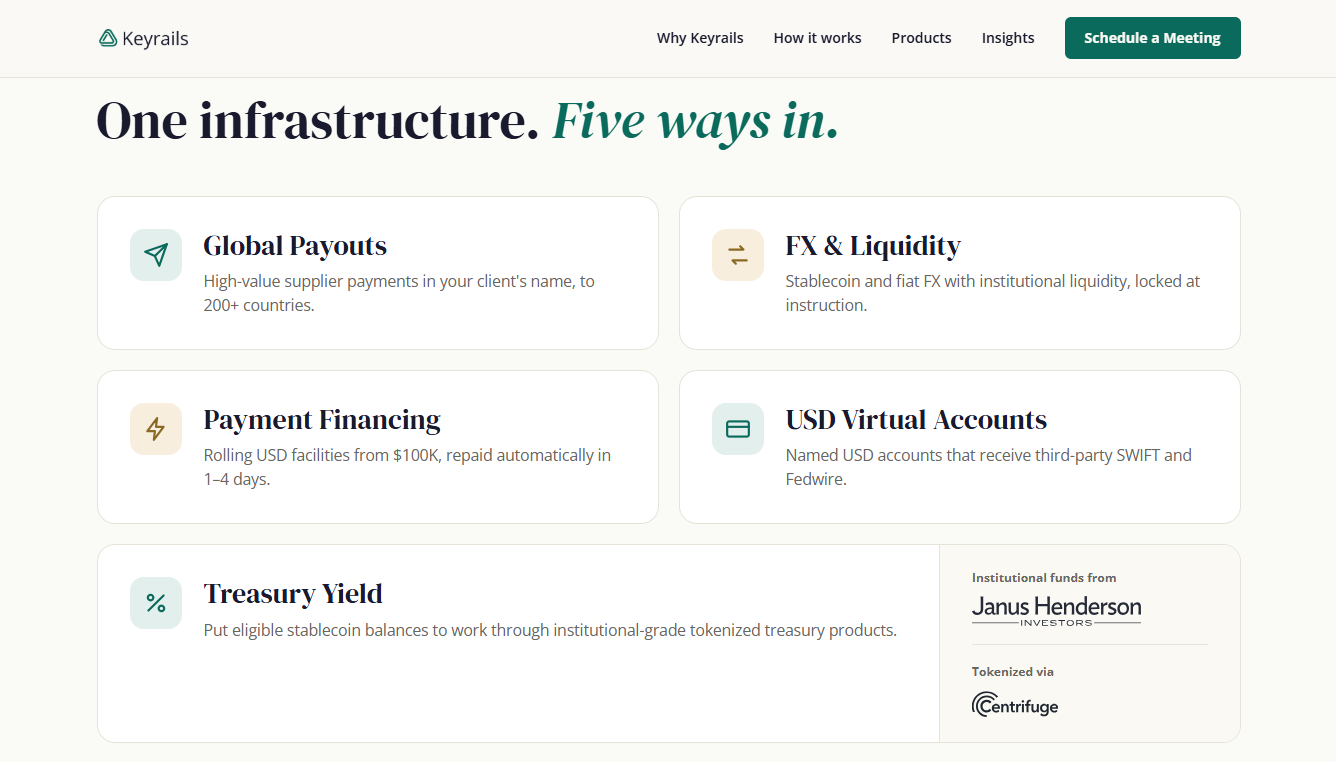
A provider can only guarantee a rate at the time of instruction if it manages the elements of the flow that determine the price and facilitate the movement of fiat. Three key capabilities are particularly important: institutional FX access, direct banking relationships, and control over the settlement process.
"Treasury teams at fintechs and NBFIs should not have to guess what will land in their account. When a client instructs a stablecoin FX trade with us, the rate is fixed at that moment. Our direct banking relationships, own SWIFT BIC and our access to interbank FX as well as local clearing & RTGS mechanisms in over 70 jurisdictions for 45+ currencies provide a more controlled and auditable path from stablecoin liquidity into the banking system. That certainty is what allows clients to plan liquidity across currencies with confidence.” — Berhan Kongel, CEO, Keyrails Institutional FX liquidity To honour a firm FX rate, a provider needs more than access to liquidity. It must also be able to manage market movements between the time a rate is agreed and the transaction is executed. Access to both spot markets and hedging instruments, such as forward contracts & swaps, helps providers protect agreed rates across different execution windows, including transactions involving markets in different time zones. Without these capabilities, clients may face slippage, unexpected costs, or cancelled transactions. Keyrails' FX & Liquidity product provides stablecoin and fiat FX with institutional liquidity, locked at instruction. Keyrails combines direct banking relationships with interbank FX access to provide institutional stablecoin-to-fiat and fiat-to-stablecoin liquidity. Direct banking relationships The fiat leg of a stablecoin conversion has to land in the banking system. Direct banking relationships reduce reliance on borrowed banking access and give the provider greater visibility and control over the settlement process. A provider that borrows access through a partner adds a dependency it cannot fully manage. Keyrails maintains direct relationships with its banking partners, giving institutional clients a more reliable route between stablecoin liquidity and the traditional banking system. This reduces reliance on intermediaries and provides greater visibility over how transactions are processed. Direct clearing and an own SWIFT BIC Keyrails operates under its own SWIFT BIC, KEYRCA62, with access to local clearing and RTGS systems across more than 70 jurisdictions and 45+ currencies. This infrastructure enables Keyrails to execute supported payments in the underlying client's name, supporting greater transparency, compliance, and faster reconciliation. Combined with effective management of local banking hours and payment cut-offs, these capabilities provide a more controlled and predictable settlement process, particularly for transactions across different time zones. Regulatory standing, by entity Institutional counterparties should check which legal entity they contract with and how it is regulated. For Keyrails, the public disclosures list Entity Jurisdiction Registration Keyrails Inc. Canada Payment Service Provider under the Retail Payment Activities Act, registered with the Bank of Canada Keyrails Inc. Canada Money Services Business with FINTRAC (MSB #M23573916), covering FX dealing, money transferring, dealing in virtual currencies and payment services Keyrails Inc. United States Money Services Business with FinCEN (MSB #31000319550919) Keyrails Swiss GmbH Switzerland Member of VQF, a self-regulatory organisation recognised under the Swiss Anti-Money Laundering Act Keyrails US Inc. is a Delaware technology company and does not provide financial services. Keyrails is also a certified member of the Circle Alliance Program and was named an initial partner for Mastercard's Stablecoin Security risk-intelligence solution, announced at Money20/20 USA in October 2026. Coverage and scale As of August 2026, Keyrails supports 45+ outgoing currencies and 15+ incoming currencies, with $10B+ in annualised TPV. For the wider context, Keyrails CEO Berhan Kongel was one of nine executives interviewed in the Dfns Stablecoin FX report on how stablecoin FX becomes a working market. The Delos report The Great Rail Shift also covers how legacy rails and stablecoin rails are converging, with Keyrails as a case. Due Diligence Checklist: Questions to Ask a Stablecoin FX Provider Before routing high-value conversions through any provider, treasury and operations teams should get clear written answers to these questions. Question Why it matters What a strong answer looks like Is the quoted rate firm or indicative? Only a firm rate removes slippage The rate is locked at instruction and confirmed in writing How is liquidity sourced and execution managed? Third-party execution reintroduces price risk The provider can clearly explain its liquidity model, execution counterparties, and how the quoted rate is protected through settlement Does the provider maintain direct banking relationships? Borrowed access adds dependencies Direct banking relationships supporting the relevant settlement flows Can the provider execute payments in the underlying client's name? Supports transparency, compliance, and faster reconciliation. The underlying client can be identified as the sender on supported payments. How does the provider manage fiat settlement and payment cut-offs across multiple time zones? Banking hours and cut-offs can delay international payments, particularly across time zones. Local clearing access without intermediaries and effective cut-off management support predictable settlement. Which entity contracts with you, and where is it regulated? Regulatory protection depends on the entity Registrations listed by entity and jurisdiction Which currencies are supported in each direction? Coverage varies between onramp and offramp A clear list of incoming and outgoing currencies How are fees structured? Hidden spreads undo a locked rate A disclosed basis-point fee plus any fixed payment charges Is there an API? Manual processes do not scale API and dashboard access for quotes, instructions and reporting For teams thinking about stablecoins as a treasury tool rather than only a payment method, Keyrails' essay Why Stablecoins Will Reshape Treasury Management Before They Disrupt Payments sets out the argument in more detail. Its piece Why Stablecoins Matter for Global Trade covers why bank-grade settlement still matters when value moves on-chain. Final Thoughts For fintechs and NBFIs that hold value in stablecoins but operate in other currencies, the conversion between stablecoin and fiat is one of the points where treasury teams need the greatest execution certainty. A rate locked at instruction turns that step from a market exposure into a known number. The lock is only as reliable as the infrastructure behind it: institutional FX access, direct banking relationships, a controlled settlement path and clear regulatory standing by entity.” Treasury and operations leaders evaluating stablecoin FX can review the Keyrails FX & Liquidity offering, test conversions in the settlement simulator on keyrails.com, or contact the team at [email protected]. FAQs 1. What does " — Berhan Kongel, CEO, Keyrails
Institutional FX Liquidity
To uphold a firm FX rate, a provider requires more than mere access to liquidity. It must also effectively manage market fluctuations between the agreement of a rate and the execution of the transaction. Access to both spot markets and hedging instruments, including forward contracts and swaps, aids providers in safeguarding agreed rates throughout various execution windows, including transactions involving markets in different time zones. Without these capabilities, clients may encounter slippage, unforeseen costs, or failed transactions.
Keyrails' FX & Liquidity product offers stablecoin and fiat FX with institutional liquidity, locked at the point of instruction. Keyrails combines direct banking relationships with interbank FX access to provide institutional liquidity for stablecoin-to-fiat and fiat-to-stablecoin transactions.
Direct Banking Relationships
The fiat component of a stablecoin conversion must be deposited within the banking system. Direct banking relationships diminish reliance on borrowed banking access and provide the provider with greater control and visibility over the settlement process. A provider that depends on borrowed access from a partner introduces a dependency that it cannot fully manage.
Keyrails maintains direct connections with its banking partners, offering institutional clients a more reliable pathway between stablecoin liquidity and the traditional banking system. This reduces dependency on intermediaries and enhances transparency in transaction processing.
Direct Clearing and an Own SWIFT BIC
Keyrails operates under its own SWIFT BIC, KEYRCA62, with access to local clearing and RTGS systems spanning over 70 jurisdictions and 45+ currencies. This infrastructure enables Keyrails to process supported payments in the underlying client's name, which enhances transparency, compliance, and expedites reconciliation.
When combined with efficient management of local banking hours and payment deadlines, these capabilities facilitate a more controlled and predictable settlement process, especially for transactions across various time zones.
Regulatory Status by Entity
Institutional counterparties should verify which legal entity they are engaging with and its regulatory framework. For Keyrails, the public disclosures include
| Entity | Jurisdiction | Registration |
|---|---|---|
| Keyrails Inc. | Canada | Payment Service Provider under the Retail Payment Activities Act, registered with the Bank of Canada |
| Keyrails Inc. | Canada | Money Services Business with FINTRAC (MSB #M23573916), covering FX dealing, money transferring, dealing in virtual currencies, and payment services |
| Keyrails Inc. | United States | Money Services Business with FinCEN (MSB #31000319550919) |
| Keyrails Swiss GmbH | Switzerland | Member of VQF, a self-regulatory organization recognized under the Swiss Anti-Money Laundering Act |
Keyrails US Inc. is a Delaware technology company and does not provide financial services. Keyrails is also a certified member of the Circle Alliance Program and was named an initial partner for Mastercard's Stablecoin Security risk-intelligence solution, announced at Money20/20 USA in October 2026.
Coverage and Scale
As of August 2026, Keyrails supports over 45 outgoing currencies and more than 15 incoming currencies, with over $10 billion in annualized total payment volume (TPV).
In a broader context, Keyrails CEO Berhan Kongel was among nine executives interviewed for the Dfns Stablecoin FX report, which discusses how stablecoin FX is evolving into a functional market. The Delos report, The Great Rail Shift, also explores the convergence of legacy and stablecoin rails, featuring Keyrails as a case study.
Due Diligence Checklist: Key Questions to Ask a Stablecoin FX Provider
Before routing high-value conversions through any provider, treasury and operations teams should obtain clear written responses to the following questions.
| Question | Importance | Strong Response Indicators |
|---|---|---|
| Is the quoted rate firm or indicative? | Only a firm rate eliminates slippage | The rate is locked at instruction and confirmed in writing |
| How is liquidity sourced and execution managed? | Third-party execution reintroduces price risk | The provider can clearly articulate its liquidity model, execution counterparties, and how the quoted rate is safeguarded through settlement |
| Does the provider maintain direct banking relationships? | Borrowed access introduces dependencies | Direct banking relationships that support relevant settlement flows |
| Can the provider execute payments in the underlying client's name? | Enhances transparency, compliance, and speeds up reconciliation. | The underlying client can be identified as the sender on supported payments. |
| How does the provider manage fiat settlement and payment deadlines across multiple time zones? | Banking hours and cut-off times can delay international payments, especially across different time zones. | Local clearing access without intermediaries and effective cut-off management facilitate predictable settlement. |
| Which entity contracts with you, and where is it regulated? | Regulatory protection is entity-dependent | Registrations presented by entity and jurisdiction |
| Which currencies are supported in each direction? | Coverage varies between on-ramp and off-ramp | A comprehensive list of incoming and outgoing currencies |
| How are fees structured? | Hidden spreads can undermine a locked rate | A disclosed basis-point fee plus any fixed payment charges |
| Is there an API? | Manual processes do not scale well | API and dashboard access for quotes, instructions, and reporting |
For teams considering stablecoins as a treasury tool rather than merely a payment method, Keyrails' article, Why Stablecoins Will Reshape Treasury Management Before They Disrupt Payments, offers a detailed discussion. Additionally, its piece, Why Stablecoins Matter for Global Trade, emphasizes the ongoing importance of bank-grade settlement when value is transferred on-chain.
Concluding Thoughts
For fintechs and NBFIs holding value in stablecoins while operating in other currencies, the conversion between stablecoin and fiat represents one of the areas where treasury teams require maximum execution certainty. A rate locked at the time of instruction transforms this process from one of market exposure to one of predetermined figures.
The reliability of the lock is contingent upon the underlying infrastructure: institutional FX access, direct banking relationships, a well-managed settlement path, and clear regulatory standing by entity.
Treasury and operations leaders assessing stablecoin FX offerings can explore Keyrails' FX & Liquidity products, test transactions using the settlement simulator at keyrails.com, or reach out to the team at [email protected].
FAQs
1. What does "rate locked at instruction" mean?
This means the FX rate between the stablecoin and fiat currency is fixed when you submit the trade, rather than when the provider executes it later. The expected fiat amount, net of applicable fees, is known upon trade confirmation. A locked FX rate indicates that both legs of execution, namely stablecoin to USD and USD to final currency, are locked simultaneously.
2. Can I lock a rate when converting USDT or USDC to currencies other than USD?
Yes, provided that the providers can offer firm institutional FX quotes for the relevant currency pair. Keyrails, for instance, allows institutions to trade USDC and USDT directly against supported non-USD currencies via an API and dashboard.
3. Why is a locked rate more crucial for high-value transfers?
Because the financial impact of rate movement increases with the amount. A few basis points may be insignificant on $10,000 but become substantial on $5 million, especially when conversions occur weekly.
4. Who bears the FX risk when the rate is locked?
Once the rate is set for the agreed instruction period, the client is shielded from ordinary market fluctuations during that timeframe, subject to the provider's stipulated terms.
5. What is a SWIFT BIC, and why is it significant for stablecoin FX?
A SWIFT BIC identifies an institution on the SWIFT network. Keyrails operates under its own BIC, KEYRCA62, allowing it to execute supported payments on behalf of its clients, with the underlying client recognized as the sender. This enhances transparency, supports compliance, and simplifies reconciliation for institutional clients.
6. How long does a locked rate remain valid?
This is dependent on the provider's instruction window, which determines the time allowed between instructing the trade and transferring the stablecoins. Treasury teams should confirm this window in writing before instructing, as it defines how long the provider holds the price.
7. What fees apply in addition to a locked rate?
A locked rate is generally associated with a disclosed basis-point fee. Keyrails prices transactions on a basis-point model, tailored to the currency, transaction type, and agreed commercial terms.
8. Which currencies are supported by Keyrails?
As of August 2026, Keyrails supports over 45 outgoing currencies and more than 15 incoming currencies. The currencies are displayed in its settlement simulator. Complete coverage is provided in a briefing with the Keyrails team.