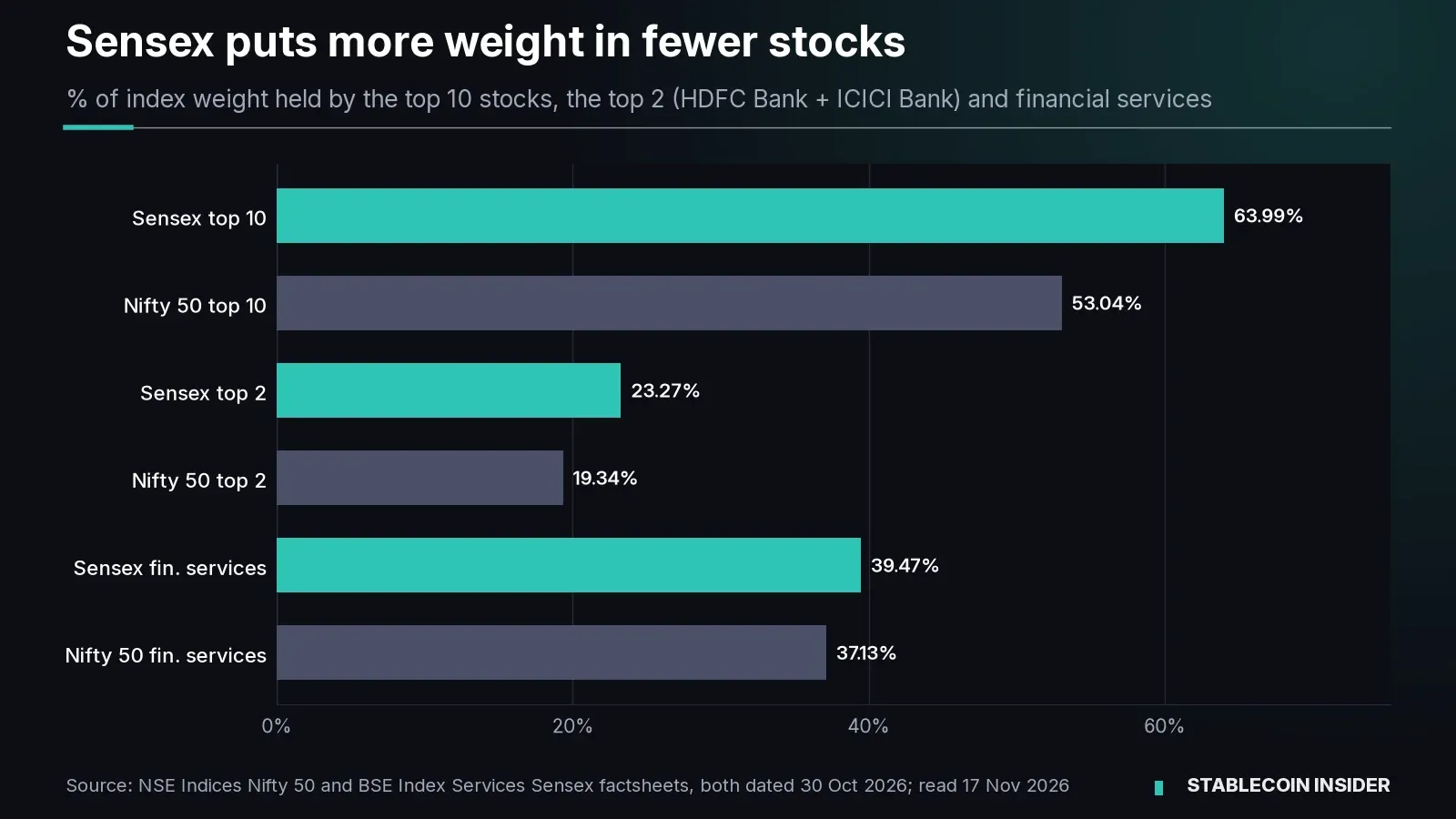
The analysis comparing the Nifty 50 and Sensex underscores their unique characteristics, particularly regarding concentration levels and the number of companies involved. Indian investors typically opt for the Nifty 50, which consists of 50 companies. The top ten stocks within this index represent 53.04% of the total, while the Sensex shows even greater concentration, with its leading stocks comprising 63.99%. Over the five years leading to 30 October 2026, the Nifty 50 achieved an annual return of 6.70%, surpassing the Sensex's return of 5.92%, as indicated by relevant financial documentation.
For those aiming to construct a concentrated portfolio consisting of 30 blue-chip companies, the BSE Sensex may be a more suitable option. Furthermore, UTI's index fund for the Sensex has slightly lower fees than its Nifty 50 equivalent, with annual charges of 0.23% compared to 0.25% for direct plans, according to the AMFI scheme summaries. Traders should also consider that the choice of index is heavily influenced by contract specifics: Nifty 50 weekly options expire on Tuesdays at the NSE with a lot size of 65, whereas Sensex weekly options conclude on Thursdays at the BSE with a lot size of 20.
As of the most recent update on 17 November 2026, the index data, returns, and weightings are sourced from the NSE Indices and BSE Index Services fact sheets dated 30 October 2026. Fund expenses are derived from AMFI scheme summaries, while regulations regarding futures and options are based on circulars from the NSE and BSE, all noted as of this date. All financial amounts are presented in Indian rupees (₹).
Key Takeaways
The following points summarize the key differences between the Nifty 50 and Sensex.
- The Nifty 50 is made up of 50 firms, whereas the Sensex tracks 30 companies from the BSE 100.
- As of 30 October 2026, the Sensex exhibits a higher concentration, with HDFC Bank and ICICI Bank collectively accounting for 23.27% of the index, in contrast to 19.34% for the Nifty 50.
- Both indices experienced declines in the year ending 30 October 2026: the Nifty 50 recorded a total return of -9.45%, while the Sensex noted a decrease of -10.42%.
- For an investment of ₹10 lakh, the direct-plan costs for UTI's funds vary by approximately ₹200 annually between the two indices; selecting a regular plan instead of a direct plan results in higher expenses.
| Item | Nifty 50 | BSE Sensex |
|---|---|---|
| Our pick:Nifty 50 | Default for most long-term index investors: broader, less concentrated (NSE) | Better fit for a tighter 30-stock blue-chip basket (BSE) |
| Index provider and exchange | NSE Indices Ltd (NSE factsheet) | BSE Index Services Pvt. Ltd, a BSE subsidiary (BSE methodology) |
| Number of stocks | 50 (NSE) | 30 companies, chosen from the BSE 100 (BSE) |
| Launch, base date, base value | Launched 22 Apr 1996; base date 3 Nov 1995; base 1,000 (NSE) | Launched 2 Jan 1986; first value date 3 Apr 1979; base 100 (BSE) |
| Who gets in | Stocks in the F&O segment, impact cost of 0.50% or less, at least one month listed (NSE) | BSE 100 members with a derivative contract, six months' listing, traded every day of the review period (BSE methodology) |
| Review schedule | Semi-annual; cut-offs 31 Jan and 31 Jul (NSE) | Semi-annual, in June and December (BSE) |
| Weighting | Free-float market cap (NSE) | Float-adjusted market cap (BSE) |
| Item | Nifty 50 | BSE Sensex |
|---|---|---|
| Top 10 stocks' weight | 53.04% (sum of the 10 weights listed) (NSE) | 63.99% (BSE) |
| Largest stock | HDFC Bank, 9.95% (NSE) | HDFC Bank, 11.95% (BSE) |
| Total return, 1 year / 5 years a year | -9.45% / 6.70% (NSE) | -10.42% / 5.92% (BSE) |
| P/E ratio | 19.30 (NSE) | 19.31 (BSE) |
| Example index fund cost (UTI, direct / regular) | 0.25% / 0.31% a year, no exit load (AMFI) | 0.23% / 0.30% a year, no exit load (AMFI) |
| Weekly options expiry and lot size | Tuesday on NSE; 65 units (NSE expiry;NSE lot) | Thursday on BSE; 20 units (BSE expiry;BSE lot) |
| Fund and plan | Fee per year | Fees over 10 years (flat value) |
|---|---|---|
| UTI Nifty 50 Index Fund, direct (0.25%) | ₹2,500 | ₹25,000 |
| UTI BSE Sensex Index Fund, direct (0.23%) | ₹2,300 | ₹23,000 |
| UTI Nifty 50 Index Fund, regular (0.31%) | ₹3,100 | ₹31,000 |
| UTI BSE Sensex Index Fund, regular (0.30%) | ₹3,000 | ₹30,000 |