The evaluation of TSB and Santander current accounts primarily depends on individual banking preferences. Both institutions are merging but still maintain separate offerings. TSB is favored by those who frequently use their cards, featuring the Spend & Save Plus account for £3 per month, which grants £5 cashback after 20 debit card transactions, and it has no fees for card usage abroad. In contrast, Santander appeals to customers looking for switching incentives or cashback on bills. Its free Everyday account includes a £240 switching bonus, while the Edge account provides 1% cashback on eligible household bills, up to £10 each month.
Public interest regarding these accounts is increasing due to the impending merger. Santander UK completed the acquisition of TSB on 30 April 2026, and on 10 November 2026, they filed an application to transfer TSB's banking operations to Santander UK plc. The High Court is scheduled to review this plan on 15 February 2027, with the transfer expected to be finalized on 22 March 2027.
As of 19 November 2026, fees, cashback rates, switching terms, and transfer timelines have been confirmed against the latest details from TSB, Santander, and the FSCS. All amounts are stated in pounds sterling (£) for UK residents.
Key Takeaways
- TSB and Santander UK remain distinct banks. If the court approves, Santander UK will officially manage TSB accounts starting 22 March 2027, with plans to transition customers to Santander's systems in the latter half of 2027.
- After this transition, eligible deposits at TSB, Santander UK, and cahoot will share a single £120,000 FSCS limit, rather than two separate limits.
- Both banks provide free basic accounts; however, foreign card transactions incur fees: 2.99% at TSB Spend & Save and 2.95% at Santander Everyday.
- Santander does not charge for unarranged overdrafts, while TSB applies a 39.90% EAR on such overdrafts, limited to £30 monthly.
- In our illustrative scenario, TSB Spend & Save Plus results in a gain of £24 annually, while Santander Edge breaks even, with both free accounts incurring roughly £35 in card fees each year.
TSB vs Santander Overview
The following table illustrates the differences between TSB and Santander for personal customers as of now. Each row includes links to the respective TSB, Santander, or FSCS pages consulted on 19 November 2026.
| Item | TSB | Santander |
|---|---|---|
| Our pick:TSB Spend & Save Plus for regular card users | £3 monthly, £5 cashback with 20+ card payments, no TSB fees abroad (TSB) | Opt for Everyday for the £240 switching offer, or Edge if your monthly bills exceed £300 (Santander) |
| Legal status | Acquired by Santander UK on 30 April 2026; still operates as a separate entity (TSB) | Santander UK plc; will become the legal provider of TSB accounts from 22 March 2027 if approved (Santander) |
| Free everyday account | Spend & Save: no monthly fee, £5 cashback for the first 6 months (TSB) | Everyday: no monthly fee, no funding requirement (Santander) |
| Card use abroad (free account) | 2.99% non-sterling fee; plus £1 per payment outside the EEA (TSB fee document) | 2.95% conversion fee; free withdrawals at Santander ATMs in 11 countries (Santander fee document) |
| Arranged overdraft | 39.90% representative APR (Spend & Save); 40.10% on Plus, first £100 interest-free (TSB) | 39.94% representative APR/EAR across all adult accounts (Santander) |
| Unarranged overdraft | 39.90% EAR, capped at £30 monthly (TSB fee document) | No interest or charges apply (Santander fee document) |
| Switching offer | No cash incentive available on TSB's switching page (TSB) | £240 Switch & Save offer, conditions apply (Santander T&Cs) |
| FSCS protection | £120,000 protected separately from Santander until the transfer (TSB) | £120,000 combined with TSB and cahoot after the transfer (TSB) |
Notable patterns emerge: while the free accounts are similarly priced, significant differences exist in the paid account tiers and overdraft policies. Moreover, the merger is particularly crucial for customers holding savings at both banks, as the deposit protection will reduce from two limits to one.
Direct Comparisons of TSB and Santander Current Accounts
The current accounts undergoing direct comparison are TSB Spend & Save versus Santander Everyday (both free), and TSB Spend & Save Plus against Santander Edge (both £3 per month). Santander also presents Edge Up at £5 monthly and Edge Explorer at £17 monthly, which TSB does not match.
Fees and card use abroad
| Account | Monthly fee | Card fee abroad |
|---|---|---|
| TSB Spend & Save | £0 | 2.99%; £1 per payment outside the EEA (TSB) |
| TSB Spend & Save Plus | £3 | No TSB fees (TSB) |
| Santander Everyday | £0 | 2.95% (Santander) |
| Santander Edge | £3 | 0% (Santander) |
| Santander Edge Up | £5 | 0% (Santander) |
Cashback, interest, and linked savings
| Account | Cashback or interest | Linked saver |
|---|---|---|
| TSB Spend & Save | £5 monthly for up to the first 6 months with 20+ card payments (TSB) | Monthly Saver 5.00% AER fixed, £25–£250 a month (TSB) |
| TSB Spend & Save Plus | £5 monthly with 20+ card payments (TSB) | Monthly Saver 5.00%; Savings Pots 1.55% AER (TSB) |
| Santander Everyday | No cashback; £240 switching offer if eligible (Santander) | Regular Saver 8.00% AER variable including a 5.00% 12-month bonus, up to £200 monthly (Santander) |
| Santander Edge | 1% on eligible household bills via Direct Debit, up to £10 monthly; requires £500 monthly and two Direct Debits (Santander) | Edge Saver 6.00% AER variable on balances up to £4,000, including a 2.50% 12-month bonus (Santander) |
| Santander Edge Up | 1% on selected bills up to £15 monthly, plus 2.10% AER on balances up to £25,000; requires £1,500 monthly (Santander) | Regular Saver 8.00% (Santander) |
Santander defines 'selected household bills' to include items such as council taxes, mobile and home phone services, broadband, and paid television services; however, TV licenses, liquid petroleum gas, and maintenance contracts do not qualify. TSB counts payments made via debit card, online, mail order, and contactless methods toward the 20 payments requirement, which must be completed by the end of the month.
Which bank is more economical: TSB or Santander?
For individuals who make 20 or more card transactions each month, TSB is the more economical option. This arises from cashback rather than fees. We calculated a year’s expenses for a sample customer relying solely on published fees.
Assumptions for our calculation include a UK resident making at least 20 debit card transactions monthly, depositing a minimum of £500 each month, paying £300 in eligible household bills via Direct Debit monthly (including energy, water, phone, and broadband), spending £1,200 annually by card in euros within the EEA with the bank handling conversions, and not using any overdraft. Bonuses for switching accounts and interest on savings were excluded, and figures refer to an ongoing year; the six-month introductory cashback for TSB Spend & Save is calculated separately.
| Account | Fees, cashback, and card fees abroad | Net per year |
|---|---|---|
| TSB Spend & Save Plus | Fees −£36; cashback +£60; card fees abroad £0 | +£24 |
| Santander Edge | Fees −£36; cashback +£36 (1% of £3,600); card fees abroad £0 | £0 |
| Santander Everyday | Fees £0; cashback £0; card fees abroad −£35.40 (2.95%) | −£35.40 |
| TSB Spend & Save | Fees £0; cashback £0 (£30 in year one); card fees abroad −£35.88 (2.99%) | −£35.88(−£5.88 in year one) |
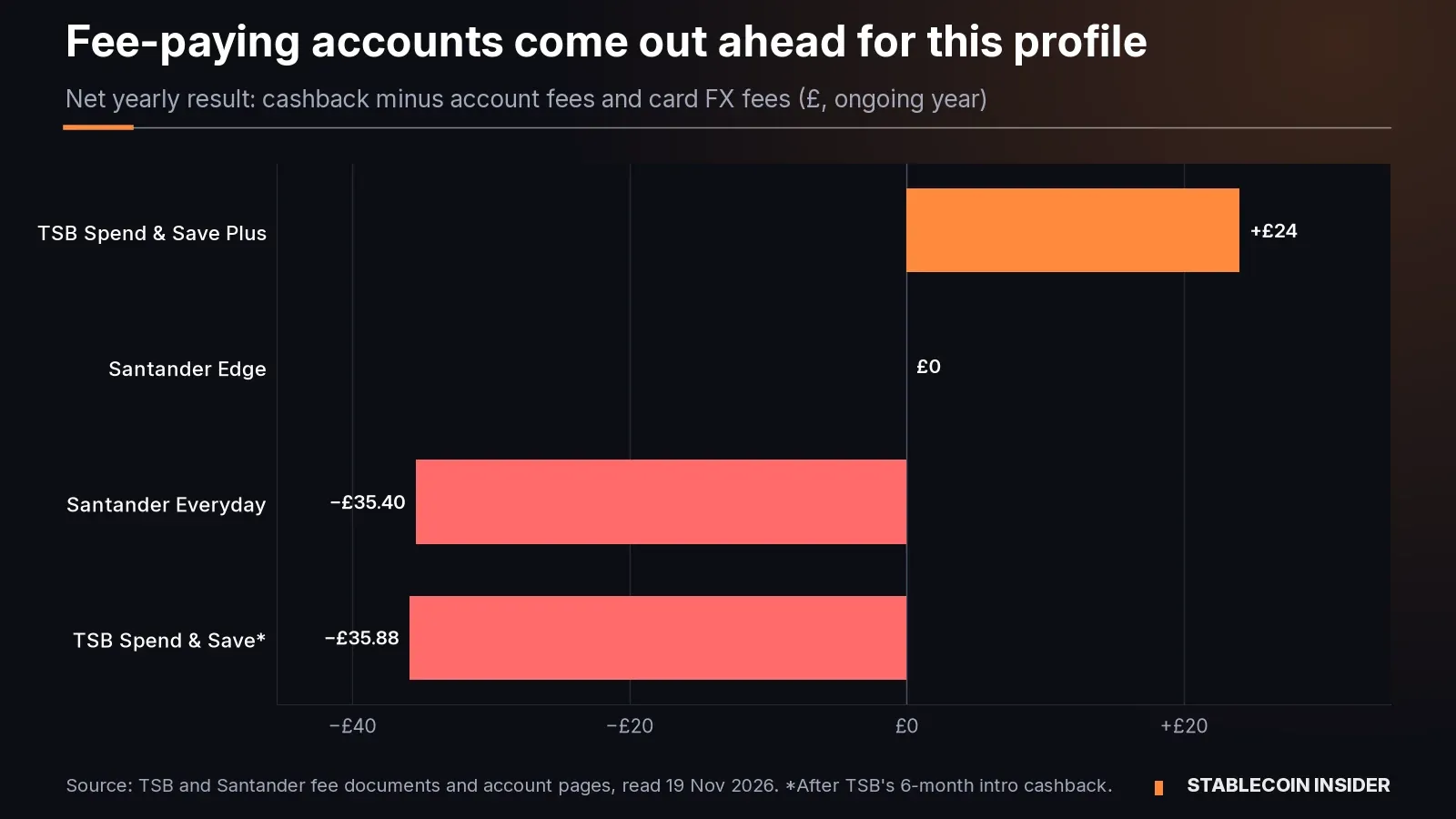
The break-even points are clear. The Santander Edge account covers its £3 fee once eligible monthly bills reach £300, and its cashback stops increasing at £1,000 monthly, where the £10 limit is reached. TSB Spend & Save Plus earns £2 more in each month when 20 card payments are made and incurs a £3 loss in any month where the threshold is not met. For infrequent travelers who rarely pay bills via Direct Debit, either of the free accounts would be more beneficial.
What will change for TSB customers with the transition to Santander?
If the court approves the merger on 22 March 2027, the primary change for TSB customers will be legal: Santander UK will become the account provider, while account numbers, cards, PINs, payments, and contact information will remain unchanged. Three specific exceptions are noted:
- FSCS: Deposits at TSB and Santander UK, along with cahoot, Santander Business, and Santander Corporate & Commercial, will be protected up to a combined total of £120,000 instead of separately.
- ISAs: Santander UK will take over as the ISA manager; the ISA will continue to be tax-free, and customers wishing to object may transfer it.
- Euro Direct Debits: New euro Direct Debits cannot be established, and existing ones will cease.
The implications of the FSCS change are significant. For example, a customer holding £90,000 at TSB and £60,000 at Santander would currently be fully protected, as each bank has its individual £120,000 limit. After the transfer, the total balance would be treated as £150,000 at one institution, leaving £30,000 exceeding the limit unless moved to a bank with a separate license. Joint accounts are eligible for £120,000 per individual.
A more substantial change will occur later. TSB plans to migrate accounts to Santander's systems, platforms, and channels in the latter half of 2027, with notice of any changes to be provided at that time. Neither bank has specified the fate of TSB's account offerings, so the fees outlined above may not remain after the transition. TSB's press release states that Santander UK has guaranteed no additional branch closures before 2028 at the earliest, and TSB debit cards currently benefit from avoiding TSB foreign exchange fees on cash withdrawals from Santander ATMs in Spain and Portugal.
Should you switch from TSB to Santander at this time?
At this stage, switching from TSB to Santander is not necessary. Both banks have confirmed that TSB customers can continue their banking activities as usual without taking any action. Switching only makes sense if a Santander account better aligns with individual needs or if one wishes to benefit from the £240 incentive.
The £240 Switch & Save offer, launched on 27 October 2026, requires a complete switch to Santander Everyday via the Current Account Switch Service. The old account must be closed within 60 days, a minimum deposit of £1,500 must be made, two active household Direct Debits must be maintained, and at least £200 must be placed into a Santander Regular Saver. Eligibility is void if anyone on the account held a Santander current account as of 1 January 2026, or if switching from a Santander, cahoot, or Cater Allen account; TSB is not included in that restriction. Santander reserves the right to withdraw or modify the offer without prior notice.
For those concerned about potential negative impacts from the transfer, objections can be voiced to TSB through online channels, by calling 0345 835 7841, via post, or at the court hearing on 15 February 2027.
Who should consider TSB?
TSB is well-suited for individuals who frequently make small card transactions and travel, and who prefer in-person banking services: TSB operates 175 branches along with banking pods and hubs. The Spend & Save Plus account offers fee-free card use abroad and £60 in cashback annually for a £36 fee. Its Monthly Saver account provides a fixed 5.00% AER for one year on deposits between £25 and £250.
However, there are drawbacks: TSB's free account incurs an additional £1 charge for each non-EEA card transaction on top of the 2.99% fee. Additionally, unarranged overdrafts carry charges, there is no mentioned switching bonus on its switching page, and account offerings may change once customers are transitioned to Santander systems in late 2027.
Who should choose Santander?
Santander is ideal for those who pay significant household bills via Direct Debit, seek a switching bonus, or want to avoid fees from unarranged overdrafts. The Edge account can yield up to £10 monthly on eligible bills, the Regular Saver account offers an 8.00% AER, including a 12-month bonus on up to £200 monthly, and unarranged overdrafts incur no fees.
On the downside, the Edge and Edge Up accounts require monthly deposits of £500 or £1,500 alongside two Direct Debits, and the free Everyday account charges 2.95% on international card transactions and has a £25 fee plus a 1%–3% markup on non-SEPA payments. For those with considerable savings at TSB, the combined FSCS limit presents a compelling reason to consider diversifying their funds instead of consolidating.
Are you contemplating leaving both banks? Explore our comparison of six alternatives to TSB, featuring options like Nationwide, first direct, Club Lloyds, Starling, Monzo, and Chase UK. If you're reassessing your savings options, our comparison of Premium Bonds versus cash ISAs discusses returns and tax implications. Additionally, our guide on DWP bank account checks outlines what the DWP can access in UK bank accounts.
Frequently Asked Questions
Is TSB owned by Santander?
When will TSB officially become part of Santander?
Will my TSB account number and card remain the same?
What will happen to my TSB ISA?
Can TSB customers access Santander ATMs abroad without fees?
Conclusion: TSB or Santander?
Choose TSB Spend & Save Plus if you make 20 or more card transactions each month and travel frequently, as it offers a £24 annual advantage with no TSB card fees overseas. Opt for Santander Edge if your eligible household bills exceed £300 monthly, and select Santander Everyday if you qualify for the £240 switching offer and can meet the £1,500 deposit requirement. Current TSB customers do not need to take any action before 22 March 2027, except to ensure their combined TSB and Santander balances remain within the £120,000 FSCS limit.