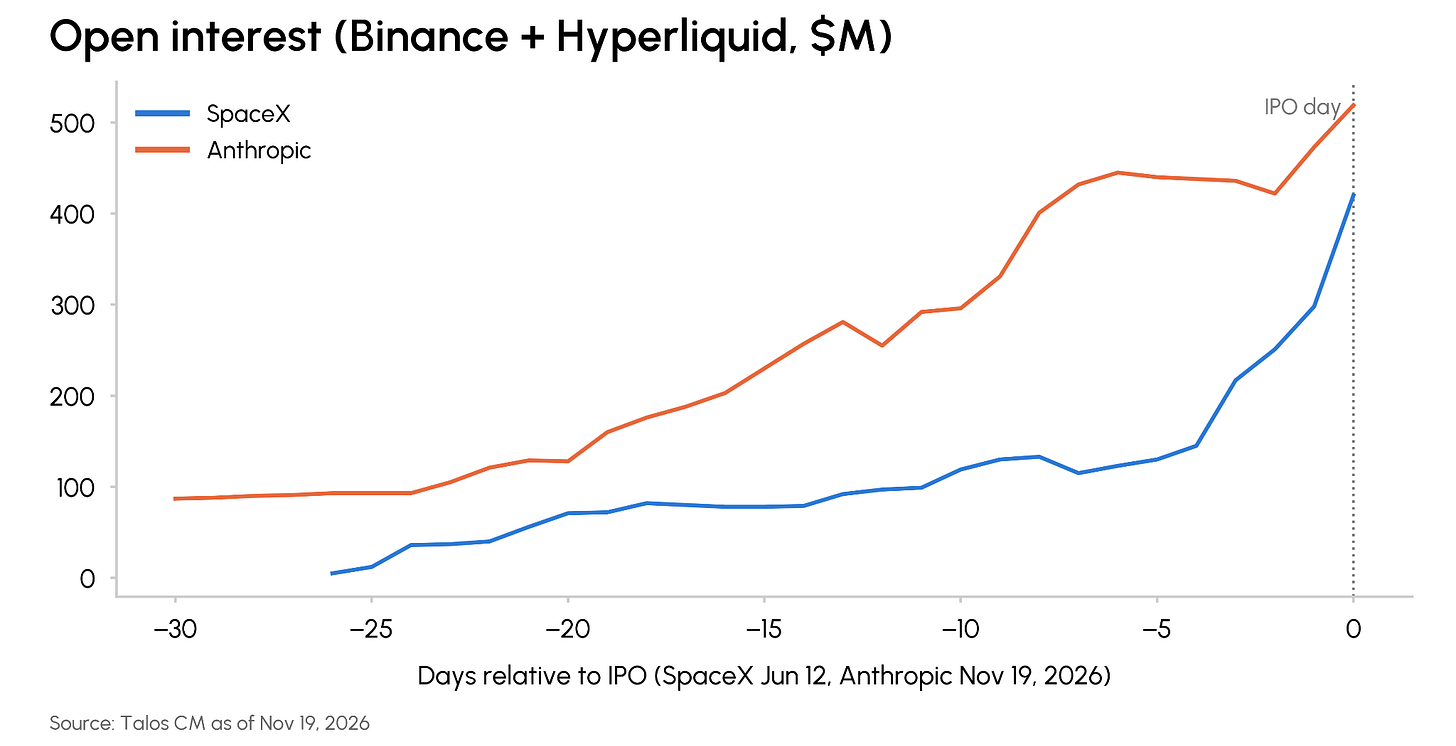
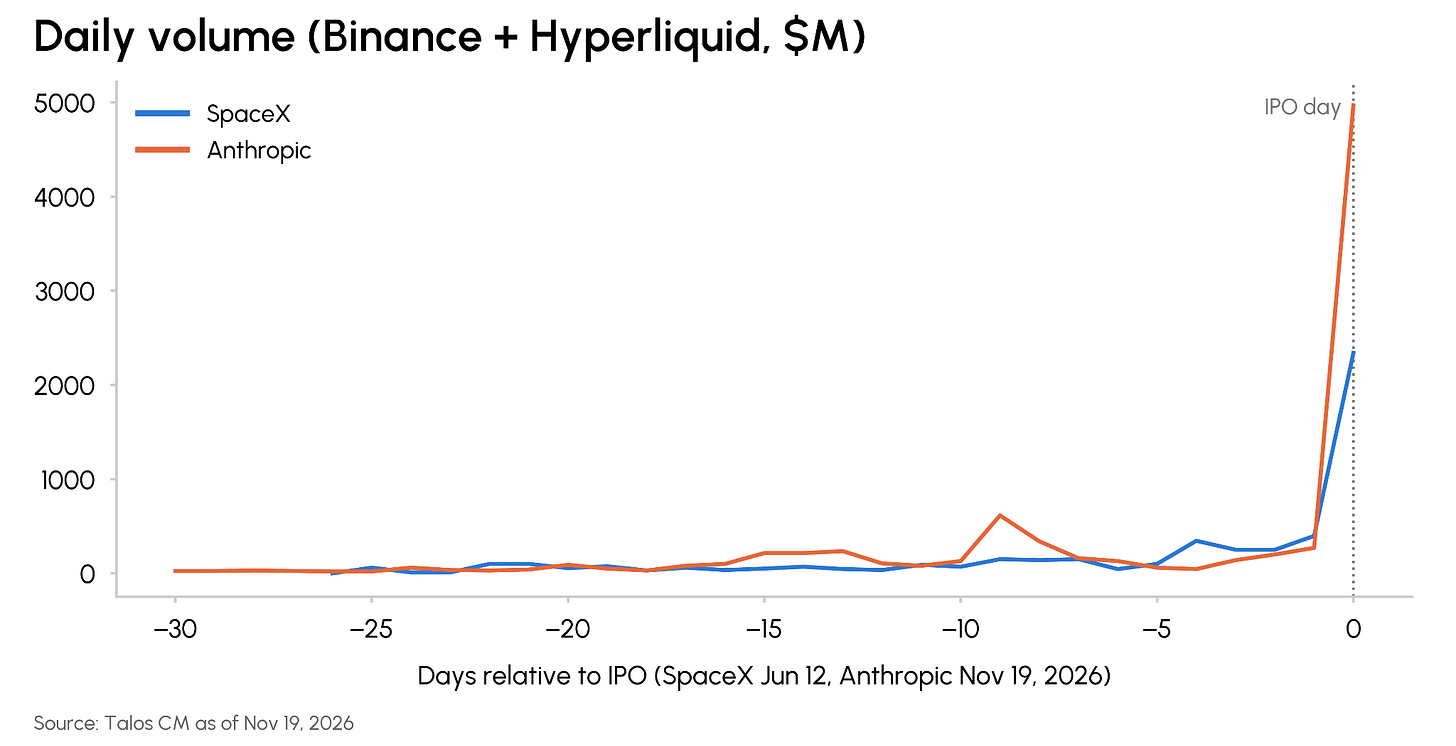
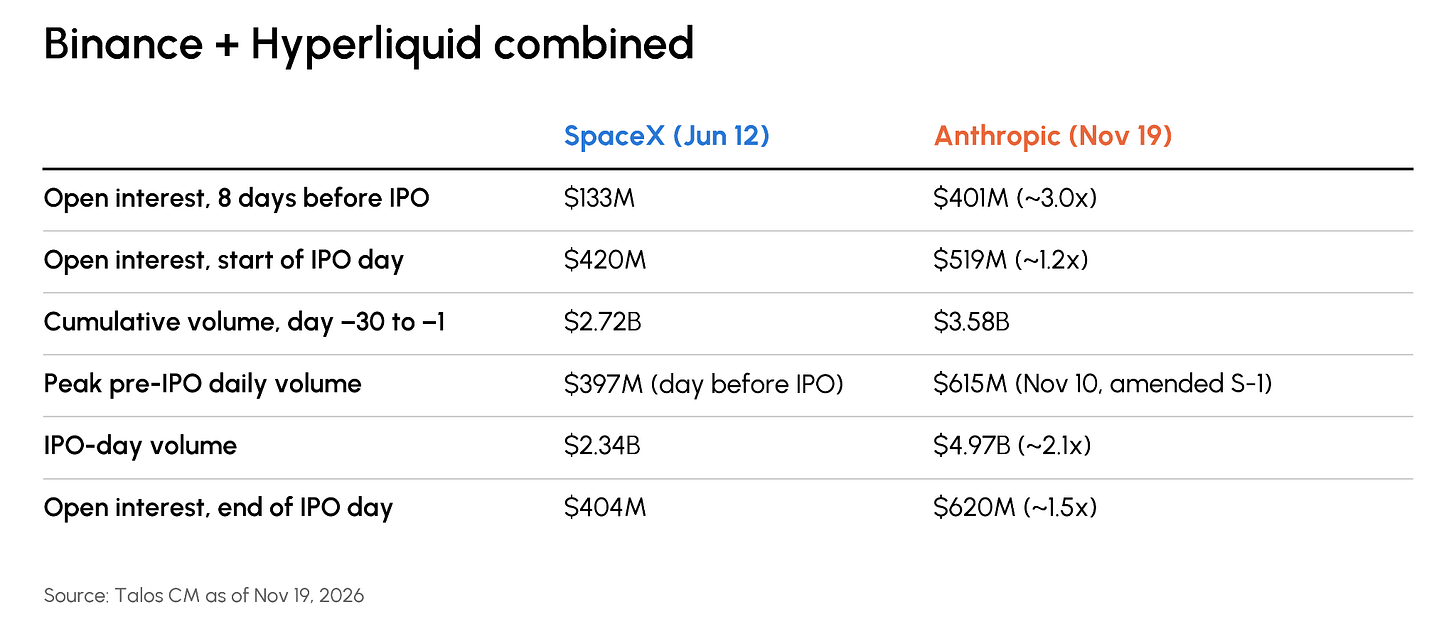
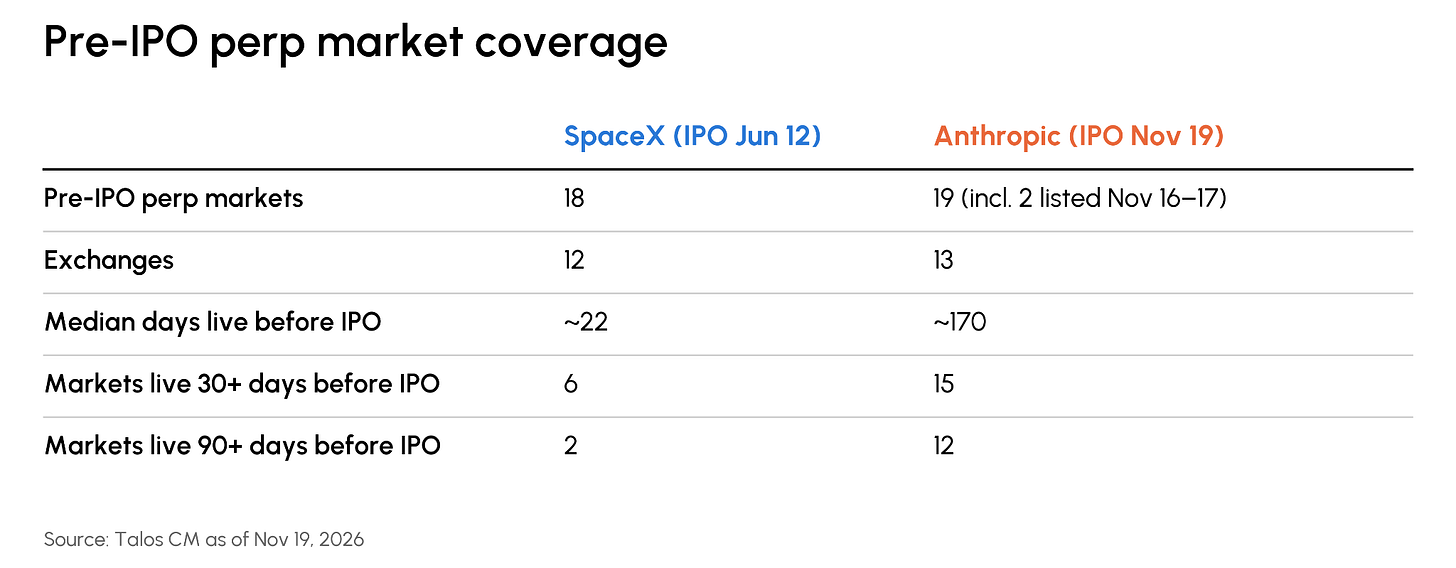
The perpetual futures market experienced significant growth prior to Anthropic's initial public offering (IPO), particularly after SpaceX's foray into this space. On average, Anthropic's perpetual futures were actively traded for approximately 170 days leading up to its IPO, in stark contrast to SpaceX, which saw just 22 days of trading activity. On the day of the IPO, trading volume surged to $4.97 billion, representing a 2.1-fold increase compared to SpaceX's figures.
Before the amended S-1 filing on November 10, considerable price fluctuations were observed across various formats, including per-share valuations and placeholders. After this amendment, most trading platforms transitioned to per-share pricing.
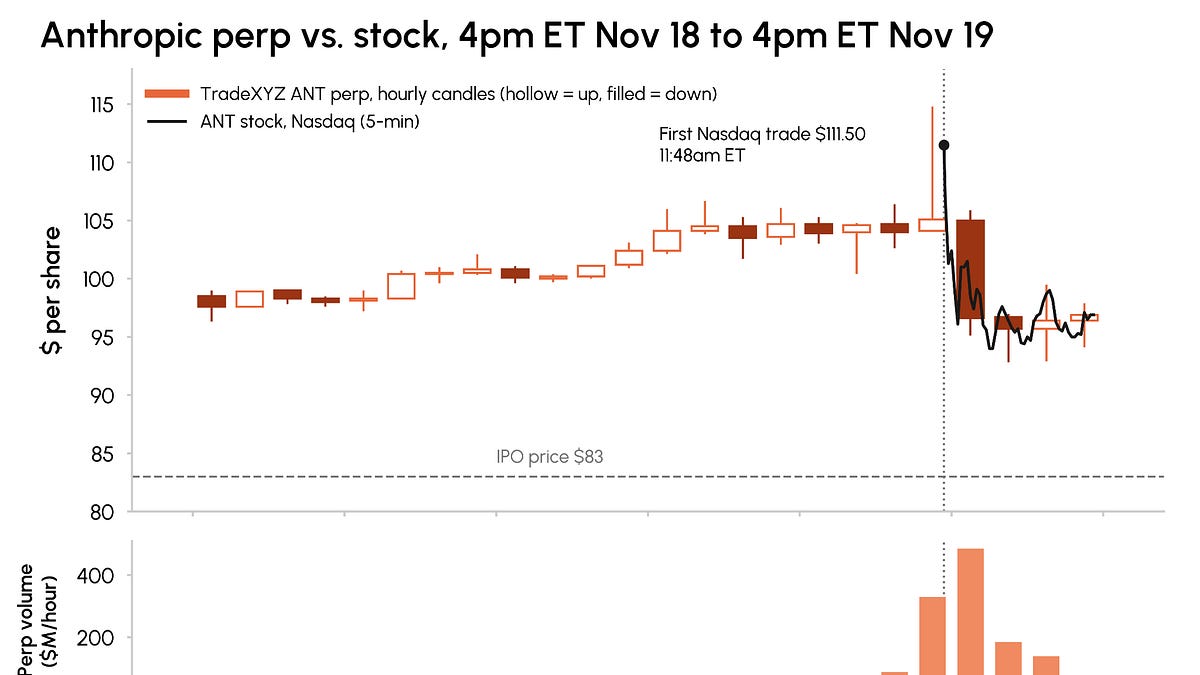
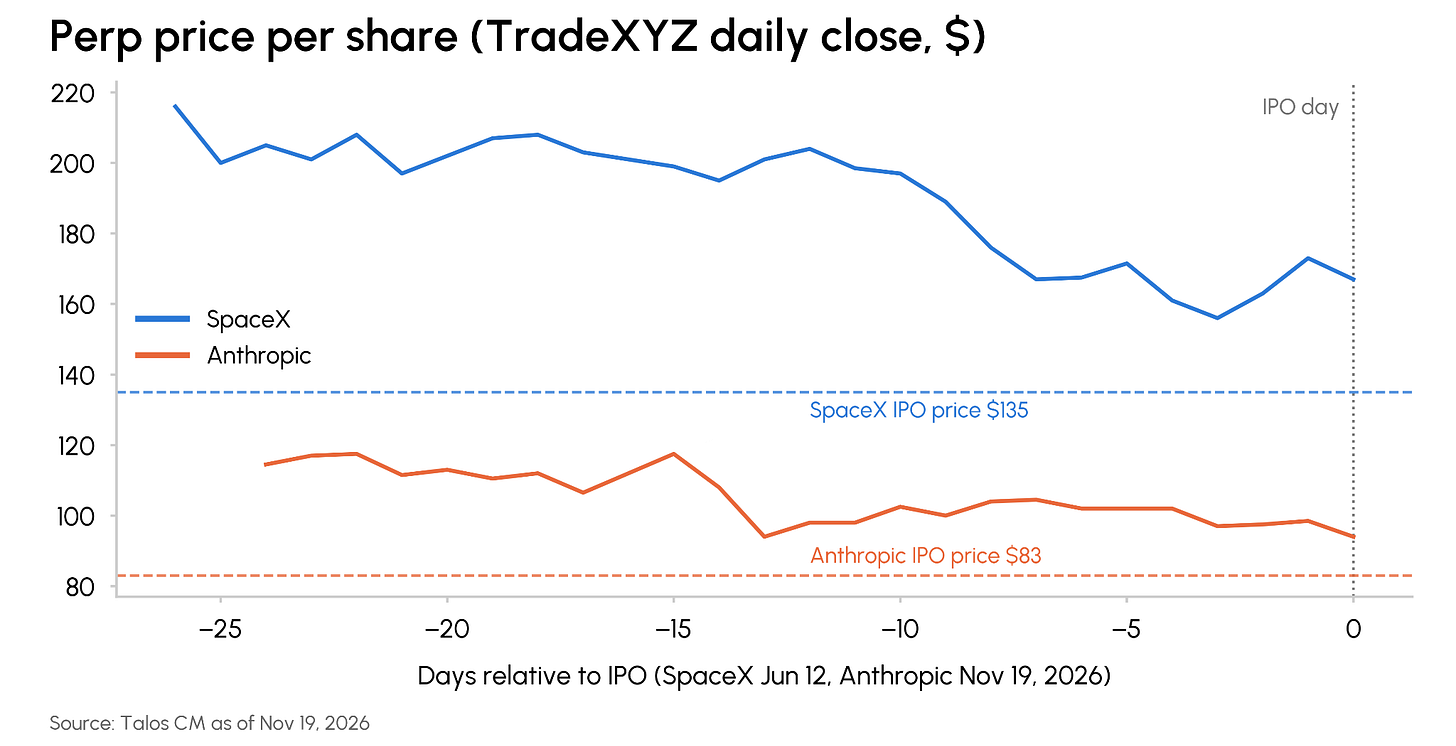
Perpetual futures emerged as a more reliable gauge than the IPO price itself, closing at $98.33 shortly before the listing—approximately 1% away from the first-day closing price of $97.17.
As the opening bell approached, the pricing discrepancies significantly diminished, reducing from about 12% the night before to just 0.45% a minute prior to the commencement of trading.
No disruptions were reported either during the listing or the overnight session; perpetual futures concluded on the IPO day within 0.2% of the stock price, maintaining a close proximity at 0.4% of the subsequent pre-market print.
Anthropic's stock performance has struggled to keep pace with the AI market's recovery, declining 1.0% from Friday's close to figures on Monday, while Nvidia surged by 31%. This trend has raised investor concerns about the potential returns on AI investments, leading some to hedge their gains from the IPO.
Market Insights and Trading Activity
Earlier this month, our research titled Countdown to ANT explored how crypto-native perpetual futures provided insights into Anthropic ahead of its Nasdaq debut. Anthropic set its share price at $83 on November 18, exceeding the revised range of $70 to $78, opened at $111.50 on November 19, and concluded its first trading day at $97.17.
This analysis examines the differences between the implied values from perpetual futures and actual stock performance, making comparisons to SpaceX's listing in June. It assesses the significant growth of the market, ongoing fragmentation, rapid adaptability to new information, and performance during the listing.
Across nearly all metrics, Anthropic's perpetual futures outperformed those associated with SpaceX.
Trading Volume and Open Interest
Two notable distinctions are clear: Trade activity on the IPO day was exceptionally robust. On the listing day, Anthropic's perpetual futures recorded a trading volume totaling $4.97 billion, with Binance’s newly launched per-share ANTUSDT contract contributing $3.14 billion to that figure.
Positions remained active following the listing. Anthropic's open interest increased from $519 million to $620 million during the IPO day, while SpaceX’s open interest fell from $420 million to $404 million.
In just five months, pre-IPO perpetual futures have transformed from a trial phase into a substantial multi-billion-dollar market.
Anthropic had a similar number of perpetual futures markets when compared to SpaceX, but many had been trading for several months as opposed to just weeks.
Price alignment was also observed; as trading platforms shifted to per-share quotes, they remained within approximately 4% of each other, fluctuating between $95 and $99 in the days leading up to the listing.
Price Adjustments and Market Strategies
Various companies used the following conventions: TradeXYZ (Hyperliquid) provided pricing per Class A share. Entropy (Hyperliquid) offered a fully diluted valuation in billions. Binance initiated trading of ANTHROPICUSDT based on a placeholder of 1 billion shares before switching to a per-share ANTUSDT contract on November 17, just two days ahead of the listing. OKX began with a 1 billion-share placeholder and underwent two rebases (to 10 billion on June 30 and 13.12 billion on November 12), adjusting the pricing, contract count, and entry price each time.
After the amended S-1 was published and the share count established on November 10, trading venues quickly adopted per-share pricing. OKX modified its pricing to align with the S-1 share count on November 12, while Deribit transitioned to per-share pricing on November 16. On November 17, MEXC adjusted from around $1,280 to $98, Binance moved to ANTUSDT, and Bitget launched its per-share contract. However, Entropy continued to quote the fully diluted valuation on the IPO day.
This led to a lack of a unified price, with rebases giving the impression of diminishing open interest and liquidity spread across five distinct books.
As more companies adopt this strategy, establishing a consistent, venue-neutral reference price for pre-IPO perpetual futures could enhance comparisons and foster market expansion.
Key Trading Signals
Two crucial signals emerged: The amended S-1 generated peak trading activity. The highest pre-IPO trading day was November 10, with $615 million traded following the amendment that established the price range. The premium over the IPO price served as a more accurate measure than the IPO price itself. The day before the listing, perpetual futures closed at $98.33, representing an 18% increase over the $83 IPO price and within about 1% of the $97.17 first-day close. In comparison, for SpaceX, the perpetual futures were 28% higher than the $135 IPO price and concluded around 7% above the $161 first-day close.
When assessed against the opening print, the situation becomes more complex.
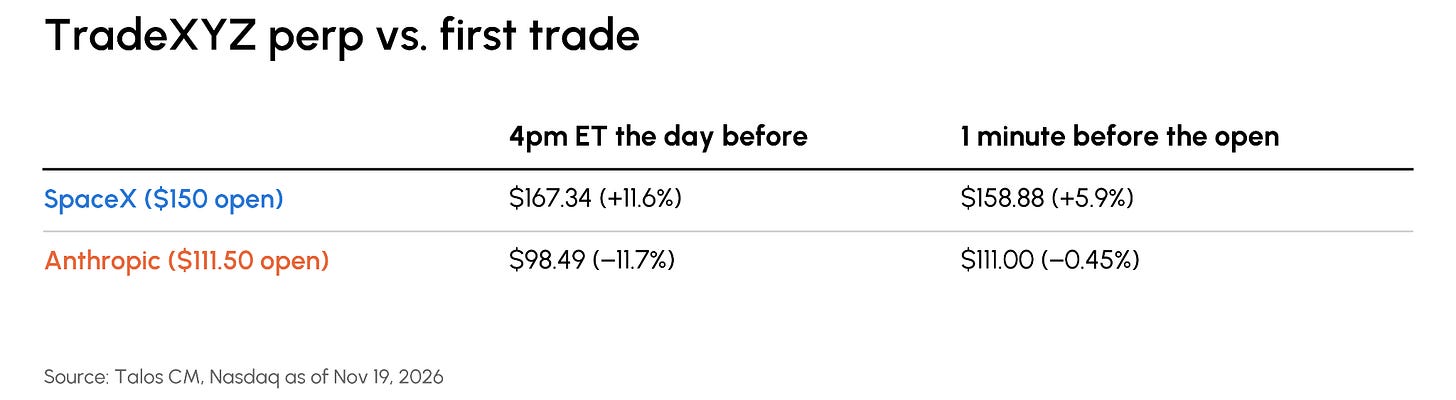
The night prior to the listing, both perpetual futures were approximately 12% from the opening print, with SpaceX’s being too high and Anthropic’s too low. By a minute before trading began, Anthropic’s gap had narrowed to 0.45%. A recent analysis revealed a similar trend for Cerebras and CXMT, where gaps of 12–14% the night before contracted to 1–3% by market open.
The listing represents the most challenging moment for these contracts, as a mismatch in convention or a demand shock could create a pricing gap. Anthropic's listing did not encounter such challenges: Leading up to the opening, perpetual futures appreciated in value throughout the morning of November 19, reaching $111.00 just a minute before the first Nasdaq trade at $111.50.
At the market open, the perpetual futures briefly surged to $114.73 in the first minute before retreating to around $105 by noon as the stock faced a sell-off. The busiest hour of trading accounted for $483 million.
During the closing period, perpetual futures tracked the decline of the stock, finishing within approximately 0.2% of the $97.17 Nasdaq closing price.
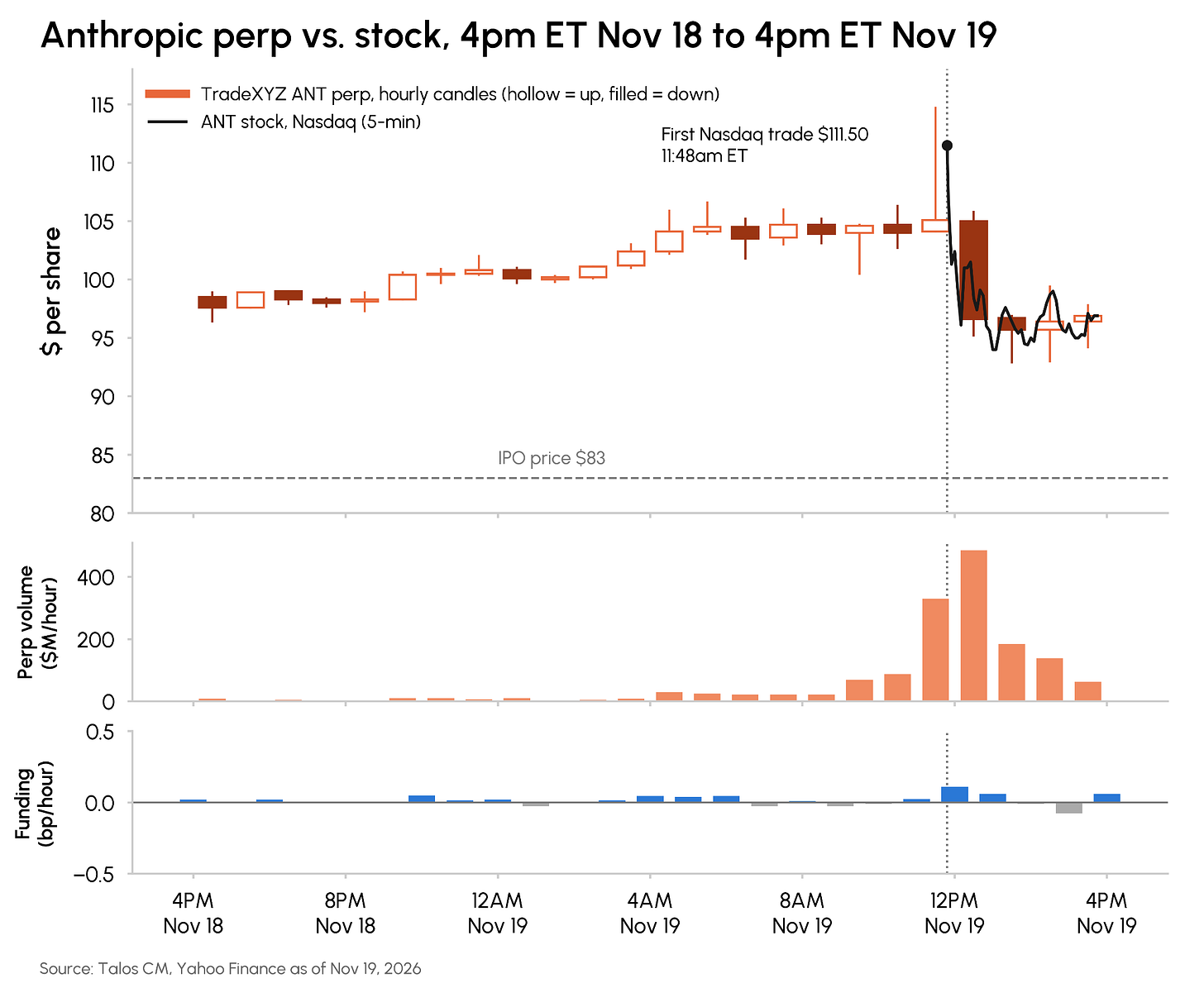
From the second day through Monday, tracking continued, with the perpetual futures lagging behind the stock's recovery. Anthropic's listing coincided with a sharp market reversal: on IPO day, the Nasdaq swung from a 2% increase to a 2.25% decrease, while the VIX rose to about 28. Overnight, while the stock was not trading, the perpetual futures continued to price it, landing within 0.4% of the stock's first pre-market print at 4 a.m. and 0.2% of Friday's opening price. As AI stocks surged over the weekend and into Monday, Anthropic lagged, ending Monday 1.0% lower than Friday’s close. It was the only AI stock tracked that saw a decline, in contrast to Nvidia's +31% and +6.6% for the Nasdaq-100 perpetual futures, which also dropped an additional 2% after hours. Two significant factors contribute to this: first, Anthropic's performance serves as a public assessment of whether investments in AI yield returns, given its filings indicating hundreds of billions in computing commitments, with computing costs constituting 55% of its revenue in the first half of 2026. Second, the stock remains above the $83 IPO price, leading some investors to use perpetual futures as a continuous hedge to secure part of their gains. Funding has fluctuated in both directions, and open interest has stabilized around $550 million.
The Countdown to ANT research analyzed the insights provided by pre-IPO perpetual futures regarding Anthropic. They accurately predicted the stock's trajectory, narrowing to within 0.5% by the market opening, and managed the listing without any interruptions, despite the market still being divided across various conventions and venues.
Pre-IPO perpetual futures are evolving from speculative bets on a listing into a continuous extension of the listed stock. Future challenges include whether ANT perpetual futures will maintain a premium or discount in relation to the stock, whether trading venues will standardize on per-share quotes from the outset, and how the next major listing, likely OpenAI, will compare.