
Bungee emerged as one of the pioneering cross-chain swap and bridge aggregators, developed by the team behind Socket, whose routing engine facilitates cross-chain functionalities in various wallets and applications.
In 2026, Bungee has undergone significant changes. The homepage now prominently features funded perpetual trading, a leveraged trading terminal, and tokenized stocks, with swaps positioned as the third offering.
This review delves into the current operation of Bungee swaps, associated costs, security history, changes in usage, and its suitability for stablecoin transfers.
Bungee swaps remain functional and are not subject to additional Socket fees. However, the product has evolved towards trading, leading to a notable decline in swap volume, meaning it no longer serves as the primary cross-chain router it once did.
Key takeaways
This section summarizes the main points regarding Bungee's current offerings and operational status.
- Socket states that it imposes no extra fees on Bungee swaps.
- Bungee now emphasizes funded perps, a trading terminal, and stocks.
- The Fixed Swap feature allows users to specify the exact amount they will receive.
- A January 2024 exploit resulted in the loss of approximately 3.3 million dollars.
- The bridge volume reached about 24 million dollars over the past 30 days.
Understanding Bungee in 2026
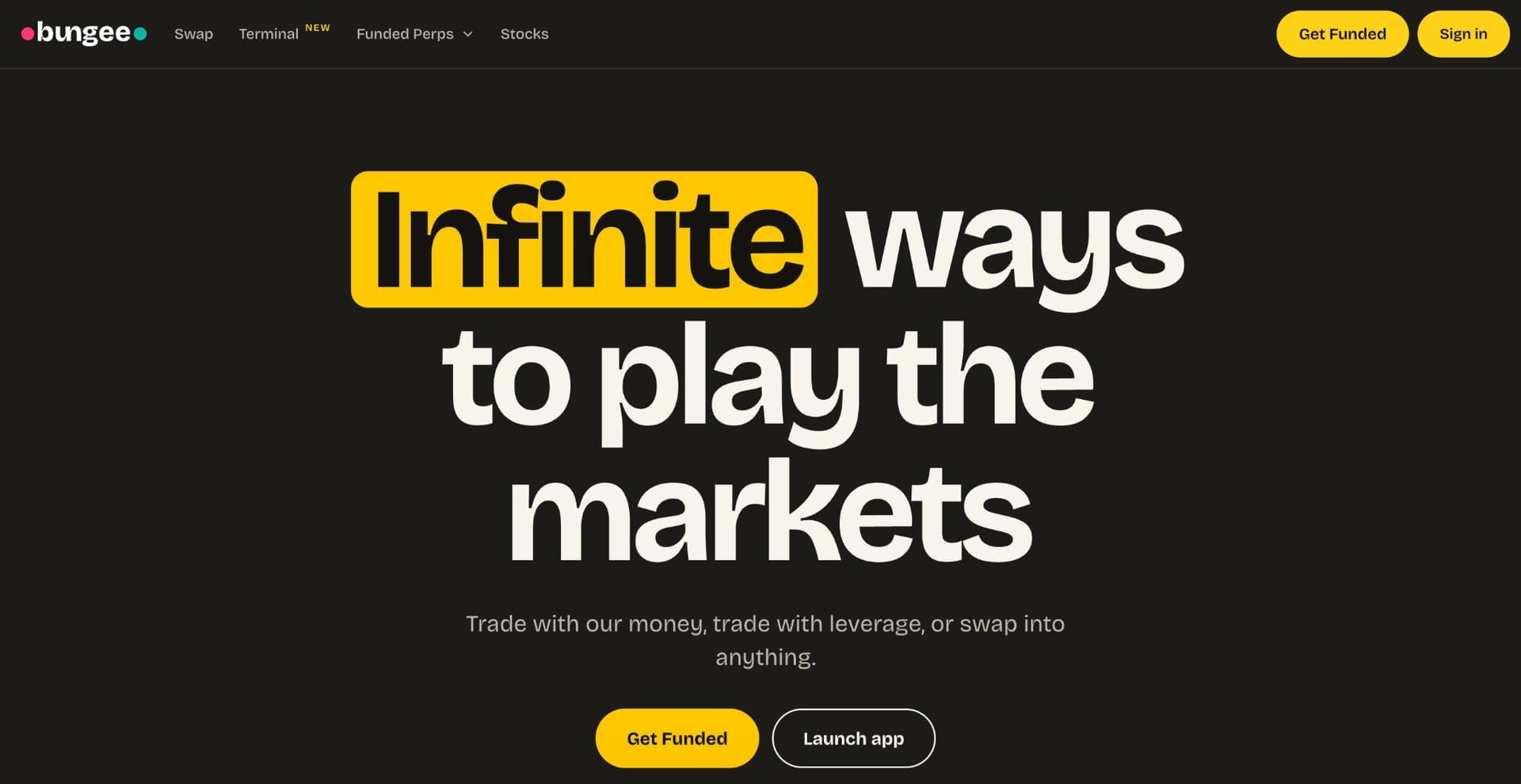
Bungee's homepage currently highlights three main products. Funded Perps enables traders to pass a challenge and utilize up to 100,000 dollars of Bungee's capital, while the Terminal provides instruments for perpetual contracts in cryptocurrencies, stocks, and commodities. Additionally, Swaps facilitates transactions across over 40 chains.
Bungee claims that 40 billion dollars have been transacted through its platform, with Coinbase Ventures and Lightspeed listed as notable investors. These figures encompass Socket's infrastructure, not solely the Bungee application.
For a comparative analysis with other cross-chain routers, refer to our compilation of the leading cross-chain aggregators.
It is important to note that funded perps and leveraged trading involve significant risks, distinct from the swap tool discussed in this review.
How Bungee swaps function
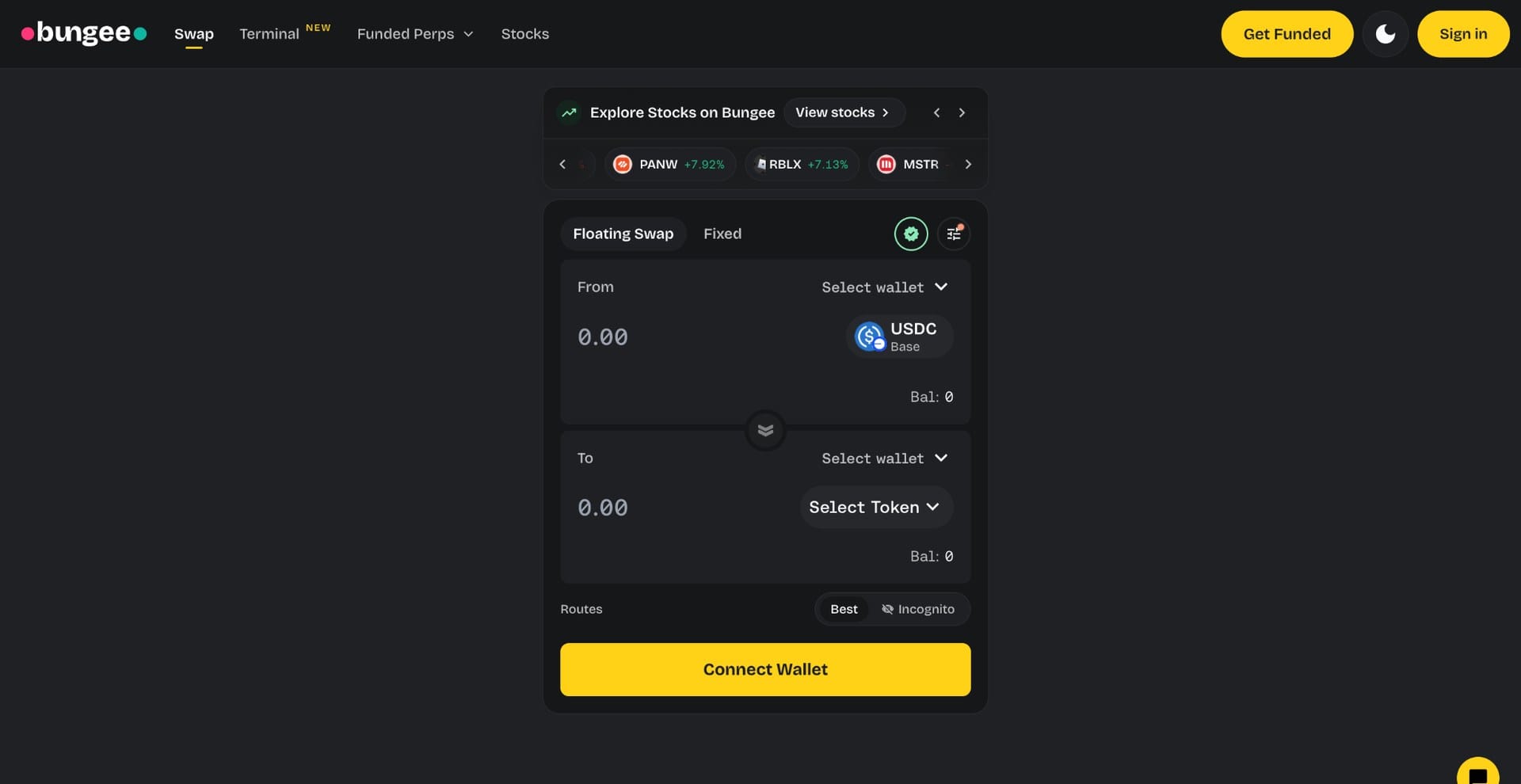
The swap interface operates on Socket's routing engine, which claims to analyze routes across more than 50 chains and over 10,000 assets, drawing from various bridges, decentralized exchanges (DEXs), and solver networks.
The default setting is Floating Swap. Users define the amount they wish to send, and the amount received is contingent upon the selected route and prevailing market conditions at the time of execution.
A Routes toggle allows users to select between Best, which identifies the most advantageous quote, and Incognito. Bungee does not elaborate on how Incognito routing differs on its webpage.
It is noteworthy that Bungee's previous documentation now redirects to Socket's resources, making detailed swap mechanics less accessible than before.
Fixed Swap for precise amounts
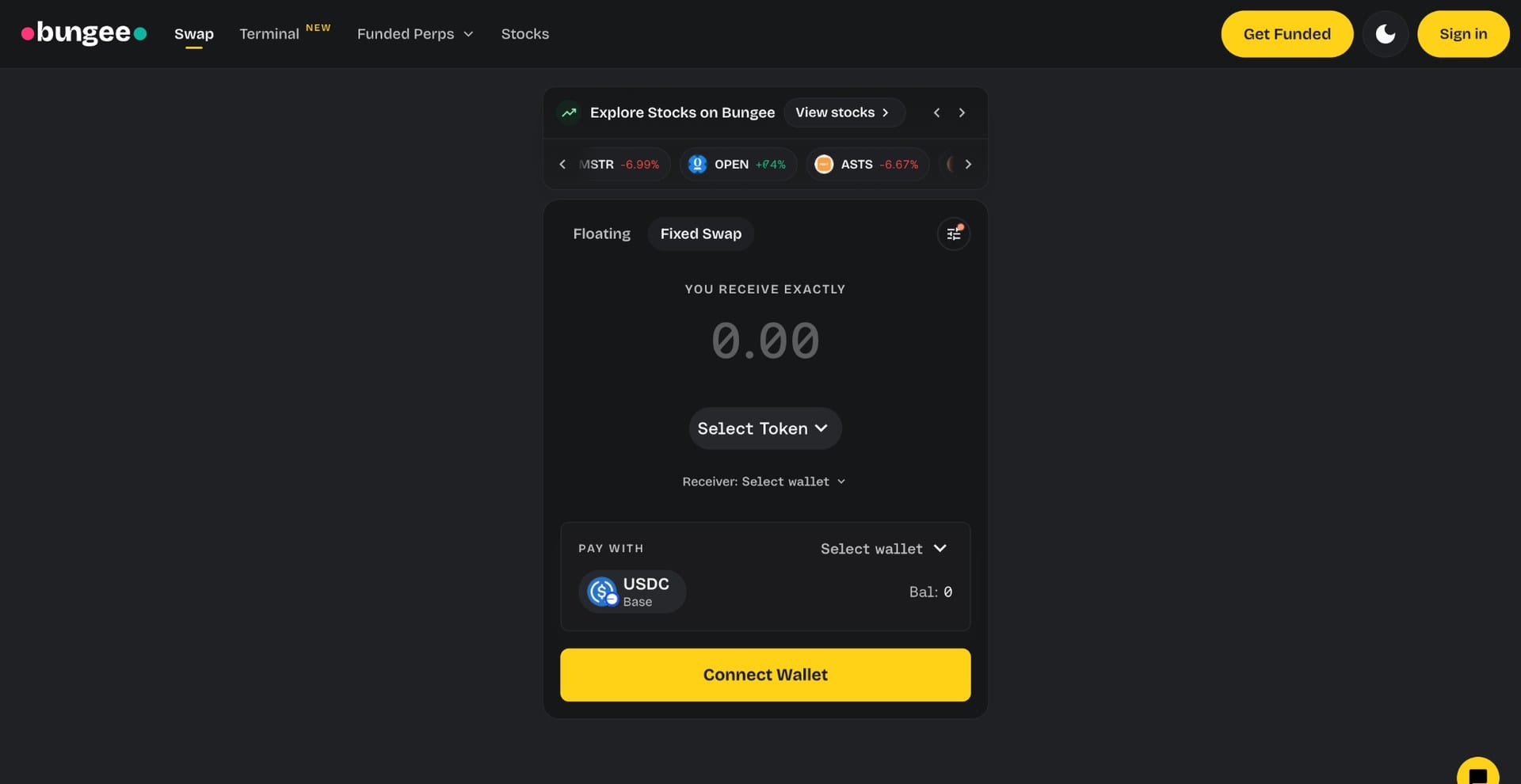
The Fixed Swap option operates inversely. Users input the exact amount they wish to receive, and Bungee calculates the corresponding payment required.
This feature is ideal for stablecoin transactions where the recipient requires a specific amount, such as 1,000 USDC on a designated chain. Additionally, users can direct the output to a different receiving wallet.
For most transfers between personal wallets, Floating Swap is more straightforward. Fixed Swap becomes particularly beneficial when the amount received is more critical than the amount sent.
Users should exercise caution when checking the payable amount in Fixed Swap, as this figure fluctuates with market dynamics.
Understanding costs
According to Socket's fee page, there are no additional charges. The costs associated with on-chain execution are included in the quote, without any markup.
| Cost | What Socket states |
|---|---|
| Socket or Bungee fee | No additional fee |
| Execution and gas | Included in the quoted amount |
| Bridge and DEX costs | Built into the route quote |
| Integrator fee | Determined by applications embedding Socket |
DefiLlama continues to track a minor amount of fees for Bungee, approximately 8,440 dollars over the past month. However, Socket's documentation does not specify the sources of these fees.
It is essential to note that wallets and applications utilizing Socket's API may impose their own fees, potentially resulting in higher costs for identical routes outside of Bungee.
Security history
On January 16, 2024, an assailant exploited vulnerabilities and stole at least 3.3 million dollars from wallets that had granted unlimited token approvals to Socket contracts. PeckShield attributed the incident to insufficient input validation in a route introduced three days prior.
Socket responded by pausing operations, disabling the route, and later communicated that it recovered 1,032 ETH, valued at approximately 2.3 million dollars at the time. Users were advised to revoke approvals for the affected contract.
Socket's audit repository includes evaluations by Consensys Diligence, Zellic, Hexens, and PeckShield conducted between 2023 and 2024.
Users should only approve the amount they intend to swap and revoke any old unlimited approvals for routers that are no longer in use.
Current usage and volume
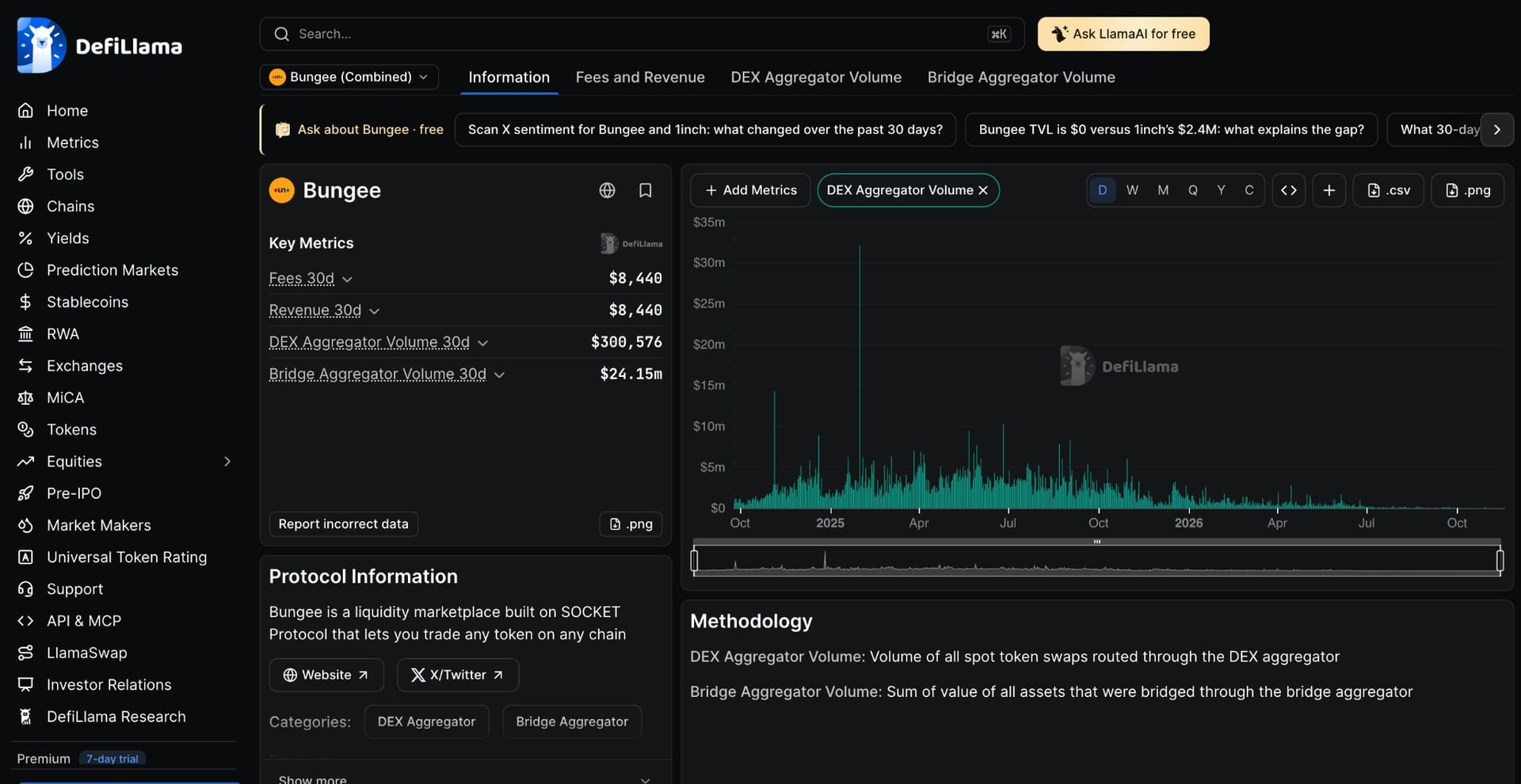
DefiLlama indicates a significant decline in Bungee's swap activity. The daily volume recorded by DEX aggregators has decreased throughout 2026, totaling roughly 300,000 dollars over the last month.
Conversely, bridge aggregator volume has remained more stable at about 24 million dollars over the same period, with cumulative bridge volume approximating 9.5 billion dollars.
A reduction in volume does not necessarily correlate with poorer quotes, as Bungee routes through external bridges and DEXs. However, it suggests a shift in focus for both users and the development team. For a more active alternative, see our review of the LI.FI aggregator.
It is worth noting that a router's volume can indicate its maintenance level, so users should review recent activity before executing large transfers.
Who benefits from Bungee
This section outlines the types of users who may find Bungee advantageous or less suitable.
- Users requiring precise output: Fixed Swap is advantageous for transferring a specific amount of stablecoins across chains.
- Cost-conscious swappers: Socket asserts that it does not impose additional fees beyond route costs.
- Traders: Funded perps and the Terminal are conveniently located within the same application for those who seek them.
- Less appropriate for: Users desiring a swap-centric application with comprehensive public documentation.
Review methodology
The information presented is sourced from bungee.exchange, Socket's documentation and audit repository, DefiLlama, and reporting regarding the 2024 exploit, as of November 18, 2026. No trades were executed during this review.
Volume, trading, and funding statistics are based on company claims or third-party data. Funded perps and the Terminal were not evaluated in this review.
It is advisable to always compare the expected amount against another aggregator prior to finalizing transactions.
Risks and limitations
This section highlights the potential risks and limitations associated with using Bungee.
- Bungee's emphasis has shifted from swaps to products centered on leveraged trading.
- A significant drop in swap volume has been observed throughout 2026.
- Comprehensive documentation for swaps is now integrated into general Socket resources.
- Unlimited approvals were exploited in the 2024 incident.
- Applications incorporating Socket may introduce their own fees.
FAQs
This section addresses common questions regarding Bungee's operations and features.
1. Does Bungee impose fees?
Socket, which underpins Bungee, claims it does not charge any supplementary fees. Execution expenses are encapsulated in the quoted amount, although applications embedding Socket might levy their own fees.
2. How do Floating Swap and Fixed Swap differ?
Floating Swap fixes the amount sent but allows the received amount to fluctuate. In contrast, Fixed Swap guarantees the specific amount received and indicates the necessary payment.
3. Is Bungee synonymous with Socket?
Bungee is constructed and supported by the team behind Socket. Socket serves as the routing engine, while Bungee functions as the consumer application that now also features funded perps, a trading terminal, and stocks.
4. Did Bungee experience a hack?
In January 2024, an exploit targeted wallets with unlimited approvals to Socket contracts, resulting in a loss of at least 3.3 million dollars. Socket later reported recovering 1,032 ETH.
5. Is Bungee still a viable bridge aggregator?
While it remains operational and adds no extra Socket fees, its swap volume has dramatically decreased, and the app has shifted focus towards trading. Users should compare quotes with other aggregators before executing large transfers.