The choice between Premium Bonds and a cash ISA ultimately hinges on the preference for certainty versus chance. For the majority of savers, a cash ISA emerges as the more advantageous option, offering a guaranteed, tax-free interest rate. Some cash ISAs even provide returns exceeding the 4.35% prize fund rate associated with Premium Bonds; for instance, Moneybox offers an AER of 4.86%, which includes a 12-month bonus.
Premium Bonds become more appealing after reaching the £20,000 ISA allowance, particularly for those in higher or additional tax brackets, or for saving on behalf of children under 16. The 4.35% prize rate is merely an average; actual returns for typical holders are often lower. In simulations based on NS&I's published prize table for November 2026, a £20,000 investment yields a median return of approximately 3.6%, while a holder with £1,000 faces about a 56% chance of receiving nothing over the course of a year.
The latest update was on 18 November 2026, confirming that prize tables, rates, odds, and eligibility had been re-verified against NS&I, Moneybox, and FSCS pages. All figures are presented in pounds sterling (£) for UK savers, with tax considerations based on the 2026/27 tax year.
Key Takeaways
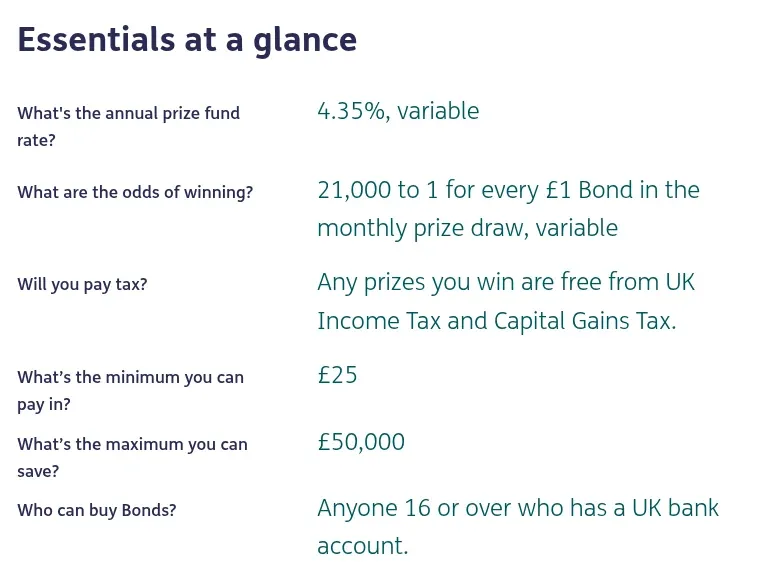
This section summarizes the essential points regarding Premium Bonds and cash ISAs. Premium Bonds do not generate interest; they feature a 4.35% variable prize fund rate that finances a monthly draw, with odds of 21,000 to 1 per £1 Bond, applicable to holdings from £25 up to £50,000. Cash ISAs provide tax-free interest on annual contributions up to £20,000 for the 2026/27 tax year; eligibility requires the individual to be at least 18 years old and a UK resident.
In the November 2026 draw, 98.7% of the 6,575,175 prizes were valued at £25, £50, or £100. For a £20,000 investment over 12 months, a cash ISA yielding 4.86% would generate £972, while NS&I's 3.80% Direct ISA would yield £760, and Premium Bonds would average £870 but have a modelled median return of £725. The Budget on 28 October 2026 maintained the £20,000 cash ISA limit and proposed new savings tax rates of 24%, 44%, and 49% effective from 6 April 2027, pending legislation.
Quick Comparison of Premium Bonds and Cash ISAs
This section provides a concise comparison of the characteristics and returns of both products. A table below outlines the features of Premium Bonds and cash ISAs, with each row linking to the respective sources consulted on 18 November 2026.
| Item | Premium Bonds | Cash ISA |
|---|---|---|
| Our recommendation: | Alternative for cash after utilizing the ISA allowance or for gifting to under-16s (NS&I) | Preferred choice for most savers: fixed rate, tax-free interest () |
| How earnings are generated | Monthly prize draw from £25 to £1 million; no interest (NS&I) | Interest at a rate determined by each provider; NS&I's Direct ISA rate is variable (NS&I Direct ISA) |
| Current rate (variable) | 4.35% prize fund rate from the September 2026 draw (NS&I) | Examples: NS&I Direct ISA 3.80% AER; Moneybox 4.86% AER including 1.16% 12-month bonus (NS&I;Moneybox) |
| Tax implications | Prizes are exempt from UK Income Tax and Capital Gains Tax (NS&I) | Interest is tax-exempt and outside the Personal Savings Allowance (NS&I;) |
| Minimum and maximum limits | Minimum purchase of £25; maximum holding of £50,000 (NS&I) | Annual ISA allowance of £20,000 across all ISAs () |
| Eligibility | Available to those aged 16 and over with a UK bank account; parents or guardians can hold for those under 16 (NS&I) | Available to those aged 18 and over who are UK residents; Junior ISAs are available for those under 18 () |
| Protection | Fully backed by HM Treasury (NS&I) | FSCS protection up to £120,000 per person per bank; NS&I's ISA is backed by the Treasury (FSCS;NS&I) |
| Access to funds | Cash can be withdrawn anytime without penalty; funds take 3–5 days to reach your bank; new Bonds must wait a full month before entering the draw (NS&I) | Access rules vary by account; NS&I Direct ISA: no notice or penalty required, 3–5 days (NS&I) |
There are two notable patterns. Firstly, both options are tax-free, creating a comparison between a guaranteed rate and a lottery-style average that most participants fail to achieve. Secondly, they have different limits and age restrictions, which underscores the practicality of using both products.
Understanding the Difference between Premium Bonds and Cash ISAs
This section clarifies the primary distinction between Premium Bonds and cash ISAs. The key difference lies in the payment structure. Cash ISAs provide interest on the balance at a specified rate, whereas Premium Bonds do not offer interest but instead enter each £1 Bond into a monthly prize draw funded by the annual prize fund rate.
Premium Bonds represent a singular offering from NS&I, which is backed by HM Treasury. In contrast, a cash ISA serves as a tax wrapper offered by various banks, building societies, and apps, resulting in variability in rates and withdrawal policies.
Which Option Yields Higher Returns: Premium Bonds or Cash ISAs?
This section examines the comparative returns of Premium Bonds and cash ISAs. A competitive cash ISA tends to yield higher returns than Premium Bonds for the average saver, whereas a subpar cash ISA may provide lower returns. The following example illustrates a £20,000 investment in each option over a 12-month period, presuming current variable rates remain constant and no funds are added or withdrawn.
| Option | Rate and terms | Return on £20,000 |
|---|---|---|
| Moneybox Cash ISA (introductory rate) | 4.86% AER including a 1.16% bonus for 12 months; requires a balance of £500 or more and fewer than four withdrawals annually; transfers in earn 3.70% (Moneybox) | £972 |
| Moneybox Open Access Cash ISA | 4.50% AER with a 1.00% bonus; unlimited withdrawals (Moneybox) | £900 |
| Premium Bonds: average | 4.35% prize fund rate; average across all holders, not a forecast (NS&I) | £870 |
| NS&I Direct ISA | 3.80% AER; backed by the Treasury; no transfers allowed (NS&I) | £760 |
| Premium Bonds: modelled median | simulation (details below); range for middle 80% of outcomes is £425 to £1,225 | £725 |
All five returns listed above are tax-free. The cash ISA calculations are based on the stated AER multiplied by £20,000. Moneybox also illustrates the same calculation on £1,000 (£1,048.60 at 4.86%). Note that bonus rates expire after 12 months, after which Moneybox's standard cash ISA rate drops to 3.70%.
Assessing Your Odds of Winning with Premium Bonds
This section evaluates the likelihood of winning with Premium Bonds. Holding a few thousand pounds in Premium Bonds increases the likelihood of winning smaller prizes, but large wins remain elusive. With odds of 21,000 to 1 per £1 Bond per draw, £20,000 in Bonds can expect approximately 11 prizes annually, predominantly in the £25 to £100 range.
The results from the November 2026 Premium Bonds draw, with prize counts sourced from NS&I, reveal the following breakdown (calculated from the total of 6,575,175 prizes valued at £500,535,100):
| Prize value | Number of prizes | Share of total prizes |
|---|---|---|
| £1 million | 2 | 0.00003% |
| £5,000 to £100,000 | 3,557 | 0.05% |
| £1,000 | 20,020 | 0.30% |
| £500 | 60,060 | 0.91% |
| £100 | 2,381,417 | 36.22% |
| £50 | 2,381,417 | 36.22% |
| £25 | 1,728,702 | 26.29% |
NS&I allocates 80% of the prize fund to prizes of £25, £50, and £100, with 10% designated for £500 and £1,000 prizes, and another 10% for amounts of £5,000 and above. This structure explains why the average return is elevated by infrequent larger wins, while the typical holder earns less.
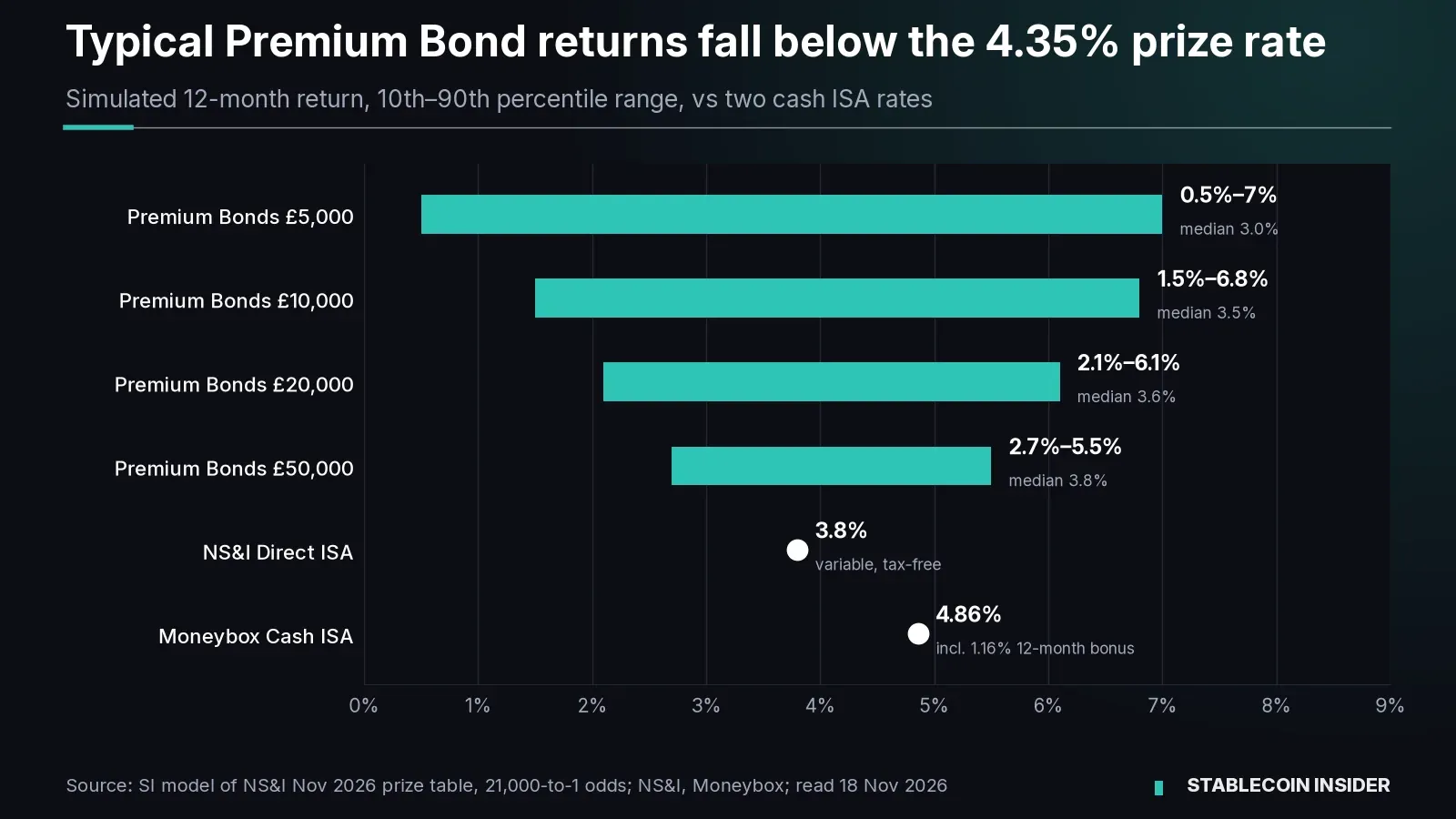
To model potential outcomes, we simulated 500,000 holders at varying balances over 12 draws, applying the 21,000-to-1 odds and the prize distribution from the November 2026 draw, assuming both parameters remain constant throughout the year. This model reproduces the 4.35% average and yields these median returns: 3.0% on £5,000, 3.5% on £10,000, 3.6% on £20,000, and 3.8% on £50,000. A holder with £20,000 has around a 13.5% chance of receiving at least one prize of £500 or more within a year. These figures are statistical estimates rather than precise forecasts, as actual draws can vary, and NS&I reserves the right to modify rates, odds, and prize distributions at any time.
When Do Premium Bonds Outperform Cash ISAs?
This section discusses scenarios where Premium Bonds may be more beneficial. Premium Bonds are more advantageous primarily when the ISA is not an option: if your £20,000 allowance is exhausted, if you are under 18, or if the funds are intended for a child. In these scenarios, the practical alternative becomes a taxable savings account, making tax implications significant.
Interest exceeding your Personal Savings Allowance incurs taxation, which is set at £1,000 for basic-rate taxpayers, £500 for higher-rate taxpayers, and £0 for additional-rate taxpayers. The respective Income Tax rates are 20%, 40%, and 45%.
For example, if a £50,000 sum cannot be deposited into an ISA this year, placing it in NS&I's Direct Saver at a gross rate of 3.75% yields £1,875 before taxes. Assuming no other savings interest, a basic-rate taxpayer retains £1,700, a higher-rate taxpayer keeps £1,325, and an additional-rate taxpayer would receive approximately £1,031. Conversely, the same £50,000 held in Premium Bonds could yield a modelled median return of £1,900, tax-free, although the actual outcome is uncertain (middle 80% range: £1,350 to £2,725).
This disparity is expected to widen from 6 April 2027 if Parliament enacts the Budget proposal to raise savings tax rates to 24%, 44%, and 49%.
Who Should Opt for a Cash ISA?
This section identifies the ideal candidates for a cash ISA. A cash ISA is ideal for savers desiring a reliable return and possessing remaining ISA allowance. It is also beneficial for smaller balances; for instance, a £1,000 investment in Premium Bonds carries approximately a 56% chance of yielding no prize in a year, while cash ISAs provide interest on the entire amount.
However, there are limitations: promotional rates often include temporary bonuses and restrictions on withdrawals, as seen with Moneybox's limit of four withdrawals per year. Furthermore, some accounts, including NS&I's Direct ISA, lack flexibility, meaning that withdrawals count towards the annual allowance. Deposits held in banks benefit from FSCS protection up to £120,000 per individual per authorised firm.
Who Should Consider Premium Bonds?
This section outlines who might benefit from Premium Bonds. Premium Bonds are suited for savers who have maximized their ISA allowance, face higher or additional tax rates, and are willing to accept uncertain returns in exchange for tax-free prizes with full Treasury backing. Additionally, they can be purchased as gifts for children under 16, with a parent or guardian managing the Bonds until the child turns 16.
Limitations include the absence of guaranteed returns, no regular income, and the inability to hold them jointly. NS&I emphasizes that new Bonds must wait a full calendar month before their first draw. Inflation can diminish the real value of funds held in either option, a concern noted by NS&I on its Premium Bonds page.
Considering other financial decisions in the UK? Explore our comparisons of UK SIPP providers regarding fees, and check our guides on TSB and Metro Bank alternatives if your bank is changing.
Curious about comparing cash savings with on-chain yield? Visit our Stablecoin yield hub for comprehensive insights.
Frequently Asked Questions
This section addresses common inquiries regarding Premium Bonds and cash ISAs. Can I hold both Premium Bonds and a cash ISA simultaneously? Do prizes from Premium Bonds count towards my Personal Savings Allowance? What is the withdrawal timeline for Premium Bonds or a cash ISA? Which accounts were impacted by the NS&I duplicate prize payment issue? When will the next Premium Bonds results be announced?
Final Thoughts: Premium Bonds or a Cash ISA?
If you have remaining ISA allowance and seek a guaranteed return, opt for a cash ISA first, especially if it offers higher returns than 4.35%, such as Moneybox's introductory rate of 4.86%. This outperforms both the average return from Premium Bonds and the modelled median. Choose Premium Bonds for tax-free savings beyond the £20,000 limit, particularly when in higher or additional tax brackets, or as a gift for a child under 16. Holding both options is permissible.