
Swift's blockchain ledger opened for live use in July 2026, with 17 banks from six continents, including Citi, HSBC, UBS, and Wells Fargo, preparing to pilot 24/7 cross-border payments with tokenised deposits.
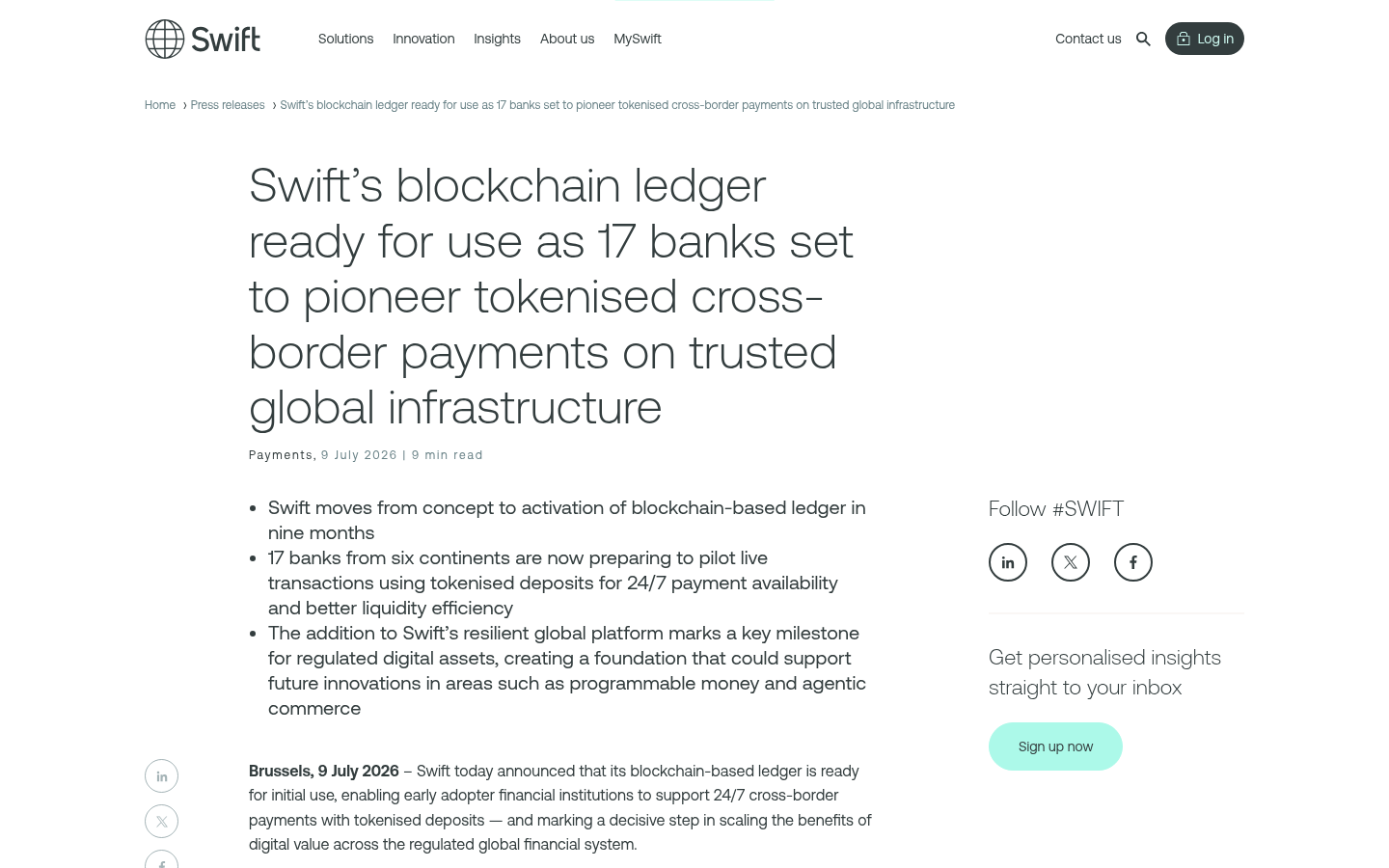
The ledger tracks the movement of digital dollars across borders and represents the banking system's most direct response to stablecoins.
Both technologies aim to facilitate cross-border money transfers at any time, ensuring quick settlements while adhering to their own regulatory frameworks. However, they achieve these goals in distinct ways.
Swift's ledger operates by coordinating bank money that remains within regulated institutions, whereas stablecoins are bearer tokens that users can hold and transfer on public blockchains.
This comparison outlines the operational mechanisms of each system, their current deployments, and how they differ in terms of speed, cost, accessibility, and associated risks, ultimately determining which payment solution is more suitable in 2026.
Key Takeaways
This section summarizes the main points of comparison between Swift's blockchain ledger and stablecoins.
- Swift's ledger facilitates the movement of tokenised bank deposits; stablecoins enable transactions with tokens on public blockchains.
- Since its launch in July 2026, 17 banks have been piloting Swift's ledger.
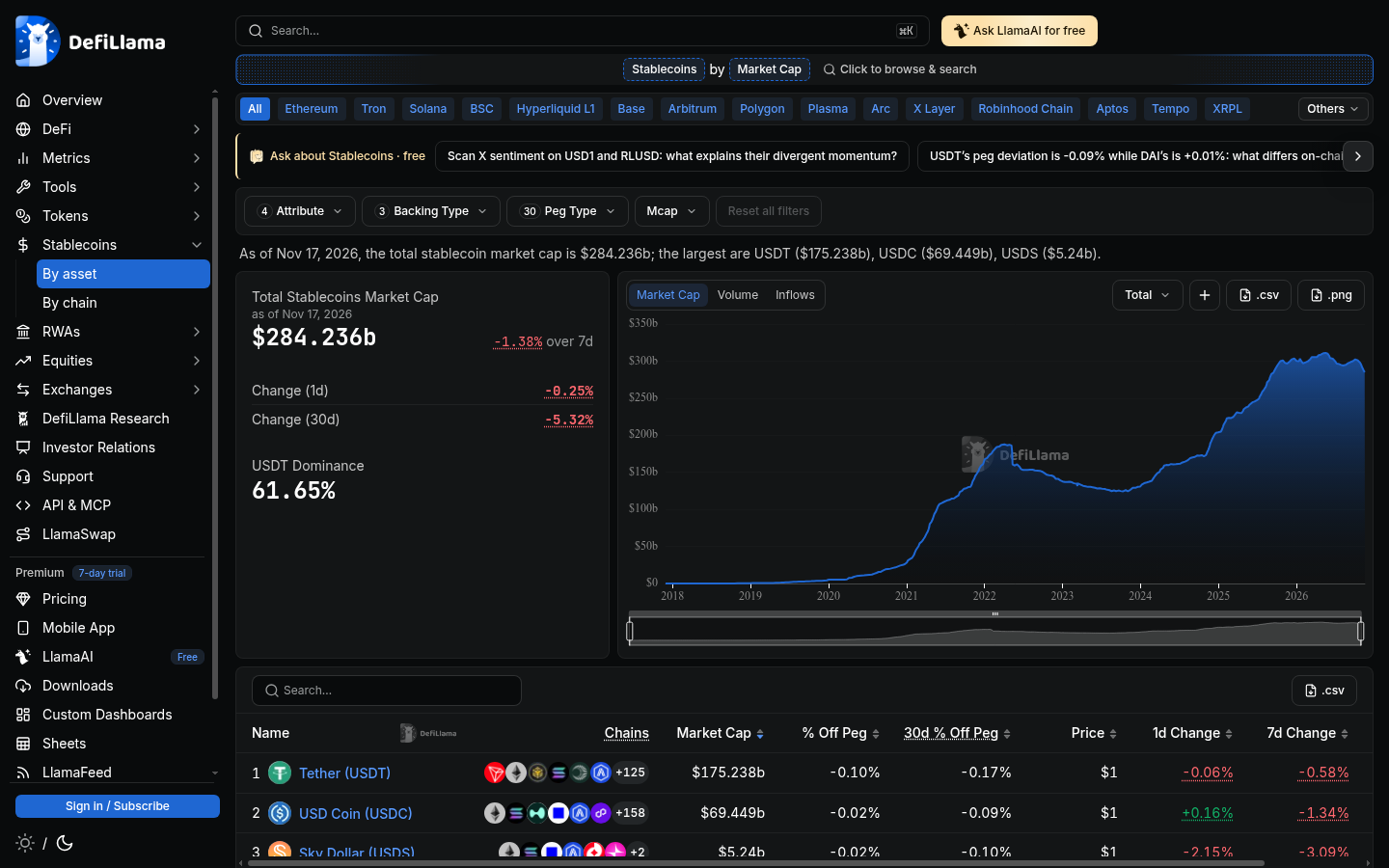
- The supply of stablecoins was recorded at $284.2 billion on November 17, 2026.
- Stablecoins can be accessed by anyone with a wallet, while Swift's ledger is limited to participating banks.
- Most banks are expected to utilize both systems rather than opting for just one.
What Swift's Blockchain Ledger Actually Is
Swift unveiled the ledger in September 2025, completing its development in nine months. It acts as an orchestration layer, where banks maintain their tokenised deposits on their own ledgers, while Swift's ledger records, matches, and coordinates payment obligations among them, with settlements being processed through existing systems.
The technology is permissioned and the minimum viable product employs an EVM-compatible architecture based on Hyperledger Besu. Swift indicated it is collaborating with over 40 financial institutions on the ledger.
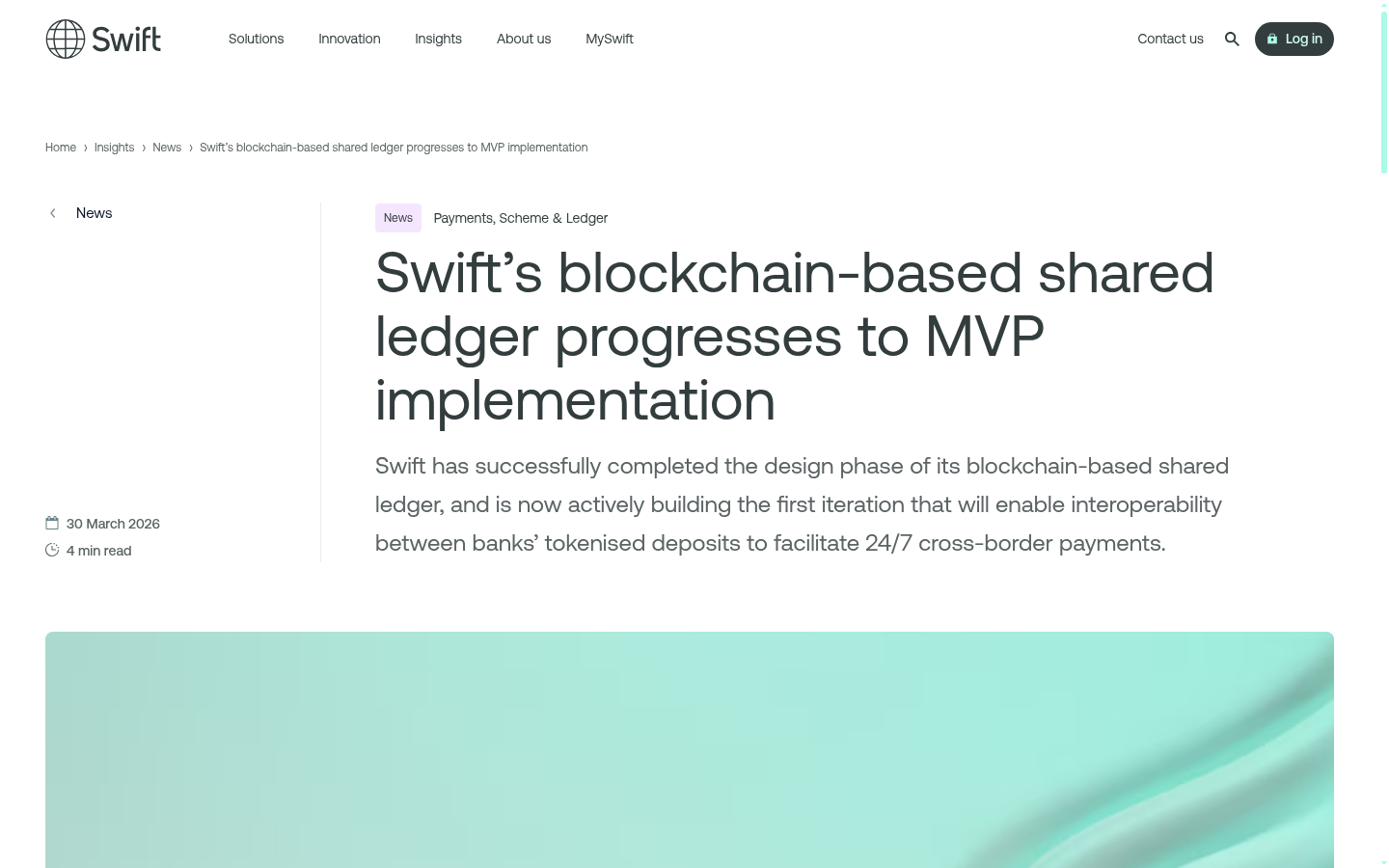
It builds on Swift's existing network, which connects more than 11,500 banking and securities organizations, market infrastructures, and corporates across more than 200 countries and territories.
The ledger's first application involves tokenised deposits, which represent digital claims on commercial banks rather than being distinct assets. Further details on how tokenised deposits differ from stablecoins can be found in our explainer.
Where Stablecoins Stand in Cross-Border Payments
Stablecoins have established themselves as a significant and open market. As of November 17, 2026, the total supply of stablecoins was $284.2 billion, with Tether accounting for 61.65% of that total.
However, the majority of this supply is not utilized for payments. According to McKinsey, actual stablecoin payments are estimated at around $390 billion annually, representing about 0.02% of global payment volumes, with B2B payments comprising approximately $226 billion of that figure.

Card networks are also incorporating stablecoins. Visa's settlement for stablecoins exceeded a $20 billion annualized run rate in 2026, marking more than a 15-fold increase from the previous year.

The growth in this sector is further examined in our report on stablecoin B2B cross-border payments.
How Each Rail Moves Money
Within Swift's ledger, payment messages are exchanged between a sending and receiving bank, and the resulting obligations are recorded as tokenised deposit obligations on each bank's system. The ledger matches and nets these obligations before final settlement through existing payment frameworks.
Customers do not hold tokens directly; they experience expedited bank transfers while banks maintain their existing compliance, credit, and risk controls.
In contrast, stablecoins function as the money itself. A sender acquires or holds a dollar stablecoin, transfers it via blockchain to the recipient's wallet, and the recipient can either retain it or convert it to local currency through an exchange or off-ramp.
This characteristic designates stablecoins as bearer assets that can be transacted at any time, whether it's 3 a.m. on a Sunday or noon on a Tuesday. Comparisons of platforms that facilitate the conversion process are available in our guide to the best stablecoin FX platforms.
Swift Ledger vs Stablecoins at a Glance
This table summarizes the key features of Swift's ledger and stablecoins, highlighting their differences and similarities.
| Feature | Swift Ledger | Stablecoins |
|---|---|---|
| What Moves | Tokenised deposits | Bearer tokens |
| Issuer | Commercial banks | Licensed issuers |
| Network | Permissioned | Public blockchains |
| Access | Pilot banks only | Anyone with a wallet |
| Hours | 24/7 | 24/7 |
| Final Settlement | Existing bank systems | On-chain |
| Status | Live pilot | $284B in supply |
The primary distinction lies in the intermediaries involved. Swift's ledger integrates banks into each transaction, while stablecoins enable direct payments between businesses and individuals once they possess the token.
Speed and Availability
Swift has already established a reputation for speed in most transactions. Half of the payments on its network reach recipient banks within 40 seconds, and 75% are completed within 10 minutes. However, the last mile—from the receiving bank to the customer's account—accounts for 80% of the total transaction time.

The timing of traditional cross-border payments is hindered by the closure of correspondent banks, which is precisely the gap that the ledger aims to address.
Proof of the ledger's efficiency was demonstrated on September 5, 2026, when DBS and Citi executed a payment from Singapore to US dollars over Swift's Digital Ledger in mere minutes, compared to the two business days required via traditional channels.

Stablecoins have enabled weekend settlements since their inception, which is why they are often referred to as the preferred option for weekend payments. Typically, on-chain transfers confirm within seconds to minutes, but converting them back to local currency is still dependent on the banking hours of the off-ramp.
Cost and Fees
Currently, neither system has a standardized pricing structure. Swift's ledger announcements have not disclosed specific costs, and banks will determine customer charges.
To address cost concerns, Swift is implementing a separate retail scheme. Over 50 banks have endorsed a framework that ensures customers receive certainty regarding costs, full-value delivery, and end-to-end traceability, with more than 25 committed to processing transactions under this system by June 2026.
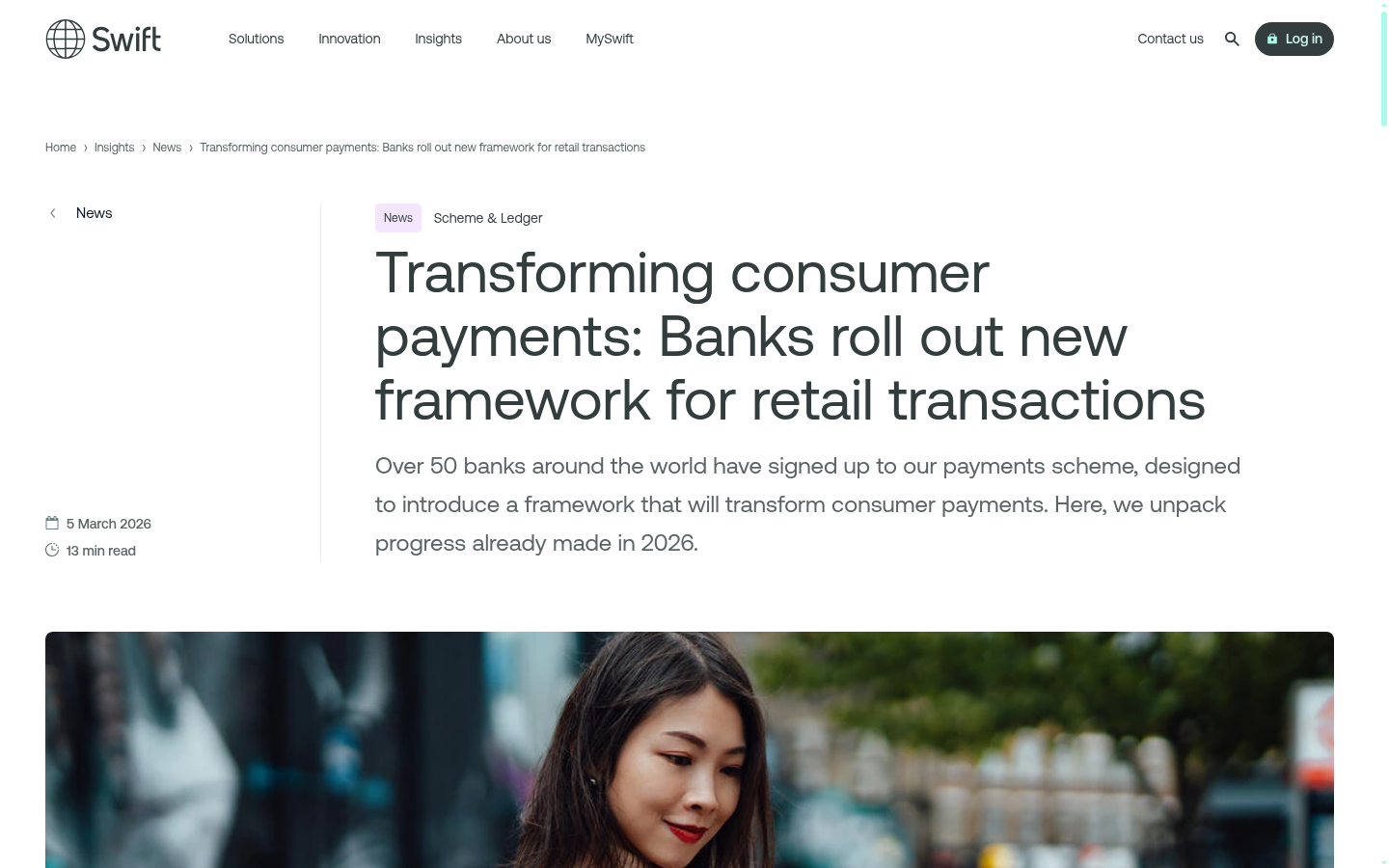
By the time of Sibos in October 2026, over 100 banks had expressed their commitment to the scheme, with the next step being the introduction of pay-by-alias functionalities using phone numbers or email addresses.
Although transfer fees for stablecoins are generally minimal, the total cost encompasses purchasing the token, network fees, and the off-ramp spread on the receiving end. Our analysis of cross-border payments utilizing stablecoin rails breaks down these expenses by corridor.
Who Can Use Each One
This section outlines the accessibility of Swift's ledger and stablecoins for different user groups.
- Swift's Ledger: Accessible only to participating banks and, through them, their customers. The pilot group of 17 includes ANZ, BNP Paribas, BNY, Citi, DBS, HSBC, MUFG, Standard Chartered, UBS, and Wells Fargo.
- Stablecoins: Available to anyone with a wallet, including businesses in regions with limited banking access and fintechs that are not traditional banks.
- Corporates: Large treasury departments can access the ledger through their existing banks; HSBC has already linked its Tokenised Deposit Service to it.
- Smaller Businesses: Currently, stablecoins present a faster option, as access to the ledger remains restricted to the pilot banks.
Regulation and Settlement Risk
Tokenised deposits remain on bank balance sheets, thus carrying the same regulatory requirements, deposit protection rules, and credit risks as conventional bank accounts. This regulation is a key reason why banks favor these deposits, as highlighted in our coverage of the BIS perspective on stablecoins and tokenised deposits.
In the United States, stablecoins are now operating under a federal regulatory framework. The OCC finalized the inaugural GENIUS Act rule for payment stablecoin issuers on October 21, 2026, with the Act set to take effect on January 18, 2027.
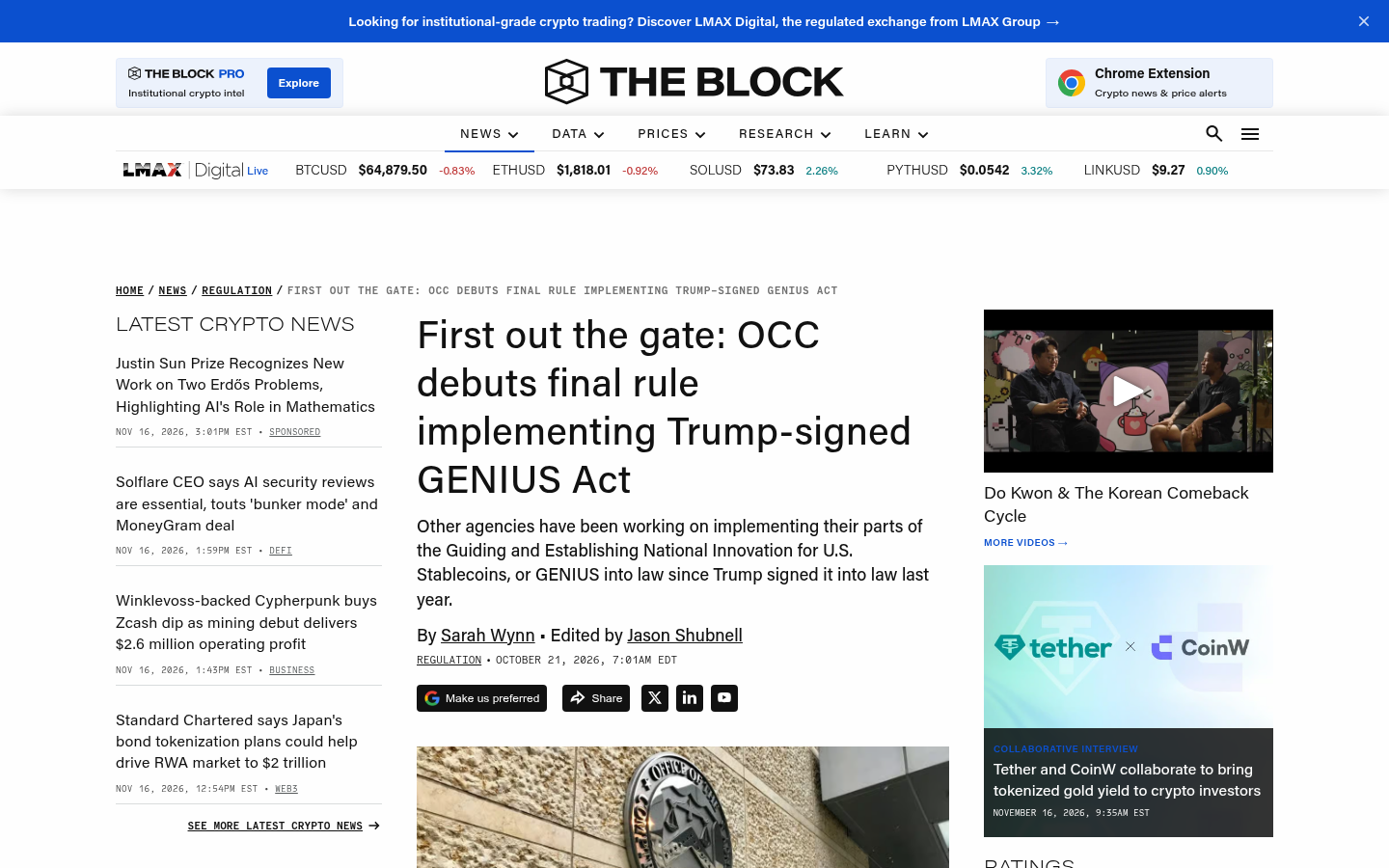
The rule mandates reserve backing and redemption standards, which help mitigate the risk of a regulated dollar stablecoin losing its peg. Further details on the changes for issuers can be found in our breakdown of the OCC GENIUS Act final rule.
The Live Transactions So Far
This section highlights the milestones achieved in the live transactions of Swift's ledger and stablecoins.
| Date | Milestone | Rail |
|---|---|---|
| Sep 2025 | Ledger Announced | Swift |
| Jul 2026 | Opened to 17 Banks | Swift |
| Aug 2026 | HSBC and StanChart | Swift |
| Sep 2026 | DBS and Citi Weekend | Swift |
| Oct 2026 | OCC Final Rule | Stablecoins |
| Jan 2027 | GENIUS Act in Force | Stablecoins |
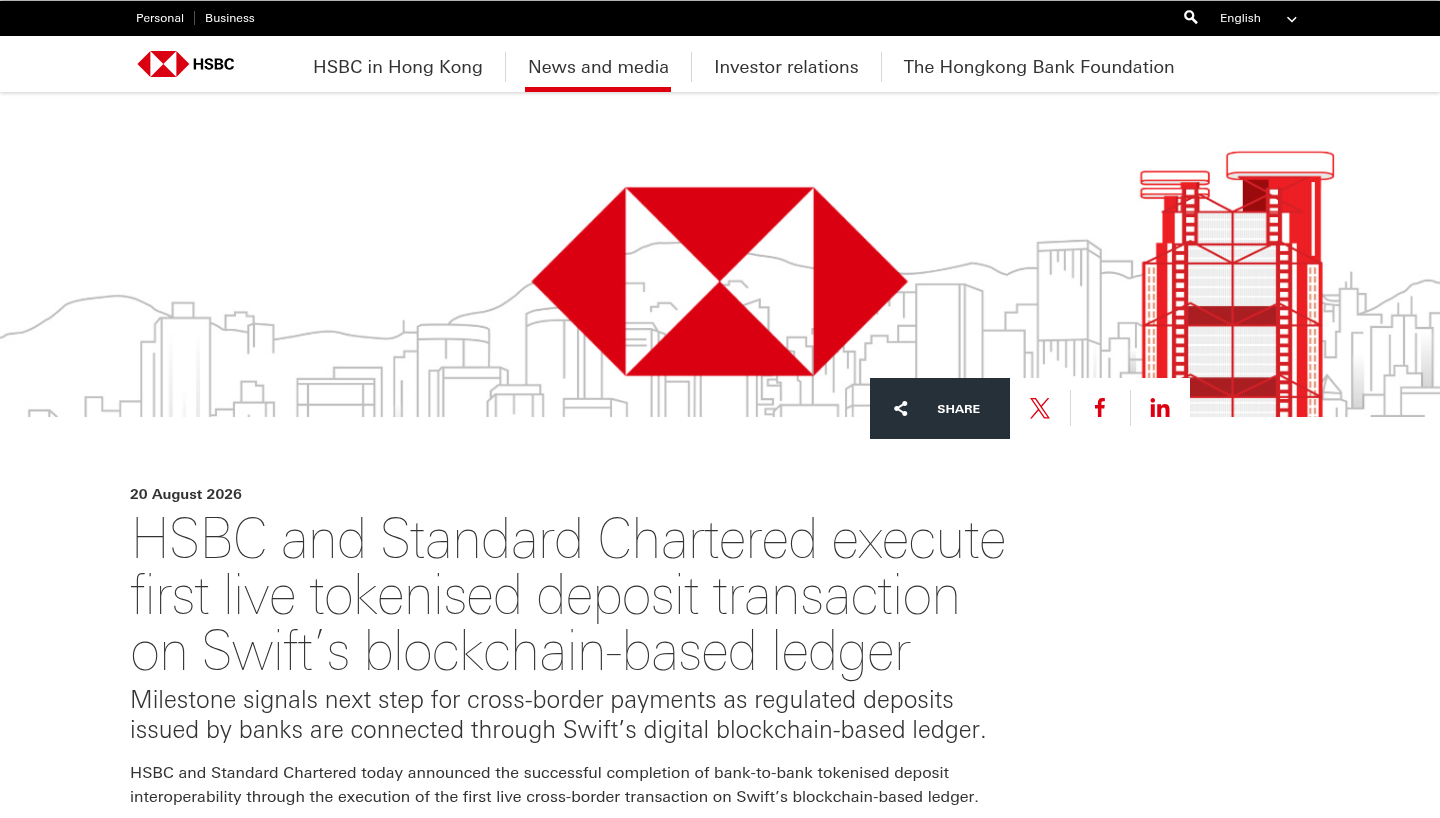
HSBC and Standard Chartered executed the first live interbank transaction on the ledger on August 20, 2026, followed by the DBS and Citi weekend payment in September. Both transactions were part of pilot programs, not full commercial launches.
The Third Option: Bank Tokenised Deposit Networks
Swift is not the only bank-led initiative. JPMorgan, Citi, Bank of America, Wells Fargo, HSBC, and several other US banks are planning a shared tokenised deposit network managed by The Clearing House, with a launch anticipated in the first half of 2027.
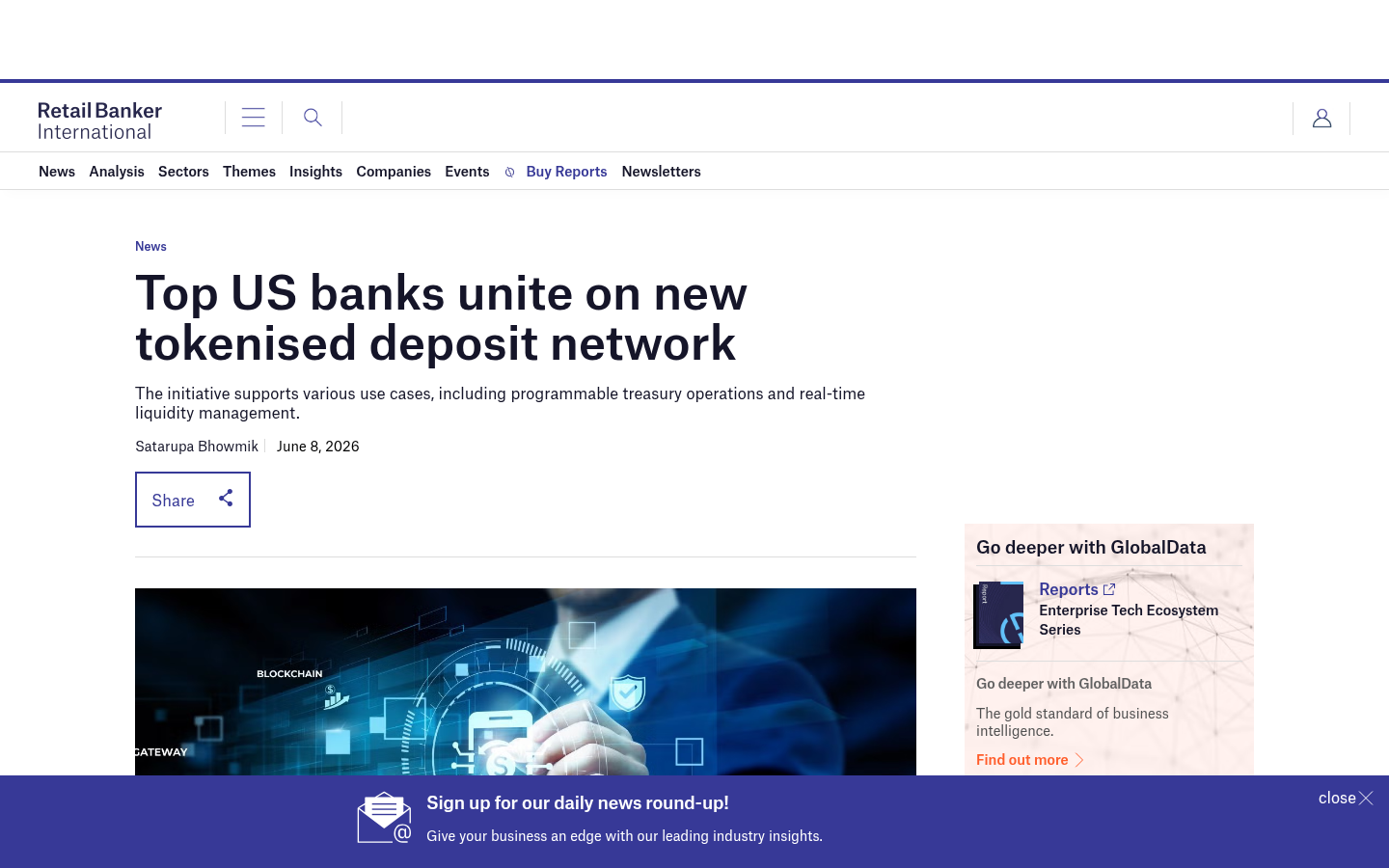
This network aims to connect on-chain bank money to US payment systems such as RTP and CHIPS, with cross-border payments among its intended applications.
Some banks are opting to directly adopt stablecoins instead. Our report detailing the commitments of 21 banks to a USD stablecoin initiative illustrates that these institutions are diversifying across both models.
Which Rail Fits Which Payment
This section provides guidance on which payment rail to use for different types of transactions.
- Large corporate treasury flows between major banks: Swift's ledger, provided that your bank is operational on it. It maintains payments within established controls.
- Payments to suppliers in regions with weak correspondent banking connections: Stablecoins, which do not require the recipient's bank to be part of any network.
- Weekend and holiday liquidity: Both systems function 24/7, but only stablecoins are currently operational without being part of a bank pilot.
- Consumer remittances: Keep an eye on Swift's retail scheme for cost certainty, and stablecoin applications for more affordable corridors.
- Programmable payments: Currently, stablecoins are favorable, with Swift identifying programmable money and agentic commerce as future use cases for its ledger.
What to Watch in 2027
This section outlines key developments to monitor in the coming year regarding both payment systems.
- Ledger expansion: The speed at which Swift transitions from 17 pilot banks to broader commercial usage.
- Stablecoin connectivity: Whether Swift's ledger will begin to coordinate regulated stablecoins alongside tokenised deposits.
- The GENIUS Act start date: The number of bank and nonbank issuers licensed by January 18, 2027.
- The Clearing House network: Whether its anticipated launch in the first half of 2027 will connect to Swift for cross-border transactions.
- The G20 2027 targets: Swift's ambitious deadline for achieving faster, more cost-effective, and transparent cross-border payments.
FAQs
This section addresses common questions regarding Swift's blockchain ledger and stablecoins.
1. What is Swift's blockchain ledger?
Swift's blockchain ledger is a permissioned shared ledger that coordinates tokenised bank deposits between banks to facilitate cross-border payments 24/7. It became operational in July 2026, with 17 banks piloting transactions while final settlements occur through existing systems.
2. Is Swift's ledger a stablecoin?
No, Swift's ledger is not a stablecoin. It does not issue its own tokens; instead, it coordinates tokenised deposits that remain on each participating bank's balance sheet, while stablecoins are separate tokens issued by licensed entities and held directly by users.
3. Which is faster, Swift's ledger or stablecoins?
Both Swift's ledger and stablecoins are designed for speed and operate 24/7. Swift's pilot successfully settled a weekend payment from Singapore to the US in minutes, while stablecoin transfers typically confirm on-chain within seconds to minutes, although the conversion back to local currency may take longer.
4. Can businesses use Swift's blockchain ledger today?
Currently, businesses can access Swift's blockchain ledger only through one of the participating pilot banks, such as Citi, HSBC, or DBS. Direct access for companies is not available, meaning most businesses outside these banks still rely on traditional wire transfers or stablecoins for 24/7 payments.
5. Will Swift's ledger replace stablecoins?
It is unlikely that Swift's ledger will replace stablecoins. The ledger serves banks and their clients within the regulated framework, while stablecoins cater to anyone with a wallet, suggesting that both systems will likely coexist, with banks managing tokenised deposits and stablecoins addressing the outer edges of the financial ecosystem.