
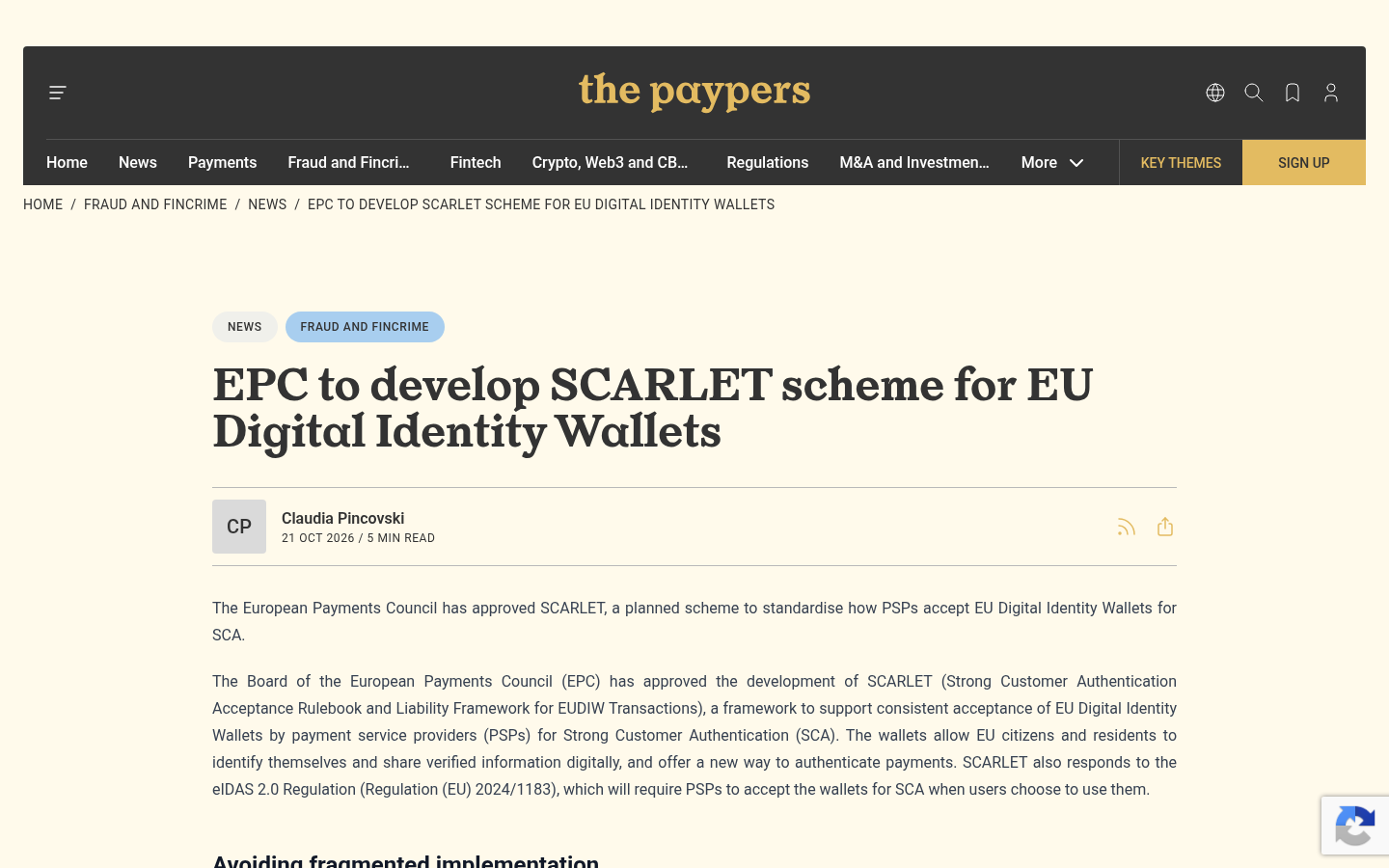
The European Payments Council anticipates that over 3,000 payment service providers and more than 27 EU Digital Identity Wallet providers will become operational within the EU and EEA. On 19 October 2026, it introduced SCARLET, establishing a unified rulebook for wallet-based payment authentication.
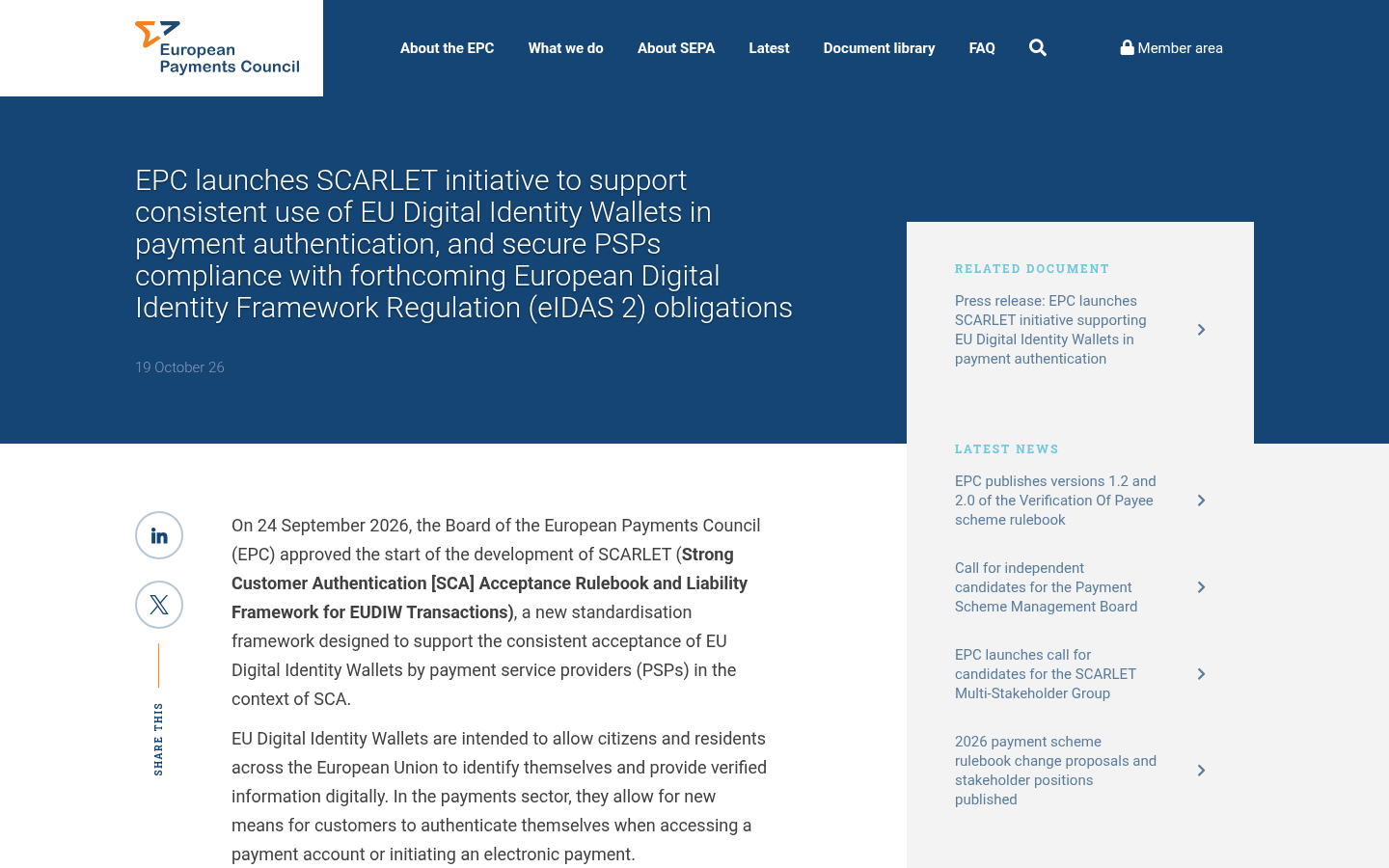
SCARLET aligns with the regulations and systems that govern payment processes across Europe. Additionally, the EU Digital Identity Wallet is poised to serve as a new method for accessing bank accounts and authorizing transactions.
Every EU member state is mandated to provide its citizens with a digital identity wallet, and banks, alongside payment firms, will need to accept it for strong customer authentication when customers opt to use it.
A key issue remains regarding the collaboration of numerous payment firms and wallet providers without creating incompatible systems.
This guide outlines what the EU Digital Identity Wallet entails, the eIDAS 2.0 deadlines, the implications of the EPC SCARLET scheme, existing gaps, and the actions banks and fintechs should consider now.
Key Takeaways
- Every member state is required to offer a digital identity wallet by the end of 2026.
- Banks and payment service providers must accept the wallet for authentication from December 2027.
- SCARLET will establish common rules, liability frameworks, and technical standards.
- The initial SCARLET rulebook is scheduled for release in December 2027.
- There are still gaps between eIDAS authentication and PSD2 strong customer authentication requirements.
Understanding the EU Digital Identity Wallet
The EU Digital Identity Wallet functions as a mobile application that allows individuals to verify their identity both online and in-person, share verified information, and sign documents. It is established under Regulation (EU) 2024/1183, commonly referred to as eIDAS 2.0, which revises the EU's electronic identification guidelines from 2014.
The European Commission characterizes the wallet as a means to authenticate access to both public and private services, allowing users to share only the necessary information, such as age or nationality, while eliminating the need for multiple passwords. Large-scale pilot programs commenced in April 2023, involving over 350 entities from 26 member states, Norway, Iceland, and Ukraine, with payment and bank account opening scenarios being evaluated.
- Personal identification data: A fundamental set of identity attributes, including name, date of birth, and a unique identifier, issued by a national authority.
- Attestations of attributes: Verified proof of various credentials, including age, driving licenses, diplomas, or payment account details like an IBAN.
- Selective disclosure: Users control which information is shared with each service.
- Free and voluntary: Member states are obligated to provide the wallet at no cost, and individuals cannot be compelled to use it.
Notably, one pilot project, the NOBID consortium, which includes Nordic and Baltic nations alongside Italy and Germany, is evaluating the wallet's functionality for authorizing payments for goods and services.
Timeline for eIDAS 2.0 Implementation for Financial Institutions
The eIDAS 2.0 regulation took effect on 20 May 2024. Member states are required to provide digital wallets by 24 December 2026, and starting December 2027, entities that mandate strong online authentication, including banks and payment service providers, must accept all recognized wallets.
| Milestone | Date | Responsible Party |
|---|---|---|
| eIDAS 2.0 implementation | May 2024 | European Union |
| Approval of SCARLET | September 2026 | EPC |
| Availability of wallets | December 2026 | Member states |
| SCARLET consultation period | Summer 2027 | EPC |
| Acceptance of wallets | December 2027 | Banks and PSPs |
| Release of SCARLET 1.0 rulebook | December 2027 | EPC |
| PSR version 1.1 | 2028 to 2029 | EPC |
The obligation for acceptance is conditional on the customer's choice to utilize the wallet. Banks are permitted to maintain their own applications and login processes, but they cannot deny a recognized wallet when a customer opts to use it for authentication.
Defining EPC SCARLET
SCARLET, which stands for Strong Customer Authentication Acceptance Rulebook and Liability Framework for EU Digital Identity Wallet Transactions, was approved for development by the EPC Board on 24 September 2026. This initiative will encompass a business and contractual framework, standardized functional and operational rules, as well as technical specifications. An open consultation is planned for summer 2027, culminating in the initial rulebook release in December 2027.
| Component | Coverage | Foundation |
|---|---|---|
| Business rules | Roles and liabilities | EPC scheme model |
| Operating rules | Process workflows | PSD2 and EBA RTS |
| Technical specifications | Connection between wallets and PSPs | ARF and TS12 |
- Why the EPC: The EPC is already responsible for Europe's SEPA payment schemes and the Verification of Payee scheme, thus possessing the requisite expertise to develop rules followed by numerous banks.
- Who initiated the request: The European Commission’s digital and financial services departments, DG CNECT and DG FISMA, invited the EPC to formulate the scheme.
- Who is involved in the development: An EPC task force, collaborating with the European Commission and the European Banking Authority, along with a diverse group of wallet providers and industry stakeholders.
- Two iterations: Version 1.0 will operate under the current PSD2 regulations, while Version 1.1 will encompass the forthcoming Payment Services Regulation, ensuring early investments remain valuable.
The liability aspect is particularly significant. In the event of fraudulent wallet-approved transactions, a mechanism must be in place to allocate the financial responsibility. SCARLET aims to clarify this division of accountability between banks and wallet providers prior to widespread wallet use.
Process of Wallet-Based Payment Authentication
Currently, most EU customers validate payments through their bank's app, using an SMS code, or via authentication steps required by card schemes. The wallet introduces an additional option that functions uniformly across all banks in the EU.
- Login: The customer accesses their bank's website or app and opts to log in using their EU Digital Identity Wallet.
- Request: The bank dispatches a request to the wallet, which displays the information being requested to the customer.
- Approval: The customer confirms their identity using a PIN or biometric verification within the wallet.
- Payment: For transactions, the approval must correspond to the specific amount and payee, as mandated by PSD2.
- Outcome: The bank verifies the response and proceeds with the login or payment.
The wallet itself does not facilitate money transfers; rather, it verifies the customer's identity and indicates their consent, while transactions proceed through established methods such as SEPA Instant, cards, or account-to-account systems.
Addressing the SCA Gap: Banks' Concerns
eIDAS 2.0 emphasizes strong user authentication, typically translating to two-factor authentication. Conversely, PSD2 strong customer authentication introduces additional requirements such as dynamic linking, which creates a cryptographic connection between the payment amount, payee, and the approval. This discrepancy presents uncertainty regarding how payment providers can comply with both frameworks simultaneously.
- No obligation for payment initiation: While eIDAS 2.0 may require banks to accept the wallet as an authentication tool, it does not mandate support for payment initiation via the wallet.
- No requirement for attestations: Banks are not obligated to provide attestations, such as verified IBANs, within the wallet.
- Outsourcing concerns: Under the proposed PSR, entities providing technical services related to wallets for banks might be classified as technical service providers, potentially establishing an outsourcing relationship.
- Timing uncertainty: There is no guarantee that the necessary technical standards under the PSR will be finalized before the December 2027 deadline.
SCARLET represents the industry’s initiative to resolve these gaps through a set of common regulations, rather than waiting for individual national regulators to address them. Further insights on PSD3 and the PSR encompass the broader payment regulations that Version 1.1 will need to observe.
Current Status of Member States
National implementations are progressing at varying rates. Notably, Finland's national wallet legislation became effective on 1 October 2026, with Traficom overseeing wallet providers and maintaining a registry of services that accept wallets. However, the Finnish government has indicated that the wallet itself is not expected to be available until 2027.
The situation in Finland exemplifies a trend likely to manifest across Europe: the legal framework arrives punctually, while the actual downloadable application follows at a later date. In the Netherlands, the government is developing a reference application known as the NL-Wallet, with plans to allow certified commercial wallets to follow.
- Public wallets: Most countries are anticipated to provide at least one government-developed wallet.
- Private wallets: Banks, telecommunications companies, and technology firms may create certified wallets, provided they adhere to the same regulations.
- Bank-integrated wallets: Banks could integrate certified wallets within their own applications, merging identity verification and banking services.
Implications for Fintechs, Wallet Providers, and Stablecoin Companies
The wallet's impact extends beyond just bank logins; it has the potential to transform how fintechs onboard clients, how wallet providers generate revenue, and how cryptocurrency firms fulfill identity verification requirements.
- Accelerated onboarding: Verified identity data from the wallet can significantly reduce the costs associated with know-your-customer checks.
- Compliance for crypto: Cryptocurrency service providers licensed under MiCA could leverage the wallet for identity verification, alongside the licensing procedures detailed in compliance guides.
- Enhancing European payment sovereignty: The wallet aligns with the EU's initiative for domestically developed payment solutions, alongside initiatives like Wero and the digital euro.
- New revenue streams for wallet providers: Private wallet providers will be required to establish contracts with each bank they serve, which is precisely what SCARLET aims to standardize.
Recommendations for Banks and Payment Providers
- Map authentication processes: Identify every login and payment approval step that will necessitate a wallet option by December 2027.
- Engage in the SCARLET process: Participate in the EPC multi-stakeholder group and provide feedback during the summer 2027 consultation.
- Prepare for dynamic linking: Determine how wallet approvals can be linked to specific amounts and payees to comply with PSD2.
- Examine vendor agreements: Assess whether wallet-related service providers might fall under outsourcing regulations once the PSR is enacted.
- Revise onboarding processes: Consider how wallet identity data will be incorporated into customer due diligence practices.
- Maintain alternatives: Since the wallet is voluntary, customers without it must still have alternative methods for logging in and making payments.
Key Developments to Monitor
- 24 December 2026: The deadline by which member states are expected to launch a wallet.
- Multi-stakeholder group: Monitor the composition of the EPC's SCARLET group and the representation of wallet providers.
- Summer 2027 consultation: Anticipate the initial public draft of the SCARLET rules and the liability distribution.
- Final PSR details: Observe how the Payment Services Regulation approaches wallet authentication and the role of technical service providers.
- EBA guidance: Look for any clarifications regarding how wallet authentication aligns with strong customer authentication standards.
Frequently Asked Questions
1. What is the EU Digital Identity Wallet?
The EU Digital Identity Wallet is a complimentary, voluntary mobile application that enables EU residents to verify their identity, share validated information, and electronically sign documents. It is established under the eIDAS 2.0 Regulation, with every member state obligated to provide one.
2. What is EPC SCARLET?
EPC SCARLET is a framework being created by the European Payments Council to establish uniform regulations for accepting EU Digital Identity Wallets for strong customer authentication. It encompasses contracts, liability, operational rules, and technical standards, with the initial rulebook slated for release in December 2027.
3. When are banks required to accept the EU Digital Identity Wallet?
Banks must accept the EU Digital Identity Wallet starting December 2027, provided a customer decides to use it for strong authentication. This requirement applies to banks, payment institutions, and e-money providers needing strong online authentication.
4. Can the EU Digital Identity Wallet facilitate payments?
The EU Digital Identity Wallet can be utilized to authorize payments, but it does not itself transfer funds. It serves to confirm the customer's identity and consent, while transactions proceed via existing systems like cards or SEPA transfers.
5. Is the EU Digital Identity Wallet compulsory for consumers?
The EU Digital Identity Wallet is not mandatory for consumers. Its use is voluntary, free of charge, and service providers cannot deny access solely because a customer chooses not to use the wallet.