Current trends in crypto basis trade
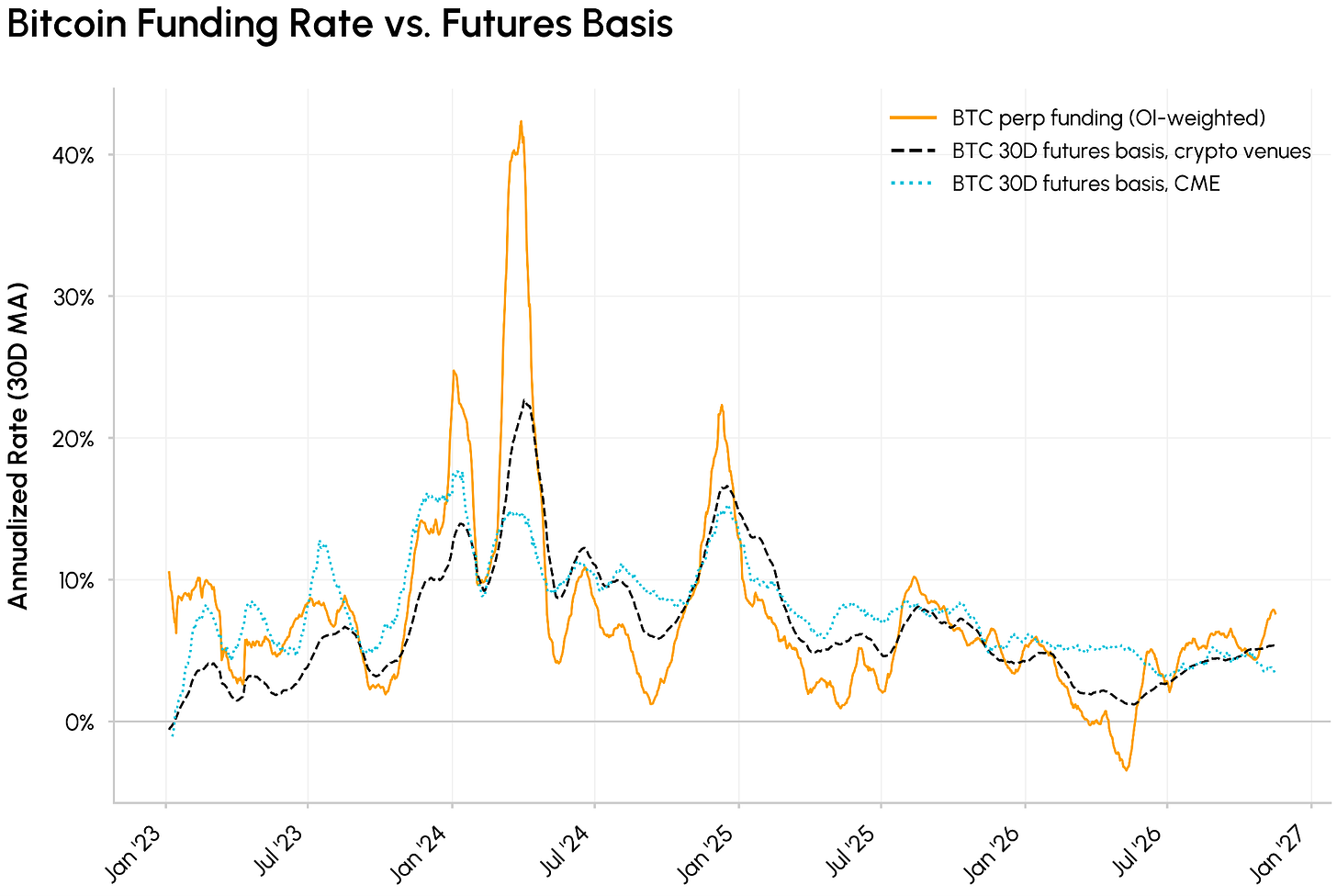
The crypto basis trade has seen a significant contraction in 2026. Bitcoin perpetual funding and the 30-day futures basis, which reached annualized rates of 20–40% in early 2024, have now decreased to approximately 3–5%, aligning closely with or falling below Treasury yields.
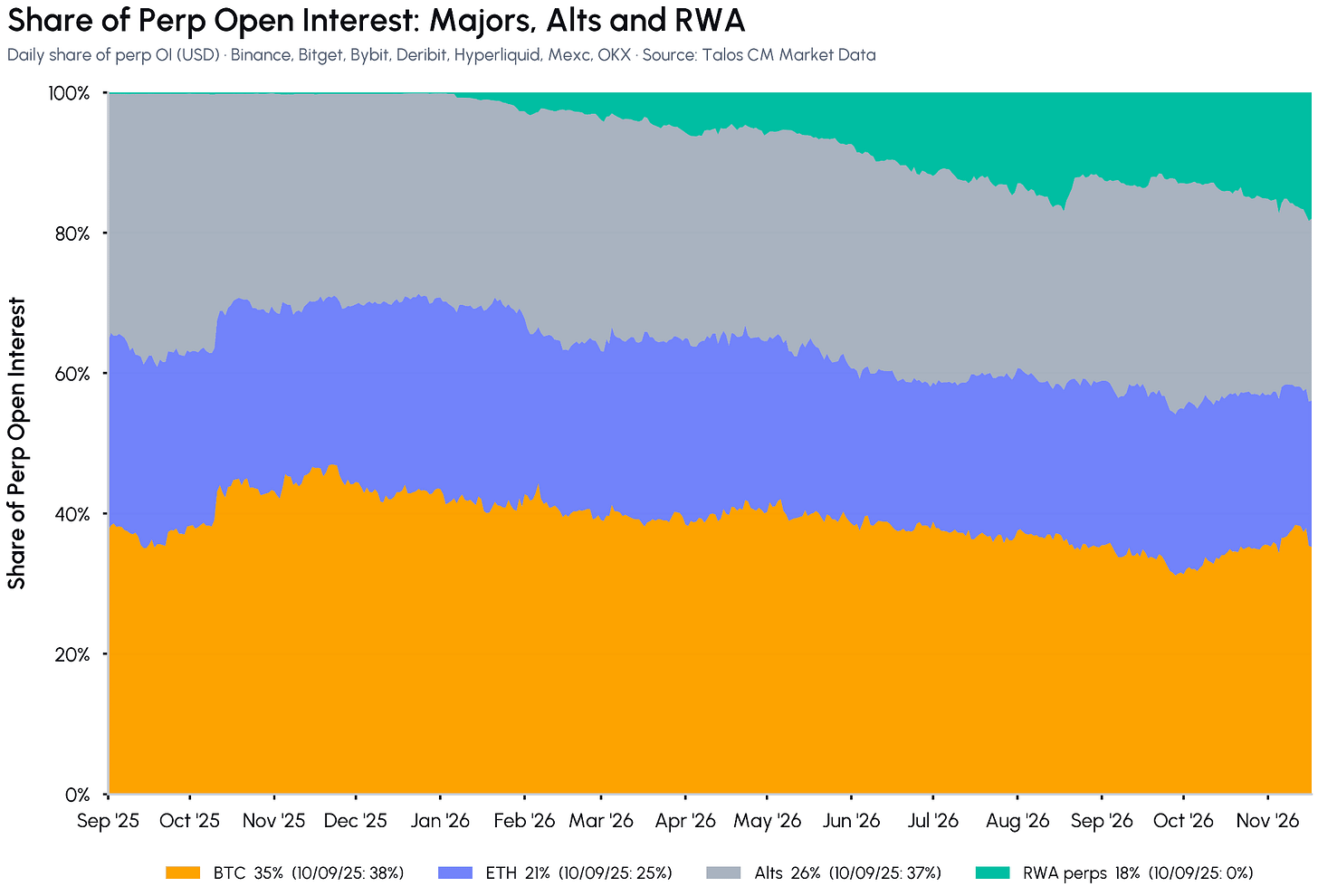
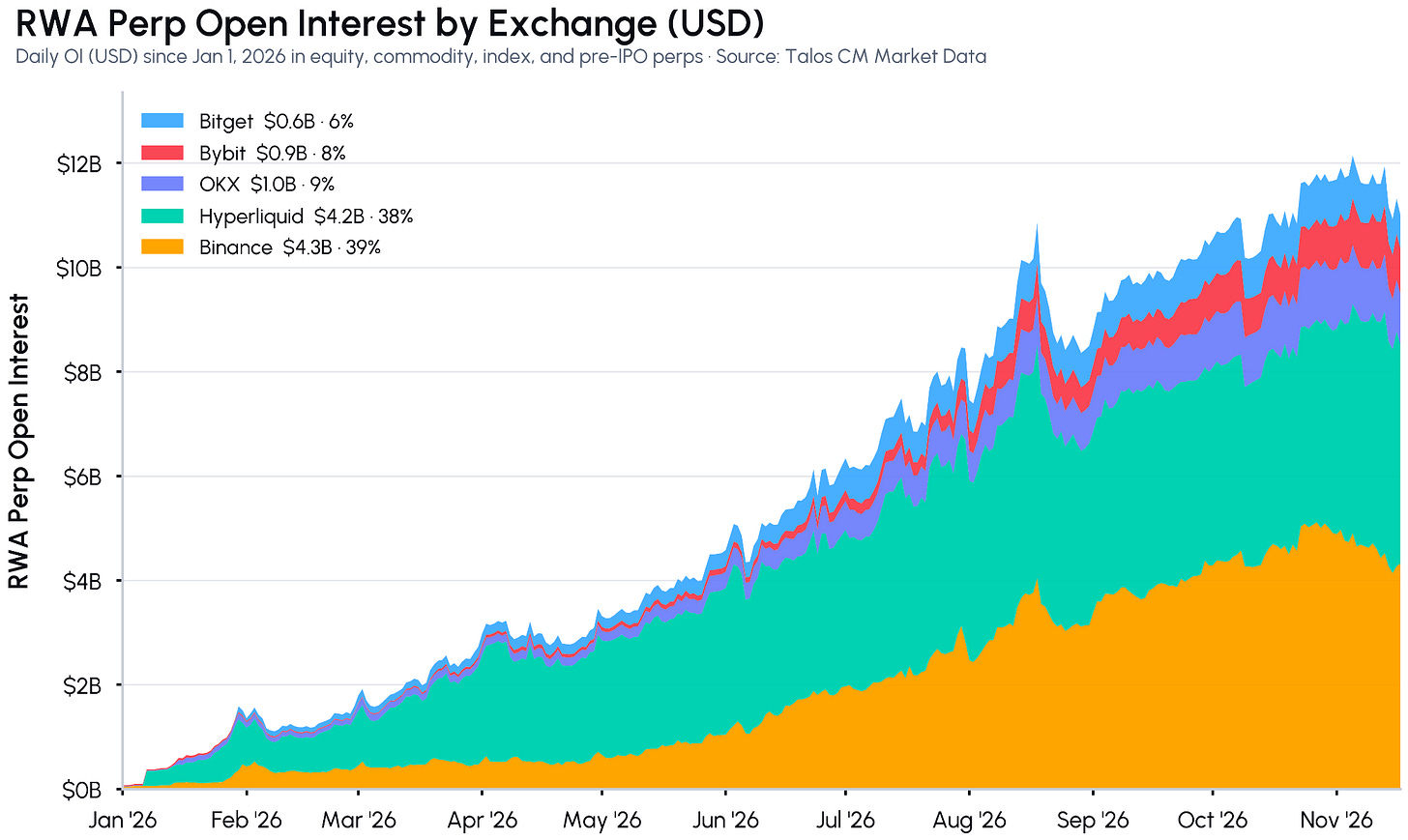
Perpetuals linked to real-world assets (RWAs) have surged from virtually 0% to around 18% of perpetual open interest across major exchanges since October 2025, totaling over $11 billion. Binance and Hyperliquid dominate this space, holding 39% and 38%, respectively.
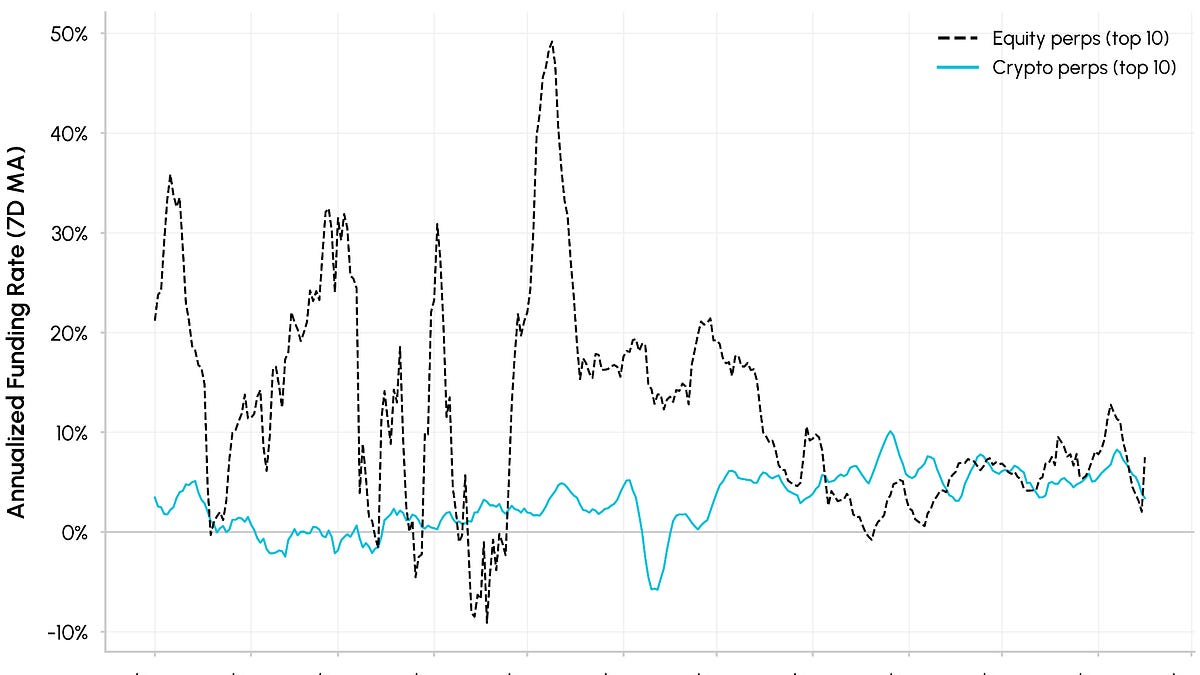
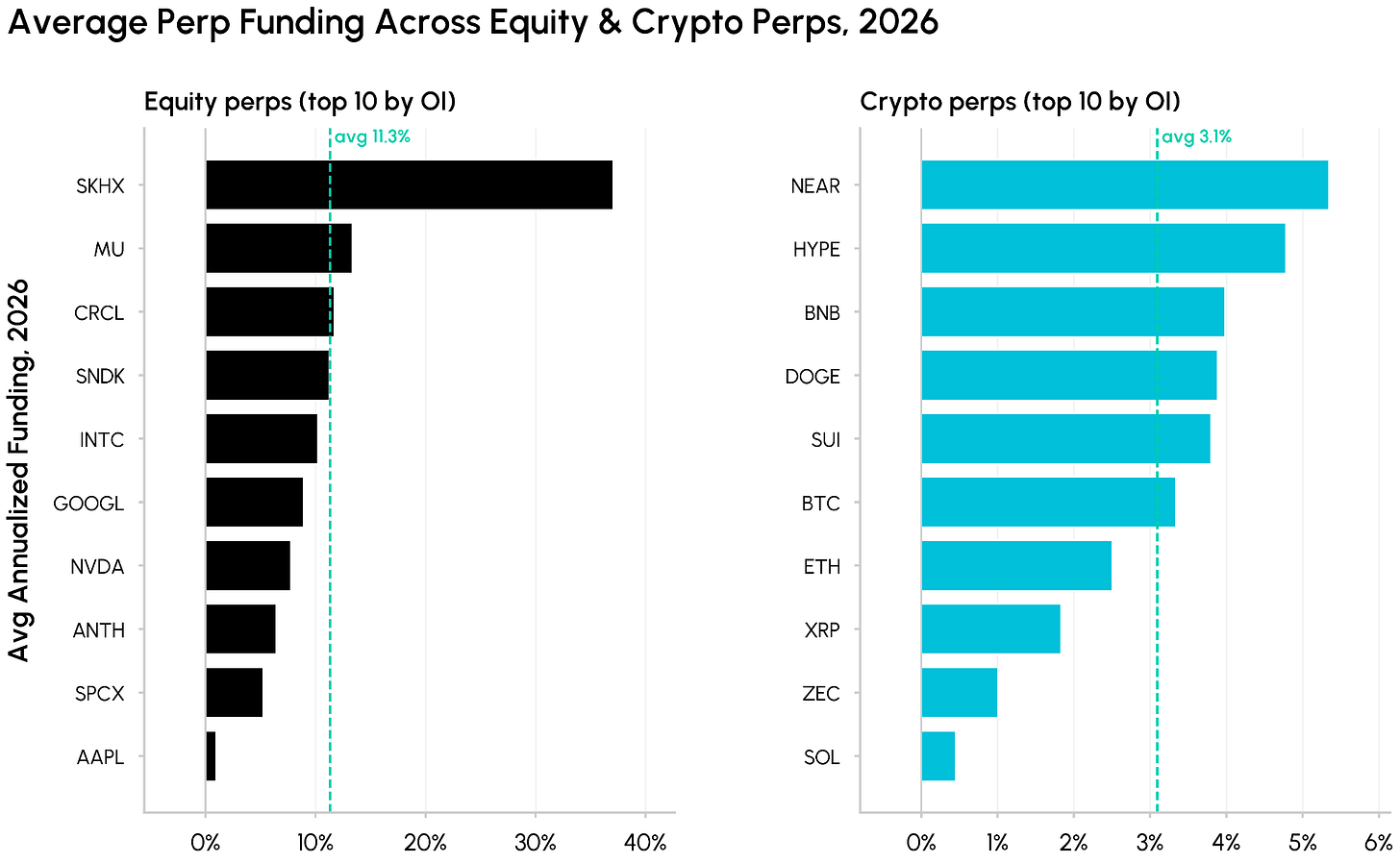
Equity perpetuals command a higher premium, with the top ten equity perps averaging around 11% annualized funding in 2026 compared to about 3% for the leading ten crypto perps. The disparity has reduced since August, making returns increasingly reliant on the trading venue and asset choice.
With the CFTC affirming that single-stock perps can now trade on regulated U.S. exchanges, and Kalshi reporting $3 billion in volume within weeks, equity perps are poised to attract a wider range of traders, creating fresh opportunities for both directional exposure and basis trades.
Understanding the basis trade
The basis trade, often referred to as “ The Race for Tokenized Stocks & The Path Ahead ” gained traction following the introduction of spot Bitcoin ETFs in 2024. This strategy involves purchasing spot Bitcoin or a spot Bitcoin ETF while simultaneously shorting an equivalent futures position to mitigate directional price risk and earn the “basis yield.” By the years 2025-2026, this yield significantly diminished as institutional engagement matured, occasionally dipping below U.S. Treasury yields.
Simultaneously, perpetual contracts associated with real-world assets, such as stocks, indices, and commodities, have rapidly expanded, creating the potential for similar trading strategies in an entirely new asset class. On November 3rd, the CFTC confirmed that perpetual futures on individual stocks could be traded on regulated U.S. exchanges for the first time. As U.S. platforms emerge to join existing markets like Binance and Hyperliquid, equity perps are likely to appeal to a broader array of traders and institutional investments.
Market dynamics and performance
This analysis delves into the compression of the crypto basis trade and explores the rise of equity perps as an alternative asset class for delta-neutral strategies. We will compare funding across the largest crypto and equity perps, investigate how fragmentation among exchanges influences trade execution, and assess whether the premium can be capitalized upon using tokenized stocks on Binance.
Perpetual futures do not have an expiry date; instead, they utilize periodic funding payments between long and short positions to maintain price alignment with the underlying asset. When funding is positive, long positions compensate short positions, allowing a hedged investor to profit from these payments.
The Bitcoin perpetual funding rate and the 30-day futures basis, which previously peaked at annualized rates of 20–40% in early 2024, have now stabilized around 3–5% in 2026. At times, funding even turned negative in the second quarter of 2026. This situation, where yields are at or below Treasury levels, offers little incentive for a hedged crypto position.
Ethena has “tokenized” this delta-neutral strategy, making it available on-chain with the launch of USDe in February 2024. This structure paired crypto holdings with offsetting short futures positions, and its staked variant, sUSDe, accrued funding payments and staking rewards. Ethena’s allocation for the crypto basis reached a peak exceeding $8 billion, but the collapse in open interest on October 10th resulted in the basis premium plummeting to historical lows. Since then, USDe’s market cap has dwindled from a high of over $14 billion to approximately $4.5 billion today.
Perpetuals associated with real-world assets (RWAs) have increased from nearly nothing to around 18% of perpetual open interest across key venues since October 2025, hitting over $11 billion in November 2026. Both retail and institutional interest in 24/7 products is growing as they seek to speculate on or hedge traditional finance investments that include equities, indices, and commodities.
By mid-2026, Hyperliquid dominated the market for RWA perpetuals; however, centralized exchanges have gained substantial ground in the latter half of the year, capturing a larger share. Binance now holds 39%, amounting to $4.3 billion in open interest among the top five exchanges, with regulated U.S. players like Kalshi entering the market following CFTC guidance for single-stock perps.
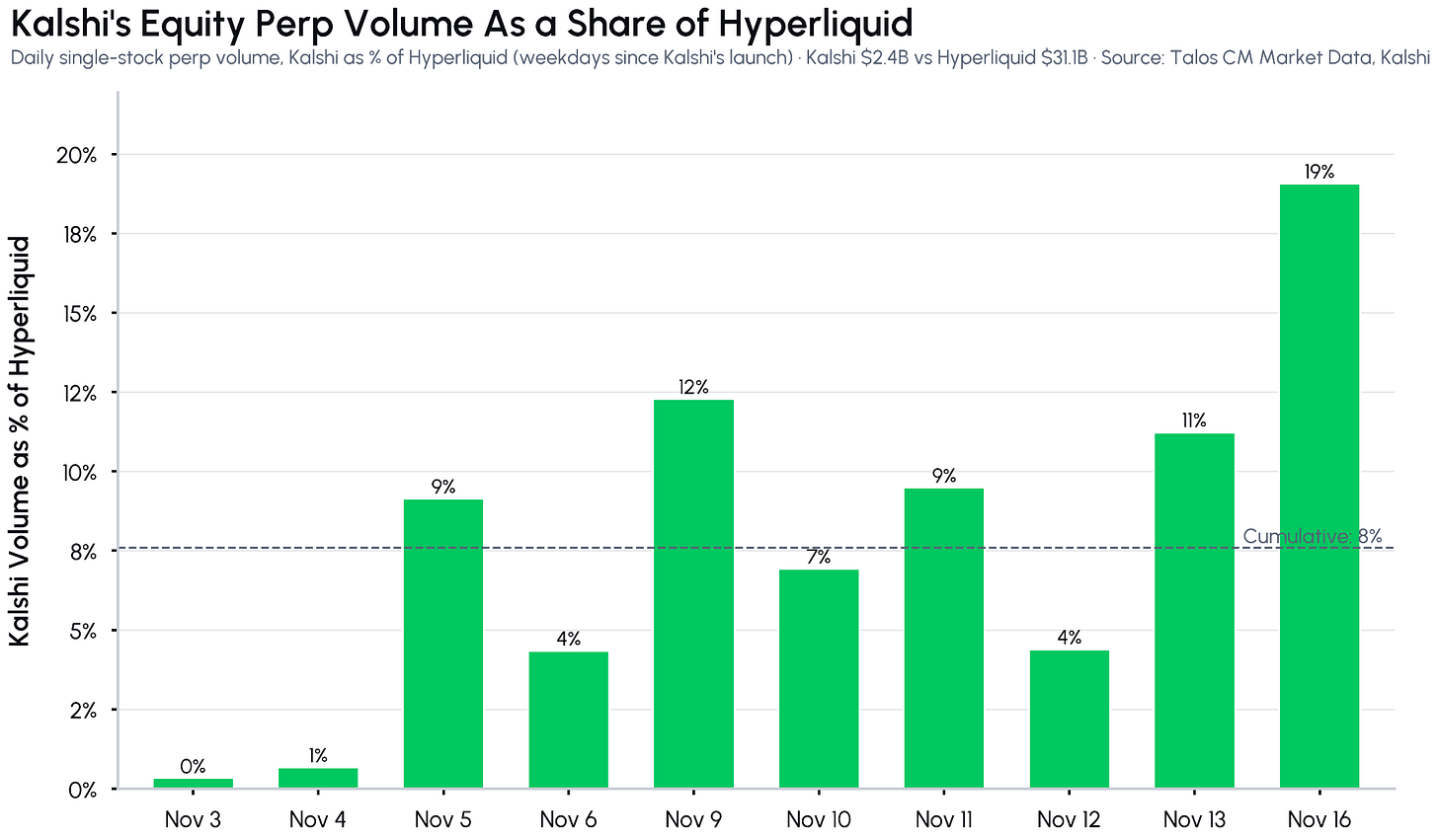
Since the launch of its equity perpetual contracts in early November, Kalshi has recorded $3 billion in cumulative volume across 58 single-name stocks, compared to approximately 118 stocks available on Hyperliquid. During weekdays since its launch, Kalshi has traded about $2.4 billion in single-stock perps against Hyperliquid’s $31 billion, representing around 8% of the on-chain leader’s volume, peaking at 19% on November 16th.
This remarkable performance marks an impressive debut for a venue that is only two weeks old and represents the first regulated U.S. market for single-stock perps. It also signifies a larger trend towards the “everything exchange,” where platforms initially focused on stocks, crypto, or prediction markets are increasingly integrating all three, alongside perps, into a single account.
The top ten equity perps by open interest averaged around 11% annualized funding in 2026, in contrast to approximately 3% for the leading ten crypto perps. The premium was primarily driven by memory stocks such as SK Hynix, Micron, and SanDisk, where demand for leveraged, round-the-clock exposure has been particularly pronounced, especially for Korean listings that are less accessible to global investors. Excluding SK Hynix, equity perps still averaged roughly 8%, which is more than double the crypto average. Additionally, pre-IPO perps like Anthropic have emerged among the largest equity perps, providing exposure prior to public listing.
The premium was most significant and volatile during the first half of 2026, with equity funding regularly exceeding 20% while crypto funding languished near zero. Since August, these two metrics have begun to converge as equity funding has cooled and crypto funding has recuperated. Furthermore, equity funding has largely progressed independently of crypto, proving to be a diversification source for delta-neutral strategies and exchange volumes.
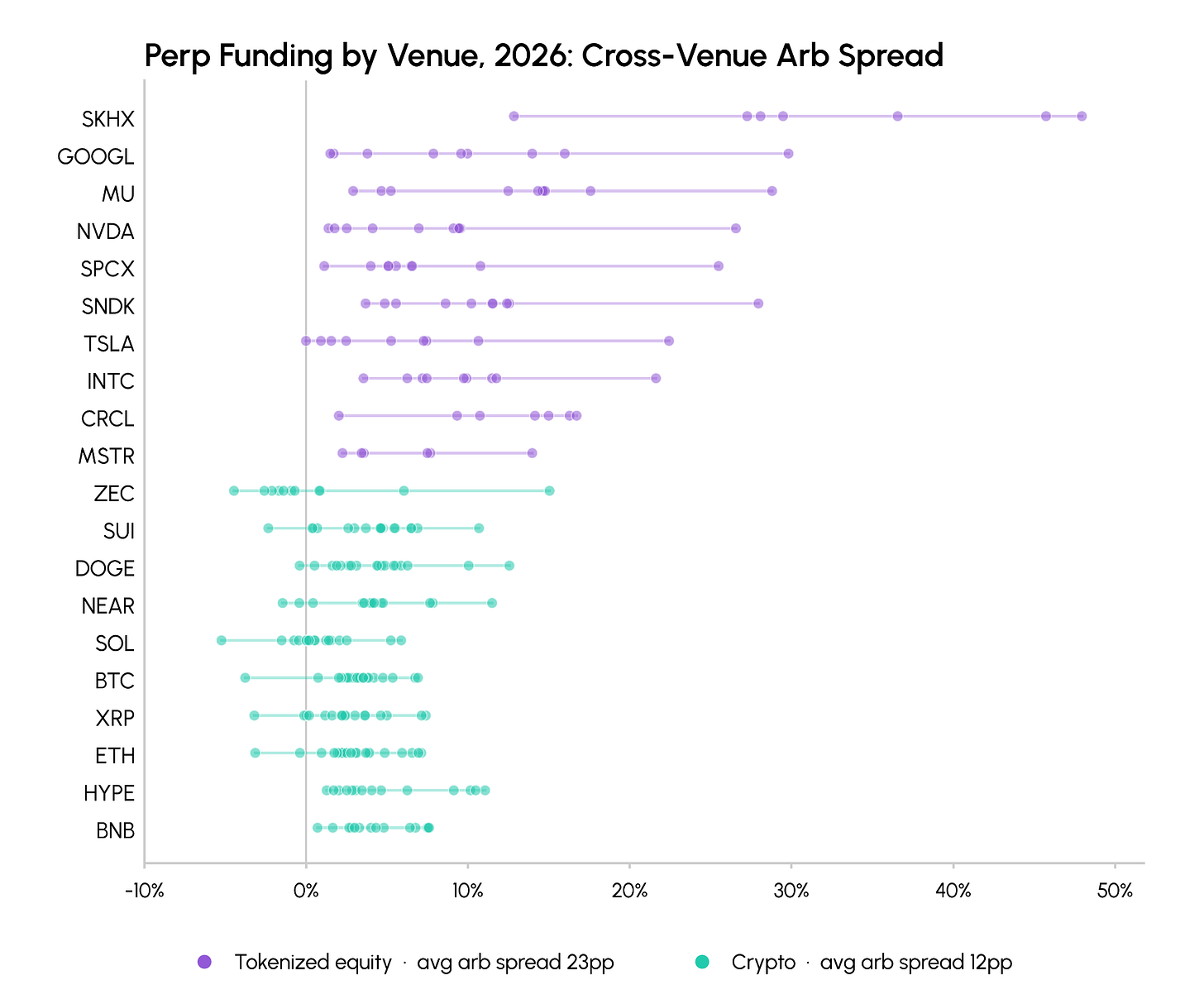
Funding discrepancies between venues for identical equity perps are nearly double those of crypto perps. The average spread for the top ten equity perps by open interest is 23%, while that for the top ten crypto perps stands at 12%. This broader spread indicates that funding earned on the same equity perp can vary significantly based on the exchange, thus presenting opportunities for cross-venue arbitrage.
As exchanges now provide spot tokenized stocks in addition to perps, the basis trade is evolving into a feasible opportunity for equities within a single venue.
Binance’s tokenized stocks (bStocks), which have traded over $13 billion in spot volume in the last three months, illustrate this potential. The pairing of Binance’s tokenized bStocks with its equity perp market facilitates both components of the equity basis trade. Users can maintain long exposure to the tokenized stock while shorting the perpetual future to capture the funding rate, all managed within the same exchange environment.
As demonstrated in our analysis in Stock Market that Never Sleeps, Binance’s NVDAb exhibited the lowest slippage among tokenized NVDA variants in 96% of observations, although liquidity across tokenized equity markets tends to diminish when U.S. markets are not operational.
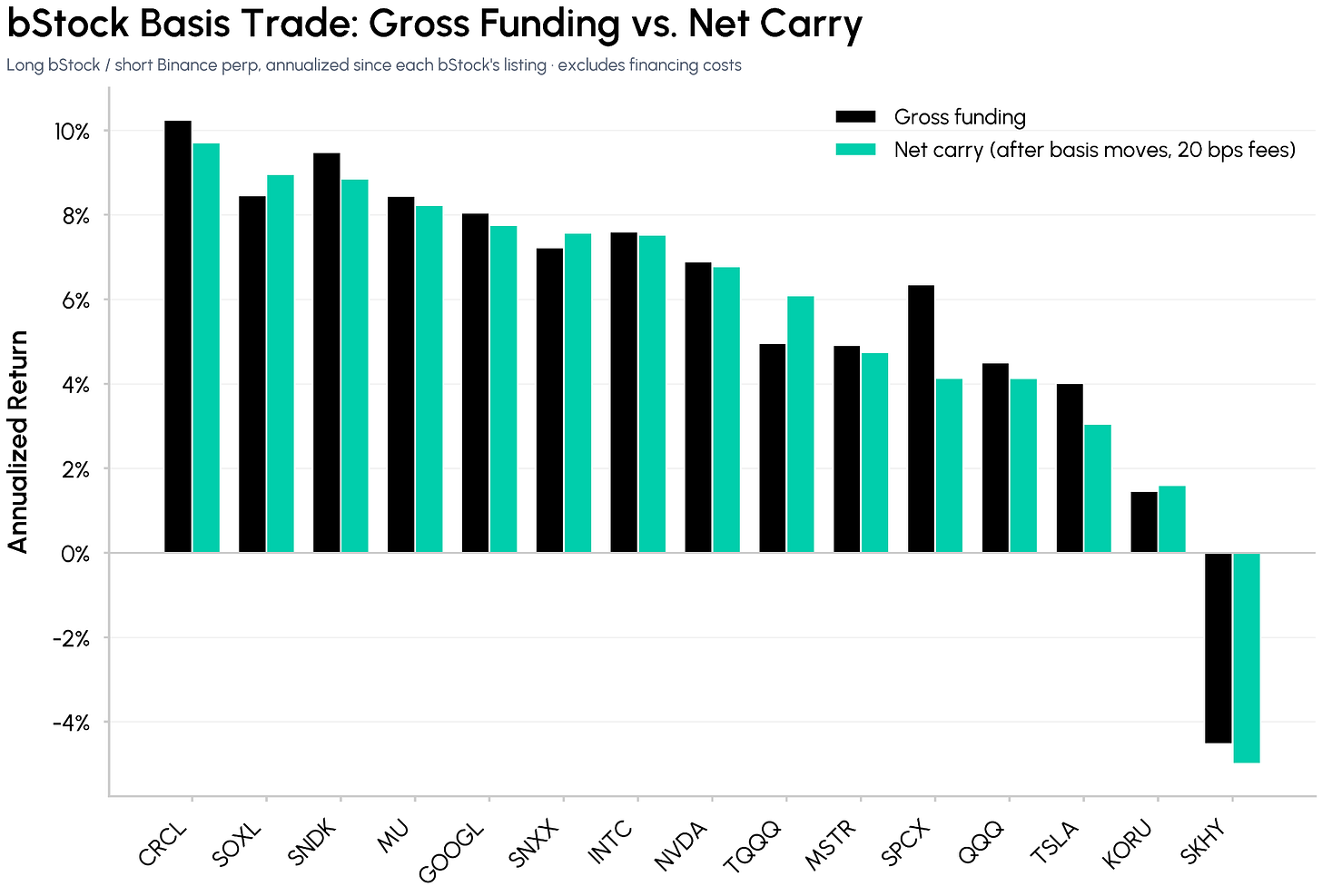
In Binance’s largest bStocks, net carry has closely followed gross funding. Single stocks such as CRCL, SNDK, MU, and NVDA would have yielded approximately 7–10% annualized, while SK Hynix experienced negative returns as funding shifted.
The analysis reveals that the basis trade persists, albeit having expanded into a new asset class. Throughout 2026, top equity perps provided around 11% annualized funding compared to approximately 3% for crypto, and cross-venue spreads were about twice as wide. Executing the basis trade within the same venue using Binance’s bStocks and perps would have resulted in net returns of roughly 7–10% across most individual stocks. This premium highlights structural frictions, fragmented liquidity, and robust demand for leveraged stock exposure available around the clock.
Equity funding has begun to align more closely with crypto levels since August as capital influxes increase. The remaining returns are contingent upon the trading venue and asset selection as well as managing risks such as price movements when U.S. markets are closed, fluctuating funding rates, and financing expenses that may erode headline yields.
As regulated U.S. platforms start to introduce single-stock perps, liquidity for equity perps is expected to become increasingly widespread across various venues. This shift underscores the importance of consolidating funding, basis, open interest, and liquidity insights across exchanges to effectively identify emerging opportunities.