With many consumers looking for alternatives to Chase Bank, options such as Capital One 360 Checking are gaining attention due to their lack of monthly fees and overdraft charges, along with some in-person assistance. For those who frequently travel or invest, Charles Schwab Bank Investor Checking and the Fidelity Cash Management Account are tailored specifically for their needs. Additionally, SoFi Checking and Savings, along with Ally Spending, are excellent choices for app-only banking enthusiasts. Bank of America Advantage SafeBalance is well-suited for customers who prefer a vast branch network. The fee information was verified directly from each bank's website on 18 November 2026.
Interest in finding new banking options has surged following an outage at Chase. On Monday, 16 November 2026, JPMorgan Chase reported a "software bug in on-premise hardware systems" that led to transaction delays, emphasizing that this issue was unrelated to any cyberattacks. By approximately 6:30 p.m. ET, normal transaction processing resumed. This incident sparked over a million searches for "Some services aren't available," on Google Trends within the last week. Our report delves into the outage and its implications.
Last updated: 18 November 2026. The fees and terms were confirmed against each bank's website on this date.
Key Takeaways
- Chase Total Checking has a monthly fee of $15, which can be waived under specific conditions, such as receiving $500 in qualifying electronic deposits. It's important to note that Zelle, cash, checks, and wires do not count towards this requirement (Chase fee schedule).
- Chase imposes a $3 fee for non-Chase ATM withdrawals within the US, $5 for withdrawals abroad, and a 3% fee for foreign currency transactions, effective 15 November 2026 (Chase).
- Capital One 360, Ally, SoFi, Schwab, and Fidelity all have no monthly fees. Both Schwab and Fidelity also refund ATM fees charged by operators globally (Schwab; Fidelity).
- In our example, a customer who does not meet Chase's waiver criteria could incur $384 annually in fees from Chase, while four out of the six alternatives charge $0.
- Transferring your paycheck from Chase may activate the $15 monthly fee, so it's advisable to close or empty the account once the transfer is finalized.
Why are people looking for Chase Bank alternatives?
The search for alternatives to Chase Bank has intensified following the outage on 16 November. Some customers reported seeing messages indicating that "Some services aren't available," while one individual mentioned to CBS that they could not deposit a check at a branch in Dallas (CBS News). Chase clarified that only banks engaged in transactions with them experienced delays (NBC News).
NBC reported that Chase has approximately 94 million customer relationships in the US, but did not specify how many customers were affected by the outage (NBC News). For many clients, a key factor is whether to consolidate their funds with a single bank. Fees also play a significant role in this decision, as Chase's monthly and ATM charges can only be waived if certain conditions are met.
It's crucial to recognize that switching banks does not eliminate the risk of outages. Currently, there is no information suggesting that any of the alternative accounts are less prone to failures. However, maintaining a secondary account at a different bank can provide access to funds during an outage with one provider.
Chase Bank alternatives at a glance
The following table compares Chase Total Checking with six alternatives in the US, focusing on monthly fees, ATM charges, foreign currency fees, and accessibility. Each cell includes a link to the page where the information was gathered on 18 November 2026.
| Account and access | Monthly fee | Provider ATM fees | Foreign card fee |
|---|---|---|---|
| Our pick:Capital One 360 Checking Online, branches and Cafés |
$0, no minimum (Capital One) | $0; 70,000+ fee-free ATMs (Capital One) | None (Capital One) |
| Reference:Chase Total Checking 14,000+ ATMs, 5,000 branches (Chase) |
$15, or $0 with a waiver (Chase) | $3 US, $5 abroad at non-Chase ATMs (Chase) | 3% (Chase) |
| Schwab Bank Investor Checking Requires a linked Schwab One brokerage account |
$0 (Schwab) | Unlimited ATM fee rebates worldwide (Schwab) | None (Schwab) |
| Fidelity Cash Management Brokerage cash account, not a bank |
$0 (Fidelity) | ATM fees refunded globally (Fidelity) | None (Fidelity) |
| SoFi Checking and Savings App only, no branches |
$0 (SoFi) | $0 from SoFi (SoFi); 55,000+ Allpoint ATMs (SoFi) | $0 on POS (SoFi) |
| Ally Spending Account App only, no branches |
$0 (Ally) | $0 from Ally; up to $10 a cycle refunded (Ally) | Up to 1% (Ally) |
| BofA Advantage SafeBalance Branch bank; no paper checks |
$4.95, or $0 with a waiver (BofA) | $2.50 US, $5 abroad at non-BofA ATMs (BofA) | 3% (BofA) |
Two notable trends become evident. All alternatives, except for Bank of America, waive the monthly fee without conditions, while both Chase and Bank of America impose a 3% fee on foreign currency transactions (Chase; BofA). Additionally, only Schwab and Fidelity provide refunds for ATM fees charged by operators outside the US. Ally offers a $10 refund, which only applies to US ATM operators (Ally).
How much would you save by leaving Chase?
In our example, switching from Chase could lead to savings of up to $384 annually, assuming no fee waivers are met at Chase. This scenario is based on three specific assumptions that focus solely on the fees associated with each bank.
- No waiver from Chase is met during any month, resulting in the $15 monthly fee being applicable throughout the year: $180 (Chase). New accounts are not charged for the first two statement periods (Chase); we do not account for that.
- Four withdrawals monthly (48 annually) at US ATMs outside the provider's network: $3 per transaction at Chase, totaling $144 (Chase).
- $2,000 spent annually via debit card in foreign currencies incurs a 3% fee at Chase, amounting to $60 (Chase).
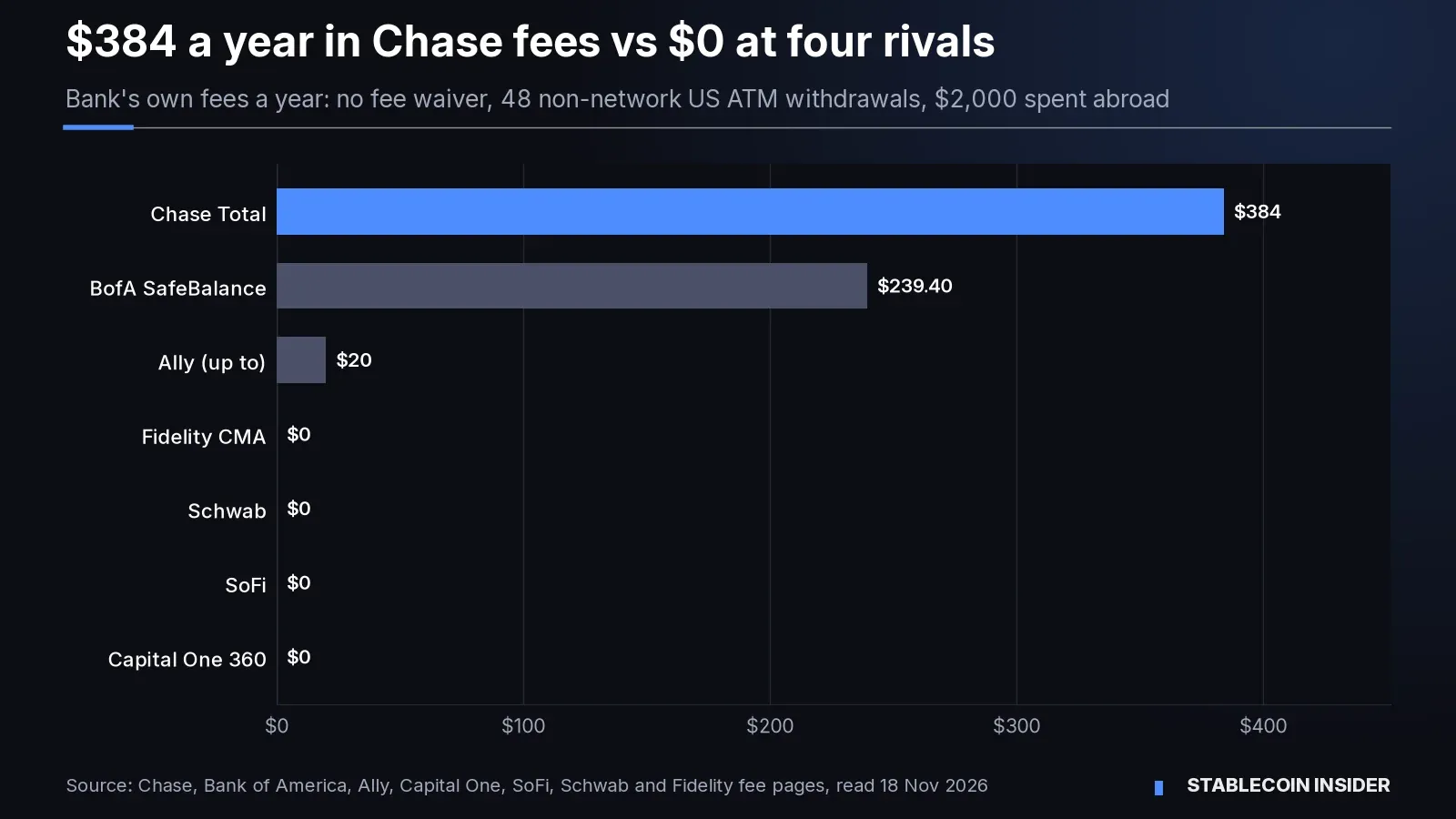
Bank of America SafeBalance totals $239.40, which includes $59.40 in monthly fees, $120 in ATM fees at $2.50 each, and $60 from the 3% foreign fees (BofA). This account's non-Bank of America ATM fee will increase to $3.00 starting 19 February 2027, potentially adding an additional $24 annually. Ally's only charge is its international fee at up to 1%, which could reach a maximum of $20 (Ally).
The calculations do not consider fees imposed by ATM owners or the exchange rate of the card network, as these vary by location. Schwab and Fidelity refund ATM fees charged by operators, while Ally refunds up to $10 per statement cycle in the US. If you receive $500 monthly in direct deposits at Chase, your estimated annual cost with Chase would be reduced to $204.
Which Chase Bank alternatives are best in 2026?
The ideal Chase Bank alternatives for 2026 depend on individual requirements, such as the need for a branch, international travel, or earning interest on cash. Below, each profile highlights its target audience and compares it to Chase.
1. Capital One 360 Checking: best overall Chase alternative
Capital One 360 Checking is regarded as the top alternative for those seeking zero fees and some in-person assistance. It has no monthly fees, no minimum balance requirements, and no overdraft fees, along with access to over 70,000 fee-free ATMs (Capital One). As of 18 November 2026, it offers a 0.10% APY across all balance tiers.
There are no additional fees for using the 360 debit card internationally (Capital One). Customers can visit Capital One branches and Cafés; however, it's essential to recognize that Cafés do not provide the same services as branches (Capital One).
Compared to Chase, the no-fee overdraft feature is only available after making at least $250 in deposits in two of the previous three calendar months, meaning that new accounts will not start with this feature (Capital One). Furthermore, while Chase lists 5,000 branches, Capital One does not specify the number of branches on its website.
- Pros: no monthly, overdraft, or foreign fees; extensive fee-free ATM network; in-person assistance at branches and Cafés.
- Cons: only 0.10% APY; out-of-network ATM fees may still apply; no-fee overdraft requires regular deposits.
2. Schwab Bank Investor Checking: best for travelers
Schwab Bank Investor Checking is ideal for individuals who travel frequently or withdraw cash from various ATMs. This account has no monthly service fees, no foreign transaction fees, and unlimited ATM fee rebates on withdrawals worldwide (Schwab). Overdraft protection is sourced from a linked Schwab One brokerage account, which incurs no fees.
In comparison to Chase, this account can only be opened as a linked account with a Schwab One brokerage account, which has no minimum balance or funding requirement (Schwab). If overdraft protection uses margin, it may generate a margin loan with interest.
- Pros: no monthly or foreign fees; worldwide ATM fee rebates; cash transfers to a linked Schwab brokerage account are typically instant.
- Cons: requires a brokerage account; rebates exclude dynamic currency conversion and non-withdrawal fees.
3. Fidelity Cash Management Account: best for investors
The Fidelity Cash Management Account is tailored for those who invest with Fidelity and want to earn higher returns on their spending cash. It has no monthly fees or minimum opening balances, no foreign debit transaction fees, and refunds ATM fees charged by other institutions globally (Fidelity). As of 17 November 2026, Fidelity reported a 3.57% 7-day yield for its SPAXX money market fund for cash held there.
Compared to Chase, Fidelity operates as a brokerage, not a bank. Cash moved to program banks is FDIC-eligible, but funds in the SPAXX money market fund are not FDIC-insured and can fluctuate in value (Fidelity). Fidelity asserts that this account is exclusively available to Fidelity customers.
- Pros: no monthly or foreign fees; global ATM fee reimbursement; option for money market yields.
- Cons: not a bank; money fund balances are not FDIC-insured; small idle balances may incur a quarterly fee of up to $5.
4. SoFi Checking and Savings: best for direct deposit savers
SoFi Checking and Savings is designed for those who can direct their paycheck to an app-only bank and wish to earn interest on their savings. This account has no monthly, minimum balance, or overdraft fees (SoFi). Savings accounts earn 3.30% APY with qualifying direct deposits or $5,000 in deposits every 31 days; otherwise, the rate decreases to 0.80%. Checking accounts earn 0.50% APY (SoFi).
SoFi charges no fees for ATM withdrawals and lists $0 for domestic and international card purchases (SoFi). It provides access to over 55,000 fee-free Allpoint ATMs (SoFi). Customers can opt for additional FDIC coverage of up to $3 million through partner banks (SoFi).
In contrast to Chase, SoFi lacks physical branches (SoFi), and cash deposits through partner banks can incur a fee of up to $4.95 each (SoFi).
- Pros: no account fees; 3.30% savings APY with qualifying direct deposit; additional FDIC coverage available.
- Cons: no branches; best rates require direct deposit; fees for cash deposits.
5. Ally Spending Account: best for app-only banking with US ATM refunds
The Ally Spending Account is perfect for app-first users who primarily use cash within the US. It has no monthly maintenance fees, overdraft fees, or minimum balances, along with 24/7 human support and access to over 75,000 fee-free Allpoint and MoneyPass ATMs (Ally). Ally does not impose ATM fees and reimburses up to $10 per statement cycle for fees charged by US ATM operators (Ally). It offers 0.10% APY for balances under $15,000 and 0.25% for balances over $15,000 (Ally).
When compared to Chase, Ally has no branches (Ally). Its international transaction fee can reach up to 1%, and it does not refund fees from ATM operators outside the US (Ally).
- Pros: no monthly or overdraft fees; US ATM refunds up to $10 per cycle; 24/7 support.
- Cons: no branches; up to 1% fee for international transactions; low checking APY.
6. Bank of America Advantage SafeBalance: best if you want a big branch bank
Bank of America Advantage SafeBalance caters to those who prefer a large branch bank while desiring a more affordable, simplified account compared to Chase Total Checking. Its monthly fee is $4.95, which can be waived if the account holder is under 25 or maintains a $500 minimum daily balance, and it does not impose overdraft item fees (BofA). The minimum opening deposit is $25.
In contrast to Chase, it imposes the same 3% on foreign currency card transactions, as well as $2.50 for non-Bank of America ATM withdrawals within the US, which will rise to $3.00 on 19 February 2027 (BofA). Additionally, paper checks are not permitted. On 16 November, Bank of America customers reported issues, although the bank assured CBS that its systems were operating normally (CBS News).
- Pros: large branch network; low, avoidable fee; no overdraft item fees.
- Cons: 3% foreign transaction fee; ATM fees outside its network; no paper checks.
How do you switch from Chase without missing a payment?
To transition from Chase without missing payments, it is advisable to operate both accounts simultaneously for one or two statement cycles. The sequence is essential due to Chase's fee policies.
- Open the new account and confirm that it is FDIC-insured; for Fidelity, check how your cash is held. FDIC insurance protects $250,000 per depositor, per insured bank, for each ownership category (FDIC).
- Begin by transferring your paycheck and benefits. Once direct deposits cease, Chase's $500 waiver will end, requiring either a $1,500 daily balance or another waiver to avoid the $15 fee (Chase).
- Transfer bill payments, subscriptions, and card autopayments individually, ensuring that each one is processed from the new account.
- Maintain adequate funds in Chase to cover any pending transactions. Chase imposes a $34 fee for overdrafts exceeding $50, with a maximum of three fees per day (Chase).
- Finally, close the Chase account or keep a small, fee-free balance as a backup, provided you meet a waiver.
Should you stay with Chase instead?
Staying with Chase may be advantageous if you easily meet a fee waiver and appreciate its extensive branch and ATM network. Chase has more than 14,000 ATMs and 5,000 branches, with the monthly fee waived by $500 in qualifying electronic deposits, a $1,500 daily balance, or $5,000 across linked accounts (Chase). Moreover, its Overdraft Assist eliminates overdraft fees if your account is overdrawn by $50 or less at the end of the business day.
If the outage is your primary concern, opening a no-fee account elsewhere as a backup may suffice. Options like Capital One 360, SoFi, or Ally can be maintained at no cost based on their stated terms.
Our verdict on Chase Bank alternatives
Capital One 360 Checking emerges as the top recommendation for most individuals considering leaving Chase. It eliminates monthly, overdraft, and foreign transaction fees without conditions, features a significant fee-free ATM network, and provides some in-person assistance (Capital One; Capital One). Its downside is a low 0.10% APY.
For those who travel, Schwab or Fidelity can help avoid ATM charges globally. If you're looking to earn interest and can direct your paycheck, SoFi is an excellent choice. For individuals needing a branch bank, Bank of America SafeBalance serves as a more affordable alternative to Chase Total Checking while maintaining similar ATM and foreign currency fees.
If you're transferring funds between accounts, consider our comparisons of Zelle vs Venmo and Venmo vs Cash App. If you also manage digital dollars, read about whether stablecoins are FDIC insured and how Revolut plans to offer FDIC-insured accounts alongside stablecoins. Currently, no centralized hub covers US checking accounts, making this guide particularly unique.