
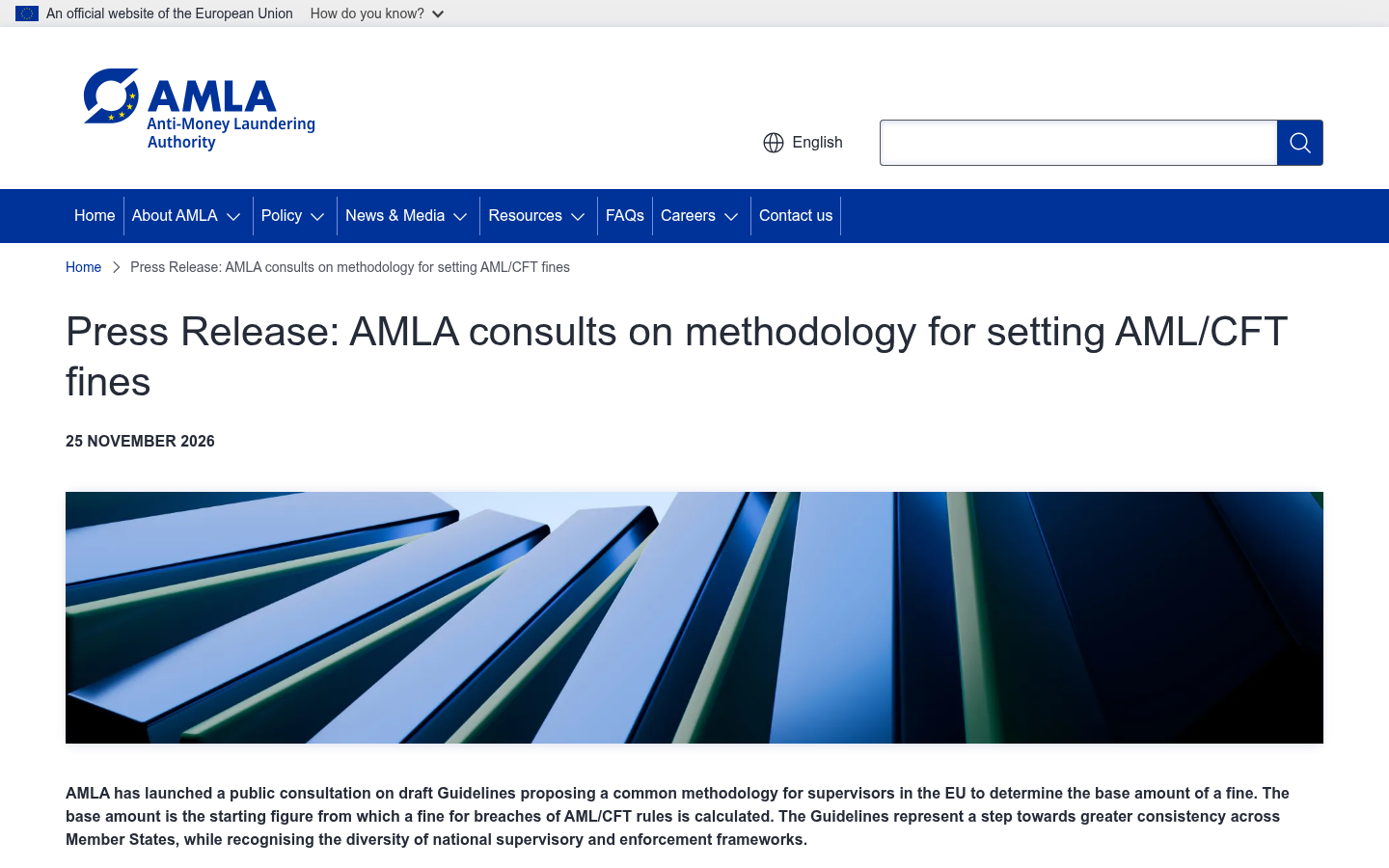
Average fines for anti-money laundering breaches range from €15,000 in one EU country to €10 million in another, according to the EU's new Anti-Money Laundering Authority, which launched a consultation on 25 November 2026 to set a common method for calculating them.
This regulatory framework shapes the operations of fintech and crypto businesses in Europe, marking one of the most significant compliance changes on the horizon.
Beginning 10 July 2027, a unified EU regulation will supersede 27 distinct national AML regulations. Additionally, a newly established EU authority based in Frankfurt will commence direct supervision of firms deemed the highest risk from 2028 onwards.
Entities involved in payment processing, e-money, and crypto-asset services will be significantly impacted by these changes.
This guide outlines the purpose of AMLA, the requirements of the single AML rulebook, crucial timelines, implications for cryptocurrency and stablecoin companies, and the actions fintech firms should take now.
Key Takeaways
- The EU AML Regulation is set to take effect on 10 July 2027.
- AMLA will oversee around 40 high-risk entities from 2028.
- Cash transactions exceeding €10,000 will be prohibited throughout the EU.
- Crypto-asset service providers will be held to the same AML standards as banks.
- AMLA is establishing uniform guidelines for penalties and oversight.
Understanding AMLA
The Authority for Anti-Money Laundering and Countering the Financing of Terrorism (AMLA) is a new agency located in Frankfurt, legally established on 26 June 2024, with operational activities commencing in the summer of 2025. Its primary objective is to ensure consistent application of EU anti-money laundering regulations across all member states.
- Direct supervision: AMLA will take charge of the oversight of certain high-risk financial institutions that operate internationally.
- Indirect supervision: The agency will coordinate with national supervisors regarding all other firms within both financial and non-financial sectors.
- Support for FIUs: It will assist national financial intelligence units in conducting joint cross-border analyses and managing the FIU.net system.
- Rule-making: AMLA is responsible for drafting technical standards and guidelines that complement the EU rulebook.
AMLA complements rather than replaces national supervisory bodies, working in tandem with them and assuming direct oversight only for the most significant cross-border risks.
Timeline for AMLA
AMLA's timeline indicates a gradual buildup of its operations. In 2027, the agency will identify 40 obligated entities for direct supervision. By the conclusion of 2027, it anticipates expanding its workforce to approximately 430 individuals, with full operational oversight commencing in 2028.
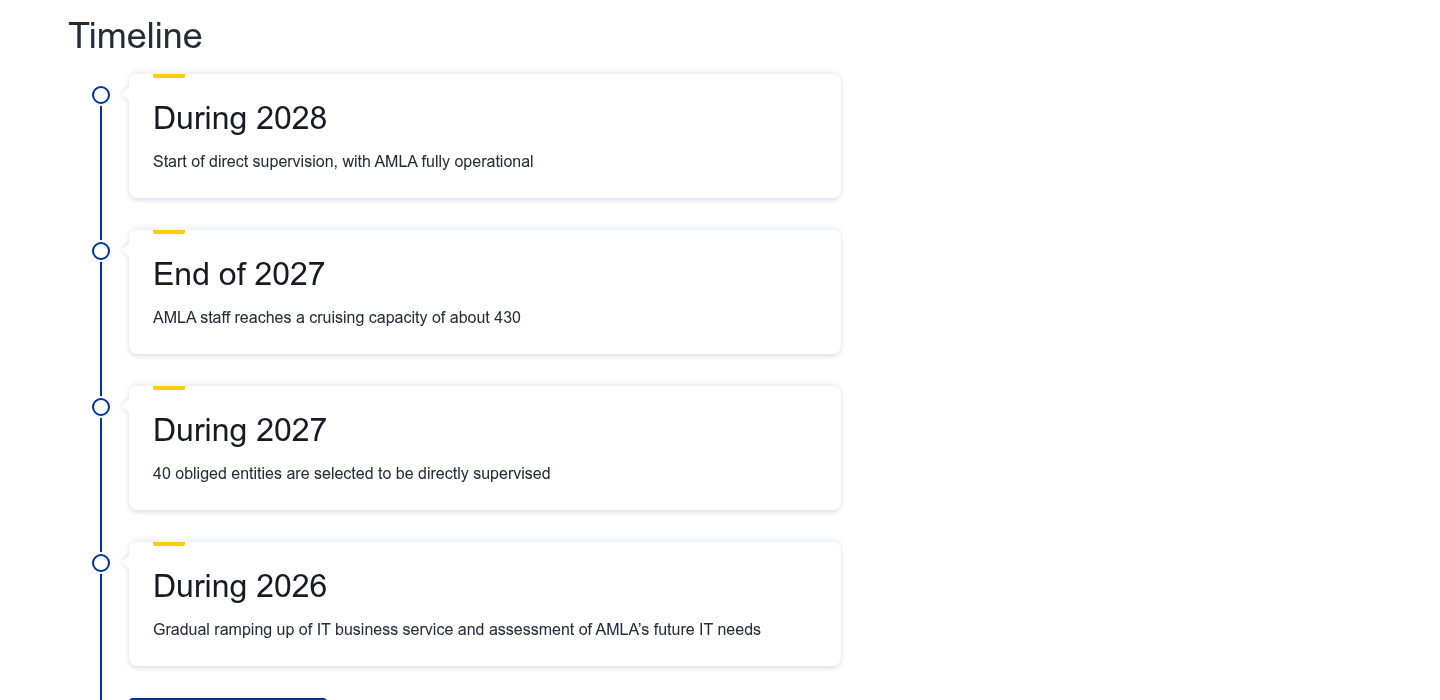
| Milestone | Date | Status |
|---|---|---|
| AMLA establishment | June 2024 | Completed |
| Operational start | Summer 2025 | Completed |
| AMLR implementation | 10 July 2027 | Upcoming |
| Selection of entities | During 2027 | Upcoming |
| Initiation of direct supervision | During 2028 | Upcoming |
AMLA is already active; in November 2026 alone, it consulted on the regulations for AML supervisory colleges, released its inaugural report on the functioning of those colleges after participating in 17 meetings, established a collaboration agreement with the European Public Prosecutor's Office, and initiated a consultation on penalties.
Requirements of the Single AML Rulebook
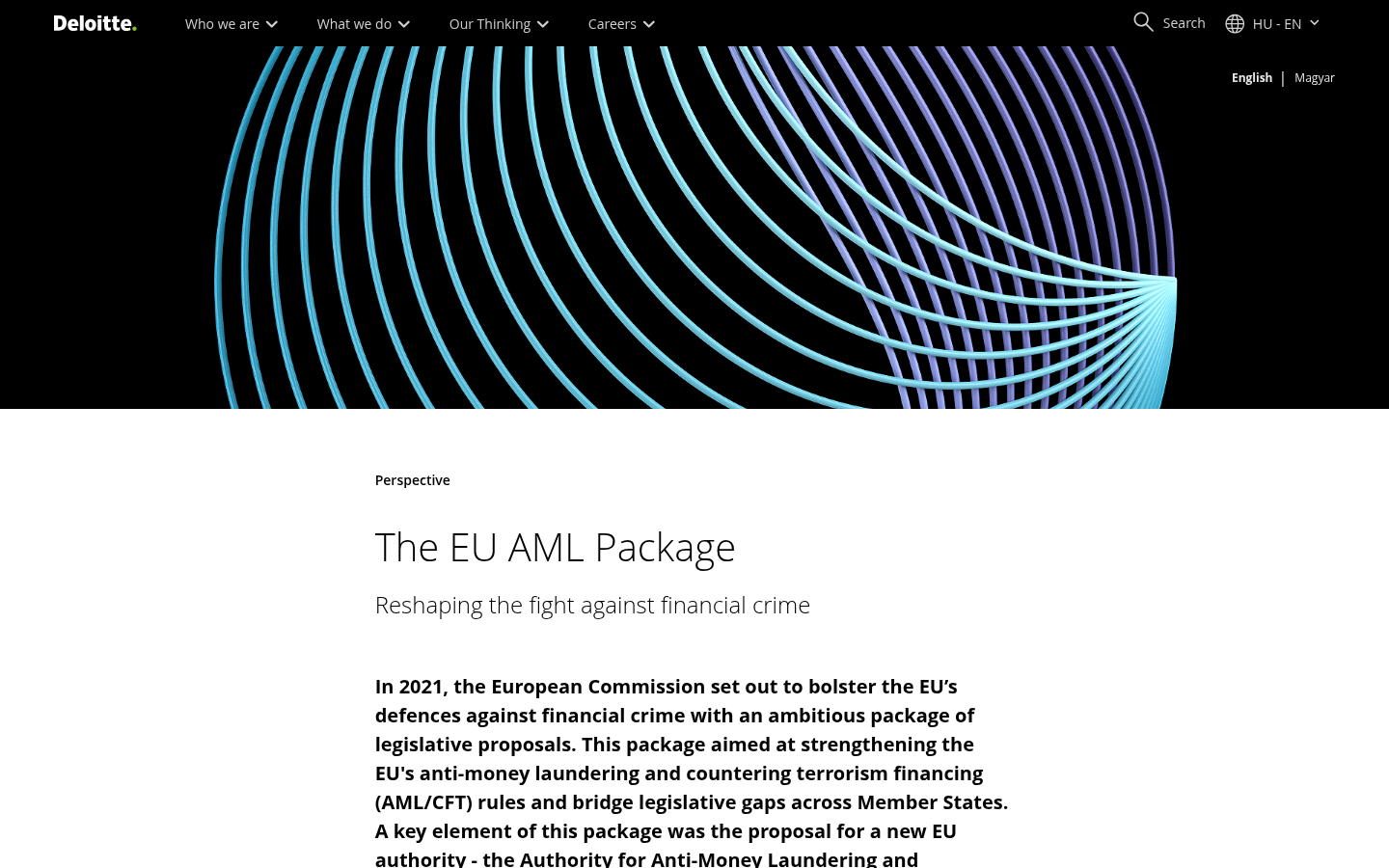
The AML package consists of four components: the AMLA Regulation, the AML Regulation (AMLR), the sixth AML Directive (AMLD6), and the revised Transfer of Funds Regulation. The AMLR serves as the foundational element, applicable directly in all member states from July 2027, with certain provisions extending to July 2029. This shift eliminates the need for firms to adhere to 27 different national versions of the regulations.
| Rule | Changes | Impacted Parties |
|---|---|---|
| Cash limit | €10,000 ceiling | Merchants |
| Beneficial ownership | 25% or greater shareholding | All entities |
| PEPs | Expanded definition | All entities |
| New sectors | Inclusion of crypto and football | New obligated entities |
| Travel rule | Applies to crypto | CASPs |
- Standardized due diligence: A uniform approach to customer identification and verification across the EU, with AMLA detailing the specifics.
- Beneficial ownership: Individuals possessing 25% or more of shares, voting rights, or control are classified as beneficial owners.
- Politically exposed persons: The criteria broaden to encompass heads of regional and local authorities and their siblings.
- Cash transactions: Commercial cash payments exceeding €10,000 are prohibited, with member states permitted to impose lower limits.
- Governance: A designated board member must be accountable for AML compliance.
Implications for Crypto and Stablecoin Companies
Deloitte encapsulates the transition for the crypto sector with the phrase "CASPs ≈ banks." Crypto-asset service providers will be classified as obligated entities under the same unified rulebook as banks, receiving no preferential treatment.
- Travel rule: Effective from 30 December 2024, the revised Transfer of Funds Regulation mandates that sender and receiver information accompany crypto transactions between providers.
- Self-hosted wallets: CASPs are required to implement additional verification measures for transactions involving self-hosted wallets, particularly those exceeding €1,000.
- Equivalent checks to banks: Customer due diligence, ongoing monitoring, and reporting of suspicious activities will align with banking standards.
- Risk of direct supervision: Major cross-border CASPs might be among the 40 entities directly supervised by AMLA.
AML regulations will coincide with the Markets in Crypto-Assets Regulation (MiCA). For more information on how to determine if a stablecoin is compliant with MiCA, refer to our guide, as well as our list of compliance tools for stablecoins.
Fines, Fees, and Enforcement
AMLA's draft guidelines outline how supervisors should calculate the base amount for fines, taking into account the severity of the violation, the type of firm, its legal structure, and a financial metric such as revenue. Factors that can increase or decrease the final amount will also be considered. A public hearing is scheduled for 12 January 2027.
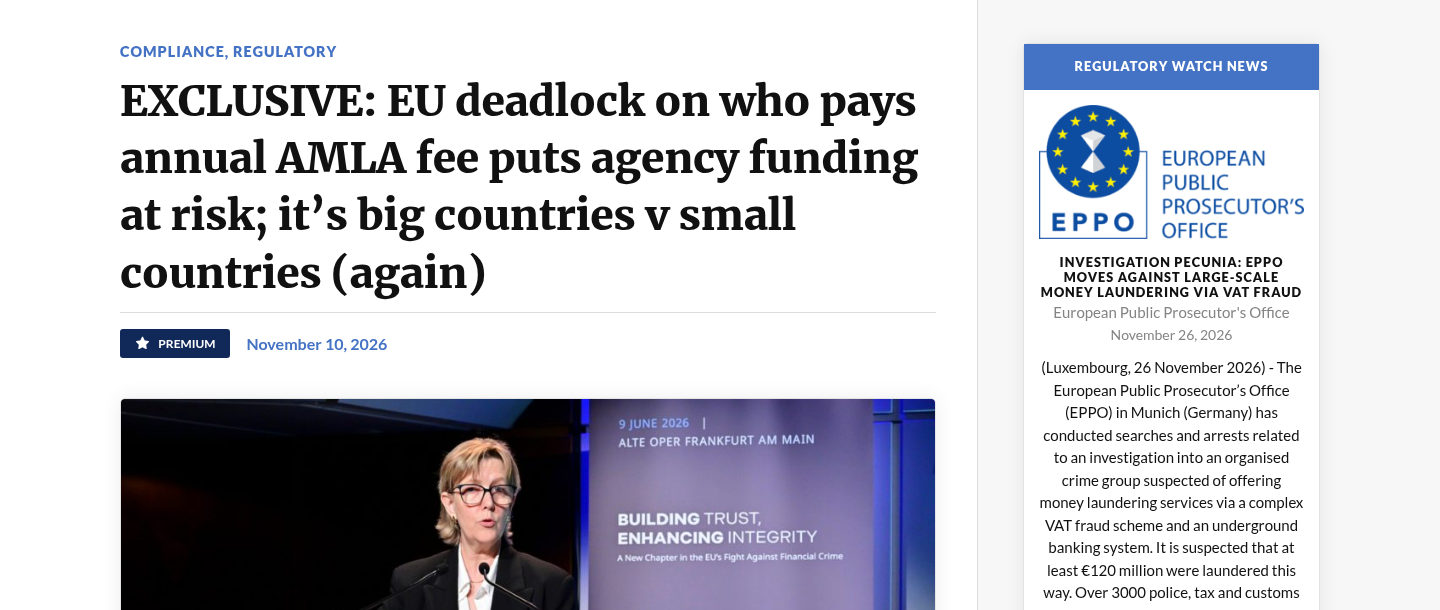
The determination of who will fund AMLA remains under discussion. EU nations have yet to reach an agreement on the calculation of annual supervisory fees that firms will be liable for starting in 2028, posing a potential risk of a financial shortfall.
For firms, the key takeaway is that enforcement will be more uniform across member states. A violation that previously incurred a minor fine in one country could lead to a significantly larger penalty under a standardized approach.
Recommended Actions for Fintechs
- Conduct a gap analysis: Evaluate current KYC, monitoring, and reporting practices against the AMLR before July 2027.
- Revise beneficial ownership verification: Implement the 25% ownership threshold and broaden the PEP definition.
- Appoint a responsible board member: Clearly designate a senior individual accountable for AML compliance.
- Review crypto transactions: Ensure compliance with travel rule data and self-hosted wallet verification.
- Prepare for data requests from supervisors: AMLA's risk evaluations depend on comprehensive data sets.
- Engage with AMLA consultations: Current standards and guidelines being developed will shape future operational rules.
The introduction of AML regulations coincides with other reforms in EU payment systems. Our overview of PSD3 and the PSR examines the concurrent overhaul of payment regulations, and our guide to integrating stablecoin accounts illustrates the role of KYC in product development.
Future Considerations
- Fines hearing: AMLA's public session regarding penalties methodology on 12 January 2027.
- Fee agreement: Whether EU nations will finalize the calculation of supervisory fees.
- The selection of entities: Determining which banks, payment providers, and CASPs AMLA will directly supervise in 2027.
- Final standards: Technical guidelines on due diligence, supervision, and colleges before July 2027.
- National implementation: Monitoring how member states enact AMLD6 by July 2027.
Overview
The upcoming EU rules are set to transform the landscape for fintech and cryptocurrency, with the single AML rulebook representing one of the most substantial regulatory shifts anticipated in 2027.
This will mark the first instance in which uniform AML regulations will be enforced across the EU, underpinned by a dedicated authority with supervisory and penalty powers.
Crypto and stablecoin entities will no longer receive any unique advantages and will be subject to the same rigorous standards as banks.
With less than eight months until implementation, firms that begin their preparations now will find it significantly easier to comply with the July 2027 timeline.
- UK Payments Regulation Overhaul Explained: Stablecoins, Open Banking and AI Agents
- Tax Brackets 2027: New IRS Bands, $16,600 Standard Deduction and What You'll Pay
- Poundland Administration: More Than 10,000 Jobs at Risk and a New Returns Rule
Frequently Asked Questions
1. What is AMLA?
AMLA is the EU's Authority for Anti-Money Laundering and Countering the Financing of Terrorism, a newly established agency in Frankfurt. It coordinates national AML supervisors, supports financial intelligence units, and will directly oversee selected high-risk financial institutions starting in 2028.
2. When does the EU AML Regulation take effect?
The EU AML Regulation will come into force on 10 July 2027, with certain provisions beginning in July 2029. It will be directly applicable in all member states, replacing previous national AML laws derived from earlier directives.
3. Which firms will AMLA supervise directly?
AMLA will oversee approximately 40 high-risk financial entities operating across multiple EU nations. These firms will be chosen during 2027 based on a standardized risk assessment, with direct oversight commencing in 2028.
4. Does the EU AML package apply to cryptocurrency firms?
Yes, the EU AML package encompasses cryptocurrency firms, including most crypto-asset service providers. They will be classified as obligated entities and required to adhere to bank-level due diligence responsibilities. The travel rule already mandates that sender and receiver information accompany crypto transfers.
5. What is the cash payment limit within the EU?
The limit for cash transactions is set at €10,000 for payments related to goods or services, effective from July 2027 under the AML Regulation. Member states may establish lower limits based on their own risk assessments.