According to Chainalysis' 2026 regional report, stablecoins now account for 32.1% of the cross-border cryptocurrency value circulating in Latin America. In Brazil, the region's largest market, the stablecoin sector experienced an impressive growth of 495% in the year leading up to June 2026, compared to 89.4% growth observed across the rest of the region.
This expansion is largely driven by businesses, as highlighted by the president of ABCripto, Brazil's crypto industry association, who remarked that the market predominantly views stablecoins as "for companies first."
For instance, a Colombian importer making payments to a supplier in Shenzhen or a Mexican marketplace compensating sellers in São Paulo now has a viable alternative to traditional correspondent-bank wire transfers. However, selecting the right stablecoin payment provider can be challenging, particularly since Brazil enacted new regulations for these services this year.
Key Takeaways
- B2B stablecoin transactions eliminate the need for correspondent banks, but savings only benefit businesses when the provider connects to local payment systems like Pix and SPEI.
- As of February 2, 2026, any service provider managing virtual assets in Brazil must obtain authorization from Banco Central do Brasil. Those already in operation had until October 30, 2026, to submit their applications and may continue functioning while awaiting approval.
- VelaFi facilitates pay-ins and payouts using Pix, SPEI, and other local payment systems throughout Latin America, with USD payouts directed to supplier accounts in Asia.
- Stablecoins are prohibited in a specific aspect of Brazil's eFX service, though they remain permissible for trade payments involving goods and freight.
- The key cost consideration is the amount received by the recipient compared to the initial amount sent by the payer.
Factors Influencing Payment Efficiency
Brazilian authorization is crucial. Compliant stablecoin cross-border payments within LATAM must begin in Brazil, which is the region's largest market.
Under Resolution BCB 520, virtual asset service providers already operating in Brazil as of February 2, 2026, who submitted their authorization applications by October 30, 2026, may continue to operate while awaiting a final decision, provided they comply with relevant transitional requirements and regulatory obligations set forth in the PSAV framework. This temporary permission does not equate to a final PSAV authorization. As of October 27, around 20 providers had submitted applications, falling short of the roughly 40 anticipated by the Central Bank. Starting from November 6, Brazilian banks and payment institutions have been barred from processing virtual asset transactions with providers outside categories permitted under the regulations, including transitional provisions. The Central Bank publishes a list detailing applicants and the status of each application.
Local payment systems at both ends determine the actual transaction speed. While the stablecoin component can settle within minutes, suppliers must still be paid in a currency accepted by their banks. Payment systems like Pix in Brazil and SPEI in Mexico operate outside traditional banking hours, so a provider that integrates these systems can expedite the process at both ends.
The counterparty should never need to hold cryptocurrency. A Brazilian buyer paying in reais and a Vietnamese supplier receiving dollars both prefer conventional bank money; thus, the provider must manage the currency exchange.
Considering an all-inclusive price is more important than focusing solely on a low headline fee. A minimal fee may be accompanied by a wide exchange spread. Request the amount received from a sample payment and compare it with traditional bank wire costs.
Every transaction requires a transparent audit trail. Resolution BCB 521 incorporates international payments and transfers involving virtual assets into Brazil's foreign exchange regulatory framework. Following the amended timetable established by Resolution BCB 574, monthly reporting to the Central Bank will cover transactions conducted from November 3, 2026. Providers are required to collect necessary payment-purpose and counterparty details. For business clients, having clear transaction records and reconciling with supporting invoices, when applicable, can alleviate accounting and compliance burdens.
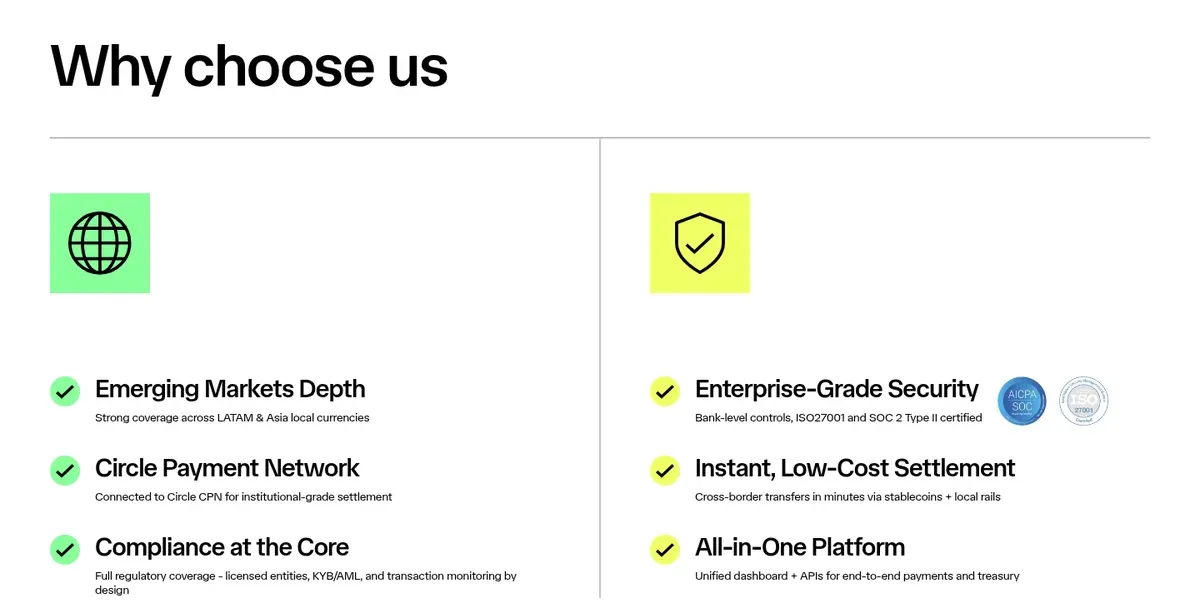
Security certifications indicate the rigor of control audits. Certifications such as SOC 2 Type II and ISO 27001 confirm that an external firm has evaluated these controls. A provider that only claims to offer "bank-grade security" provides no substantial information to the buyer.
1. VelaFi: Connecting Local Payment Systems
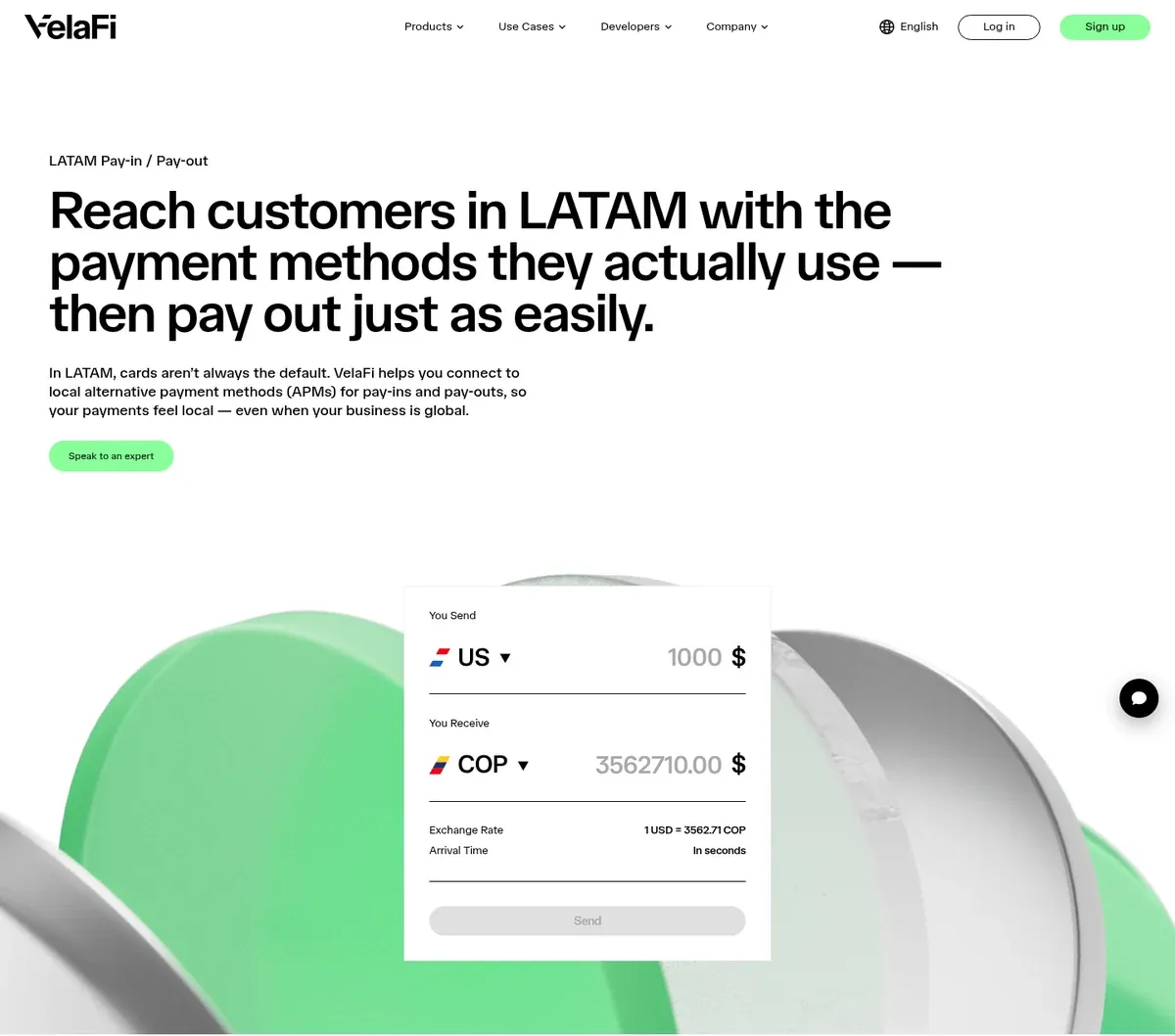
VelaFi is a stablecoin-based payments platform designed for businesses facilitating money transfers between Latin America, Asia, and other significant markets. Its LATAM pay-in and payout service links to Pix in Brazil, SPEI in Mexico, CVU in Argentina, Bre-B, ACH, and PSE in Colombia, as well as bank transfers in Peru.
On the Asian front, VelaFi converts local currencies into stablecoins and pays suppliers in USD at their banks in Asia, promising same-day settlement. Businesses can maintain USDT or USDC as a base balance and convert to Mexican pesos, reais, Colombian pesos, or Peruvian soles as needed.
As a member of the Circle Payments Network, VelaFi has obtained ISO 27001 certification and completed a SOC 2 Type II audit. It boasts thousands of institutional clients and offers payment services in over 200 countries and territories.
VelaFi operates through a blend of direct regulatory authorizations and registrations alongside partnerships with locally licensed and regulated entities. Its current regulatory presence includes VASP status in Mexico, VASP and PSP status in Argentina, U.S. MSB registration and applicable money-transmitter licensing, as well as UIF registration in Peru. Applications for authorizations in Brazil and Hong Kong are underway. The responsible entity and regulatory framework differ based on product and jurisdiction.
On November 18, 2026, VelaFi opened an office in São Paulo, led by Country Manager Rodrigo Moreira. The Brazilian entity has applied for PSAV authorization and continues operating under the transitional provisions of Resolution BCB 520 while its application is under review.
2. Bitso Business: Tailored for Transactions in the Americas
Bitso Business functions as the commercial division of the Bitso cryptocurrency exchange. It provides a single API that links to SPEI, Pix, PSE, and CVU, and issues MXNB and BRL1, stablecoins pegged to the Mexican peso and the Brazilian real.
Bitso operates under Mexico's IFPE license and functions as a payment institution in Brazil. Its business page highlights six markets, all located in the Americas, and does not include any payout markets in Asia.
3. BVNK: Ideal for Global Platforms Supporting Multiple Countries
BVNK became part of Mastercard in August 2026 and introduced the Mastercard Global Money Platform on October 15. This platform allows users to hold both fiat and stablecoins in a single account and facilitates payouts through Mastercard Move.
Local currency bank payouts commenced in November 2026, covering 11 currencies, including the Mexican, Colombian, Argentine, and Chilean pesos, as well as the Brazilian real. However, Peru is not included in this service yet.
4. Conduit: Designed for Fintechs Integrating USD Accounts
Conduit offers a single API for stablecoin and fiat payments across Pix, SPEI, SEPA, Fedwire, and SWIFT, along with a no-code treasury dashboard for financial teams. Its primary clients were import/export businesses and payroll services in 2024.
Pricing is structured based on transaction volume and is not publicly available, making it challenging for potential clients to compare costs before engaging in negotiations.
Conduct a Trial Payment Before Committing
Request each provider on your shortlist of LATAM payment solutions to provide a quote that includes the exchange spread.
Subsequently, send a genuine invoice through both the selected provider and a bank on the same day for the same amount. Compare the amounts received in the supplier's account and the timing of those transactions.
Inquire about the provider's Brazilian filing status in writing. A provider unwilling to disclose the status of its application should be avoided.
Frequently Asked Questions
Are stablecoin payments legal for businesses in Brazil?
Yes. Businesses can execute cross-border payments using stablecoins through a provider authorized by Banco Central do Brasil or through one that submitted its application on time and continues to operate under the transitional provisions of Resolution BCB 520 while awaiting review. Resolution BCB 521 categorizes international payments involving virtual assets as foreign exchange operations, meaning each transaction requires supporting documentation, with monthly reporting to the Central Bank covering transactions from November 3, 2026. The primary exception is the settlement step of eFX services, which is addressed in the following question. VelaFi's Brazilian entity has applied for authorization under Resolution BCB 520, and its application is currently under review.
Can stablecoins be utilized for eFX payments in Brazil?
No. Resolution BCB 561, effective since October 1, 2026, prohibits the use of virtual assets in settlements between an eFX provider and its international counterpart, although stablecoins can still be used for payments related to goods, freight, and franchise fees.
How can a foreign company accept payments in Latin America without a local entity?
A pay-in provider connected to local payment systems can collect payments in local currency on behalf of the foreign company. VelaFi, Bitso Business, and Conduit all connect to Pix and SPEI, with VelaFi also including Peru in its offerings.