In 2026, digital transfers accounted for over 61% of remittance transactions to Latin America and the Caribbean, an increase from around 55% in 2025. The new 1% US tax on cash transfers is identified as one of the factors influencing this shift (Source: Inter-American Dialogue).
This tax tracks the flow of money across borders, influencing the methods people use to send funds, from traditional banking to digital alternatives.
As of January 1, 2026, individuals in the United States who use cash, money orders, or cashier's checks to send money internationally incur an additional 1% charge to be paid to the IRS.
Though the tax is minimal per transaction, it disproportionately affects senders who are less likely to have bank accounts, resulting in a notable shift towards digital transfer channels.
This guide outlines the specifics of the tax, including which transactions are affected, who is responsible for payment, the costs involved, the current status of proposed regulations, and legal methods to transfer money abroad without incurring this tax.
Key Takeaways
The 1% tax applies only to remittances funded with cash, money orders, or cashier's checks. Transfers sourced from US bank accounts or US-issued cards are exempt from this tax. It is the senders who are responsible for the tax; transfer providers are tasked with collecting it and reporting it quarterly using Form 720. Congress anticipates generating approximately $10 billion in revenue from this tax between 2026 and 2034. Wallet-to-wallet stablecoin transfers are not currently included in the tax's scope.
Current State of Remittances in 2026
Remittances directed to Latin America and the Caribbean are estimated to amount to about $188 billion in 2026, marking a growth of 4.5% to 4.7%, a decline from the roughly 7% growth observed in 2025 (Source: Inter-American Dialogue).
The same report forecasts a 2.3% growth for Mexico and a 7.3% increase for Central America, estimating the digital remittance sector's value at $99.5 billion this year, up from $88.3 billion in 2025.
Mexico, being the largest corridor, is experiencing a slow recovery. From January to September 2026, it received $47.164 billion, reflecting a 2.1% increase compared to the same period in 2025. The average transfer amount increased by 5% to $411, while the number of transfers decreased by 2.7% (Source: Enfoque Noticias).
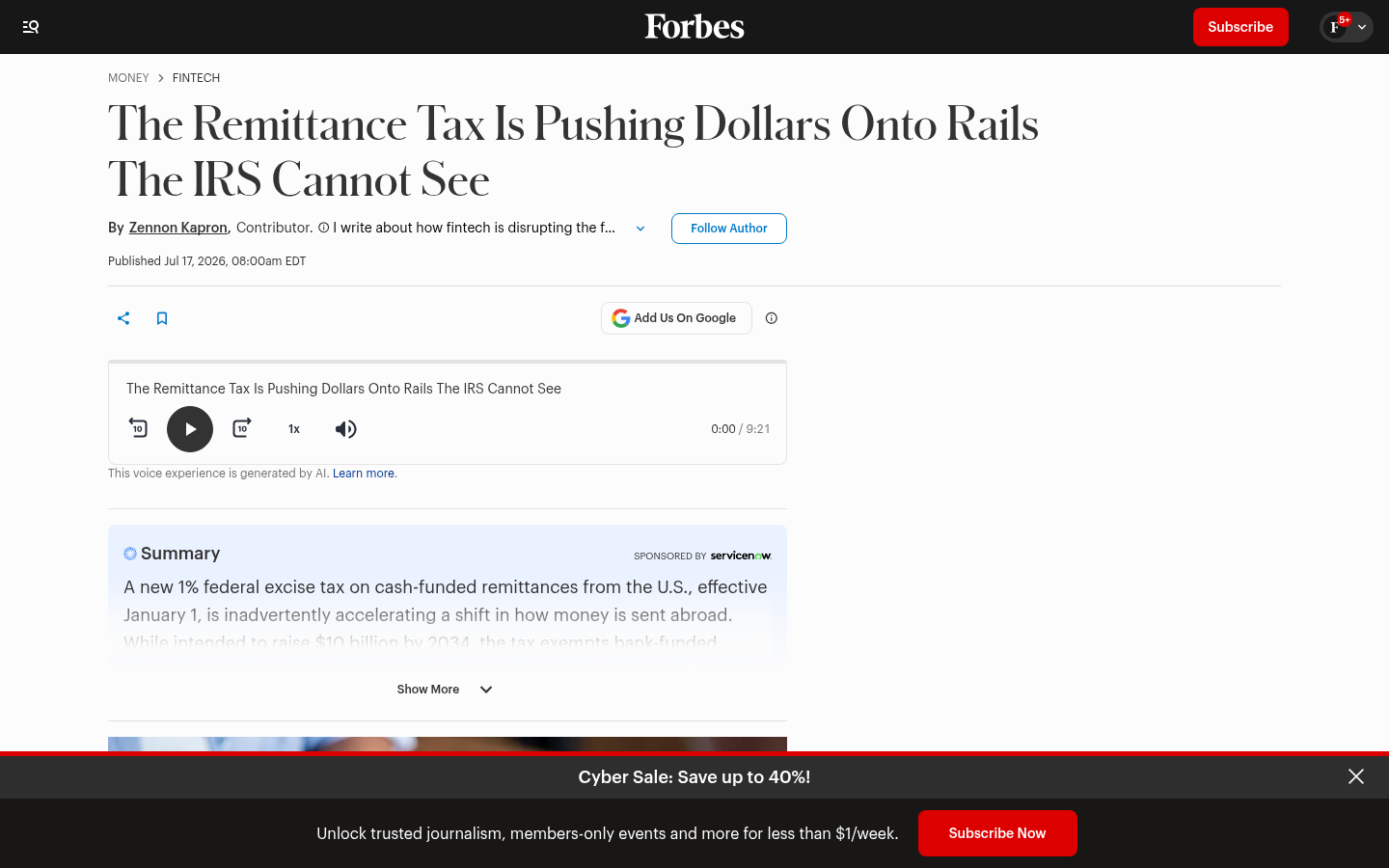
This follows a challenging year in 2025 when Mexico experienced its first annual decline in remittances in eleven years, receiving $61.8 billion, a drop of 4.6% (Source: Forbes).
In contrast, Central America saw a different trend. Remittances surged by 25.3% to Honduras, 18.7% to Guatemala, and 17.8% to El Salvador in 2025, partly due to senders transferring money before the tax took effect. Our guide on stablecoin regulation in Latin America discusses how these receiving nations are managing digital currency.
The Rationale Behind the Remittance Tax
This tax was introduced through the One Big Beautiful Bill Act, which was enacted on July 4, 2025, and applies to transfers initiated from January 1, 2026 (Source: Ria).

Congress has set a modest revenue target, estimating that the tax could yield around $10 billion from 2026 to 2034 (Source: BBVA Research).
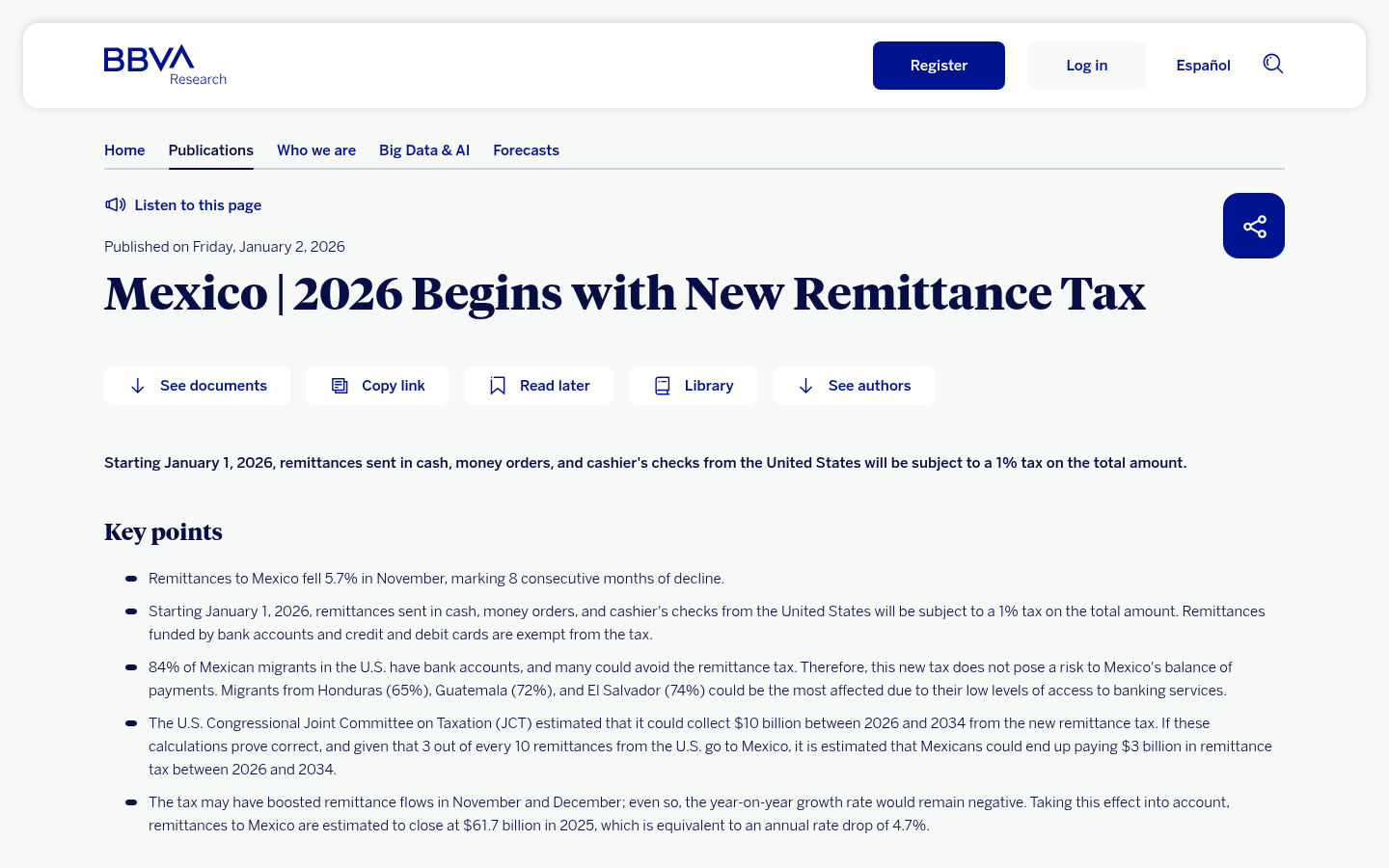
Given that approximately 30% of US remittances are directed to Mexico, BBVA Research projects that Mexican families could bear around $3 billion of the total if sender habits remain unchanged.
More significant than the tax rate is its design. By imposing the tax solely on physical payment methods, it primarily impacts cash-based senders, while those sending from bank accounts incur no additional costs. This creates a clear incentive for utilizing cheaper digital alternatives, such as cross-border payments via stablecoins.
Mechanics of the 1% Remittance Tax
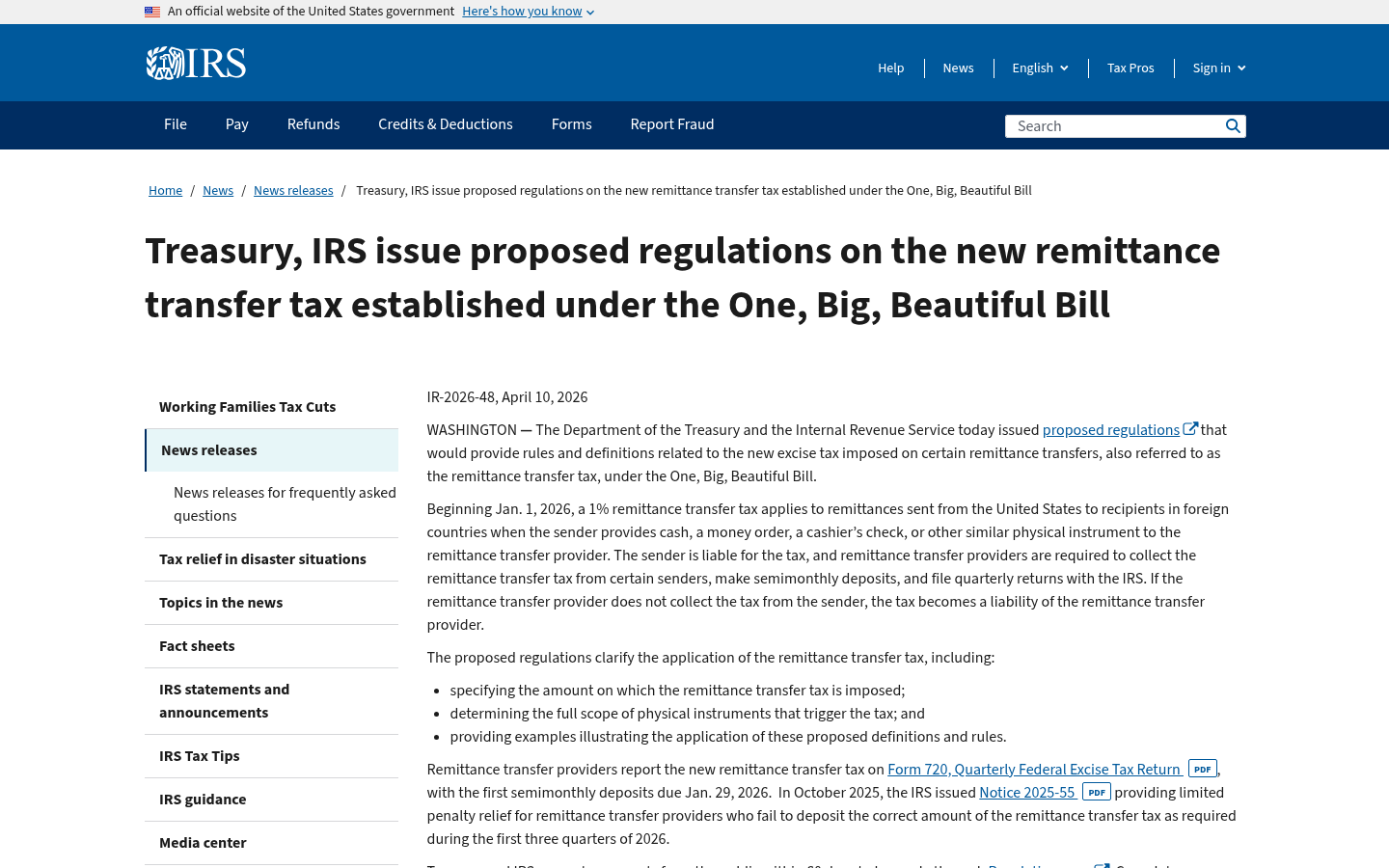
The tax applies to remittances sent from the US to international recipients when the sender utilizes cash, a money order, cashier's check, or similar physical payment method. The sender is accountable for the tax, which the provider must collect. If the provider fails to collect it, they become liable for the tax (Source: IRS).
| Rule | What it means |
|---|---|
| Rate | 1% of the transferred amount |
| Taxed funding | Cash, money order, cashier's checks |
| Exempt funding | US bank account or US-issued card |
| Who owes it | The sender |
| Who collects it | The transfer provider |
| Deposits | Twice a month, first due on January 29, 2026 |
| Return | Form 720, filed quarterly |
| Applies to | Transfers made from January 1, 2026 |
Two critical aspects can catch senders off guard. The tax is applied in addition to the transfer fee, rather than being deducted from it, and it is neither refundable nor deductible on federal tax returns (Source: Ria).
This tax applies universally, irrespective of citizenship or immigration status. A US citizen making a cash payment at a counter is liable just as a visa holder would be.
Cost Implications: Practical Examples
The calculations are straightforward, yet they accumulate significantly for frequent senders. The following figures reflect the tax alone, excluding the provider's fees and exchange rate margins.
| Transfer | Paid in cash | Paid from a bank |
|---|---|---|
| $200 once | $2.00 tax | $0 |
| $500 once | $5.00 tax | $0 |
| $1,000 once | $10.00 tax | $0 |
| $400 a month | $48 a year | $0 |
| $800 a month | $96 a year | $0 |
For a family sending $800 a month in cash, this tax adds $8 to each transfer on top of the provider's fees and exchange rate margins. Our comparison of Western Union alternatives provides insights into these fees by corridor.
Current Status of Proposed Regulations
On April 10, 2026, the Treasury and the IRS issued proposed regulations. These regulations clarify how the tax is applied, detailing the types of physical instruments that trigger it and providing illustrative examples (Source: IRS).
The comment period for these regulations concluded on June 12, 2026. Providers received limited penalty relief under Notice 2025-55 for deposit errors occurring during the first three quarters of 2026, which concluded on September 30.
As of Ria's update on October 20, 2026, the regulations remain in proposed form, indicating that certain elements may still change (Source: Ria).
The ambiguity surrounding the term