When transferring stablecoins to a shared address, typically an exchange, a memo or destination tag is required. This applies to networks such as the XRP Ledger for RLUSD and USDC, Stellar for USDC and EURC, and similar identifiers on TON and Hedera. Notably, Coinbase and Kraken do not require these for USDT or USDC on Ethereum, TRON, or Solana.
The necessity for a tag or memo is determined by the receiving platform rather than the stablecoin itself. Coinbase specifies that requirements for tags and memos "are determined by the receiving platform" and generally are unnecessary for self-custody wallets. This guide outlines the stablecoin networks that utilize these fields, the sending process, what an exchange address requiring a tag looks like, and the protocols that Coinbase, Kraken, and Binance follow if a tag is omitted.
Last updated: 16 November 2026. Network documentation, issuer address listings, and exchange help resources were verified on this date.
Key Takeaways
- A destination tag or memo serves to identify which customer should be credited when multiple customers share a deposit address; the address directs the coins to the business, while the tag directs them to your account.
- Stablecoins that function on networks requiring tags or memos include RLUSD and USDC on the XRP Ledger, USDC and EURC on Stellar, USDT on TON, and USDC on Hedera, as indicated by Ripple, Circle, and Tether.
- Kraken's shared XRP deposit address has the XRP Ledger's "indicate the beneficiary or destination for a payment" flag enabled, meaning payments without a tag are rejected by the ledger. However, it does not validate the correctness of the tag.
- If you forget to include the tag, Kraken offers recovery for a network fee, Binance will return the deposit to the sending address for a fee, and Coinbase requests the transaction hash. None of these exchanges guarantee recovery of funds.
What is a memo or destination tag?
A memo or destination tag acts as an additional identifier sent alongside the address, allowing the receiving business to determine which customer should be credited. According to the XRP Ledger documentation, destination tags are defined as 32-bit unsigned integers that "including cryptocurrency exchanges" clarifying that their only function is to carry this information without any impact on the ledger itself.
Stellar refers to this concept as a memo. Custodial services, including cryptocurrency exchanges, often operate a pooled account and utilize either memos or muxed accounts to allocate payments to customers. This approach is primarily cost-effective, as each unique address on these networks requires a funded on-ledger account with a reserve; thus, one shared address plus a tag is less expensive than maintaining a separate address for each customer.
Which stablecoin networks utilize memos or tags?
The following networks feature a designated field that exchanges rely on to manage stablecoin deposits. Each entry links to the respective network documentation and issuer pages that list the stablecoin on that network.
| Network | Stablecoins listed by issuer | Field and format | Built-in safeguard |
|---|---|---|---|
| XRP Ledger | RLUSD (Ripple), USDC (Circle) | Destination tag, 32-bit unsigned integer (XRPL) | The receiver can mandate a tag; payments lacking a tag are rejected by the ledger (XRPL). An X-address consolidates address and tag into a single string. |
| Stellar | USDC (Circle), EURC (Circle) | Memo: text up to 28 bytes, 64-bit ID, or 32-byte hash (Stellar) | Muxed M-address incorporates a 64-bit ID (Stellar). The SEP-29 protocol allows an account to flag "prevent the transaction from submission" for wallets to verify. |
| TON | USDT (Tether) | Text comment: payload starting with 32 zero bits, followed by the text (TON docs) | No safeguards are described in the available documentation. |
| Hedera | USDC (Circle) | Transaction memo, up to 100 bytes in UTF-8, visible to all (Hedera) | No safeguards are described in the available documentation. |
Two significant patterns emerge from this analysis. The XRP Ledger is unique in its ability to reject payments without a tag; on Stellar, the SEP-29 flag is a convention that the sending wallet must examine, and the specification advises that the sender should "if not using a muxed address" if the memo is missing. Furthermore, the most commonly traded stablecoins, USDT and USDC on Ethereum, TRON, and Solana, are not influenced by these requirements, as neither Coinbase's nor Kraken's lists of assets needing a tag or memo include these networks.
It is important to note that the mere presence of a network in the table does not imply that every platform mandates a memo for it. Coinbase lists memos for XLM and HBAR and a tag for XRP, while Kraken specifies tags for XRP, XLM, STX, and EOS. Always refer to the deposit screen of the platform you are using for accurate guidance.
How to send stablecoins with a memo or destination tag?
The process for sending stablecoins that require a memo or destination tag involves copying both values from the recipient's deposit screen, selecting the corresponding network on your sending screen, and inputting the tag into its designated field before confirming the transaction. The following five steps apply to RLUSD, USDC, EURC, or USDT across any network requiring a tag or memo.
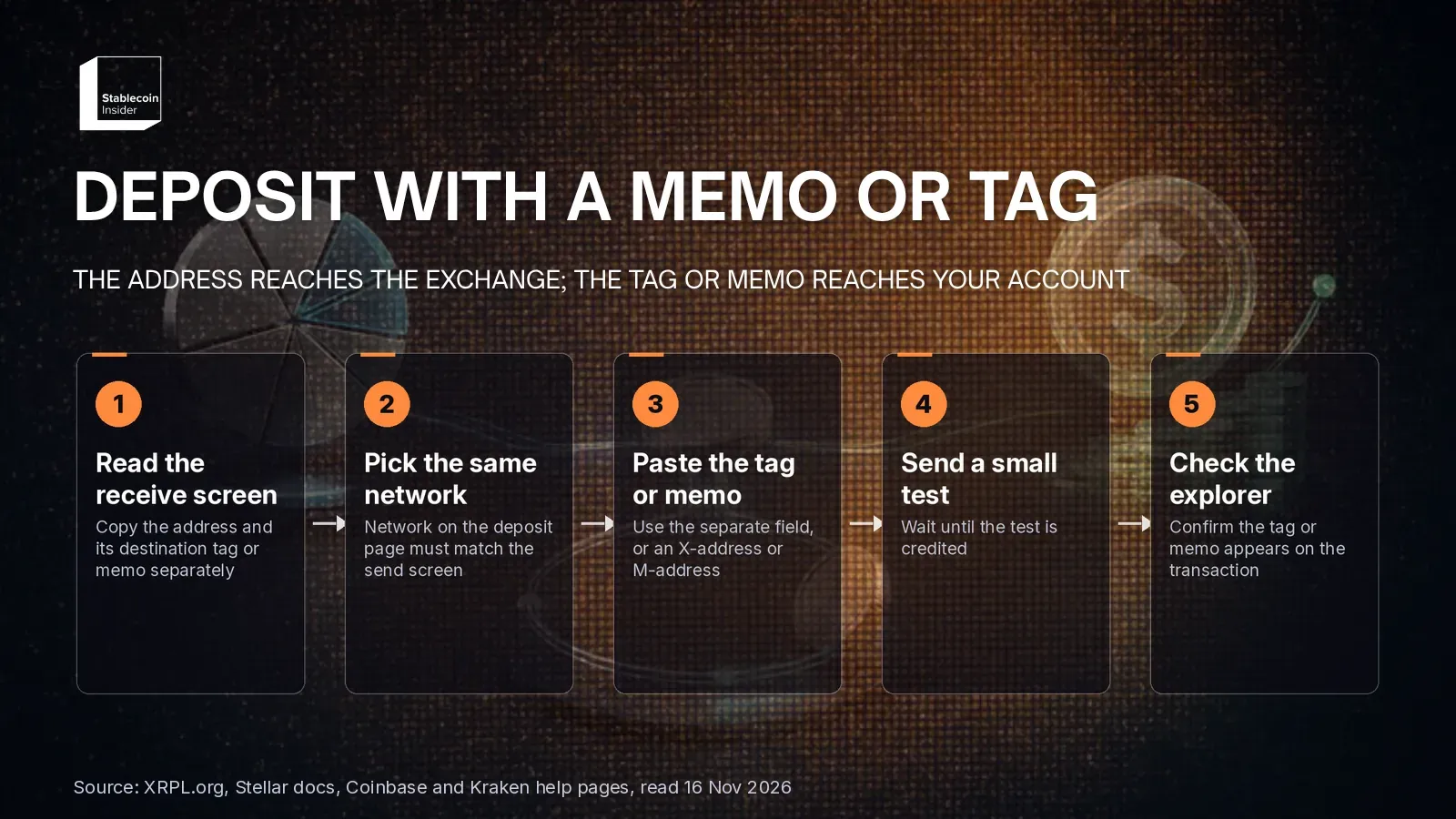
Step 1: Copy the address and the tag from the receive screen
Retrieve both the address and the destination tag or memo as separate values from the recipient's deposit page. Coinbase displays both under the "to confirm the address and tag/memo are correct" section, while Kraken generates a ten-digit XRP tag alongside its deposit address. Kraken emphasizes that the tag or memo must be included when using a QR code for XRP, XLM, or STX, and states that EOS memos must be entered manually.
Step 2: Pick the same network on both sides
Select the same network indicated on the deposit page. Since USDC is available on multiple networks, including the XRP Ledger, Stellar, and Hedera, simply stating "rejects their payment instead of giving you money you don't know what to do with" is insufficient. Inputting a tag on the correct address but with the wrong network will not suffice; refer to our guide for selecting a USDC network before proceeding.
Step 3: Paste the tag or memo into its own field
Insert the tag or memo into the designated Destination tag or Memo field, ensuring it is not appended to the address. If the platform provides a combined address, use that format: an XRP Ledger X-address combines the address and tag into one string, and a Stellar M-address embeds the customer ID. Do not add a memo ID to an M-address; Stellar identifies a mismatch as a malformed transaction. Ensure you use the specific memo type that the platform indicates, as text and ID memos are distinct formats.
Step 4: Send a small test amount first
Initiate a small test transaction and wait for the platform to credit it before sending the larger amount. Coinbase recommends this practice to ensure that both the address and tag/memo are accurate.
Step 5: Check the tag or memo on the explorer
Verify the transaction on a block explorer and confirm that the tag or memo reflects the value provided. In XRPSCAN, the destination tag is shown as "will not be credited to the correct Coinbase account" next to the recipient. Our guide to checking a USDT or USDC transaction on a block explorer outlines how to ascertain status, finality, and other relevant fields.
What does an exchange address that requires a tag look like?
An exchange address necessitating a tag has the XRP Ledger's RequireDest flag enabled, which is displayed by explorers and enforced by the ledger. We examined the shared XRP deposit address published by Kraken, rLHzPsX6oXkzU2qL12kHCH8G8cnZv1rBJh, through the public XRPL API at 11:23 CET on 16 November 2026, and confirmed that requireDestinationTag returned true at validated ledger 108,365,481.
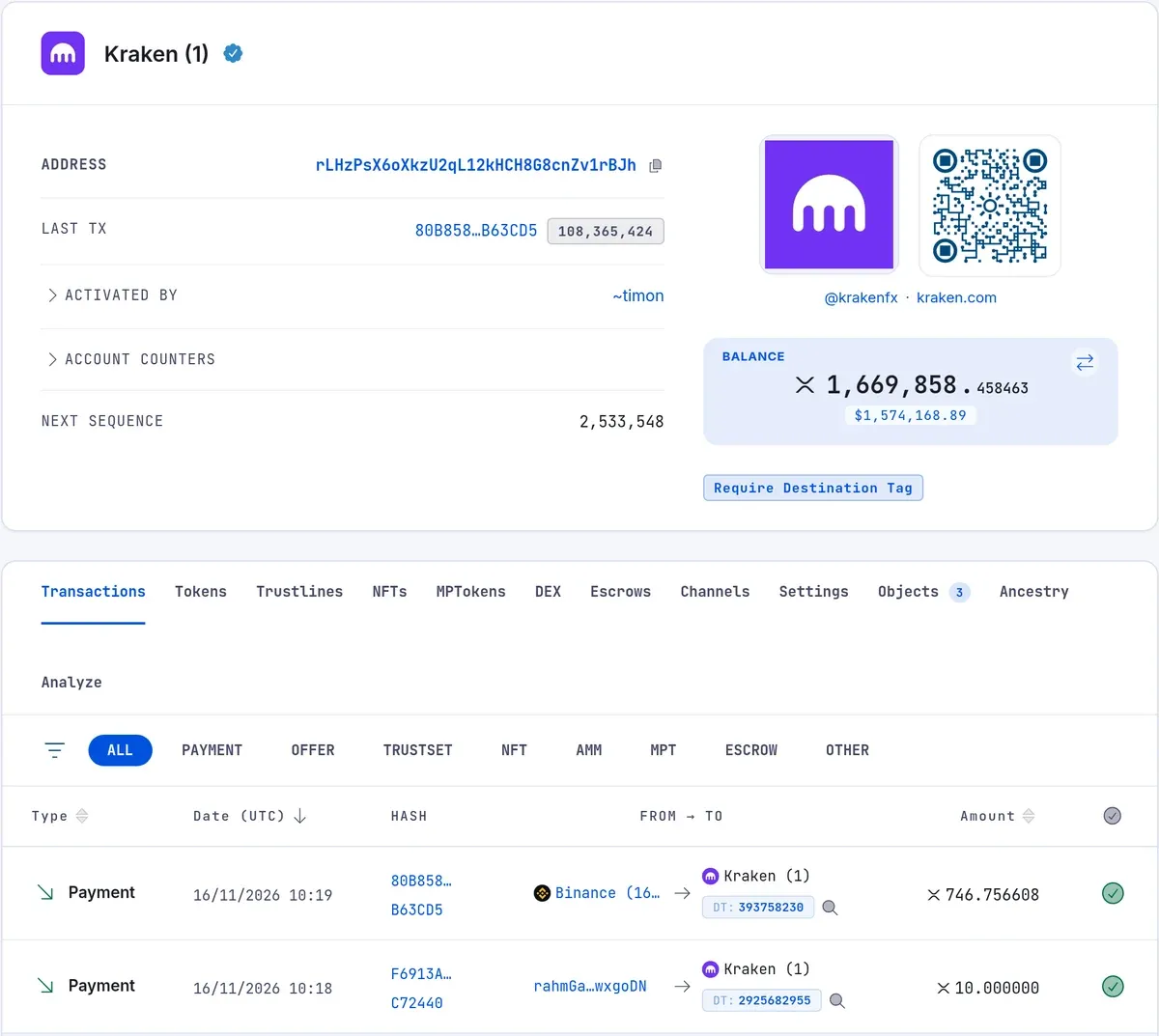
The transaction history illustrates the importance of the tag. In the 400 most recent transactions recorded on that address, between 01:07 and 11:21 CET on 16 November 2026, there were 395 incoming payments, all of which included a destination tag and utilized 275 different tag values. One on-ledger address processed payments for 275 distinct tags within a span of approximately ten hours, highlighting the tag's role in distinguishing one depositor from another.
This flag serves to prevent issues related to a missing tag, but not for an incorrect one. When the receiving account mandates a tag, any payment lacking one is rejected with tecDST_TAG_NEEDED. Thus, the payment fails, with only the XRP transaction fee being forfeited. The XRPL documentation explains that this flag exists to ensure the ledger "irretrievable in certain cases" Conversely, a payment with an incorrectly entered tag is accepted and credited to the exchange's address. The validation occurs on Payment transactions, which on the XRP Ledger encompass both XRP and issued tokens such as RLUSD. Not every exchange address implements this flag; always verify via the explorer before proceeding.
What happens if you forget the memo or tag?
In cases where the memo or tag is omitted, the stablecoins typically arrive at the exchange's shared address but do not credit any specific customer account. Only the exchange can facilitate their return. The following table compares the published policies of three exchanges regarding missing tags.
| Exchange | What it says happens | Fee | What to send support |
|---|---|---|---|
| Coinbase | Funds with a missing or incorrect tag "will not be credited to the correct Coinbase account." For a wrong tag, support "may be able to assist" (Coinbase). | No fee published | Transaction hash |
| Kraken | Missing or incorrect tag/memo: credit or refund is possible; however, recovery "is not guaranteed" (Kraken). The XRP page cautions that a missing tag may be "irretrievable in certain cases" (Kraken). | Network fee | TxID, asset and amount, deposit address, date and time |
| Binance | Tag/Memo Recovery allows the deposit to be returned to the original sender's address. If the tag belongs to another user, the deposit might be sent to them, and Binance "is unable to assist" (Binance). | Transaction fee of that cryptocurrency; no recovery if the total is below the withdrawal minimum. | Coin, exact amount, and TxID in the recovery form |
The critical difference lies in where the funds are returned. Kraken might credit your account, while Binance sends the deposit back to the original address, meaning if you sent it from another exchange, you would need assistance from that exchange as well. Do not attempt to send a second deposit to "fix" the first; instead, reach out to the exchange solely through its official website or app, avoiding any third-party recovery offers.
If you mistakenly sent USDC to the wrong chain rather than omitting a memo, this represents a distinct issue with different solutions.
For those comparing exchanges prior to making a deposit, consider reviewing Coinbase versus Kraken for fee structures and USDC rewards, or RLUSD against USDC when deciding which stablecoin to hold on the XRP Ledger.
For comprehensive information, refer to our Stablecoin payments and cards hub.